PUBLISHER: Mordor Intelligence | PRODUCT CODE: 2125340

PUBLISHER: Mordor Intelligence | PRODUCT CODE: 2125340
Europe Access Control Hardware - Market Share Analysis, Industry Trends & Statistics, Growth Forecasts (2026 - 2031)
According to Mordor Intelligence, the Europe access control hardware market size is estimated at USD 2.63 billion in 2026, and is expected to reach USD 3.54 billion by 2031, at a CAGR of 6.12% during the forecast period (2026-2031).
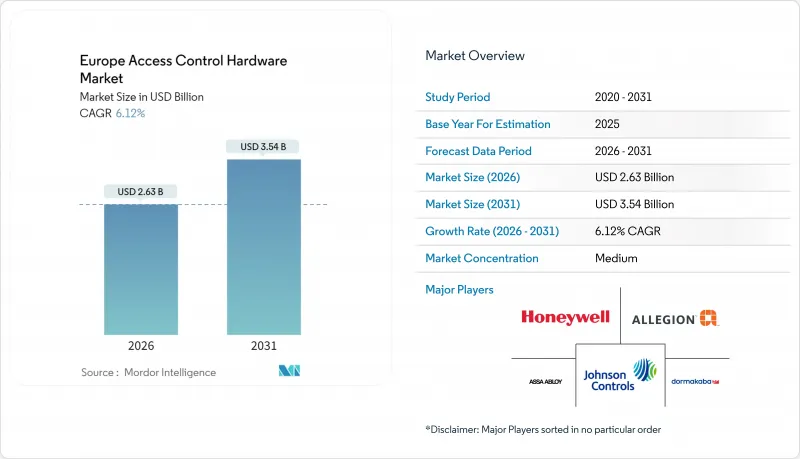
This report is Segmented by Hardware Type (Readers, Locks, and Controllers), Authentication Technology (RFID/NFC, BLE, Wi-Fi/IP, and Biometrics), Installation Mode (On-Premise, Stand-Alone, Cloud/ACaaS, and Retrofit Kits), End-User Vertical (Commercial, Residential, Government, Healthcare, and Transportation), and Geography. The Market Forecasts are in Value (USD).
Europe Access Control Hardware Market Trends and Insights
Rapid Shift to Mobile-Credential and Cloud-Native Systems
Wireless deployments overtook wired installations for the first time in 2025, with mobile credentials hitting 17%, triple their 2023 level. By 2027, nine in ten enterprises are expected to satisfy multi-factor authentication requirements through native cloud platforms that trim total cost of ownership by 40%. Europe's 30% 5G penetration, coupled with RedCap connectivity, lets battery-powered locks export real-time logs while consuming under 1 watt. Subscription models that convert capital expenses into operating budgets are boosting adoption across small and medium-sized enterprises, while sustainability goals are accelerating the retirement of PVC cards that generate 2.5 kilograms of waste per 1,000 credentials.
EU Green-Building Retrofits Driving Smart-Lock Demand
Directive 2024/1275 obligates automation and control systems in non-residential facilities with HVAC capacity above 290 kilowatts by 2029, positioning interoperable locks as compliance enablers. Spain intends to refurbish 1.2 million structures by 2030, embedding networked access control within its digital readiness index. Germany earmarked EUR 2.5 billion (USD 2.75 billion) for public-sector modernizations that pair electronic locks with occupancy-driven HVAC scheduling. Complementary incentives such as Italy's 65% Superbonus credit and the United Kingdom's Public Sector Decarbonisation Scheme (GBP 1.8 billion, USD 2.27 billion) sustain demand for IP-enabled hardware that feeds energy dashboards.
High Upfront Capex for Multi-Factor, Cyber-Secure Systems
Multi-factor panels that bundle secure elements and encrypted modules cost 60-80% more than single-factor readers, straining small business budgets. Cloud ACaaS platforms can lower five-year costs by 40%, yet entrance fees of USD 150-250 per door still deter multisite roll-outs. Biometric readers certified to EAL6+ cost more than USD 800 per unit, compared with USD 120 for basic RFID alternatives, extending payback periods beyond three years. Elevated power tariffs of EUR 0.15-0.20 per kWh (USD 0.16-0.22) inflate operating costs over the decade, as energy accounts for up to 70% of system life-cycle expenses.
Other drivers and restraints analyzed in the detailed report include:
- GDPR-Driven Need for Privacy-Preserving Hardware
- Growing Adoption Amid Rising Crime and Terrorism Threats
- Legacy-System Integration Complexity Across EU Property Stock
For complete list of drivers and restraints, kindly check the Table Of Contents.
Segment Analysis
Electronic and smart locks held 42.73% of the Europe access control hardware market share in 2025, supported by ease of installation in retrofit apartments and commercial suites. Biometric readers, although smaller in base, are projected to register an 8.03% CAGR through 2031 as GDPR-compliant healthcare and public facilities adopt iris and fingerprint systems that keep templates on-device. Card readers persist in legacy estates, yet sustainability requirements and digital wallet roll-outs are eroding their relevance. Controllers now embed edge processors that complete matching in under 200 milliseconds, mitigating bandwidth use and data privacy risks. By 2029, NFC-enabled panels capable of ingesting eIDAS credentials are expected to displace 60% of non-compliant units still operating in the field.
Second-generation smart locks also integrate occupancy sensors to optimize HVAC systems. This cross-link between security and energy savings bolsters business cases in public retrofits funded by Germany's Federal Building Modernization Program. Equally, modular designs that accept plug-in BLE or Wi-Fi radios let facility managers adopt new credentials without swapping entire units, lengthening asset obsolescence cycles. Price competition heats as challengers introduce stand-alone smart cylinders for under USD 120, contrasted with USD 800 plus for multimodal biometric stations certified to EAL6+. Edge-computing upgrades nevertheless command premiums among defense users following NATO SDIP-27 encryption mandates.
RFID and NFC maintained a 37.53% revenue stake in 2025, leveraging entrenched card ecosystems and solid 10-meter read ranges favored in logistics yards. Bluetooth Low Energy, however, is projected to log a 7.67% CAGR as smartphone-based credentials shrink provisioning costs and let administrators revoke access within seconds. Wi-Fi and IP readers serve organizations seeking unified network management, but their 3-5 watt draw clashes with Directive 2024/1275 energy benchmarks. Multimodal biometrics merge iris and vein scans for high-security applications, and uptake is bolstered by the 22% rise in GDPR enforcement cases involving centralized biometric storage.
Recent firmware enables BLE locks to drop consumption below 1 watt, aided by Europe's 30% 5G penetration, which supports low-power RedCap uplinks. Although RFID dominates at transportation nodes, BLE's rising share in commercial offices and apartments signals a decisive shift toward plastic-free credentials. Ultra-wideband positioning emerges as a hybrid solution for sub-meter precision when RFID read ranges fall short, especially in warehouses that need real-time asset tracing.
Complete Report Scope:
- By Hardware Type
- Card/Proximity Readers
- Biometric Readers
- Electronic and Smart Locks
- Controllers and Panels
- By Authentication Technology
- RFID/NFC
- Bluetooth Low Energy (BLE)
- Wi-Fi/IP
- Multimodal Biometrics
- By Installation Mode
- On-premise Networked
- Stand-alone
- Cloud/ACaaS
- Retrofit Kids
- By End-User Vertical
- Commercial Offices
- Residential and Multi-Dwelling
- Government and Defense
- Healthcare
- Transportation and Logistics
- By Country
- United Kingdom
- Germany
- France
- Italy
- Spain
List of Companies Covered in this Report:
- ASSA ABLOY AB
- Dormakaba Holding AG
- Allegion plc
- Honeywell International Inc.
- Johnson Controls International plc
- Robert Bosch GmbH (Bosch Security Systems)
- Schneider Electric SE
- Axis Communications AB
- Nedap N.V.
- Identiv Inc.
- IDEMIA Group SAS
- NEC Corporation
- Suprema Inc.
- SALTO Systems S.L.
- Paxton Access Ltd.
- Genetec Inc.
- Gallagher Group Ltd.
- Brivo Inc.
- HID Global Corporation
- Axis Communications AB
Additional Benefits:
- The market estimate (ME) sheet in Excel format
- 3 months of analyst support
TABLE OF CONTENTS
1 INTRODUCTION
- 1.1 Study Assumptions and Market Definition
- 1.2 Scope of the Study
2 RESEARCH METHODOLOGY
3 EXECUTIVE SUMMARY
4 MARKET LANDSCAPE
- 4.1 Market Overview
- 4.2 Market Drivers
- 4.2.1 Growing Adoption Amid Rising Crime and Terrorism Threats
- 4.2.2 Rapid Shift To Mobile-Credential and Cloud-Native Systems
- 4.2.3 EU Green-Building Retrofits Driving Smart-Lock Demand
- 4.2.4 GDPR-Driven Need For Privacy-Preserving Hardware
- 4.2.5 Digital Id/eIDAS 2.0 Enabling Biometric Access Use-Cases
- 4.2.6 Edge-AI Readers Lowering TCO and Latency
- 4.3 Market Restraints
- 4.3.1 High Upfront Capex For Multi-Factor, Cyber-Secure Systems
- 4.3.2 Legacy-System Integration Complexity Across EU Property Stock
- 4.3.3 Supply-Chain Chip Shortages Causing Hardware Lead-Times
- 4.3.4 Energy-Price Spikes Raising Total Cost Of Ownership
- 4.4 Industry Value Chain Analysis
- 4.5 Regulatory Landscape
- 4.6 Technological Outlook
- 4.7 Porter's Five Forces Analysis
- 4.7.1 Bargaining Power of Suppliers
- 4.7.2 Bargaining Power of Buyers
- 4.7.3 Threat of New Entrants
- 4.7.4 Threat of Substitutes
- 4.7.5 Intensity of Competitive Rivalry
5 MARKET SIZE AND GROWTH FORECASTS (VALUE)
- 5.1 By Hardware Type
- 5.1.1 Card/Proximity Readers
- 5.1.2 Biometric Readers
- 5.1.3 Electronic and Smart Locks
- 5.1.4 Controllers and Panels
- 5.2 By Authentication Technology
- 5.2.1 RFID/NFC
- 5.2.2 Bluetooth Low Energy (BLE)
- 5.2.3 Wi-Fi/IP
- 5.2.4 Multimodal Biometrics
- 5.3 By Installation Mode
- 5.3.1 On-premise Networked
- 5.3.2 Stand-alone
- 5.3.3 Cloud/ACaaS
- 5.3.4 Retrofit Kids
- 5.4 By End-User Vertical
- 5.4.1 Commercial Offices
- 5.4.2 Residential and Multi-Dwelling
- 5.4.3 Government and Defense
- 5.4.4 Healthcare
- 5.4.5 Transportation and Logistics
- 5.5 By Country
- 5.5.1 United Kingdom
- 5.5.2 Germany
- 5.5.3 France
- 5.5.4 Italy
- 5.5.5 Spain
6 COMPETITIVE LANDSCAPE
- 6.1 Market Concentration
- 6.2 Strategic Moves
- 6.3 Market Share Analysis
- 6.4 Company Profiles (includes Global level Overview, Market Level Overview, Core Segments, Financials as Available, Strategic Information, Market Rank/Share for Key Companies, Products and Services, and Recent Developments)
- 6.4.1 ASSA ABLOY AB
- 6.4.2 Dormakaba Holding AG
- 6.4.3 Allegion plc
- 6.4.4 Honeywell International Inc.
- 6.4.5 Johnson Controls International plc
- 6.4.6 Robert Bosch GmbH (Bosch Security Systems)
- 6.4.7 Schneider Electric SE
- 6.4.8 Axis Communications AB
- 6.4.9 Nedap N.V.
- 6.4.10 Identiv Inc.
- 6.4.11 IDEMIA Group SAS
- 6.4.12 NEC Corporation
- 6.4.13 Suprema Inc.
- 6.4.14 SALTO Systems S.L.
- 6.4.15 Paxton Access Ltd.
- 6.4.16 Genetec Inc.
- 6.4.17 Gallagher Group Ltd.
- 6.4.18 Brivo Inc.
- 6.4.19 HID Global Corporation
- 6.4.20 Axis Communications AB
7 MARKET OPPORTUNITIES AND FUTURE OUTLOOK
- 7.1 White-space and Unmet-Need Assessment

