PUBLISHER: Mordor Intelligence | PRODUCT CODE: 2124917

PUBLISHER: Mordor Intelligence | PRODUCT CODE: 2124917
Car Sharing Telematics - Market Share Analysis, Industry Trends & Statistics, Growth Forecasts (2026 - 2031)
According to Mordor Intelligence, car sharing telematics market size in 2026 is estimated at USD 19.11 billion, growing from 2025 value of USD 16.87 billion with 2031 projections showing USD 35.63 billion, growing at 13.29% CAGR over 2026-2031.
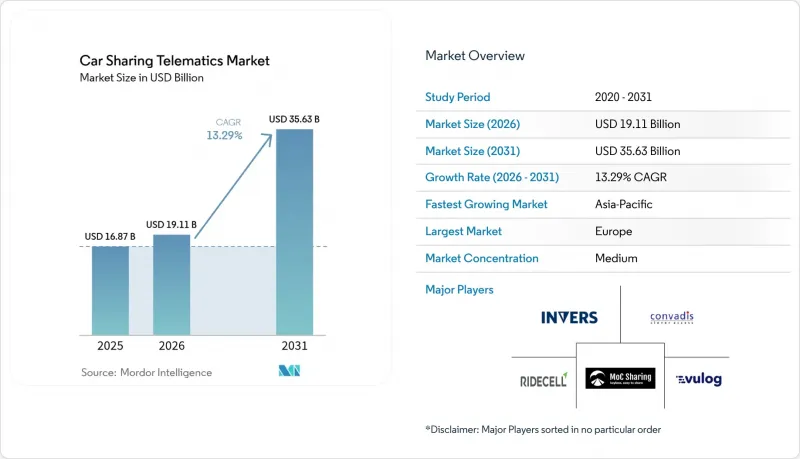
This report is Segmented by Channel (Original Equipment Manufacturer (OEM) and Aftermarket), Form (Embedded, Tethered, and Integrated), Car-Sharing Model (Round-Trip / Station-Based, Corporate / Fleet, Peer-To-Peer (P2P), and More), Vehicle Propulsion (Internal-Combustion Engine (ICE), Battery-Electric Vehicle (BEV), and Hybrid Electric Vehicle (HEV/PHEV)), and Geography.
Global Car Sharing Telematics Market Trends and Insights
Growing Urban Preference for Shared Mobility
Continued densification and escalating congestion-charging schemes are shifting commuter economics toward shared fleets, nudging municipal planners to re-allocate curb space for multimodal mobility hubs that integrate car sharing, micro-mobility, and public transit. Free-floating operators use real-time heat-map telemetry to reposition vehicles in zones of peak demand, cutting customer wait times and trimming fleet idle minutes. In Munich and Berlin, usage clusters align with demographic density and proximity to subway interchanges, confirming location analytics as a core profitability lever. Dynamic-pricing engines, trained on weather feeds and event calendars, optimize vehicle distribution while lowering per-ride emissions footprints. Such urban network effects underscore why investors continue to back car sharing telematics market platforms that internalize both transportation and environmental externalities.
Government Mandates for Vehicle Telematics (eCall, Safety)
Regulators are accelerating adoption by making telematics a legal obligation. Under the EU General Safety Regulation II, all new M1 and N1 vehicles must feature intelligent speed assistance, automatic emergency-braking, and event-data recorders from July 2024. Next-Generation eCall shifts the emergency-alert backbone from 2G/3G to 4G/5G, demanding hardware refreshes across car-sharing fleets.Comparable frameworks are rolling out in Russia and Brazil, and the FCC is reviewing a similar mandate, giving scale economies to vendors able to standardize multi-region compliance. Vehicles upgraded for NG-eCall deliver richer crash datasets that operators now monetize through safer-driving programs and refined insurance pricing.
High Hardware and Installation Costs
Silicon supply constraints and escalating sensor counts are pushing semiconductor content per vehicle toward USD 1,200 by 2030, doubling 2022 levels, a trend highlighted by NITI Aayog's component-cost tracking. Upgrading fleets from 4G to 5G radios elevates module prices yet delivers minimal payback until low-latency apps reach scale. Consequently, smaller operators defer refresh cycles or seek subscription models that spread capital outlay across contractual terms. Strategic OEM-tier-one alliances-Geotab with Volkswagen Group, Samsara with Stellantis-are emerging to unlock purchase discounts and shared R&D while ensuring compliance updates flow over-the-air rather than via costly service campaigns.
Other drivers and restraints analyzed in the detailed report include:
- Integration of IoT/AI/ML for Fleet Optimization
- Rapid Electrification of Car-Sharing Fleets
- Data-Privacy and Cyber-Security Concerns
For complete list of drivers and restraints, kindly check the Table Of Contents.
Segment Analysis
In 2025, aftermarket retrofits dominated with 57.42% revenue, reflecting the sizeable legacy vehicle pool. Yet OEM-embedded units are advancing at 14.92% CAGR, helped by factory-level compliance with eCall-style mandates and tighter cybersecurity hardening. Automakers now expose on-board APIs that furnish granular battery, ADAS, and climate data, giving operators more levers to drive up fleet utilization. Partnerships such as Geotab's direct pipeline into Volkswagen Group dashboards exemplify the gravitation toward ecosystem plays that marry hardware, software, and field-updatable firmware in a single lifecycle stack.
The car sharing telematics market size for OEM-integrated deployments is projected to climb sharply as BEV adoption widens, because battery diagnostics demand direct traction-system access that retrofit dongles cannot match reliably. Nonetheless, retrofit vendors still serve mixed-fuel fleets and emerging markets where vehicle ages average above eight years, keeping a two-speed channel landscape intact through the mid-term.
Cost parity between embedded and aftermarket is narrowing as silicon prices climb, while over-the-air provisioning reduces fit-out labor for factory units. Larger operators hedge by blending both strategies: new acquisitions arrive with embedded telematics, but veteran gasoline or hybrid units receive certified third-party devices to unify granular data feeds. This hybrid posture insulates businesses from single-vendor risk and shortens refresh cycles without stranding capital-practices that shape procurement playbooks across the broader car sharing telematics market.
Embedded modules accounted for 45.48% revenue in 2025, but fully integrated connectivity platforms-encompassing 4G/5G modems, edge AI, and secure bootloaders-exhibit a 16.65% CAGR. These units aggregate functions that once required discrete devices, trimming wiring harnesses while expanding compute throughput. Integrated architectures expose open APIs, enabling developers to layer MaaS billing engines, predictive-maintenance dashboards, and carbon-footprint calculators atop the same telemetry backbone.Tethered solutions that depend on smartphone pairing are receding as fleet operators prioritize always-on redundancy for lock/unlock, immobilizer, and remote-disabling commands. The car sharing telematics market size attached to integrated-form deployments is forecast to outstrip tethered revenues by 2027 as 5G coverage proliferates across metropolitan corridors, permitting latency-sensitive applications such as tele-driving and remote-valet services.
Edge-side containerization now allows multiple virtualized applications to coexist securely within one telematics control unit, future-proofing fleets against evolving standards. Standardization drives cross-OEM data fusion, simplifying multi-brand fleet operations and trimming software-integration overhead. As a result, integrated solutions increasingly underpin RFP criteria among both new entrants and incumbent operators, accelerating their momentum within the car sharing telematics market.
Complete Report Scope:
- By Channel
- Original Equipment Manufacturer (OEM)
- Aftermarket
- By Form
- Embedded
- Tethered
- Integrated
- By Car-Sharing Model
- Round-trip / Station-based
- Free-floating (One-way)
- Peer-to-Peer (P2P)
- Corporate / Fleet
- By Vehicle Propulsion
- Internal-Combustion Engine (ICE)
- Battery-Electric Vehicle (BEV)
- Hybrid Electric Vehicle (HEV/PHEV)
- By Geography
- North America
- United States
- Canada
- Mexico
- South America
- Brazil
- Argentina
- Rest of South America
- Europe
- Germany
- United Kingdom
- France
- Italy
- Spain
- Russia
- Rest of Europe
- Asia Pacific
- China
- India
- Japan
- South Korea
- ASEAN
- Rest of Asia Pacific
- Middle East and Africa
- Middle East
- Saudi Arabia
- UAE
- Turkey
- Rest of Middle East
- Africa
- South Africa
- Rest of Africa
- Middle East
- North America
Geography Analysis
Europe retains 36.62% revenue leadership owing to mature regulations that mandate advanced safety and connectivity suites on all new vehicles. National incentive schemes bordering Germany, France, and the Nordics subsidize electrified car-sharing fleets, making BEV subscriptions financially compelling for operators. ShareNow's expansion eastward demonstrates intra-continental knowledge transfer, while Renault's Utrecht V2G pilot showcases grid-integrated mobility potential. Asia Pacific is scaling fastest at 14.33% CAGR, underwritten by rapid urban migration and sovereign smart-city budgets. Mainland China alone fields robotaxi pilots across more than 50 municipalities, each requiring ultra-low-latency connectivity baked into fleet telematics. The region counts 1.8 billion mobile subscribers, a connectivity bedrock for real-time fleet orchestration and over-the-air updates. Southeast Asian governments are likewise subsidizing telematics-based fleet-management rollouts, cultivating a fertile runway for the car sharing telematics market. North America exhibits mixed momentum: tech-centric metros adopt 5G-enabled tele-driving pilots, whereas suburban sprawl depresses vehicle-turnover metrics. Verizon Business' Las Vegas partnership with Vay highlights the push toward remote-driven e-vehicles that cut repositioning labor while leveraging mmWave bandwidth. Rural and ex-urban districts, however, remain tethered to LTE or legacy 3G networks, tempering service-expansion economics. Canada and the United States increasingly prioritize cybersecurity alignment with federal standards such as ISO/SAE 21434, adding an additional compliance layer yet reinforcing consumer trust-crucial for sustained car sharing telematics market penetration.
- INVERS GmbH
- Vulog
- Ridecell Inc.
- Convadis AG
- Continental Aftermarket and Services
- OCTO Group S.p.A
- Geotab Inc.
- Targa Telematics
- Fleetster
- OpenFleet
- Mobility Tech Green
- WeGo B.V.
- MoC Sharing
- Free2Move
- Miles Mobility
- Share Now
- Sixt share
- Getaround
- Zity
- Bolt Drive
Additional Benefits:
- The market estimate (ME) sheet in Excel format
- 3 months of analyst support
TABLE OF CONTENTS
1 INTRODUCTION
- 1.1 Study Assumptions and Market Definition
- 1.2 Scope of the Study
2 RESEARCH METHODOLOGY
3 EXECUTIVE SUMMARY
4 MARKET LANDSCAPE
- 4.1 Market Overview
- 4.2 Market Drivers
- 4.2.1 Growing urban preference for shared mobility
- 4.2.2 Government mandates for vehicle telematics (eCall, safety)
- 4.2.3 Integration of IoT/AI/ML for fleet optimisation
- 4.2.4 Rapid electrification of car-sharing fleets
- 4.2.5 Usage-based-insurance partnerships lowering OPEX
- 4.2.6 API-first telematics platforms enabling MaaS aggregation
- 4.3 Market Restraints
- 4.3.1 High hardware and installation costs
- 4.3.2 Data-privacy and cyber-security concerns
- 4.3.3 Lack of telematics interoperability standards
- 4.3.4 Low utilisation rates in suburban and rural zones
- 4.4 Value Chain Analysis
- 4.5 Regulatory Landscape
- 4.6 Technological Outlook
- 4.7 Porter's Five Forces Analysis
- 4.7.1 Threat of New Entrants
- 4.7.2 Bargaining Power of Buyers
- 4.7.3 Bargaining Power of Suppliers
- 4.7.4 Threat of Substitute Products
- 4.7.5 Intensity of Competitive Rivalry
- 4.8 Investment and Funding Trends
5 MARKET SIZE AND GROWTH FORECASTS (VALUE)
- 5.1 By Channel
- 5.1.1 Original Equipment Manufacturer (OEM)
- 5.1.2 Aftermarket
- 5.2 By Form
- 5.2.1 Embedded
- 5.2.2 Tethered
- 5.2.3 Integrated
- 5.3 By Car-Sharing Model
- 5.3.1 Round-trip / Station-based
- 5.3.2 Free-floating (One-way)
- 5.3.3 Peer-to-Peer (P2P)
- 5.3.4 Corporate / Fleet
- 5.4 By Vehicle Propulsion
- 5.4.1 Internal-Combustion Engine (ICE)
- 5.4.2 Battery-Electric Vehicle (BEV)
- 5.4.3 Hybrid Electric Vehicle (HEV/PHEV)
- 5.5 By Geography
- 5.5.1 North America
- 5.5.1.1 United States
- 5.5.1.2 Canada
- 5.5.1.3 Mexico
- 5.5.2 South America
- 5.5.2.1 Brazil
- 5.5.2.2 Argentina
- 5.5.2.3 Rest of South America
- 5.5.3 Europe
- 5.5.3.1 Germany
- 5.5.3.2 United Kingdom
- 5.5.3.3 France
- 5.5.3.4 Italy
- 5.5.3.5 Spain
- 5.5.3.6 Russia
- 5.5.3.7 Rest of Europe
- 5.5.4 Asia Pacific
- 5.5.4.1 China
- 5.5.4.2 India
- 5.5.4.3 Japan
- 5.5.4.4 South Korea
- 5.5.4.5 ASEAN
- 5.5.4.6 Rest of Asia Pacific
- 5.5.5 Middle East and Africa
- 5.5.5.1 Middle East
- 5.5.5.1.1 Saudi Arabia
- 5.5.5.1.2 UAE
- 5.5.5.1.3 Turkey
- 5.5.5.1.4 Rest of Middle East
- 5.5.5.2 Africa
- 5.5.5.2.1 South Africa
- 5.5.5.2.2 Rest of Africa
- 5.5.5.1 Middle East
- 5.5.1 North America
6 COMPETITIVE LANDSCAPE
- 6.1 Market Concentration
- 6.2 Strategic Moves
- 6.3 Market Share Analysis
- 6.4 Company Profiles (includes Global level Overview, Market level overview, Core Segments, Financials as available, Strategic Information, Market Rank/Share for key companies, Products and Services, and Recent Developments)
- 6.4.1 INVERS GmbH
- 6.4.2 Vulog
- 6.4.3 Ridecell Inc.
- 6.4.4 Convadis AG
- 6.4.5 Continental Aftermarket and Services
- 6.4.6 OCTO Group S.p.A
- 6.4.7 Geotab Inc.
- 6.4.8 Targa Telematics
- 6.4.9 Fleetster
- 6.4.10 OpenFleet
- 6.4.11 Mobility Tech Green
- 6.4.12 WeGo B.V.
- 6.4.13 MoC Sharing
- 6.4.14 Free2Move
- 6.4.15 Miles Mobility
- 6.4.16 Share Now
- 6.4.17 Sixt share
- 6.4.18 Getaround
- 6.4.19 Zity
- 6.4.20 Bolt Drive
7 MARKET OPPORTUNITIES AND FUTURE OUTLOOK
- 7.1 White-space and Unmet-need Assessment

