PUBLISHER: Mordor Intelligence | PRODUCT CODE: 2124919

PUBLISHER: Mordor Intelligence | PRODUCT CODE: 2124919
Remote Tank Monitoring System - Market Share Analysis, Industry Trends & Statistics, Growth Forecasts (2026 - 2031)
According to Mordor Intelligence, the remote tank monitoring system market size is projected to expand from USD 2.73 billion in 2025 and USD 3.21 billion in 2026 to USD 9.16 billion by 2031, registering a CAGR of 23.33% between 2026 to 2031.
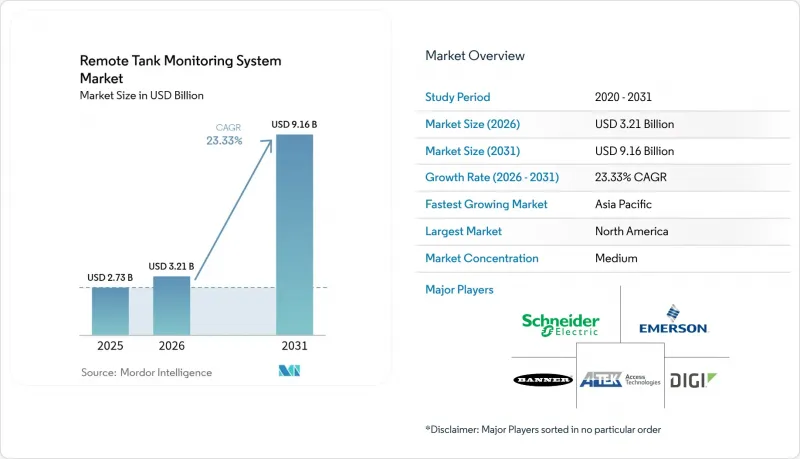
This report is Segmented by Monitoring Type (Point-Level, and Continuous-Level), Technology (Contact Sensors, and Non-Contact Sensors), Connectivity (Cellular, LPWAN, and More), Tank Type (Above-Ground Fixed-Roof, and More), End-User Industry (Oil and Gas, Chemicals, and More), and Geography. The Market Forecasts are Provided in Terms of Value (USD).
Global Remote Tank Monitoring System Market Trends and Insights
Expansion of Oil and Gas and Chemical Storage Infrastructure
Roughly 180 million barrels of new above-ground capacity were commissioned worldwide in 2025, 42% of which arose in the United States. Operators embedded radar and magnetostrictive probes during construction to satisfy American Petroleum Institute Standard 653, cutting retrofit expense and ensuring compliance at start-up. Saudi Aramco's Jafurah condensate program equipped every new tank with wireless sensors feeding a digital twin, reducing manual gauging by 85% and unexpected shutdowns by 30%. In China's Yangtze River Delta, 12,000 transmitters went live during 2025 to meet hazardous-chemical rules that require real-time alarms. Continuous telemetry shortens inventory reconciliation from weekly to hourly intervals, lowering working capital by up to 20% for integrated petrochemical hubs.
Proliferation of Cloud-Based IoT Platforms
Microsoft Azure IoT Operations processed 4.5 billion daily sensor messages by December 2025, with tank-level data ranking third largest.[2] Edge analytics on local gateways cut cellular traffic by 60% and maintained sub-second alarms during outages. Emerson Plantweb Optics added 2,300 endpoints in 2025, trimming tank-cleaning downtime by 25%. Democratized analytics now let mid-sized propane dealers run weather-driven refill schedules, reducing truck rolls. Total cost for a 50-tank installation has fallen from USD 85,000 in 2024 to USD 62,000 in 2026, pushing the Remote Tank Monitoring System market deeper into the mid-market.
High Upfront Hardware and Integration Costs
A fully featured wireless radar node plus solar power and gateway averages USD 2,200-3,800, with another USD 800-1,500 for historian mapping and staff training. A 500-tank propane fleet costs USD 1.1 million, nearly two years of net income for many small distributors. Seventy-eight percent of Indian and Brazilian cooperatives in a 2025 International Water Management Institute survey said concessional loans would be required for breakeven within five years. HaaS eases the burden, but price-sensitive sectors still postpone adoption, limiting Remote Tank Monitoring System market penetration among micro-operators.
Other drivers and restraints analyzed in the detailed report include:
- Stricter Global Spill-Prevention and Inventory Regulations
- Satellite-IoT Coverage for Ultra-Remote Tanks
- Cyber-Security and Data-Ownership Concerns
For complete list of drivers and restraints, kindly check the Table Of Contents.
Segment Analysis
The segment generated the largest share of Remote Tank Monitoring System market size in 2025 at 58.82%. Regulatory language in both the SPCC rule and Europe's Industrial Emissions Directive explicitly calls for uninterrupted level tracking, locking in demand.
Continuous systems also feed machine-learning models that detect micro-leaks and optimize refill logistics, justifying their 60-80% price premium. Point-level probes remain relevant for low-value or non-hazardous liquids where budgets dominate purchase decisions, but their footprint is slowly eroding as standards migrate toward real-time visibility.
Contact probes held 36.77% Remote Tank Monitoring System market share in 2025, buoyed by decades of installed magnetostrictive and float-and-tape devices in refined-product terminals. Their +-1 mm accuracy still defines custody-transfer contracts, sustaining replacement demand.
Non-contact radar receivers are closing the gap for corrosive, foaming, or high-temperature duties, and the VEGAPULS 6X's 80 GHz beam is displacing guided-wave radar in obstructed tanks. Yet many operators prefer proven wetted probes until decommissioning cycles force capex decisions, keeping contact technology expansion at a healthy 23.77% CAGR.
Complete Report Scope:
- By Monitoring Type
- Point-Level Monitoring
- Continuous-Level Monitoring
- By Technology
- Contact Sensors
- Float and Tape Gauge
- Magnetostrictive
- Hydrostatic Pressure
- Non-Contact Sensors
- Ultrasonic
- Radar / FMCW
- Optical / Laser
- Contact Sensors
- By Connectivity
- Cellular (4G LTE, 5G, NB-IoT, Cat-M)
- LPWAN (LoRaWAN, Sigfox)
- Satellite (LEO / GEO)
- Short-Range RF / Wi-Fi / BLE
- By Tank Type
- Above-Ground Fixed-Roof
- Above-Ground Floating-Roof
- Underground / UST
- By End-User Industry
- Oil and Gas
- Chemicals and Petrochemicals
- Water and Wastewater
- Food and Beverage
- Agriculture and Irrigation
- Power Generation
- Mining and Metals
- Pharmaceuticals and Healthcare
- By Service Model
- Stand-alone Hardware Sales
- Hardware-as-a-Service (HaaS) Subscription
- Fully Managed Turnkey Platforms
- By Geography
- North America
- United States
- Canada
- Mexico
- South America
- Brazil
- Argentina
- Rest of South America
- Europe
- United Kingdom
- Germany
- France
- Italy
- Spain
- Russia
- Rest of Europe
- Asia-Pacific
- China
- Japan
- India
- South Korea
- Australia and New Zealand
- Southeast Asia
- Rest of Asia-Pacific
- Middle East
- Saudi Arabia
- United Arab Emirates
- Turkey
- Rest of Middle East
- Africa
- South Africa
- Nigeria
- Kenya
- Rest of Africa
- North America
Geography Analysis
North America commanded 32.74% of 2025 sales, driven by SPCC retrofits and strong propane adoption in the United States and Canada, driven by SPCC enforcement, extensive oil and gas infrastructure, and early industrial IoT adoption. Federal grants for rural broadband enhance LPWAN coverage, further propelling the deployment of remote tank monitoring systems in agricultural states. Canada's renewed strategic petroleum reserve buildout adds cross-border momentum as operators harmonize asset management platforms.
Asia-Pacific increases the Remote Tank Monitoring System market size fastest at 24.13% CAGR. Chinese petrochemical clusters in Zhejiang and Jiangsu require vapor caps and continuous gauges, while India's Jal Jeevan Mission funds LoRaWAN nodes for groundwater oversight.
Europe delivers 24% of global revenue on the back of Industrial Emissions enforcement and ESG reporting mandates. The Middle East deploys sensors for OGMP 2.0 methane tracking, and Australia's miners use satellite backhaul to slash truck visits by 55%.
- Schneider Electric SE
- Emerson Electric Co.
- Banner Engineering Corp.
- ATEK Access Technologies LLC (TankScan)
- Anova (DataOnline Corp.)
- Digi International Inc.
- Otodata Wireless Network Inc.
- SkyBitz Inc.
- Powelectrics Ltd.
- Dunraven Systems Limited
- Endress+Hauser Group
- Honeywell International Inc.
- Vega Grieshaber KG
- RemoteTank (Alpha Wireless Automation Inc.)
- Rugged Telemetry
- Tekelek Group
- Tank Utility Inc. (Generac Power Systems Inc.)
- Cavagna Group
- Mistras Group Inc.
- Sensile Technologies SA
- WIKA Alexander Wiegand SE and Co KG
Additional Benefits:
- The market estimate (ME) sheet in Excel format
- 3 months of analyst support
TABLE OF CONTENTS
1 INTRODUCTION
- 1.1 Study Assumptions and Market Definition
- 1.2 Scope of the Study
2 RESEARCH METHODOLOGY
3 EXECUTIVE SUMMARY
4 MARKET LANDSCAPE
- 4.1 Market Overview
- 4.2 Market Drivers
- 4.2.1 Expansion Of Oil And Gas And Chemical Storage Infrastructure
- 4.2.2 Proliferation Of Cloud-Based IoT Platforms
- 4.2.3 Stricter Global Spill-Prevention And Inventory Regulations
- 4.2.4 Satellite-IoT Coverage For Ultra-Remote Tanks
- 4.2.5 HaaS Subscription Models Lowering CAPEX Barriers
- 4.2.6 Scope-3 ESG Reporting Pressure On Bulk-Liquid Supply Chains
- 4.3 Market Restraints
- 4.3.1 High Upfront Hardware And Integration Costs
- 4.3.2 Cyber-Security And Data-Ownership Concerns
- 4.3.3 Battery-Waste Sustainability Liabilities
- 4.3.4 Steel/Aluminum Tariffs Inflating Device BOM
- 4.4 Value Chain Analysis
- 4.5 Regulatory Landscape
- 4.6 Porter's Five Forces
- 4.6.1 Bargaining Power of Suppliers
- 4.6.2 Bargaining Power of Buyers
- 4.6.3 Threat of New Entrants
- 4.6.4 Threat of Substitutes
- 4.6.5 Intensity of Competitive Rivalry
- 4.7 Impact of Macroeconomic Factors on the Market
5 MARKET SIZE AND GROWTH FORECASTS (VALUE)
- 5.1 By Monitoring Type
- 5.1.1 Point-Level Monitoring
- 5.1.2 Continuous-Level Monitoring
- 5.2 By Technology
- 5.2.1 Contact Sensors
- 5.2.1.1 Float and Tape Gauge
- 5.2.1.2 Magnetostrictive
- 5.2.1.3 Hydrostatic Pressure
- 5.2.2 Non-Contact Sensors
- 5.2.2.1 Ultrasonic
- 5.2.2.2 Radar / FMCW
- 5.2.2.3 Optical / Laser
- 5.2.1 Contact Sensors
- 5.3 By Connectivity
- 5.3.1 Cellular (4G LTE, 5G, NB-IoT, Cat-M)
- 5.3.2 LPWAN (LoRaWAN, Sigfox)
- 5.3.3 Satellite (LEO / GEO)
- 5.3.4 Short-Range RF / Wi-Fi / BLE
- 5.4 By Tank Type
- 5.4.1 Above-Ground Fixed-Roof
- 5.4.2 Above-Ground Floating-Roof
- 5.4.3 Underground / UST
- 5.5 By End-User Industry
- 5.5.1 Oil and Gas
- 5.5.2 Chemicals and Petrochemicals
- 5.5.3 Water and Wastewater
- 5.5.4 Food and Beverage
- 5.5.5 Agriculture and Irrigation
- 5.5.6 Power Generation
- 5.5.7 Mining and Metals
- 5.5.8 Pharmaceuticals and Healthcare
- 5.6 By Service Model
- 5.6.1 Stand-alone Hardware Sales
- 5.6.2 Hardware-as-a-Service (HaaS) Subscription
- 5.6.3 Fully Managed Turnkey Platforms
- 5.7 By Geography
- 5.7.1 North America
- 5.7.1.1 United States
- 5.7.1.2 Canada
- 5.7.1.3 Mexico
- 5.7.2 South America
- 5.7.2.1 Brazil
- 5.7.2.2 Argentina
- 5.7.2.3 Rest of South America
- 5.7.3 Europe
- 5.7.3.1 United Kingdom
- 5.7.3.2 Germany
- 5.7.3.3 France
- 5.7.3.4 Italy
- 5.7.3.5 Spain
- 5.7.3.6 Russia
- 5.7.3.7 Rest of Europe
- 5.7.4 Asia-Pacific
- 5.7.4.1 China
- 5.7.4.2 Japan
- 5.7.4.3 India
- 5.7.4.4 South Korea
- 5.7.4.5 Australia and New Zealand
- 5.7.4.6 Southeast Asia
- 5.7.4.7 Rest of Asia-Pacific
- 5.7.5 Middle East
- 5.7.5.1 Saudi Arabia
- 5.7.5.2 United Arab Emirates
- 5.7.5.3 Turkey
- 5.7.5.4 Rest of Middle East
- 5.7.6 Africa
- 5.7.6.1 South Africa
- 5.7.6.2 Nigeria
- 5.7.6.3 Kenya
- 5.7.6.4 Rest of Africa
- 5.7.1 North America
6 COMPETITIVE LANDSCAPE
- 6.1 Market Concentration
- 6.2 Strategic Moves
- 6.3 Market Share Analysis
- 6.4 Company Profiles (includes Global level Overview, Market level overview, Core Segments, Financials as available, Strategic Information, Market Rank / Share for key companies, Products and Services, and Recent Developments)
- 6.4.1 Schneider Electric SE
- 6.4.2 Emerson Electric Co.
- 6.4.3 Banner Engineering Corp.
- 6.4.4 ATEK Access Technologies LLC (TankScan)
- 6.4.5 Anova (DataOnline Corp.)
- 6.4.6 Digi International Inc.
- 6.4.7 Otodata Wireless Network Inc.
- 6.4.8 SkyBitz Inc.
- 6.4.9 Powelectrics Ltd.
- 6.4.10 Dunraven Systems Limited
- 6.4.11 Endress+Hauser Group
- 6.4.12 Honeywell International Inc.
- 6.4.13 Vega Grieshaber KG
- 6.4.14 RemoteTank (Alpha Wireless Automation Inc.)
- 6.4.15 Rugged Telemetry
- 6.4.16 Tekelek Group
- 6.4.17 Tank Utility Inc. (Generac Power Systems Inc.)
- 6.4.18 Cavagna Group
- 6.4.19 Mistras Group Inc.
- 6.4.20 Sensile Technologies SA
- 6.4.21 WIKA Alexander Wiegand SE and Co KG
7 MARKET OPPORTUNITIES AND FUTURE OUTLOOK
- 7.1 White-space and Unmet-Need Assessment

