PUBLISHER: Mordor Intelligence | PRODUCT CODE: 2124922

PUBLISHER: Mordor Intelligence | PRODUCT CODE: 2124922
Personal Care Contract Manufacturing - Market Share Analysis, Industry Trends & Statistics, Growth Forecasts (2026 - 2031)
According to Mordor Intelligence, the personal care contract manufacturing market size is projected to expand from USD 26.74 billion in 2025 and USD 27.01 billion in 2026 to USD 40.09 billion by 2031, registering a CAGR of 8.22% between 2026 and 2031.
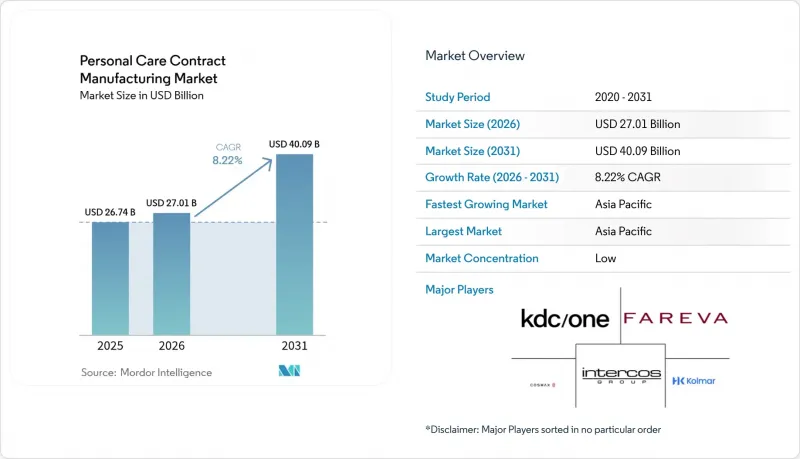
This report is Segmented by Service Type (R&D and Formulation, Manufacturing, and More), Product Type (Skin Care, Hair Care, Color Cosmetics, and More), Packaging Format (Aerosols, Bottles and Jars, Tubes and Sachets, Pumps and Dispensers, and More), Contract Manufacturing Model (OEM, ODM, and More), and Geography. The Market Forecasts are Provided in Terms of Value (USD).
Global Personal Care Contract Manufacturing Market Trends and Insights
Evolution of Service Offerings Enables Outsourcing Focus
Contract manufacturers now provide R&D, regulatory filing, and packaging under one roof, freeing brands to invest in marketing instead of fixed assets. The turnkey model compresses launch cycles from a year to only months and transfers working-capital risk to the supplier. Maesa's Magic Incubator illustrates the appeal, granting USD 35,000 plus lab access to startup brands that have since crossed USD 100 million in annual sales. ISO 22716 certification and FDA MoCRA registration handled by the vendor shield young labels from compliance pitfalls. As a result, full-service contracts are pacing 8.52% CAGR, well above standalone toll manufacturing.
Surge of Indie and DTC Brands Outsourcing Production
Thousands of venture-funded cosmetic labels launched during the e-commerce boom now hit volume thresholds where outsourcing beats building captive lines. Minimum runs of 5,000-10,000 units align neatly with contract manufacturers' pilot facilities, sparing founders multimillion-dollar capex. KDC/ONE's purchase of Maesa's EMEA arm broadened its small-batch and clean-beauty toolkit, luring digitally native brands that iterate rapidly. The ODM pathway, with a 8.41% CAGR, lets new entrants license proven recipes and swap fragrances or actives to differentiate, shrinking concept-to-shelf times to 6 months.
Stringent Regulatory and Counterfeit Concerns
The FDA's 2026 draft guidance demands real-time electronic batch records, a heavy IT lift for small and midsize vendors. The agency's new recall authority, finalized in 2025, further increases liability, nudging some suppliers out of sunscreens and eye-area products. Parallel reforms in Europe banned 23 additional CMR substances, forcing costly reformulations. Counterfeits muddy trust: the WHO estimated that fake cosmetics accounted for 10% of global trade in 2024, and when packaging is copied, legitimate contract manufacturers bear the reputational fallout.
Other drivers and restraints analyzed in the detailed report include:
- Localization of Manufacturing for Lead-Time and Cost Advantage
- AI-Enabled Rapid Formulation Platforms
- Raw-Material Price and Supply-Chain Volatility
For complete list of drivers and restraints, kindly check the Table Of Contents.
Segment Analysis
Manufacturing services contributed 58.72% of personal care contract manufacturing market share in 2025. However, turnkey contracts are scaling fastest, indexing to an 8.52% CAGR as brands off-load formulation, regulatory, and packaging in a single deal. This reallocation lightens working-capital pressure for labels that prioritize influencer campaigns over capital equipment. R&D outsourcing is also up as clean-beauty claims demand sophisticated preservative systems. Platforms such as Nouryon's BeautyCreations AI demonstrate how predictive modeling trims bench work, a capability that is pulling mid-tier brands toward external labs.
Turnkey suppliers exploit scale by bundling bottles, pumps, and secondary packaging with liquid filling, which enlarges average order values and broadens margin. The personal care contract manufacturing market size derived from full-service contracts is set to widen each year through 2031 as startups and multinational innovation teams alike pivot to variable-cost supply chains. In contrast, pure toll manufacturing grows slowly because it offers limited differentiation and places inventory liability on the brand. ISO and cGMP compliance costs continue to tilt small clients toward partners that already maintain validated systems.
Skin care dominated revenue with 38.18% in 2025, anchored by prestige serums using encapsulated actives. Hair care is expected to post an 8.76% CAGR, the quickest clip among categories, on the back of sulfate-free cleansers and scalp-serum launches. Unilever, for instance, shifted several shampoo lines to Asian ODMs specializing in coconut-derived surfactants to meet clean-label pledges. Color cosmetics lag due to minimalist makeup trends, yet specialized contract manufacturers still book seasonal palettes for luxury houses.
The personal care contract manufacturing market for hair care is set to expand as peptide-rich scalp tonics cross over from skin care technologies. Contract partners with micro-biome testing labs stand to win those programs. Fragrance and deodorants remain steady but mature; growth skews toward aluminum-free sticks, which require new wax-gel chemistries. Oral care outsourcing stays niche because giants like Colgate-Palmolive largely self-manufacture at scale.
Complete Report Scope:
- By Service Type
- R&D and Formulation
- Manufacturing
- Packaging and Allied Services
- Turnkey / Full-Service Manufacturing
- By Product Type
- Skin Care
- Hair Care
- Color Cosmetics
- Fragrance and Deodorants
- Oral Care
- Other Product Type
- By Packaging Format
- Aerosols
- Bottles and Jars
- Tubes and Sachets
- Pumps and Dispensers
- Sticks and Roll-ons
- Other Packaging Format
- By Contract Manufacturing Model
- OEM
- ODM
- OBM / Private Label
- Toll Manufacturing
- By Geography
- North America
- United States
- Canada
- Mexico
- Europe
- Germany
- United Kingdom
- France
- Italy
- Spain
- Russia
- Rest of Europe
- South America
- Brazil
- Argentina
- Rest of South America
- Asia-Pacific
- China
- India
- Japan
- South Korea
- Australia and New Zealand
- Rest of Asia-Pacific
- Middle East
- Saudi Arabia
- United Arab Emirates
- Turkey
- Rest of Middle East
- Africa
- South Africa
- Nigeria
- Rest of Africa
- North America
Geography Analysis
Asia-Pacific accounted for 36.91% of the personal care contract manufacturing market share in 2025 and is forecast to grow at a 9.11% CAGR through 2031. South Korea's COSMAX recorded KRW 319.8 billion (USD 240 million) Q3 2024 revenue, up 15.1% year over year, leveraging libraries that cut development times to six months. Chinese ODM specialists ride domestic demand from Perfect Diary and Florasis, while India attracts new factories to serve the Middle East and Africa. Japan remains niche but premium, focusing on probiotic skin care, whereas Australia emphasizes botanicals native to its biomes.
North America and Europe together generated roughly half of global turnover in 2025. The United States heads revenue, but growth moderates as brands consolidate their vendor footprint. Kolmar Korea's Pennsylvania plant added 120 million-unit capacity in 2025, slicing replenishment times for East Coast labels. Europe tightens the regulatory screws with refillable-packaging quotas and ingredient bans, nudging contract manufacturers toward investment in mold engineering and high-barrier mono-material packs. Germany leads in natural cosmetics, France in prestige fragrance, and Italy in color-cosmetic compacts.
South America, the Middle East, and Africa remain smaller but rising. Brazil's domestic houses rely on local fillers for lotions suited to humid climates, while multinationals eye Gulf Cooperation Council hubs for fragrance blending. South Africa's market is dominated by ethnic hair care lines produced at contract sites near Johannesburg. Nigeria's potential is sizable, though import dependencies and uneven power infrastructure temper growth.
- Fareva Group
- KDC/ONE (Knowlton Development Corporation)
- COSMAX Inc.
- Intercos S.p.A
- Kolmar Korea Co., Ltd.
- McBride plc
- Albea Services S.A.S
- PLZ Corp
- Voyant Beauty LLC
- Maesa Inc.
- Cosmetic Solutions LLC
- Colep Consumer Products
- Powerpack Cosmetics
- H.S.A. S.p.A
- Clarion Cosmetics
- CoValence Laboratories
- Ancorotti Cosmetics
- Tropical Products Inc.
- Virospack Inc.
- HCT Group
- Vistta Cosmetics
Additional Benefits:
- The market estimate (ME) sheet in Excel format
- 3 months of analyst support
TABLE OF CONTENTS
1 INTRODUCTION
- 1.1 Study Assumptions and Market Definition
- 1.2 Scope of the Study
2 RESEARCH METHODOLOGY
3 EXECUTIVE SUMMARY
4 MARKET LANDSCAPE
- 4.1 Market Overview
- 4.2 Market Drivers
- 4.2.1 Evolution Of Service Offerings Enables Outsourcing Focus
- 4.2.2 Localization Of Manufacturing For Lead-Time And Cost Advantage
- 4.2.3 Surge Of Indie/DTC Brands Outsourcing Production
- 4.2.4 Demand For Organic And Natural Formulations
- 4.2.5 AI-Driven Rapid Formulation Platforms
- 4.2.6 Refillable-Packaging Mandates Requiring Specialised Cm
- 4.3 Market Restraints
- 4.3.1 Stringent Regulatory And Counterfeit Concerns
- 4.3.2 Raw-Material Price And Supply-Chain Volatility
- 4.3.3 In-House Capacity Expansion By Mega Beauty Brands
- 4.3.4 Blockchain-Based Traceability And Disclosure Pressures
- 4.4 Value Chain Analysis
- 4.5 Regulatory Landscape
- 4.6 Technological Outlook
- 4.7 Porter's Five Forces Analysis
- 4.7.1 Bargaining Power of Suppliers
- 4.7.2 Bargaining Power of Buyers
- 4.7.3 Threat of New Entrants
- 4.7.4 Threat of Substitutes
- 4.7.5 Intensity of Competitive Rivalry
5 MARKET SIZE AND GROWTH FORECASTS (VALUE)
- 5.1 By Service Type
- 5.1.1 R&D and Formulation
- 5.1.2 Manufacturing
- 5.1.3 Packaging and Allied Services
- 5.1.4 Turnkey / Full-Service Manufacturing
- 5.2 By Product Type
- 5.2.1 Skin Care
- 5.2.2 Hair Care
- 5.2.3 Color Cosmetics
- 5.2.4 Fragrance and Deodorants
- 5.2.5 Oral Care
- 5.2.6 Other Product Type
- 5.3 By Packaging Format
- 5.3.1 Aerosols
- 5.3.2 Bottles and Jars
- 5.3.3 Tubes and Sachets
- 5.3.4 Pumps and Dispensers
- 5.3.5 Sticks and Roll-ons
- 5.3.6 Other Packaging Format
- 5.4 By Contract Manufacturing Model
- 5.4.1 OEM
- 5.4.2 ODM
- 5.4.3 OBM / Private Label
- 5.4.4 Toll Manufacturing
- 5.5 By Geography
- 5.5.1 North America
- 5.5.1.1 United States
- 5.5.1.2 Canada
- 5.5.1.3 Mexico
- 5.5.2 Europe
- 5.5.2.1 Germany
- 5.5.2.2 United Kingdom
- 5.5.2.3 France
- 5.5.2.4 Italy
- 5.5.2.5 Spain
- 5.5.2.6 Russia
- 5.5.2.7 Rest of Europe
- 5.5.3 South America
- 5.5.3.1 Brazil
- 5.5.3.2 Argentina
- 5.5.3.3 Rest of South America
- 5.5.4 Asia-Pacific
- 5.5.4.1 China
- 5.5.4.2 India
- 5.5.4.3 Japan
- 5.5.4.4 South Korea
- 5.5.4.5 Australia and New Zealand
- 5.5.4.6 Rest of Asia-Pacific
- 5.5.5 Middle East
- 5.5.5.1 Saudi Arabia
- 5.5.5.2 United Arab Emirates
- 5.5.5.3 Turkey
- 5.5.5.4 Rest of Middle East
- 5.5.6 Africa
- 5.5.6.1 South Africa
- 5.5.6.2 Nigeria
- 5.5.6.3 Rest of Africa
- 5.5.1 North America
6 COMPETITIVE LANDSCAPE
- 6.1 Market Concentration
- 6.2 Strategic Moves
- 6.3 Market Share Analysis
- 6.4 Company Profiles (includes Global level Overview, Market level overview, Core Segments, Financials as available, Strategic Information, Market Rank/Share for key companies, Products & Services, and Recent Developments)
- 6.4.1 Fareva Group
- 6.4.2 KDC/ONE (Knowlton Development Corporation)
- 6.4.3 COSMAX Inc.
- 6.4.4 Intercos S.p.A
- 6.4.5 Kolmar Korea Co., Ltd.
- 6.4.6 McBride plc
- 6.4.7 Albea Services S.A.S
- 6.4.8 PLZ Corp
- 6.4.9 Voyant Beauty LLC
- 6.4.10 Maesa Inc.
- 6.4.11 Cosmetic Solutions LLC
- 6.4.12 Colep Consumer Products
- 6.4.13 Powerpack Cosmetics
- 6.4.14 H.S.A. S.p.A
- 6.4.15 Clarion Cosmetics
- 6.4.16 CoValence Laboratories
- 6.4.17 Ancorotti Cosmetics
- 6.4.18 Tropical Products Inc.
- 6.4.19 Virospack Inc.
- 6.4.20 HCT Group
- 6.4.21 Vistta Cosmetics
7 MARKET OPPORTUNITIES AND FUTURE OUTLOOK
- 7.1 White-space & Unmet-Need Assessment

