PUBLISHER: Mordor Intelligence | PRODUCT CODE: 2124974

PUBLISHER: Mordor Intelligence | PRODUCT CODE: 2124974
Optical Switches - Market Share Analysis, Industry Trends & Statistics, Growth Forecasts (2026 - 2031)
According to Mordor Intelligence, the optical switches market size reached USD 8.06 billion in 2026 and is projected to climb to USD 12.71 billion by 2031, advancing at a 9.54% CAGR.
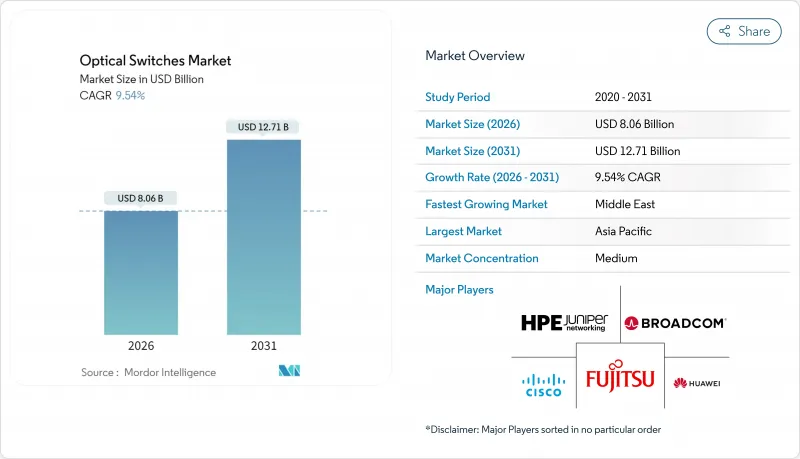
This report is Segmented by Switching Technology (Electro-Optic, Thermo-Optic Switching, and More), Port Count (1X2, 1X4, 1X8, and 1X16 and Above), Data Rate (Up To 40 Gbps, 40-100 Gbps, and More), End-User Industry (IT and Telecom, Manufacturing, and More), Application (Circuit Switching, Multiplexing, Cross-Connects, and More), and Geography. The Market Forecasts are Provided in Terms of Value (USD).
Global Optical Switches Market Trends and Insights
Surge in Hyperscale Data-Center Buildouts
Hyperscalers are shifting to optical fabrics to shave power budgets and curb latency spikes. Microsoft rolled out optical circuit switches across 12 Azure zones in 2025 and cut rack-level power draw by 18%. AWS is committed to silicon-photonics co-packaged optics for its next Graviton platforms, eliminating top-of-rack hops. Similar moves by Google and Meta confirmed a structural transition toward deterministic east-west bandwidth. These upgrades concentrate in Virginia, Oregon, Singapore, and the United Arab Emirates, where electricity costs and tax policies are favorable.
Rapid 5G and Forthcoming 6G Backhaul Densification
Mobile operators are inserting optical switches into central offices and edge sites to aggregate traffic from thousands of small cells. China Mobile equipped 47 provincial hubs with MEMS switches, trimming leased-fiber pairs by 29%. Bharti Airtel followed in 18 Indian metro areas, while Vodafone's Open RAN plan embeds optical cross-connects for real-time fronthaul redistribution. The GSM Association has already positioned optical circuit switching as a baseline for 6G backhaul, underscoring future traffic requirements.
Persistent Premium Over Electronic Leaf-Spine Fabrics
At 100- and 200 Gbps port tiers, optical switches remain 35-50% more expensive than their electronic peers. Dell'Oro pegged a 32-port optical chassis at USD 47,000 versus USD 31,000 for an electronic equivalent in Q2 2025. Many mid-tier enterprises cannot absorb the three-year payback threshold cited by Arista Networks, slowing penetration outside hyperscale footprints.
Other drivers and restraints analyzed in the detailed report include:
- Silicon-Photonics Cost Curve Crossing for >=400 Gbps Ports
- Energy-Efficiency Mandates Favoring All-Optical Switching
- Limited Field Expertise for Multi-Terabit Optical Fabrics
For complete list of drivers and restraints, kindly check the Table Of Contents.
Segment Analysis
MEMS technology accounted for 43.89% of the market in 2025 and is tracking a 10.62% CAGR through 2031. The optical switches market size for MEMS platforms is climbing as hyperscalers specify sub-millisecond reconfiguration for AI workload balancing. Calient's 1,024X1,024 array, with insertion loss below 2.5 dB, illustrates how high-port-count MEMS is replacing spine routers in pods. Electro-optic lithium niobate variants target nanosecond-switching niches, mainly finance and defense, but their higher power draw curbs mainstream adoption. Thermo-optic devices are winning cost-sensitive metro contracts, while magneto-optic switches stay limited to quantum pilots. Patent filings grew 47% year over year, reflecting brisk R&D in actuation physics.
Second-order effects center on supply-chain shifts. Specialized MEMS fabs in Taiwan and South Korea offer design-to-production services, lowering entry barriers for startups and widening vendor choice for buyers. Compliance with IEC 61753 reliability protocols is now non-negotiable in Europe, spurring vendors to harden products for millions of daily cycles. Collectively, these dynamics entrench MEMS as the benchmark for future competitive benchmarking in the optical switches market.
The 1X8 cohort held a 36.71% revenue share in 2025, owing to broad adoption in access aggregation and test-and-measurement racks. Yet demand is rapidly tilting toward 1X16 and larger matrices, expanding at a 10.41% CAGR as hyperscale operators pursue spine-level mesh fabrics. Lumentum's newly qualified 1X32 MEMS switch for Meta's data-center refresh is emblematic. Lower tiers, such as 1X2 latching models, remain vital for protection schemes but generate less revenue.
High-density products enable optical circuit-switched overlays that offload elephant flows without engaging packet silicon, driving step-function latency gains. European research networks, for example, documented a 68% reduction in latency after inserting 1X64 arrays. Given these measurable advantages, large-port switches are expected to eclipse legacy counts before the end of the decade, reinforcing their strategic importance in the optical switches market.
Complete Report Scope:
- By Switching Technology
- Electro-Optic Switching
- Acousto-Optic Switching
- MEMS-Based Switching
- Magneto-Optic Switching
- Thermo-Optic Switching
- Other Switching Technologies
- By Port Count
- 1X2
- 1X4
- 1X8
- 1X16 and Above
- By Data Rate
- Up to 40 Gbps
- 40-100 Gbps
- 100-400 Gbps
- Above 400 Gbps
- By End-User Industry
- IT and Telecom
- Government and Defense
- Banking, Financial Services, and Insurance (BFSI)
- Manufacturing
- Healthcare and Life Sciences
- Other End-User Industries
- By Application
- Circuit Switching
- Testing and Monitoring
- Multiplexing
- Cross-Connects
- Signal Monitoring
- Other Applications
- By Geography
- North America
- United States
- Canada
- Mexico
- Europe
- Germany
- United Kingdom
- France
- Russia
- Rest of Europe
- Asia-Pacific
- China
- Japan
- India
- South Korea
- Australia
- Rest of Asia-Pacific
- Middle East and Africa
- Middle East
- Saudi Arabia
- United Arab Emirates
- Rest of Middle East
- Africa
- South Africa
- Egypt
- Rest of Africa
- Middle East
- South America
- Brazil
- Argentina
- Rest of South America
- North America
Geography Analysis
Asia Pacific generated 35.79% of global revenue in 2025, fueled by China's quantum backbones, India's 5G standalone buildouts, and Japan's post-Olympic data-center boom. China Mobile connected 12 provincial quantum links with optical switches, aiming for 50-city coverage by 2028. Bharti Airtel's optical fiber rollout across 18 metros reduced backhaul fiber requirements by 31%. South Korea's 6G roadmap names optical switching as a terahertz fronthaul enabler, while Australia's National Broadband Network committed AUD 1.2 billion (USD 804 million) to optical upgrades.
The Middle East is projected to grow at 10.51% through 2031 as Saudi Arabia and the United Arab Emirates localize cloud capacity. Saudi Telecom installed MEMS switches to underpin the NEOM smart-city backbone and real-time grid automation. Etisalat integrated optical fabrics into its 5G core, aiming for sub-5 ms latency for industrial IoT.
North America held roughly 30% of 2025 demand, anchored by USD 15 billion in hyperscale retrofits from Microsoft, Amazon, and Google. Europe accounted for nearly 22%, with German and French operators accelerating upgrades to meet energy-efficiency regulations. South America and Africa together contributed under 8%, but they received tailwinds from new spectrum allocations in Brazil and fiber corridor funding in Kenya. Regulatory frameworks, such as the EU's Network and Information Security Directive 2 and a proposed U.S. FCC interoperability mandate, will shape regional adoption curves by standardizing security and compatibility baselines.
- Broadcom Inc.
- Cisco Systems Inc.
- Huawei Technologies Co. Ltd.
- Fujitsu Ltd.
- Nokia Corporation
- Juniper Networks Inc.
- NTT Advanced Technology Corporation
- Furukawa Electric Co. Ltd.
- Keysight Technologies Inc.
- Agiltron Inc.
- Ciena Corporation
- Infinera Corporation
- Huber+Suhner AG
- Lumentum Holdings Inc.
- II-VI Incorporated (Coherent Corp.)
- DiCon Fiberoptics Inc.
- Sercalo Microtechnology Ltd.
- Calient Technologies Inc.
- Accelink Technologies Co. Ltd.
- HYC Co. Ltd.
Additional Benefits:
- The market estimate (ME) sheet in Excel format
- 3 months of analyst support
TABLE OF CONTENTS
1 INTRODUCTION
- 1.1 Study Assumptions and Market Definition
- 1.2 Scope of the Study
2 RESEARCH METHODOLOGY
3 EXECUTIVE SUMMARY
4 MARKET LANDSCAPE
- 4.1 Market Overview
- 4.2 Market Drivers
- 4.2.1 Surge In Hyperscale Data-Center Buildouts
- 4.2.2 Rapid 5G And Forthcoming 6G Backhaul Densification
- 4.2.3 Silicon-Photonics Cost Curve Crossing For >=400 Gbps Ports
- 4.2.4 Energy-Efficiency Mandates Favouring All-Optical Switching
- 4.2.5 Government Quantum-Network Pilot Deployments
- 4.2.6 AI-Driven Optical Network Automation And Self-Healing
- 4.3 Market Restraints
- 4.3.1 Persistent Premium Over Electronic Leaf-Spine Fabrics
- 4.3.2 Limited Field Expertise For Multi-Terabit Optical Fabrics
- 4.3.3 Supply-Chain Exposure To III-V Wafer Shortages
- 4.3.4 Cyber-Resilience Certification Lag For Mission-Critical Users
- 4.4 Industry Value Chain Analysis
- 4.5 Impact of Macroeconomic Factors on the Market
- 4.6 Regulatory Landscape
- 4.7 Technological Outlook
- 4.8 Porter's Five Forces Analysis
- 4.8.1 Threat of New Entrants
- 4.8.2 Bargaining Power of Buyers
- 4.8.3 Bargaining Power of Suppliers
- 4.8.4 Threat of Substitutes
- 4.8.5 Intensity of Competitive Rivalry
5 MARKET SIZE AND GROWTH FORECASTS (VALUE)
- 5.1 By Switching Technology
- 5.1.1 Electro-Optic Switching
- 5.1.2 Acousto-Optic Switching
- 5.1.3 MEMS-Based Switching
- 5.1.4 Magneto-Optic Switching
- 5.1.5 Thermo-Optic Switching
- 5.1.6 Other Switching Technologies
- 5.2 By Port Count
- 5.2.1 1X2
- 5.2.2 1X4
- 5.2.3 1X8
- 5.2.4 1X16 and Above
- 5.3 By Data Rate
- 5.3.1 Up to 40 Gbps
- 5.3.2 40-100 Gbps
- 5.3.3 100-400 Gbps
- 5.3.4 Above 400 Gbps
- 5.4 By End-User Industry
- 5.4.1 IT and Telecom
- 5.4.2 Government and Defense
- 5.4.3 Banking, Financial Services, and Insurance (BFSI)
- 5.4.4 Manufacturing
- 5.4.5 Healthcare and Life Sciences
- 5.4.6 Other End-User Industries
- 5.5 By Application
- 5.5.1 Circuit Switching
- 5.5.2 Testing and Monitoring
- 5.5.3 Multiplexing
- 5.5.4 Cross-Connects
- 5.5.5 Signal Monitoring
- 5.5.6 Other Applications
- 5.6 By Geography
- 5.6.1 North America
- 5.6.1.1 United States
- 5.6.1.2 Canada
- 5.6.1.3 Mexico
- 5.6.2 Europe
- 5.6.2.1 Germany
- 5.6.2.2 United Kingdom
- 5.6.2.3 France
- 5.6.2.4 Russia
- 5.6.2.5 Rest of Europe
- 5.6.3 Asia-Pacific
- 5.6.3.1 China
- 5.6.3.2 Japan
- 5.6.3.3 India
- 5.6.3.4 South Korea
- 5.6.3.5 Australia
- 5.6.3.6 Rest of Asia-Pacific
- 5.6.4 Middle East and Africa
- 5.6.4.1 Middle East
- 5.6.4.1.1 Saudi Arabia
- 5.6.4.1.2 United Arab Emirates
- 5.6.4.1.3 Rest of Middle East
- 5.6.4.2 Africa
- 5.6.4.2.1 South Africa
- 5.6.4.2.2 Egypt
- 5.6.4.2.3 Rest of Africa
- 5.6.4.1 Middle East
- 5.6.5 South America
- 5.6.5.1 Brazil
- 5.6.5.2 Argentina
- 5.6.5.3 Rest of South America
- 5.6.1 North America
6 COMPETITIVE LANDSCAPE
- 6.1 Market Concentration
- 6.2 Strategic Moves
- 6.3 Market Share Analysis
- 6.4 Company Profiles (includes Global-level Overview, Market-level Overview, Core Segments, Financials as available, Strategic Information, Market Rank/Share, Products and Services, Recent Developments)
- 6.4.1 Broadcom Inc.
- 6.4.2 Cisco Systems Inc.
- 6.4.3 Huawei Technologies Co. Ltd.
- 6.4.4 Fujitsu Ltd.
- 6.4.5 Nokia Corporation
- 6.4.6 Juniper Networks Inc.
- 6.4.7 NTT Advanced Technology Corporation
- 6.4.8 Furukawa Electric Co. Ltd.
- 6.4.9 Keysight Technologies Inc.
- 6.4.10 Agiltron Inc.
- 6.4.11 Ciena Corporation
- 6.4.12 Infinera Corporation
- 6.4.13 Huber+Suhner AG
- 6.4.14 Lumentum Holdings Inc.
- 6.4.15 II-VI Incorporated (Coherent Corp.)
- 6.4.16 DiCon Fiberoptics Inc.
- 6.4.17 Sercalo Microtechnology Ltd.
- 6.4.18 Calient Technologies Inc.
- 6.4.19 Accelink Technologies Co. Ltd.
- 6.4.20 HYC Co. Ltd.
7 MARKET OPPORTUNITIES AND FUTURE OUTLOOK
- 7.1 White-Space and Unmet-Need Assessment

