PUBLISHER: Mordor Intelligence | PRODUCT CODE: 2125303

PUBLISHER: Mordor Intelligence | PRODUCT CODE: 2125303
Personal Finance Tools - Market Share Analysis, Industry Trends & Statistics, Growth Forecasts (2026 - 2031)
According to Mordor Intelligence, the personal finance tools market size in 2026 is estimated at USD 1.71 billion, growing from 2025 value of USD 1.63 billion with 2031 projections showing USD 2.21 billion, growing at 5.18% CAGR over 2026-2031.
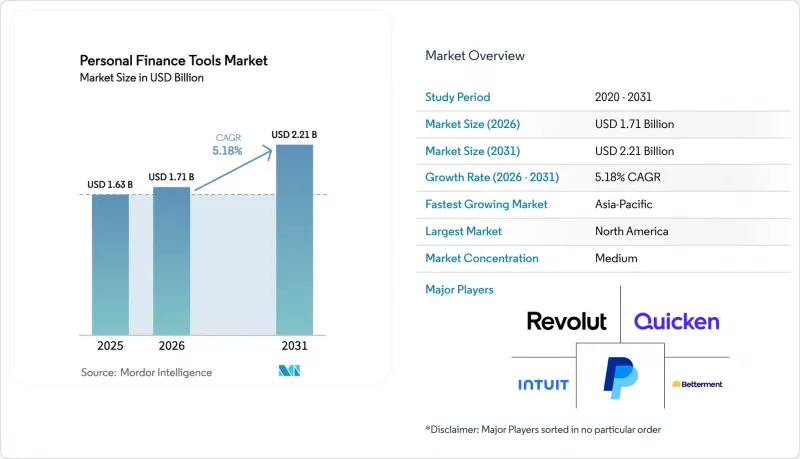
This report is Segmented by Type (Web-Based, and Mobile-Based Software), Deployment Model (Cloud-Based, and On-Premise), End User (Small Business Users, and Individual Consumers), Application (Budgeting and Expense Tracking, Tax Filing and Compliance, and More), Revenue Model (Subscription, Freemium, Transaction Fee), and Geography. The Market Forecasts are Provided in Terms of Value (USD).
Global Personal Finance Tools Market Trends and Insights
Accelerated Adoption of Open Banking APIs
Regulators are mandating standardized APIs that enable licensed apps to pull balances, transactions, and payment instructions without storing login credentials, thereby ending fragile screen-scraping practices. The United States Section 1033 rules provide the same portability rights, although large banks lobby for phased rollouts. Australia's Consumer Data Right expands to include mortgage and credit card data, driving fintech downloads and raising the standard for real-time refresh speeds. Faster access enables apps to generate predictive cash-flow alerts, automated bill negotiation offers, and consolidated dashboards in seconds. Vendors that lag on API integration risk user churn toward platforms that deliver instant visibility and friction-free switching.
Adoption of Generative AI for Hyper-Personalised Insights
Leading providers integrate large language models into spending coaches that translate transaction data into plain-English action plans. SoFi's AI investment coach analyzes volatility, tax angles, and rebalancing needs, converting insights into one-tap execution flows. The technology ingests unstructured data such as email receipts and calendar invites, surfacing proactive reminders before a user overspends. Revolut reports double-digit increases in engagement and a decrease in support tickets from AI-driven insights. Compliance with the European Union AI Act adds transparency requirements but favors well-funded incumbents that can afford bias-mitigation protocols.
Cybersecurity Breaches Undermine User Trust
A ransomware incident in 2024 compromised 2.1 million accounts, sparking industry-wide cancellations and a high-profile FTC consent decree that mandated multi-factor authentication. Regulators may levy fines up to 4% of revenue, as illustrated by the GBP 18 million (USD 23 million) penalty on Revolut for delayed breach notification. Surveys reveal that more than one-third of consumers remain unaware of the security benefits of API aggregation over credential storage, thereby keeping the perceived risk high. Providers investing in zero-knowledge encryption and biometric login incur annual costs near USD 1.2 million, straining smaller firms and nudging the personal finance tools industry toward consolidation.
Other drivers and restraints analyzed in the detailed report include:
- Embedded Finance Partnerships Between Fintechs and Banks
- Rising Smartphone Penetration in Emerging Economies
- Regulatory Uncertainty Around Consumer Data Ownership
For complete list of drivers and restraints, kindly check the Table Of Contents.
Segment Analysis
Mobile-based solutions generated the largest slice of the personal finance tools market, capturing 64.82% of the revenue in 2025 and advancing at an expected 8.12% CAGR to 2031. Daily user sessions average 4.2, supported by biometric login, push alerts, and geo-targeted spend insights that desktop browsers struggle to replicate. Revolut's cashback-at-checkout engine boosted average transaction volume per user by 19%, demonstrating how smartphone-native contexts raise monetization per session.
The segment maintains momentum as super-apps place budgeting and investment tabs alongside payments and ride-hailing, embedding personal finance tools into broader lifestyle ecosystems. Conversely, web-based platforms keep a foothold with tax prep aficionados and small businesses that value spreadsheet exports and multi-window reconciliation. Yet engagement disparities remain stark, pushing web-first vendors to release progressive-web or hybrid apps to retain visibility on home-screen real estate. Compliance with Apple and Google store policies adds friction, but higher retention offsets the 15% to 30% commission on in-app purchases for premium tiers.
Cloud-hosted platforms accounted for 77.45% of 2025 spending and exhibit a 9.35% CAGR, underscoring the scale economies of multi-tenant SaaS. Continuous delivery pipelines enable fortnightly feature pushes, accelerating user-visible improvements versus the quarterly cadence typical for on-premise upgrades. Intuit cut server provisioning costs by nearly one-third after migrating QuickBooks workloads and reallocating the savings toward AI research.
On-premise deployments persist mainly in wealth-management boutiques and regional banks, which are bound by data residency mandates. These clients cite latency control and sovereign encryption keys as trade-offs worth the higher staffing burden. Public-cloud leaders answer such objections with regional data centers and customer-managed key services, gradually eroding on-premise justifications. As regulatory clarity increases, the personal finance tools market share for on-premise solutions is likely to shrink below 20.00% by 2031.
Complete Report Scope:
- By Type
- Web-Based
- Mobile-Based Software
- By Deployment Model
- Cloud-Based
- On-Premise
- By End User
- Small Business Users
- Individual Consumers
- By Application
- Budgeting and Expense Tracking
- Investment and Wealth Management
- Credit Score Monitoring
- Debt Management and Loan Planning
- Tax Filing and Compliance
- By Revenue Model
- Subscription
- Freemium
- Transaction Fee
- By Geography
- North America
- United States
- Canada
- Mexico
- Europe
- United Kingdom
- Germany
- France
- Italy
- Rest of Europe
- Asia-Pacific
- China
- Japan
- India
- South Korea
- Rest of Asia-Pacific
- Middle East and Africa
- Middle East
- Saudi Arabia
- United Arab Emirates
- Rest of Middle East
- Africa
- South Africa
- Egypt
- Rest of Africa
- Middle East
- South America
- Brazil
- Argentina
- Rest of South America
- North America
Geography Analysis
North America accounted for 37.40% of 2025 revenue, driven by high card penetration, mature open-banking standards, and cross-sell synergies between budgeting dashboards and credit products. Canada's open-banking roadmap promises fresh API connectivity by 2026, adding tailwinds for user-growth upside. Mexico's CoDi expansion to 42 million users gives apps a channel to embed budgeting around remittance inflows, a compelling proposition for households relying on cross-border transfers. Rising acquisition costs, now near USD 68 per user, underscore the premium on retention and monetization depth.
The Asia Pacific region has the strongest growth, advancing at an 8.55% CAGR, driven by 80% smartphone saturation in India, Indonesia, and Vietnam, as well as supportive frameworks such as India's Account Aggregator system. In December 2024, UPI processed 16.7 billion payments, creating granular data that budgeting apps can parse without account-link friction. Japan's mandate for bank APIs by 2026 will open a high-income yet underserved senior demographic, while super-apps dominate in China, leaving limited space for new standalone solutions. Unbanked populations in Southeast Asia remain a greenfield for savings-first mobile propositions, aligning financial inclusion agendas with commercial growth.
Europe represents a mature yet opportunity-rich territory. PSD2 latency mandates guarantee sub-500-millisecond APIs, enhancing user experience for spending alerts and payment initiation. The United Kingdom's broadened coverage now includes savings accounts and credit cards, enabling neobanks to aggregate balances across institutions and lift engagement. Southern Europe lags in digital payments adoption, but Spain's digital-identity rollout cuts onboarding friction for cross-border providers. In contrast, South America, the Middle East, and Africa present mixed readiness; yet, Brazil's Pix and Kenya's M-Pesa demonstrate that instant payments and mobile-first interfaces can generate critical mass when interoperability and low fees coincide.
- Quicken Inc.
- Intuit Inc.
- Personal Capital Corporation
- Finicity Corporation
- PayPal Holdings Inc.
- Betterment LLC
- Revolut Ltd.
- Qube Money Inc.
- You Need A Budget LLC
- Acorns Grow Incorporated
- BlackRock Inc.
- NerdWallet Inc.
- SoFi Technologies Inc.
- Robinhood Markets Inc.
- Rocket Money Inc.
- Oportun Inc.
- Money Dashboard Ltd.
- Stash Financial Inc.
- N26 GmbH
- Klarna Bank AB
Additional Benefits:
- The market estimate (ME) sheet in Excel format
- 3 months of analyst support
TABLE OF CONTENTS
1 INTRODUCTION
- 1.1 Study Assumptions and Market Definition
- 1.2 Scope of the Study
2 RESEARCH METHODOLOGY
3 EXECUTIVE SUMMARY
4 MARKET LANDSCAPE
- 4.1 Market Overview
- 4.2 Market Drivers
- 4.2.1 Accelerated Adoption of Open Banking APIs
- 4.2.2 Rising Smartphone Penetration in Emerging Economies
- 4.2.3 Growing Preference for Subscription Models
- 4.2.4 Embedded Finance Partnerships Between Fintechs and Banks
- 4.2.5 Gamification-Based Customer Engagement Strategies
- 4.2.6 Adoption of Generative AI for Hyper-Personalised Insights
- 4.3 Market Restraints
- 4.3.1 Cybersecurity Breaches Undermine User Trust
- 4.3.2 Low Financial Literacy Among First-Time Users
- 4.3.3 High Customer Churn Due to Low Switching Costs
- 4.3.4 Regulatory Uncertainty Around Consumer Data Ownership
- 4.4 Industry Value-Chain Analysis
- 4.5 Regulatory Landscape
- 4.6 Technological Outlook
- 4.7 Impact of Macroeconomic Factors on the Market
- 4.8 Porter's Five Forces Analysis
- 4.8.1 Bargaining Power of Suppliers
- 4.8.2 Bargaining Power of Consumers
- 4.8.3 Threat of New Entrants
- 4.8.4 Intensity of Competitive Rivalry
- 4.8.5 Threat of Substitutes
5 MARKET SIZE AND GROWTH FORECASTS (VALUE)
- 5.1 By Type
- 5.1.1 Web-Based
- 5.1.2 Mobile-Based Software
- 5.2 By Deployment Model
- 5.2.1 Cloud-Based
- 5.2.2 On-Premise
- 5.3 By End User
- 5.3.1 Small Business Users
- 5.3.2 Individual Consumers
- 5.4 By Application
- 5.4.1 Budgeting and Expense Tracking
- 5.4.2 Investment and Wealth Management
- 5.4.3 Credit Score Monitoring
- 5.4.4 Debt Management and Loan Planning
- 5.4.5 Tax Filing and Compliance
- 5.5 By Revenue Model
- 5.5.1 Subscription
- 5.5.2 Freemium
- 5.5.3 Transaction Fee
- 5.6 By Geography
- 5.6.1 North America
- 5.6.1.1 United States
- 5.6.1.2 Canada
- 5.6.1.3 Mexico
- 5.6.2 Europe
- 5.6.2.1 United Kingdom
- 5.6.2.2 Germany
- 5.6.2.3 France
- 5.6.2.4 Italy
- 5.6.2.5 Rest of Europe
- 5.6.3 Asia-Pacific
- 5.6.3.1 China
- 5.6.3.2 Japan
- 5.6.3.3 India
- 5.6.3.4 South Korea
- 5.6.3.5 Rest of Asia-Pacific
- 5.6.4 Middle East and Africa
- 5.6.4.1 Middle East
- 5.6.4.1.1 Saudi Arabia
- 5.6.4.1.2 United Arab Emirates
- 5.6.4.1.3 Rest of Middle East
- 5.6.4.2 Africa
- 5.6.4.2.1 South Africa
- 5.6.4.2.2 Egypt
- 5.6.4.2.3 Rest of Africa
- 5.6.4.1 Middle East
- 5.6.5 South America
- 5.6.5.1 Brazil
- 5.6.5.2 Argentina
- 5.6.5.3 Rest of South America
- 5.6.1 North America
6 COMPETITIVE LANDSCAPE
- 6.1 Market Concentration
- 6.2 Strategic Moves
- 6.3 Market Share Analysis
- 6.4 Company Profiles {(includes Global level Overview, Market level overview, Core Segments, Financials as available, Strategic Information, Market Rank/Share for key companies, Products and Services, and Recent Developments)}
- 6.4.1 Quicken Inc.
- 6.4.2 Intuit Inc.
- 6.4.3 Personal Capital Corporation
- 6.4.4 Finicity Corporation
- 6.4.5 PayPal Holdings Inc.
- 6.4.6 Betterment LLC
- 6.4.7 Revolut Ltd.
- 6.4.8 Qube Money Inc.
- 6.4.9 You Need A Budget LLC
- 6.4.10 Acorns Grow Incorporated
- 6.4.11 BlackRock Inc.
- 6.4.12 NerdWallet Inc.
- 6.4.13 SoFi Technologies Inc.
- 6.4.14 Robinhood Markets Inc.
- 6.4.15 Rocket Money Inc.
- 6.4.16 Oportun Inc.
- 6.4.17 Money Dashboard Ltd.
- 6.4.18 Stash Financial Inc.
- 6.4.19 N26 GmbH
- 6.4.20 Klarna Bank AB
7 MARKET OPPORTUNITIES AND FUTURE OUTLOOK
- 7.1 White-Space and Unmet-Need Assessment

