PUBLISHER: Mordor Intelligence | PRODUCT CODE: 2125338

PUBLISHER: Mordor Intelligence | PRODUCT CODE: 2125338
United States Valves - Market Share Analysis, Industry Trends & Statistics, Growth Forecasts (2026 - 2031)
According to Mordor Intelligence, the US valves market size is expected to grow from USD 19.02 billion in 2025 to USD 19.94 billion in 2026 and is forecast to reach USD 25.28 billion by 2031 at 4.86% CAGR over 2026-2031.
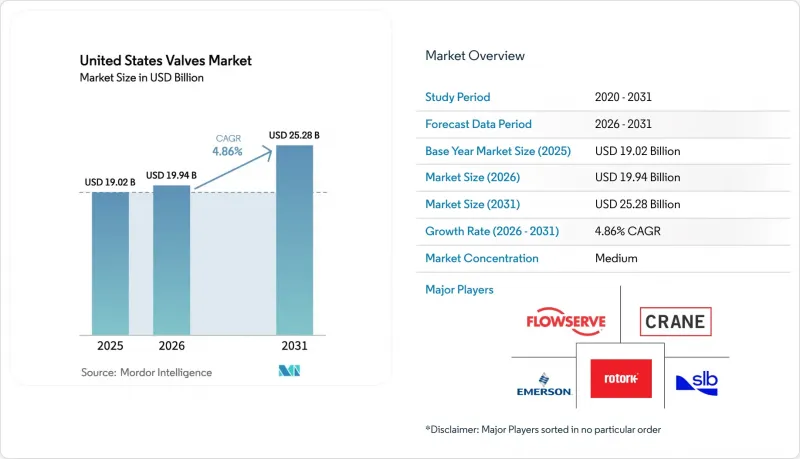
This report is Segmented by Type (Ball Valve, Butterfly Valve, Gate Valve, Globe Valve, Check Valve, Plug Valve, Control Valve, and More), Material (Steel, Cast Iron, Alloy-Based, Plastic, and More), Actuation Method (Manual, Pneumatic, Electric, Hydraulic, and More), End-User Industry (Oil and Gas, Power Generation, and More), and Region. The Market Forecasts are Provided in Terms of Value (USD).
United States Valves Market Trends and Insights
Rapid Shale-Oil Refracturing Activity Boosting Valve Replacements
Refracturing campaigns shorten valve lifecycles from 18-24 months to 12-15 months, driving steady aftermarket demand in Permian and other shale hotspots. Pressure cycling above 10,000 psi necessitates premium designs with enhanced sealing and corrosion resistance. Aftermarket providers benefit from higher replacement frequency, while OEMs capture value through upgraded materials and service agreements. Rising refracturing intensity also spurs demand for control valves that can modulate flow during multi-stage treatments. Suppliers able to certify products for rapid deployment gain a competitive edge in this time-sensitive environment.
Accelerating Federal Funding for Water Infrastructure Modernization
The Infrastructure Investment and Jobs Act allocates USD 55 billion for water systems, much of which targets aging valves that entered service 30-50 years ago. Municipalities prioritize smart, lead-free, and remotely actuated valves to increase leak detection efficiency and regulatory compliance. EPA revolving funds supplement federal grants, ensuring a steady pipeline of projects through 2030. Suppliers offering turnkey packages, including valves, actuators, and monitoring software, capture higher margins, especially in the Northeast and Midwest, where replacement urgency is acute. Long procurement cycles favor vendors with proven municipal references.
Steel and Alloy Price Volatility Squeezing OEM Margins
Spot steel prices fluctuated 40-60% in 2024, compressing margins for valve makers locked into long-term contracts. Smaller companies lacking hedging programs face greater earnings swings, sometimes redesigning products with alternative materials. Surcharge clauses and index-based pricing help larger firms offset volatility, but implementation requires customer negotiation and system updates. Volatility also complicates inventory planning, raising working capital requirements and potentially delaying innovation spending.
Other drivers and restraints analyzed in the detailed report include:
- Industrial IoT-Enabled Predictive Maintenance Adoption
- Hydrogen-Ready Valve Design Standards Emerging
- Skills Gap in Smart-Valve Commissioning and Maintenance
For complete list of drivers and restraints, kindly check the Table Of Contents.
Segment Analysis
Gate valves held 27.24% of the U.S. valve market share in 2025, reflecting their entrenched use in pipelines and water networks, where tight shut-off is mandatory. Their established specifications make them the default choice in many engineering standards, supporting steady demand for replacement. Butterfly valves gain momentum with a 5.05% CAGR, prized for compact footprints and fast quarter-turn operation in HVAC and automated process lines. The U.S. valves market size for butterfly designs grows as facility owners prioritize energy efficiency and remote control. Globe and check valves remain staples for throttling and backflow prevention, while control valves occupy higher-value niches driven by precision requirements. Growth in additive manufacturing prototypes enables rapid customization; however, large-scale production still favors traditional casting due to cost and durability considerations.
Engineering teams are increasingly evaluating total installed cost rather than purchase price, benefiting butterfly valves where weight savings reduce structural and actuation expenses. Conversely, gate valves maintain dominance in corrosive or abrasive services by offering robust wedge seals and full-bore flow paths. Digital position feedback retrofits allow legacy gate valves to integrate with plant DCS platforms, extending service life and aligning with modern monitoring strategies. Vendors that can support mixed fleets of gate and butterfly valves through unified asset-management software win maintenance contracts, thereby deepening customer stickiness in the U.S. valves market.
Steel products held a 40.88% market share in 2025, underpinned by their high tensile strength and temperature tolerance, which are essential for upstream energy and chemical processing applications. Improved metallurgy and coatings extend mean time between failure, safeguarding steel's role in critical services. Plastic valves grow at the fastest rate, with a 4.92% CAGR, driven by their corrosion resistance and lower installation weight in water treatment and certain chemical processes. The U.S. valves market size for plastics is expected to expand further as utilities address lead-replacement mandates.
Utilities weigh lifecycle costs, often selecting plastic for low-pressure lines where corrosion drives frequent steel replacement. Hybrid solutions, such as plastic-lined steel bodies, strike a balance between strength and chemical resistance, capturing a share of the mid-pressure range. Alloy-based materials maintain a premium position in extreme environments, such as nuclear and aerospace applications, although limited volumes restrict their market share. Cast iron continues to serve legacy municipal systems, but its use is slowly declining due to its weight and corrosion drawbacks. Material innovations remain pivotal to meeting increasingly stringent environmental and performance standards, especially as the introduction of hydrogen services presents new compatibility challenges.
Complete Report Scope:
- By Type
- Ball Valve
- Butterfly Valve
- Gate Valve
- Globe Valve
- Check Valve
- Plug Valve
- Control Valve
- Other Types
- By Material
- Steel
- Cast Iron
- Alloy-Based
- Plastic
- Other Materials
- By Actuation Method
- Manual
- Pneumatic
- Electric
- Hydraulic
- Other Actuation Methods
- By End-User Industry
- Oil and Gas
- Power Generation
- Chemical
- Water and Wastewater
- Mining
- Food and Beverage
- Pharmaceuticals
- Other End-User Industries
- By Region
- Northeast
- Midwest
- South
- West
List of Companies Covered in this Report:
- Emerson Electric Co.
- Schlumberger Limited
- Flowserve Corporation
- Crane Company
- Rotork plc
- Bray International, Inc.
- KITZ Corporation
- Parker-Hannifin Corporation
- Curtiss-Wright Corporation
- Watts Water Technologies, Inc.
- AVK Holding A/S
- Velan Inc.
- Johnson Controls International plc
- Honeywell International Inc.
- Spirax-Sarco Engineering plc
- Pentair plc
- Cameron (SLB)
- AUMA Riester GmbH and Co. KG
- Samson Aktiengesellschaft
- Swagelok Company
Additional Benefits:
- The market estimate (ME) sheet in Excel format
- 3 months of analyst support
TABLE OF CONTENTS
1 INTRODUCTION
- 1.1 Study Assumptions and Market Definition
- 1.2 Scope of the Study
2 RESEARCH METHODOLOGY
3 EXECUTIVE SUMMARY
4 MARKET LANDSCAPE
- 4.1 Market Overview
- 4.2 Market Drivers
- 4.2.1 Rapid Shale-Oil Refracturing Activity Boosting Valve Replacements
- 4.2.2 Accelerating Federal Funding for Water Infrastructure Modernization
- 4.2.3 Industrial IoT-Enabled Predictive Maintenance Adoption
- 4.2.4 Hydrogen-Ready Valve Design Standards Emerging
- 4.2.5 Federal Investment Tax Credits for Carbon-Capture Projects
- 4.2.6 Growth of Modular Data Centers Requiring Precision Cooling Valves
- 4.3 Market Restraints
- 4.3.1 Steel and Alloy Price Volatility Squeezing OEM Margins
- 4.3.2 Skills Gap in Smart-Valve Commissioning and Maintenance
- 4.3.3 Import Tariffs on Specialty Valve Castings
- 4.3.4 Cybersecurity Concerns Slowing Connected-Valve Deployments
- 4.4 Industry Value Chain Analysis
- 4.5 Impact of Macroeconomic Factors
- 4.6 Regulatory Landscape
- 4.7 Technological Outlook
- 4.8 Porter's Five Forces Analysis
- 4.8.1 Bargaining Power of Suppliers
- 4.8.2 Bargaining Power of Buyers
- 4.8.3 Threat of New Entrants
- 4.8.4 Threat of Substitutes
- 4.8.5 Intensity of Competitive Rivalry
- 4.9 Assessment of Impact of COVID-19
5 MARKET SIZE AND GROWTH FORECASTS (VALUE)
- 5.1 By Type
- 5.1.1 Ball Valve
- 5.1.2 Butterfly Valve
- 5.1.3 Gate Valve
- 5.1.4 Globe Valve
- 5.1.5 Check Valve
- 5.1.6 Plug Valve
- 5.1.7 Control Valve
- 5.1.8 Other Types
- 5.2 By Material
- 5.2.1 Steel
- 5.2.2 Cast Iron
- 5.2.3 Alloy-Based
- 5.2.4 Plastic
- 5.2.5 Other Materials
- 5.3 By Actuation Method
- 5.3.1 Manual
- 5.3.2 Pneumatic
- 5.3.3 Electric
- 5.3.4 Hydraulic
- 5.3.5 Other Actuation Methods
- 5.4 By End-User Industry
- 5.4.1 Oil and Gas
- 5.4.2 Power Generation
- 5.4.3 Chemical
- 5.4.4 Water and Wastewater
- 5.4.5 Mining
- 5.4.6 Food and Beverage
- 5.4.7 Pharmaceuticals
- 5.4.8 Other End-User Industries
- 5.5 By Region
- 5.5.1 Northeast
- 5.5.2 Midwest
- 5.5.3 South
- 5.5.4 West
6 COMPETITIVE LANDSCAPE
- 6.1 Market Concentration
- 6.2 Strategic Moves
- 6.3 Market Share Analysis
- 6.4 Company Profiles (includes Global level overview, Market level overview, Core Segments, Financials as available, Strategic Information, Market Rank/Share for key companies, Products and Services, and Recent Developments)
- 6.4.1 Emerson Electric Co.
- 6.4.2 Schlumberger Limited
- 6.4.3 Flowserve Corporation
- 6.4.4 Crane Company
- 6.4.5 Rotork plc
- 6.4.6 Bray International, Inc.
- 6.4.7 KITZ Corporation
- 6.4.8 Parker-Hannifin Corporation
- 6.4.9 Curtiss-Wright Corporation
- 6.4.10 Watts Water Technologies, Inc.
- 6.4.11 AVK Holding A/S
- 6.4.12 Velan Inc.
- 6.4.13 Johnson Controls International plc
- 6.4.14 Honeywell International Inc.
- 6.4.15 Spirax-Sarco Engineering plc
- 6.4.16 Pentair plc
- 6.4.17 Cameron (SLB)
- 6.4.18 AUMA Riester GmbH and Co. KG
- 6.4.19 Samson Aktiengesellschaft
- 6.4.20 Swagelok Company
7 MARKET OPPORTUNITIES AND FUTURE OUTLOOK
- 7.1 White-Space and Unmet-Need Assessment

