PUBLISHER: Mordor Intelligence | PRODUCT CODE: 2125386

PUBLISHER: Mordor Intelligence | PRODUCT CODE: 2125386
Valves - Market Share Analysis, Industry Trends & Statistics, Growth Forecasts (2026 - 2031)
According to Mordor Intelligence, the valves market size is expected to grow from USD 84.92 billion in 2025 to USD 90.06 billion in 2026 and is forecast to reach USD 120.79 billion by 2031 at 6.05% CAGR over 2026-2031.
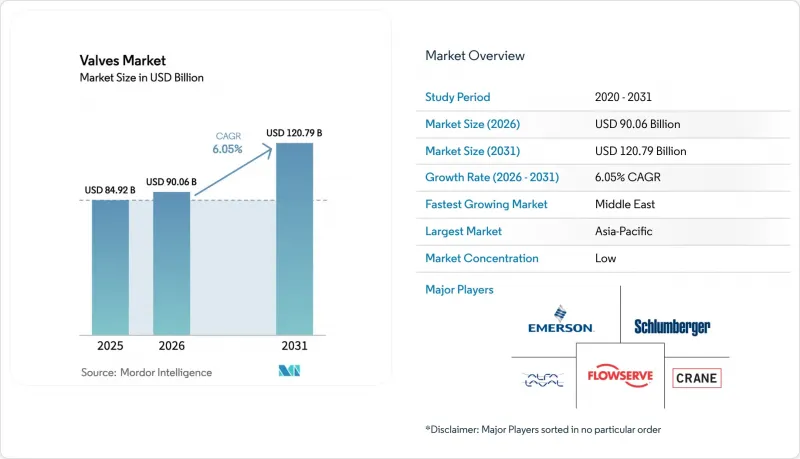
This report is Segmented by Valve Type (Ball, Butterfly, Gate, Globe, Check, Plug, Control, and More), Material (Stainless Steel, Carbon Steel, Alloy Steel, Cryogenic, and More), Actuation Type (Manual, Electric, Pneumatic, Hydraulic, and More), End-User Vertical (Oil and Gas, Power Generation, Chemical, Water and Wastewater, Mining, and More), and Geography. The Market Forecasts are Provided in Terms of Value (USD).
Global Valves Market Trends and Insights
Rise in Infrastructure-Related Developments
Capital committed to repairing and expanding water networks, expressways, and district energy systems is pulling forward purchasing schedules for valves that deliver tight shut-off, cavitation control, and long service life. Pennsylvania American Water alone programmed USD 586 million in upgrades for 2024-2026, while Ontario approved CAD 970 million (USD 719 million) to reinforce municipal pipelines. Similar headline allocations are appearing in India's Jal Jeevan Mission and Saudi Arabia's National Water Strategy, prompting OEMs to localize assembly lines and raise stainless and ductile-iron casting capacities. Urban resilience mandates are also broadening specification sheets to include surge-proof butterfly valves and smart pressure-reducing valves that integrate seamlessly with district SCADA platforms.
Growing Energy Projects in Oil and Gas Sector
Upstream and midstream operators are concentrating capital on complex, high-pressure assets where fugitive-emission compliance and digital performance dashboards are non-negotiable. ADNOC's decision to entrust Flowserve with dry-gas-seal systems for a 1.5 million ton-per-year carbon-capture installation underscores the premium placed on reliability and engineered sealing. As offshore production migrates toward deeper waters, ball and subsea gate valves rated above 15 000 psi are standardizing on all-metal seals and condition-monitoring sensors. Simultaneously, North American shale producers are retrofitting existing sites with low-bleed pneumatic controllers, propelling aftermarket demand for conversion kits and self-diagnosing actuators.
Volatility in Raw-Material Prices
Stainless and alloy-steel indices vacillated sharply throughout 2024, challenging OEMs whose contracts feature multi-year delivery windows and capped escalation clauses. Producers responded by widening supplier pools, forward-buying billet, and substituting near-equivalent alloys, but these tactics inflate working-capital needs and introduce qualification lead times. Pricing turbulence hits entry-level butterfly and gate valves hardest because end-users resist pass-throughs, forcing manufacturers to absorb margin erosion until spot markets stabilize.
Other drivers and restraints analyzed in the detailed report include:
- Investments in Water and Wastewater Treatment
- Industrial Automation and Smart Valves
- Lack of Standardized Global Certification
For complete list of drivers and restraints, kindly check the Table Of Contents.
Segment Analysis
Ball valves retained the highest 37.10% valves market share in 2025 on the strength of their low-torque operation and multi-port versatility. Control valves are projected to lead growth at a 6.65% CAGR because continuous process industries increasingly specify digital positioners for tighter loop control. This preference lifts the valves market size allocation for advanced globe, V-port ball, and rotary plug designs in chemical and power plants. The integration of self-diagnostics into control-valve assemblies is helping operators cut unscheduled downtime, translating into measurable productivity gains.
Product innovation is visible across all major styles: butterfly valves are adopting triple-offset geometries to enhance zero-leak bi-directional sealing, while gate valves destined for subsea positions feature non-intrusive actuators to simplify maintenance. Flowserve's European patent covering high-temperature packing materials demonstrates how R and D continues to push safe operating envelopes beyond 1 200°F. Meanwhile, check-valve makers are re-engineering disc profiles for lower pressure drop, responding to energy-efficiency targets in pipeline transport.
Stainless steel's 45.05% presence in 2025 underlines its status as the default alloy for general service across refineries, desalination, and food processing installations. However, LNG export terminals and liquid hydrogen pilot plants are propelling a 7.24% CAGR in cryogenic alloys such as 9% nickel and austenitic-stainless variants, expanding the Valves market size for specialty forgings. Carbon-steel grades continue to compete in room-temperature water and non-corrosive gas lines where budget discipline dominates procurement decisions.
Additive manufacturing is gradually penetrating niche severe-service applications, with SAMSON earning the first EU certificate for pressure equipment produced via powder-bed fusion. This breakthrough allows intricate flow paths that reduce turbulence and erosion inside globe-valve bodies. Plastic valves, traditionally capped by temperature limits, are also progressing via new fluoropolymer blends that tolerate up to 120 °C, widening their remit in chlor-alkali and semiconductor wet benches.
Complete Report Scope:
- By Valve Type
- Ball Valve
- Butterfly Valve
- Gate Valve
- Globe Valve
- Check Valve
- Plug Valve
- Control Valve
- Other Valve Types
- By Material
- Stainless Steel
- Carbon Steel
- Alloy Steel
- Cryogenic
- Plastic
- Other Materials
- By Actuation Type
- Manual
- Electric
- Pneumatic
- Hydraulic
- Smart (Electro-hydraulic)
- Other Actuation Types
- By End-User Vertical
- Oil and Gas
- Power Generation
- Chemical
- Water and Wastewater
- Mining
- Other End-User Verticals
- By Geography
- North America
- United States
- Canada
- Mexico
- South America
- Brazil
- Argentina
- Rest of South America
- Europe
- Germany
- United Kingdom
- France
- Italy
- Spain
- Russia
- Rest of Europe
- Asia Pacific
- China
- Japan
- India
- South Korea
- Australia and New Zealand
- Rest of Asia Pacific
- Middle East
- Saudi Arabia
- United Arab Emirates
- Turkey
- Rest of Middle East
- Africa
- South Africa
- Nigeria
- Egypt
- Rest of Africa
- North America
Geography Analysis
Asia Pacific maintained a commanding 37.75% Valves market share in 2025 on the back of aggressive infrastructure expansion in China and India, including water metros, mega-refineries, and semiconductor fabs. Regional governments allocate multi-year budgets to high-speed rail corridors and flood-control reservoirs, each generating high-volume requisitions for isolation and control devices. Japan's nuclear restart program is also refreshing demand for Class-1 safety valves certified under the ASME BPVC, whereas South Korea's smart-factory agenda boosts uptake of digitally native actuators. Australia's LNG backfill projects and Indonesia's nickel-processing plants further underpin regional volume.
The Middle East is projected to record the fastest 7.19% CAGR through 2031, energized by Saudi Arabia's Vision 2030 diversification, Qatar's LNG North Field expansion, and the United Arab Emirates' renewable desalination investments. Emerson's decision to establish a Saudi manufacturing hub signals the region's pivot from import reliance toward localized supply that meets in-kingdom content quotas. Carbon-capture initiatives such as ADNOC's 1.5 million tonnes per year project are specifying ultra-low-emission valve assemblies, opening premium opportunities for engineered packages from Flowserve and Velan.
North America combines mature installed bases with technology refresh cycles, particularly in shale gas gathering networks where ventless pneumatic controllers are retrofitted to curb methane intensity. Federal infrastructure grants under the U.S. Bipartisan Infrastructure Law accelerate municipal water replacement, keeping butterfly-valve and air-release product lines buoyant. Europe's decarbonization roadmap channels funds to hydrogen corridors and CCS clusters, pushing cryogenic and high-alloy inquiries. Eastern European markets, rebuilding district heating grids, create incremental adoption of triple-eccentric butterfly valves with thermal-cycling durability.
- Emerson Electric Co.
- Flowserve Corporation
- Schlumberger N.V.
- Alfa Laval AB
- Crane Company
- Rotork plc
- IMI plc
- SAMSON AKTIENGESELLSCHAFT
- KITZ Corporation
- Spirax-Sarco Engineering plc
- AVK Holding A/S
- Velan Inc.
- Metso Oyj
- Baker Hughes Company
- Parker Hannifin Corporation
- The Weir Group PLC
- OMB Valves S.p.A.
- Cla-Val Co.
- CIRCOR International Inc.
- Curtiss-Wright Corporation
- Neway Valve (Suzhou) Co., Ltd.
Additional Benefits:
- The market estimate (ME) sheet in Excel format
- 3 months of analyst support
TABLE OF CONTENTS
1 INTRODUCTION
- 1.1 Study Assumptions and Market Definition
- 1.2 Scope of the Study
2 RESEARCH METHODOLOGY
3 EXECUTIVE SUMMARY
4 MARKET LANDSCAPE
- 4.1 Market Overview
- 4.2 Market Drivers
- 4.2.1 Rise in infrastructure-related developments
- 4.2.2 Growing energy projects in oil and gas sector
- 4.2.3 Investments in water and wastewater treatment
- 4.2.4 Industrial automation and smart valves
- 4.2.5 Hydrogen economy build-out
- 4.2.6 Modular nuclear reactors
- 4.3 Market Restraints
- 4.3.1 Volatility in raw-material prices
- 4.3.2 Lack of standardized global certification
- 4.3.3 Cyber-security risks in intelligent valves
- 4.3.4 Seal material supply-chain concentration
- 4.4 Industry Value Chain Analysis
- 4.5 Regulatory Landscape
- 4.6 Technological Outlook
- 4.7 Impact of Macroeconomic Factors
- 4.8 Porter's Five Forces Analysis
- 4.8.1 Bargaining Power of Suppliers
- 4.8.2 Bargaining Power of Buyers
- 4.8.3 Threat of New Entrants
- 4.8.4 Threat of Substitutes
- 4.8.5 Intensity of Competitive Rivalry
- 4.9 Investment Analysis
5 MARKET SIZE AND GROWTH FORECASTS (VALUE)
- 5.1 By Valve Type
- 5.1.1 Ball Valve
- 5.1.2 Butterfly Valve
- 5.1.3 Gate Valve
- 5.1.4 Globe Valve
- 5.1.5 Check Valve
- 5.1.6 Plug Valve
- 5.1.7 Control Valve
- 5.1.8 Other Valve Types
- 5.2 By Material
- 5.2.1 Stainless Steel
- 5.2.2 Carbon Steel
- 5.2.3 Alloy Steel
- 5.2.4 Cryogenic
- 5.2.5 Plastic
- 5.2.6 Other Materials
- 5.3 By Actuation Type
- 5.3.1 Manual
- 5.3.2 Electric
- 5.3.3 Pneumatic
- 5.3.4 Hydraulic
- 5.3.5 Smart (Electro-hydraulic)
- 5.3.6 Other Actuation Types
- 5.4 By End-User Vertical
- 5.4.1 Oil and Gas
- 5.4.2 Power Generation
- 5.4.3 Chemical
- 5.4.4 Water and Wastewater
- 5.4.5 Mining
- 5.4.6 Other End-User Verticals
- 5.5 By Geography
- 5.5.1 North America
- 5.5.1.1 United States
- 5.5.1.2 Canada
- 5.5.1.3 Mexico
- 5.5.2 South America
- 5.5.2.1 Brazil
- 5.5.2.2 Argentina
- 5.5.2.3 Rest of South America
- 5.5.3 Europe
- 5.5.3.1 Germany
- 5.5.3.2 United Kingdom
- 5.5.3.3 France
- 5.5.3.4 Italy
- 5.5.3.5 Spain
- 5.5.3.6 Russia
- 5.5.3.7 Rest of Europe
- 5.5.4 Asia Pacific
- 5.5.4.1 China
- 5.5.4.2 Japan
- 5.5.4.3 India
- 5.5.4.4 South Korea
- 5.5.4.5 Australia and New Zealand
- 5.5.4.6 Rest of Asia Pacific
- 5.5.5 Middle East
- 5.5.5.1 Saudi Arabia
- 5.5.5.2 United Arab Emirates
- 5.5.5.3 Turkey
- 5.5.5.4 Rest of Middle East
- 5.5.6 Africa
- 5.5.6.1 South Africa
- 5.5.6.2 Nigeria
- 5.5.6.3 Egypt
- 5.5.6.4 Rest of Africa
- 5.5.1 North America
6 COMPETITIVE LANDSCAPE
- 6.1 Market Concentration
- 6.2 Strategic Moves
- 6.3 Market Share Analysis
- 6.4 Company Profiles (includes Global level Overview, Market level overview, Core Segments, Financials as available, Strategic Information, Market Rank/Share for key companies, Products and Services, and Recent Developments)
- 6.4.1 Emerson Electric Co.
- 6.4.2 Flowserve Corporation
- 6.4.3 Schlumberger N.V.
- 6.4.4 Alfa Laval AB
- 6.4.5 Crane Company
- 6.4.6 Rotork plc
- 6.4.7 IMI plc
- 6.4.8 SAMSON AKTIENGESELLSCHAFT
- 6.4.9 KITZ Corporation
- 6.4.10 Spirax-Sarco Engineering plc
- 6.4.11 AVK Holding A/S
- 6.4.12 Velan Inc.
- 6.4.13 Metso Oyj
- 6.4.14 Baker Hughes Company
- 6.4.15 Parker Hannifin Corporation
- 6.4.16 The Weir Group PLC
- 6.4.17 OMB Valves S.p.A.
- 6.4.18 Cla-Val Co.
- 6.4.19 CIRCOR International Inc.
- 6.4.20 Curtiss-Wright Corporation
- 6.4.21 Neway Valve (Suzhou) Co., Ltd.
7 MARKET OPPORTUNITIES AND FUTURE OUTLOOK
- 7.1 White-space and unmet-need assessment

