PUBLISHER: Mordor Intelligence | PRODUCT CODE: 2125366

PUBLISHER: Mordor Intelligence | PRODUCT CODE: 2125366
Asia-Pacific Positive Displacement Pumps - Market Share Analysis, Industry Trends & Statistics, Growth Forecasts (2026 - 2031)
According to Mordor Intelligence, the APAC positive displacement pumps market size was valued at USD 11.53 billion in 2025 and estimated to grow from USD 12.02 billion in 2026 to reach USD 14.79 billion by 2031, at a CAGR of 4.24% during the forecast period (2026-2031).
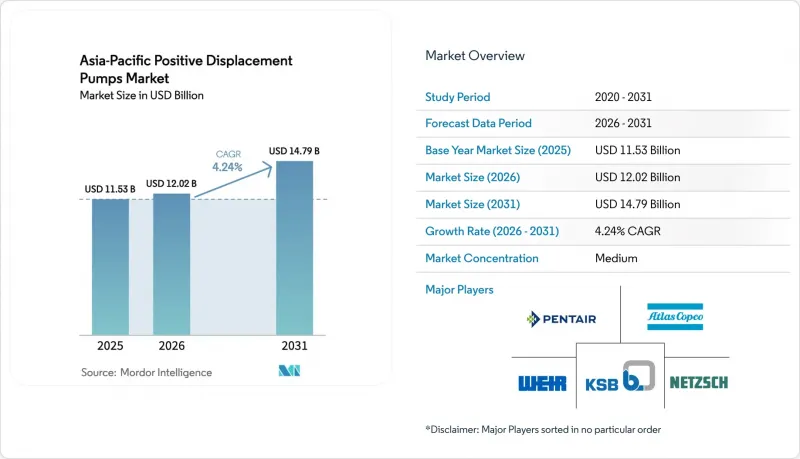
This report is Segmented by Pump Type (Reciprocating, Rotary, Progressive Cavity, and Peristaltic), Driving Method (Electric Motor, Diesel/IC Engine, and More), Material (Cast Iron, Stainless Steel, and Other Materials), End-User Industry (Oil and Gas, Chemicals, Food and Beverage, Waste and Wastewater, and More), and Country. The Market Forecasts are Provided in Terms of Value (USD).
Asia-Pacific Positive Displacement Pumps Market Trends and Insights
Rapid Build-out of Asia's Municipal Wastewater Infrastructure
Expanding municipal wastewater networks spur recurring orders for progressive cavity and screw units that handle viscous sludges with stable flow, making these pumps a preferred choice for biological treatment and chemical dosing. China and India allocate significant stimulus to decentralized plants, and Southeast Asian nations seek modular skid packages that can be deployed quickly in peri-urban areas. Progressive cavity suppliers therefore bundle monitoring sensors to flag wear on rotors and stators, reducing on-site service calls. Local fabricators in Indonesia and Vietnam also scale up cast iron models for budget-sensitive municipalities, but stainless variants continue to dominate lifecycle assessments. The APAC positive displacement pumps market benefits as water utilities anchor long-term service agreements that guarantee throughput performance across 10-year concessions.
Tightening VOC Discharge Limits in China's Specialty-Chemicals Clusters
Stringent rules mandating leak detection thresholds below 2,000 ppm push processors to specify magnetic-drive and hermetically sealed designs, creating a material premium yet reducing fugitive emissions liability. Pump makers integrate dual mechanical seals with sensor-enabled pressure compensation to ensure regulatory audits pass on first inspection. Compliance deadlines intensify replacement cycles in Jiangsu, Shandong and Guangdong complexes, positioning the APAC positive displacement pumps market for retrofit revenue. Companies offering VOC-monitoring analytics secure framework agreements with specialty polymer producers that require real-time reporting to local environmental bureaus.
Volatile Stainless-Steel and Copper Prices Inflate Pump BOM Cost
Raw materials account for up to 60% of finished-pump cost; a 15% spike in stainless price can cut gross margins by 300 bps if not passed through swiftly. Suppliers diversify into duplex or low-molybdenum grades and redesign housings to reduce wall thickness without compromising pressure ratings. Larger OEMs lock annual contracts with mills, while smaller fabricators risk cash-flow tightness, prompting consolidation within the APAC positive displacement pumps market. Design-for-cost engineering accelerates the transition to composite polymer components in non-critical housings, easing volatility exposure.
Other drivers and restraints analyzed in the detailed report include:
- Electrification of Offshore Platforms Raises Demand for Low-Shear Pumps
- Mini-Bulk Biopharma Facilities Adopting Single-Use Peristaltic Skids
- Skilled-Labor Shortage for Complex Progressive-Cavity Pump MRO
For complete list of drivers and restraints, kindly check the Table Of Contents.
Segment Analysis
Rotary units contributed 51.12% of 2025 revenue, equating to the largest slice of the APAC positive displacement pumps market size and validating their versatility in chemicals, oil and gas and food handling applications. Peristaltic pumps, however, lead volume growth at a 7.06% CAGR by satisfying single-use bioprocessing protocols and chemical-feed duties where zero contamination is non-negotiable.
Gear and twin-screw products now ship with vibration and pressure sensors that feed OEM cloud dashboards, accelerating predictive-maintenance uptake across the APAC positive displacement pumps market. Lobe designs ride demand from dairy and beverage expansions, while vane variants maintain niche roles in lubrication circuits.
Electric-motor models delivered 63.21% of 2025 revenue, underscoring their entrenched role in factory automation and conveying applications across the APAC positive displacement pumps market share. Solar-powered packages, though still a niche, achieve a 9.32% CAGR as agricultural irrigation and remote water supply projects benefit from declining photovoltaic costs.
Variable-frequency drives paired with high-efficiency IE4 motors cut lifecycle energy use, while diesel units retreat to emergency and off-grid roles under tightening emission norms. Pneumatic systems retain a foothold in hazardous environments where intrinsic safety trumps energy efficiency.
Complete Report Scope:
- By Pump Type
- Reciprocating Pumps
- Piston
- Diaphragm
- Rotary Pumps
- Gear
- Lobe
- Screw
- Vane
- Progressive Cavity
- Peristaltic
- Reciprocating Pumps
- By Driving Method
- Electric Motor
- Diesel/IC Engine
- Pneumatic
- Hydraulic
- Solar
- By Material
- Cast Iron
- Stainless Steel
- Other Materials
- By End-user Industry
- Oil and Gas
- Chemicals
- Food and Beverage
- Waste and Wastewater
- Pharmaceutical and Biotech
- Power Generation
- Pulp and Paper
- Mining and Metals
- Other Industries
- By Country
- China
- Japan
- India
- South Korea
- Australia and New Zealand
- Rest of Asia-Pacific
List of Companies Covered in this Report:
- Atlas Copco AB
- The Weir Group PLC
- KSB SE and Co. KGaA
- NETZSCH Holding GmbH
- Pentair plc
- SPX FLOW, Inc.
- Sulzer Ltd.
- Xylem Inc.
- Grundfos Holding A/S
- Tsurumi Manufacturing Co., Ltd.
- Ebara Corporation
- Flowserve Corporation
- Dover Corporation (PSG)
- IDEX Corporation
- Alfa Laval AB
- Kirloskar Brothers Ltd.
- Shakti Pumps (India) Ltd.
- Yamada Corporation
- Sepex Corporation
- Tapflo Group
Additional Benefits:
- The market estimate (ME) sheet in Excel format
- 3 months of analyst support
TABLE OF CONTENTS
1 INTRODUCTION
- 1.1 Study Assumptions and Market Definition
- 1.2 Scope of the Study
2 RESEARCH METHODOLOGY
3 EXECUTIVE SUMMARY
4 MARKET LANDSCAPE
- 4.1 Market Overview
- 4.2 Market Drivers
- 4.2.1 Rapid build-out of Asia's municipal wastewater infrastructure
- 4.2.2 Tightening VOC discharge limits in China's specialty-chemicals clusters
- 4.2.3 Electrification of offshore platforms raises demand for low-shear pumps
- 4.2.4 Mini-bulk biopharma facilities adopting single-use peristaltic skids
- 4.2.5 OEM shift to smart sensor-enabled rotary pumps (mainstream)
- 4.2.6 Post-COVID capex rebound in FandB processing lines (mainstream)
- 4.3 Market Restraints
- 4.3.1 Volatile stainless-steel and copper prices inflate pump BOM cost
- 4.3.2 Skilled-labor shortage for complex progressive-cavity pump MRO
- 4.3.3 Rising preference for seal-less mag-drive centrifugals in pharma
- 4.3.4 Lengthy BIS certification cycle delays India roll-outs
- 4.4 Value Chain Analysis
- 4.5 Regulatory Landscape
- 4.6 Technological Outlook
- 4.7 Porter's Five Forces Analysis
- 4.7.1 Bargaining Power of Suppliers
- 4.7.2 Bargaining Power of Buyers
- 4.7.3 Threat of New Entrants
- 4.7.4 Threat of Substitutes
- 4.7.5 Intensity of Competitive Rivalry
- 4.8 Assessment of Macro Economic Trends on the Market
5 MARKET SIZE AND GROWTH FORECASTS (VALUES)
- 5.1 By Pump Type
- 5.1.1 Reciprocating Pumps
- 5.1.1.1 Piston
- 5.1.1.2 Diaphragm
- 5.1.2 Rotary Pumps
- 5.1.2.1 Gear
- 5.1.2.2 Lobe
- 5.1.2.3 Screw
- 5.1.2.4 Vane
- 5.1.3 Progressive Cavity
- 5.1.4 Peristaltic
- 5.1.1 Reciprocating Pumps
- 5.2 By Driving Method
- 5.2.1 Electric Motor
- 5.2.2 Diesel/IC Engine
- 5.2.3 Pneumatic
- 5.2.4 Hydraulic
- 5.2.5 Solar
- 5.3 By Material
- 5.3.1 Cast Iron
- 5.3.2 Stainless Steel
- 5.3.3 Other Materials
- 5.4 By End-user Industry
- 5.4.1 Oil and Gas
- 5.4.2 Chemicals
- 5.4.3 Food and Beverage
- 5.4.4 Waste and Wastewater
- 5.4.5 Pharmaceutical and Biotech
- 5.4.6 Power Generation
- 5.4.7 Pulp and Paper
- 5.4.8 Mining and Metals
- 5.4.9 Other Industries
- 5.5 By Country
- 5.5.1 China
- 5.5.2 Japan
- 5.5.3 India
- 5.5.4 South Korea
- 5.5.5 Australia and New Zealand
- 5.5.6 Rest of Asia-Pacific
6 COMPETITIVE LANDSCAPE
- 6.1 Market Concentration
- 6.2 Strategic Moves
- 6.3 Market Share Analysis
- 6.4 Company Profiles (includes Global level Overview, Market level overview, Core Segments, Financials as available, Strategic Information, Market Rank/Share for key companies, Products and Services, and Recent Developments)
- 6.4.1 Atlas Copco AB
- 6.4.2 The Weir Group PLC
- 6.4.3 KSB SE and Co. KGaA
- 6.4.4 NETZSCH Holding GmbH
- 6.4.5 Pentair plc
- 6.4.6 SPX FLOW, Inc.
- 6.4.7 Sulzer Ltd.
- 6.4.8 Xylem Inc.
- 6.4.9 Grundfos Holding A/S
- 6.4.10 Tsurumi Manufacturing Co., Ltd.
- 6.4.11 Ebara Corporation
- 6.4.12 Flowserve Corporation
- 6.4.13 Dover Corporation (PSG)
- 6.4.14 IDEX Corporation
- 6.4.15 Alfa Laval AB
- 6.4.16 Kirloskar Brothers Ltd.
- 6.4.17 Shakti Pumps (India) Ltd.
- 6.4.18 Yamada Corporation
- 6.4.19 Sepex Corporation
- 6.4.20 Tapflo Group
7 MARKET OPPORTUNITIES AND FUTURE OUTLOOK
- 7.1 White-space and Unmet-Need Assessment

