PUBLISHER: Mordor Intelligence | PRODUCT CODE: 2154841

PUBLISHER: Mordor Intelligence | PRODUCT CODE: 2154841
South America Positive Displacement Pump - Market Share Analysis, Industry Trends & Statistics, Growth Forecasts (2026 - 2031)
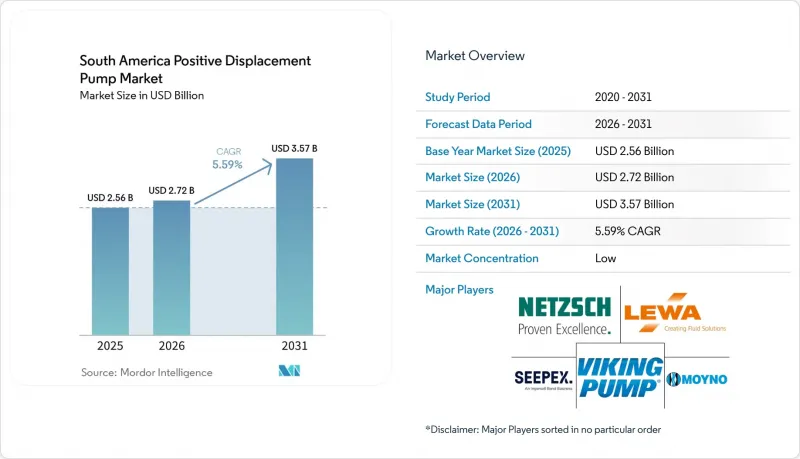
According to Mordor Intelligence, the South America positive displacement pump market size was valued at USD 2.56 billion in 2025 and estimated to grow from USD 2.72 billion in 2026 to reach USD 3.57 billion by 2031, at a CAGR of 5.59% during the forecast period (2026-2031).
South America Positive Displacement Pump Market Trends and Insights
Investment in Offshore Oil and Gas Fluid-Handling Systems
Petrobras' USD 109 billion 2026-2030 capital program includes more than USD 78 billion for upstream exploration and production, supporting demand for high-specification systems in the South America Positive Displacement Pump Market. Floating production, storage, and offloading vessels use pumps for methanol injection, chemical dosing, crude transfer, and water injection. These applications require controlled flow across changing fluid properties and operating pressures. In May 2026, Petrobras signed build-operate-transfer contracts with SBM Offshore for 2 SEAP floating production, storage, and offloading units in the Sergipe-Alagoas Basin, with investments exceeding BRL 60 billion (USD 12 billion). The units are intended to provide a combined oil production capacity of 240,000 barrels per day. Argentina's Vaca Muerta program increases demand for chemical injection, produced-water management, and fracturing-fluid transfer equipment, thereby supporting the South America Positive Displacement Pump Market.
Expansion of Water and Wastewater Infrastructure
Brazil's sanitation reform has contracted more than USD 68 billion in private investment and requires USD 8 billion in annual additional capital to achieve 99% potable-water coverage and 90% wastewater collection by 2033. Municipal systems use progressive cavity and diaphragm equipment for sludge, abrasive chemical media, and dosing duties. These duties support demand because stable flow control is important for treatment processes. Concurrent concession programs can favor suppliers already approved by major utilities, creating a practical advantage beyond product availability. New concessions, structured with development-bank support, include a multi-year installation schedule for dosing, sludge-transfer, and water-transfer equipment. This infrastructure activity provides the South America Positive Displacement Pump Market with a demand channel beyond oil and gas investment.
High Lifecycle Costs Compared with Centrifugal Alternatives
Positive displacement designs can have higher lifecycle costs than centrifugal alternatives, especially in smaller industrial and municipal installations. Progressive cavity pumps need stator maintenance, reciprocating models require valve and seat service, and diaphragm units need elastomer replacement. These expenses can direct purchasing teams toward lower-cost alternatives when fluid conditions permit. The efficiency benefit for viscous or abrasive media is not always reflected in a basic purchase-price comparison. Digital monitoring can give operators better evidence on uptime and maintenance planning. However, these systems remain more common in Brazil's offshore and larger industrial accounts, limiting their impact across the South America Positive Displacement Pump Market.
Other drivers and restraints analyzed in the detailed report include:
- Mining Slurry, Tailings, and Dewatering Requirements
- Precision Dosing in Chemicals, Food, and Pharmaceutical Industries
- Abrasive-Fluid Wear and Maintenance Downtime
For complete list of drivers and restraints, kindly check the Table Of Contents.
Segment Analysis
Rotary pumps held 54.28% of the South America Positive Displacement Pump Market share in 2025. Gear, screw, lobe, and vane designs are used for viscous crude transfer, food processing, and chemical handling. Multi-screw pumps are used in floating production, storage, and offloading fluid-handling packages because they can provide consistent flow under demanding conditions. NETZSCH commissioned its NOTOS multi-screw pump facility in Pomerode in April 2024, providing local production for units up to 1,000 kilowatts.
Reciprocating pumps are forecast to grow at a 6.37% CAGR from 2026 to 2031, making them the fastest-growing product category in the South America Positive Displacement Pump Market. Piston, plunger, and diaphragm models are used for high-pressure chemical injection, well testing, and precision dosing. Deepwater projects need methanol injection and water-injection equipment with strict flow control. Vaca Muerta development also requires equipment for fracturing-fluid management and related transfer duties. Suppliers with high-pressure test capacity and documented offshore compliance are better placed to compete for these orders.
Complete Report Scope:
- By Product Type
- Reciprocating (Piston, Plunger, and Diaphragm)
- Rotary (Gear, Screw, Lobe, and Vane)
- Peristaltic
- By Pressure Rating
- Up to 50 Bar
- 51 to 150 Bar
- Above 150 Bar
- By End-User Industry
- Oil and Gas
- Power Generation
- Water and Wastewater
- Chemicals and Petrochemicals
- Food and Beverage
- Pharmaceuticals and Biotechnology
- Mining and Minerals
- Pulp and Paper
- Other End-User Industries
- By Geography
- Brazil
- Chile
- Argentina
- Rest of South America
List of Companies Covered in this Report:
- NETZSCH Pumpen & Systeme GmbH
- SEEPEX GmbH
- LEWA GmbH
- Viking Pump, Inc.
- Moyno, Inc.
- Abel Pumps, L.P.
- PCM S.A.S.
- Verder International B.V.
- ProMinent GmbH
- Fristam Pumpen KG (GmbH & Co.)
- Wangen Pumpen GmbH
- Borger GmbH
- Roto Pumps Limited
- SANDPIPER Pump
- Tapflo AB
- Verder Liquids B.V.
- Pump Solutions Group
- Bombas Geremia Industria e Comercio Ltda.
- Industrial Flow South America LTDA
- FB Bombas Industria e Comercio Ltda.
Additional Benefits:
- The market estimate (ME) sheet in Excel format
- 3 months of analyst support
TABLE OF CONTENTS
1 INTRODUCTION
- 1.1 Study Assumptions and Market Definition
- 1.2 Scope of the Study
2 RESEARCH METHODOLOGY
3 EXECUTIVE SUMMARY
4 MARKET LANDSCAPE
- 4.1 Market Overview
- 4.2 Market Drivers
- 4.2.1 Expansion of Water and Wastewater Infrastructure
- 4.2.2 Investment in Offshore Oil and Gas Fluid-Handling Systems
- 4.2.3 Mining Slurry, Tailings, and Dewatering Requirements
- 4.2.4 Precision Dosing in the Chemicals, Food, and Pharmaceutical Industries
- 4.2.5 Industrial Localization and Reduced Import Lead Times
- 4.2.6 Lithium-Brine and Critical-Mineral Processing Pilots
- 4.3 Market Restraints
- 4.3.1 High Lifecycle Costs Compared with Centrifugal Alternatives
- 4.3.2 Abrasive-Fluid Wear and Maintenance Downtime
- 4.3.3 Currency Volatility and Delayed Capital Expenditure
- 4.3.4 Import Dependence for Advanced-Specification Equipment
- 4.4 Impact of Macroeconomic Factors on the Market
- 4.5 Industry Value Chain Analysis
- 4.6 Regulatory Landscape
- 4.7 Technological Outlook
- 4.8 Porter's Five Forces Analysis
- 4.8.1 Bargaining Power of Suppliers
- 4.8.2 Bargaining Power of Buyers
- 4.8.3 Threat of New Entrants
- 4.8.4 Threat of Substitutes
- 4.8.5 Intensity of Competitive Rivalry
5 MARKET SIZE AND GROWTH FORECASTS (VALUE)
- 5.1 By Product Type
- 5.1.1 Reciprocating (Piston, Plunger, and Diaphragm)
- 5.1.2 Rotary (Gear, Screw, Lobe, and Vane)
- 5.1.3 Peristaltic
- 5.2 By Pressure Rating
- 5.2.1 Up to 50 Bar
- 5.2.2 51 to 150 Bar
- 5.2.3 Above 150 Bar
- 5.3 By End-User Industry
- 5.3.1 Oil and Gas
- 5.3.2 Power Generation
- 5.3.3 Water and Wastewater
- 5.3.4 Chemicals and Petrochemicals
- 5.3.5 Food and Beverage
- 5.3.6 Pharmaceuticals and Biotechnology
- 5.3.7 Mining and Minerals
- 5.3.8 Pulp and Paper
- 5.3.9 Other End-User Industries
- 5.4 By Geography
- 5.4.1 Brazil
- 5.4.2 Chile
- 5.4.3 Argentina
- 5.4.4 Rest of South America
6 COMPETITIVE LANDSCAPE
- 6.1 Market Concentration
- 6.2 Strategic Moves
- 6.3 Market Share Analysis
- 6.4 Company Profiles (includes Global Level Overview, Market Level Overview, Core Segments, Financials as available, Strategic Information, Market Rank/Share, Products and Services, Recent Developments)
- 6.4.1 NETZSCH Pumpen & Systeme GmbH
- 6.4.2 SEEPEX GmbH
- 6.4.3 LEWA GmbH
- 6.4.4 Viking Pump, Inc.
- 6.4.5 Moyno, Inc.
- 6.4.6 Abel Pumps, L.P.
- 6.4.7 PCM S.A.S.
- 6.4.8 Verder International B.V.
- 6.4.9 ProMinent GmbH
- 6.4.10 Fristam Pumpen KG (GmbH & Co.)
- 6.4.11 Wangen Pumpen GmbH
- 6.4.12 Borger GmbH
- 6.4.13 Roto Pumps Limited
- 6.4.14 SANDPIPER Pump
- 6.4.15 Tapflo AB
- 6.4.16 Verder Liquids B.V.
- 6.4.17 Pump Solutions Group
- 6.4.18 Bombas Geremia Industria e Comercio Ltda.
- 6.4.19 Industrial Flow South America LTDA
- 6.4.20 FB Bombas Industria e Comercio Ltda.
7 MARKET OPPORTUNITIES AND FUTURE OUTLOOK
- 7.1 White-Space and Unmet-Need Assessment

