PUBLISHER: Mordor Intelligence | PRODUCT CODE: 2125388

PUBLISHER: Mordor Intelligence | PRODUCT CODE: 2125388
Global Pressure Relief Valves - Market Share Analysis, Industry Trends & Statistics, Growth Forecasts (2026 - 2031)
According to Mordor Intelligence, the pressure relief valves market size is expected to grow from USD 5.1 billion in 2025 to USD 5.36 billion in 2026 and is forecast to reach USD 6.84 billion by 2031 at 5.02% CAGR over 2026-2031.
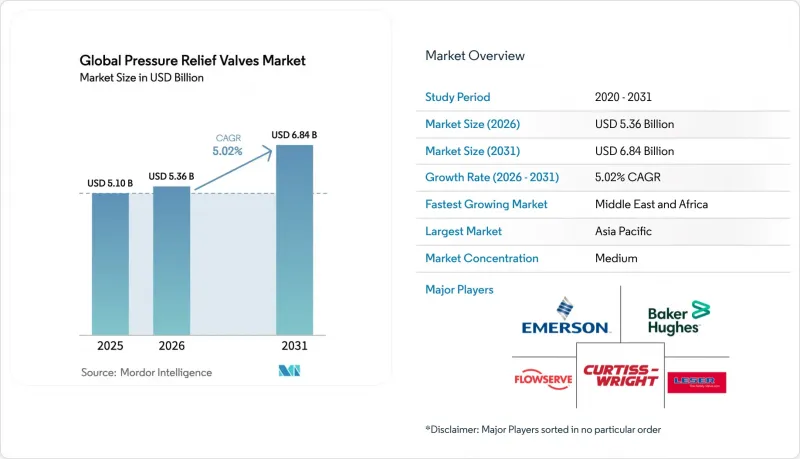
This report is Segmented by Product Type (Spring-Loaded, Pilot-Operated, and More), Valve Size (Up To 2", 2"-6", Above 6"), Set Pressure (Low, Medium, High), Material (Carbon Steel, Stainless Steel, Alloy and Exotic), End-User (Oil and Gas, Chemical, Power, Pharma, and More), and Geography. The Market Forecasts are Provided in Terms of Value (USD).
Global Pressure Relief Valves Market Trends and Insights
Rapid LNG & Hydrogen Infrastructure Expansion Demanding High-Integrity Over-Pressure Protection
Massive investment in LNG import terminals and green hydrogen projects is lifting demand for pressure relief devices engineered for cryogenic temperatures to -162 °C and for hydrogen service pressures up to 700 bar. UN Global Technical Regulation 13 obliges thermal pressure relief devices able to survive external fire while preventing tank rupture, pushing suppliers to adopt fire-resistant alloys and fast-acting discharge geometries. European Industrial Gases Association guidance also stresses accurate vent sizing and structural resilience for outdoor hydrogen stacks. Equipment such as Emerson's TESCOM HV-7000 regulator targets contamination-free operation to extend service life in 700-bar vehicle storage. As a result, the pressure relief valves market gains clear volume and value upside from these emerging energy chains.
Mandatory API 526/ASME Compliance in North America & EU Process Industries
The 2025 ASME BPVC removes the two-class vessel system and revises Appendix 47, raising design scrutiny for pressure equipment and reinforcing demand for code-certified valves. API 526 standardizes orifice sizes and center-to-face dimensions, easing retrofit but tightening acceptance criteria. Studies show that up to 85% of valve performance issues link to deviations from prescribed sizing, installation, or maintenance, placing new emphasis on OEM-led training and support. Pressure Equipment Directive 2014/68/EU requires each device above 0.5 bar to pass conformity assessment by notified bodies, leading to longer lead times yet driving preference for suppliers with in-house compliance teams.
Margin Squeeze from Proliferation of Low-Cost Asian Valve OEMs
Asian suppliers now produce API- and ASME-compliant pressure relief valves at lower cost, compressing margins for incumbents. To stay competitive, Western brands emphasize advanced materials, predictive diagnostics, and full life-cycle support that low-price entrants struggle to match. Price pressure is most acute in commodity low-pressure applications, whereas nuclear, aerospace, and severe-service hydrogen duties still reward premium engineering.
Other drivers and restraints analyzed in the detailed report include:
- Brownfield Revamps of Aging Refining Assets Across Middle East Elevating Valve Replacement Cycles
- Growth of Smart Manufacturing Driving Demand for Digital-Enabled Safety Valves (HART, IIoT)
- Substitution by Rupture Discs in Single-Use Bioprocessing Skids
For complete list of drivers and restraints, kindly check the Table Of Contents.
Segment Analysis
Spring-loaded valves retained the largest position with 46.55% share in 2025, reflecting decades of installed equipment across pressure bands from 4 psig to 6,250 psig and temperatures down to -450 °F. Cost-effective construction, simple maintenance, and high availability keep demand stable across refineries, chemical plants, and power boilers. Pilot-operated units are forecast to grow 7.44% CAGR as operators prioritize tighter leakage control and larger capacity within compact footprints. Feature sets such as remote sense lines and modulating disc action align with digital pressures for lower methane emissions and improved process efficiency, reinforcing their uptake in the pressure relief valves market.
Baker Hughes' Consolidated Type 2900 platform exemplifies hybrid flexibility, permitting field conversion between modes to suit changing process conditions. Niche devices-dead-weight, buckling pin, and balanced bellows-address custody transfer, tamper-proof calibration, or back-pressure mitigation, yet their aggregate volume remains modest. Suppliers therefore steer R&D toward pilot-operated enhancements and smart actuator integration where incremental performance justifies premium pricing.
Medium size (2"-6") valves contributed 41.02% revenue in 2025, covering mainstream flow demands in oil, chemical, and power plants. However, the large-bore segment above 6" is projected to rise at 7.74% CAGR to 2031 as LNG terminals, gas pipelines, and mega-scale hydrogen hubs command greater discharge areas for credible relief. Emerson's Fisher EZR series spans bodies up to NPS 8 with 1,050 psig inlet rating, marrying high capacity with fine pressure control.
Engineering challenges scale rapidly with diameter: weight, nozzle reaction forces, and noise require special attention, and only vendors with extensive foundry and test capacity can compete. Small valves under 2" persist in laboratory, instrumentation, and pharmaceutical skids where space, cleanliness, and accurate low-flow performance overrule volume throughput.
Complete Report Scope:
- By Product Type
- Spring-Loaded
- Pilot-Operated
- Dead-Weight
- Buckling Pin
- Balanced Bellows
- By Valve Size (Inch)
- Up to 2 inch
- 2 inch - 6 inch
- Above 6 inch
- By Set Pressure
- Low (less than 150 psi)
- Medium (15 - 600 psi)
- High (greater than 600 psi)
- By Material
- Carbon Steel
- Stainless Steel
- Alloy and Exotic
- By End-User
- Oil and Gas (Upstream, Midstream, Downstream)
- Chemical and Petrochemical
- Power Generation (Thermal, Nuclear, Renewables-Hydrogen)
- Pulp and Paper
- Food and Beverage
- Pharmaceuticals and Biotech
- Water and Waste-Water
- By Geography
- North America
- United States
- Canada
- Mexico
- Europe
- United Kingdom
- Germany
- France
- Italy
- Rest of Europe
- Asia-Pacific
- China
- Japan
- India
- South Korea
- Rest of Asia
- Middle East
- Israel
- Saudi Arabia
- United Arab Emirates
- Turkey
- Rest of Middle East
- Africa
- South Africa
- Egypt
- Rest of Africa
- South America
- Brazil
- Argentina
- Rest of South America
- North America
Geography Analysis
Asia-Pacific generated 34.18% of global revenue in 2025 and remains the cornerstone of volume growth. Chinese and Indian investments in hydrogen, LNG import, and bulk pharmaceutical production give local assemblers scale while drawing in Western OEM technology under license. Japan and South Korea add demand from advanced chemical and nuclear sectors that require high purity and seismic-qualified safety valves. Local certification schemes converge with API and ASME, easing export of Asia-fabricated devices and expanding the regional pressure relief valves market.
The Middle East exhibits the quickest 7.22% CAGR through 2031 as brownfield refinery overhauls underpin large, lump-sum valve replacement programs. Saudi-led mega-refining projects and the UAE's diversification into petrochemicals widen the call for high-capacity, high-temperature safety devices. Regional governments also back green hydrogen export hubs, further expanding high-pressure valve demand. North America maintains steady expansion based on stringent OSHA and EPA compliance, plus shale gas midstream infrastructure upgrades. Europe emphasizes PED conformity and decarbonization, encouraging adoption of valves compatible with hydrogen and carbon-capture media. Latin America delivers episodic project awards in refining and mining, while Africa offers early-stage opportunities tied to LNG export terminals. Across all geographies, digital monitoring and predictive maintenance features increasingly factor into procurement decisions, reinforcing technology differentiation in the pressure relief valves market.
- Emerson Electric Co.
- Baker Hughes Company
- Curtiss-Wright Corp.
- LESER GmbH and Co. KG
- IMI plc
- Flowserve Corporation
- General Electric (Baker Hughes collaboration)
- Alfa Laval AB
- Watts Water Technologies, Inc.
- Weir Group Plc
- Pentair plc
- Spirax-Sarco Engineering plc
- Robertshaw Industrial Products
- Goetze KG Armaturen
- AGF Manufacturing, Inc.
- ValvTechnologies Inc.
- Mercer Valve Co.
- Mack Valves Pty Ltd
- Mercer Industries (PressureGuard)
- Audco India Ltd (LandT Valves)
- Jiangsu Shuangda Pump and Valve Group
Additional Benefits:
- The market estimate (ME) sheet in Excel format
- 3 months of analyst support
TABLE OF CONTENTS
1 INTRODUCTION
- 1.1 Study Assumptions and Market Definition
- 1.2 Scope of the Study
2 RESEARCH METHODOLOGY
3 EXECUTIVE SUMMARY
4 MARKET LANDSCAPE
- 4.1 Market Overview
- 4.2 Market Drivers
- 4.2.1 Rapid LNG and Hydrogen Infrastructure Expansion Demanding High-Integrity Over-Pressure Protection
- 4.2.2 Mandatory API 526/ASME Compliance in North America and EU Process Industries
- 4.2.3 Brownfield Revamps of Ageing Refining Assets Across Middle East Elevating Valve Replacement Cycles
- 4.2.4 Growth of Smart Manufacturing Driving Dem of Ageing Refining Assets Across Middle East Elevating Valve Replacement Cyclesand for Digital-Enabled Safety Valves (HART, IIoT)
- 4.2.5 Nuclear Power Plant Modernization and Safety Upgrades Requiring Advanced Pressure Relief Systems
- 4.2.6 Accelerating Pharmaceutical Capacity Adds in India and China Requiring Sanitary PRVs
- 4.3 Market Restraints
- 4.3.1 Margin Squeeze from Proliferation of Low-Cost Asian Valve OEMs
- 4.3.2 Substitution by Rupture Discs in Single-Use Bioprocessing Skids
- 4.3.3 Volatile Nickel and Stainless-Steel Prices Disrupting Cost Structures
- 4.3.4 Extended Certification Lead-Times (PED, CRN) Delaying Project Awards
- 4.4 Value / Supply-Chain Analysis
- 4.5 Regulatory and Technological Outlook
- 4.5.1 Global Regulatory Map (ASME, API 520/521, PED 2014/68/EU, ISO 4126, KOSHA)
- 4.5.2 Smart and Connected PRVs - Sensors, Predictive Maintenance and Digital Twins
- 4.6 Porter's Five Forces Analysis
- 4.6.1 Bargaining Power of Suppliers
- 4.6.2 Bargaining Power of Buyers
- 4.6.3 Threat of New Entrants
- 4.6.4 Threat of Substitutes
- 4.6.5 Competitive Rivalry
5 MARKET SIZE AND GROWTH FORECASTS (VALUE)
- 5.1 By Product Type
- 5.1.1 Spring-Loaded
- 5.1.2 Pilot-Operated
- 5.1.3 Dead-Weight
- 5.1.4 Buckling Pin
- 5.1.5 Balanced Bellows
- 5.2 By Valve Size (Inch)
- 5.2.1 Up to 2 inch
- 5.2.2 2 inch - 6 inch
- 5.2.3 Above 6 inch
- 5.3 By Set Pressure
- 5.3.1 Low (less than 150 psi)
- 5.3.2 Medium (15 - 600 psi)
- 5.3.3 High (greater than 600 psi)
- 5.4 By Material
- 5.4.1 Carbon Steel
- 5.4.2 Stainless Steel
- 5.4.3 Alloy and Exotic
- 5.5 By End-User
- 5.5.1 Oil and Gas (Upstream, Midstream, Downstream)
- 5.5.2 Chemical and Petrochemical
- 5.5.3 Power Generation (Thermal, Nuclear, Renewables-Hydrogen)
- 5.5.4 Pulp and Paper
- 5.5.5 Food and Beverage
- 5.5.6 Pharmaceuticals and Biotech
- 5.5.7 Water and Waste-Water
- 5.6 By Geography
- 5.6.1 North America
- 5.6.1.1 United States
- 5.6.1.2 Canada
- 5.6.1.3 Mexico
- 5.6.2 Europe
- 5.6.2.1 United Kingdom
- 5.6.2.2 Germany
- 5.6.2.3 France
- 5.6.2.4 Italy
- 5.6.2.5 Rest of Europe
- 5.6.3 Asia-Pacific
- 5.6.3.1 China
- 5.6.3.2 Japan
- 5.6.3.3 India
- 5.6.3.4 South Korea
- 5.6.3.5 Rest of Asia
- 5.6.4 Middle East
- 5.6.4.1 Israel
- 5.6.4.2 Saudi Arabia
- 5.6.4.3 United Arab Emirates
- 5.6.4.4 Turkey
- 5.6.4.5 Rest of Middle East
- 5.6.5 Africa
- 5.6.5.1 South Africa
- 5.6.5.2 Egypt
- 5.6.5.3 Rest of Africa
- 5.6.6 South America
- 5.6.6.1 Brazil
- 5.6.6.2 Argentina
- 5.6.6.3 Rest of South America
- 5.6.1 North America
6 COMPETITIVE LANDSCAPE
- 6.1 Market Concentration
- 6.2 Strategic Moves
- 6.3 Market Share Analysis
- 6.4 Company Profiles (includes Global level Overview, Market level overview, Core Segments, Financials as available, Strategic Information, Market Rank/Share for key companies, Products and Services, and Recent Developments)
- 6.4.1 Emerson Electric Co.
- 6.4.2 Baker Hughes Company
- 6.4.3 Curtiss-Wright Corp.
- 6.4.4 LESER GmbH and Co. KG
- 6.4.5 IMI plc
- 6.4.6 Flowserve Corporation
- 6.4.7 General Electric (Baker Hughes collaboration)
- 6.4.8 Alfa Laval AB
- 6.4.9 Watts Water Technologies, Inc.
- 6.4.10 Weir Group Plc
- 6.4.11 Pentair plc
- 6.4.12 Spirax-Sarco Engineering plc
- 6.4.13 Robertshaw Industrial Products
- 6.4.14 Goetze KG Armaturen
- 6.4.15 AGF Manufacturing, Inc.
- 6.4.16 ValvTechnologies Inc.
- 6.4.17 Mercer Valve Co.
- 6.4.18 Mack Valves Pty Ltd
- 6.4.19 Mercer Industries (PressureGuard)
- 6.4.20 Audco India Ltd (LandT Valves)
- 6.4.21 Jiangsu Shuangda Pump and Valve Group
7 MARKET OPPORTUNITIES AND FUTURE OUTLOOK
- 7.1 White-Space and Unmet-Need Assessment

