PUBLISHER: Mordor Intelligence | PRODUCT CODE: 2125390

PUBLISHER: Mordor Intelligence | PRODUCT CODE: 2125390
United States Lawn Care - Market Share Analysis, Industry Trends & Statistics, Growth Forecasts (2026 - 2031)
According to Mordor Intelligence, the United States lawn care market size was valued at USD 60.0 billion in 2025 and estimated to grow from USD 62.91 billion in 2026 to reach USD 79.68 billion by 2031, at a CAGR of 4.85% during the forecast period (2026-2031).
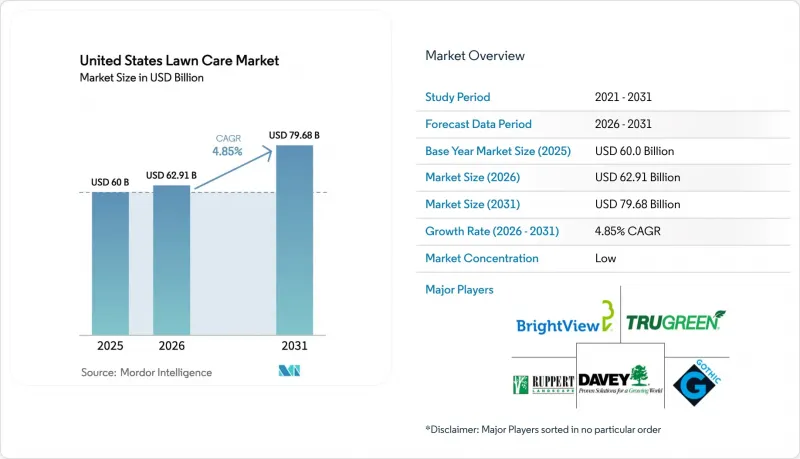
This report is Segmented by Service Type (Maintenance Services and Ancillary Services), by Application (Residential, Commercial, and Industrial, and More), by Business Model (Subscription Contracts and One-Off / On-Demand Visits), and by Distribution Channel (Direct In-House Teams, and More). The Market Forecasts are Provided in Terms of Value (USD).
United States Lawn Care Market Trends and Insights
Ongoing Migration to Sun Belt States Increasing Lawn Footprints
The southern United States gained 1.8 million new residents in 2024, marking the region's fastest population growth in over two decades. This demographic shift generates increased demand for lawn care services through new residential construction, retail developments, and municipal projects. The expansion of commercial facilities, including corporate campuses and logistics centers, further strengthens market growth by requiring comprehensive grounds maintenance in regions with year-round growing seasons. Service providers operating in Texas, Florida, and adjacent growth markets benefit from sustained revenue opportunities linked to population expansion and employment growth. Infrastructure development in Sun Belt metropolitan areas requires landscaping services for government projects, business complexes, and mixed-use properties.
Growth in Golf Course Renovations and New Short-Course Formats
Golf course renovation projects and entertainment venues require specialized turf design, precise mowing specifications, and premium hardscape elements. Golf operators focus on attracting younger players through short courses and entertainment facilities that combine visually appealing landscapes with high-maintenance requirements. The Hermann Park Golf Course plans a USD 30 million renovation in August 2025, led by the Astros Golf Foundation. The project aims to enhance community facilities, expand the driving range to increase revenue, install a stormwater recapture and irrigation system, and construct a new clubhouse. Short courses and entertainment venues incorporate extensive landscaping features, including decorative components, lighting systems, and specialized turf varieties that need regular professional maintenance. This market segment enables landscaping companies to develop technical expertise and secure premium projects that set them apart from standard maintenance service providers.
Acute Seasonal Labor Shortages Despite H-2B Visa Caps Increases
Despite the approval of 64,716 additional visas for 2025, the demand for seasonal workers exceeds 200,000 positions, resulting in understaffing during peak growth periods. Small operators with limited administrative resources struggle to navigate visa processes, forcing them to either restrict service expansion or increase wages at the expense of profit margins. Processing delays affect scheduling, increase customer turnover risk, and push larger companies toward automation investments. The labor shortage compels businesses to constrain service growth, raise wages for domestic worker recruitment, and implement labor-saving technologies that require significant capital investment.
Other drivers and restraints analyzed in the detailed report include:
- DIY-Turned-DIWM (Do-It-With-Me) Consumer Trend
- Rapid Adoption of Robotic and Autonomous Mowing Equipment
- Escalating Fuel and Equipment Costs Squeezing Margins
For complete list of drivers and restraints, kindly check the Table Of Contents.
Segment Analysis
Maintenance services accounted for 91.55% of the United States lawn care market share in 2025, providing stable recurring revenue through residential and commercial client contracts. Subscription-based service packages combining mowing, fertilization, weed control, aeration, and irrigation maintenance help companies reduce customer acquisition costs while improving route efficiency. The segment's high margins, particularly in fertilization and weed control services, stem from specialized chemical expertise and licensing requirements that create entry barriers. Regular mowing services provide frequent customer contact opportunities, enabling providers to expand revenue through seasonal plantings and hardscape maintenance. The growing adoption of smart irrigation controllers that optimize water usage and detect system issues aligns with environmental sustainability requirements. The maintenance segment is projected to grow at a CAGR of 5.18% during 2026-2031, driven by increased professional service outsourcing, demographic shifts, and technological improvements in service delivery.
Ancillary services demonstrate accelerated growth as residential customers seek enhanced outdoor living features, including fire pit installations, landscape lighting, and pollinator gardens. This service diversification helps providers reduce seasonal revenue fluctuations and offset increased labor costs, supporting the expansion of comprehensive service providers.
Commercial and industrial sites contributed 53.72% of the United States lawn care market share in 2025, as organizations outsource grounds maintenance to focus on their primary operations. Multi-property portfolios prefer service providers who offer standardized maintenance levels, sustainable landscaping, and Environmental, Social, and Governance (ESG)- aligned performance reporting. Golf courses and sports facilities, though a smaller market segment, are projected to grow at a 10.05% CAGR through 2031, driven by new entertainment formats and facility renovations targeting younger demographics. These properties require specialized turf management, precise maintenance, and integrated lighting systems, enabling premium pricing and long-term contracts.
The residential segment maintains steady demand, with millennials viewing lawn care services as a fundamental household expense similar to cleaning services. This market diversification helps service providers maintain stability during economic fluctuations. Municipal contracts provide consistent revenue but involve public bidding processes and wage requirements that may reduce profit margins compared to private sector work.
Complete Report Scope:
- By Service Type
- Maintenance Services
- Mowing
- Fertilization and Weed Control
- Irrigation System Maintenance
- Pest Control
- Ancillary Services
- Landscape Design and Installation
- Hardscaping Services
- Snow Removal
- Maintenance Services
- By Application
- Residential
- Commercial and Industrial
- Golf Courses and Sports Facilities
- Municipal and Government
- By Business Model
- Subscription Contracts
- One-Off / On-Demand Visits
- By Distribution Channel
- Direct In-House Teams
- Franchise Network
- Online Marketplaces
List of Companies Covered in this Report:
- BrightView Holdings, Inc.
- TruGreen Limited Partnership
- The Davey Tree Expert Company
- Yellowstone Landscape, Inc.(Harvest Partners, LP)
- Gothic Landscaping Inc.
- Park West Inc.
- Ruppert Landscape Inc. (Knox Lane LP)
- LandCare USA LLC
- HeartLand LLC (Pritzker Private Capital)
- SavATree, Inc.(Apax Partners LLP)
- Spring-Green Lawn Care Corp. (Spring-Green Enterprises Inc.)
- Landscape Development, Inc.
- Schill Grounds Maintenance, Inc. (Argonne Capital Group)
- Augusta Lawn Care Services, LLC
- Gibbs Landscape Company
Additional Benefits:
- The market estimate (ME) sheet in Excel format
- 3 months of analyst support
TABLE OF CONTENTS
1 Introduction
- 1.1 Study Assumptions and Market Definition
- 1.2 Scope of the Study
2 Research Methodology
3 Executive Summary
4 Market Landscape
- 4.1 Market Overview
- 4.2 Market Drivers
- 4.2.1 Ongoing Migration to Sun-Belt States Increasing Lawn Footprints
- 4.2.2 Growth in Golf Course Renovations and New Short-Course Formats
- 4.2.3 DIY-Turned-DIWM (Do-It-With-Me) Consumer Trend
- 4.2.4 Rapid Adoption of Robotic and Autonomous Mowing Equipment
- 4.2.5 Rising Millennial Home-Ownership and Outdoor Living Upgrades
- 4.2.6 Landscaping Tax Incentives in Water-Stressed Municipalities
- 4.3 Market Restraints
- 4.3.1 Acute Seasonal Labor Shortages Despite H-2B Visa Cap Increases
- 4.3.2 Escalating Fuel and Equipment Costs Squeezing Margins
- 4.3.3 Rising Liability Insurance Premiums for Contractors
- 4.3.4 Fragmented Regulatory Codes Across States Inflating Compliance Cost
- 4.4 Regulatory Landscape
- 4.5 Technological Outlook
- 4.6 Porter's Five Forces Analysis
- 4.6.1 Bargaining Power of Suppliers
- 4.6.2 Bargaining Power of Buyers
- 4.6.3 Threat of New Entrants
- 4.6.4 Threat of Substitute Products
- 4.6.5 Intensity of Competitive Rivalry
5 Market Size and Growth Forecasts (Value)
- 5.1 By Service Type
- 5.1.1 Maintenance Services
- 5.1.1.1 Mowing
- 5.1.1.2 Fertilization and Weed Control
- 5.1.1.3 Irrigation System Maintenance
- 5.1.1.4 Pest Control
- 5.1.2 Ancillary Services
- 5.1.2.1 Landscape Design and Installation
- 5.1.2.2 Hardscaping Services
- 5.1.2.3 Snow Removal
- 5.1.1 Maintenance Services
- 5.2 By Application
- 5.2.1 Residential
- 5.2.2 Commercial and Industrial
- 5.2.3 Golf Courses and Sports Facilities
- 5.2.4 Municipal and Government
- 5.3 By Business Model
- 5.3.1 Subscription Contracts
- 5.3.2 One-Off / On-Demand Visits
- 5.4 By Distribution Channel
- 5.4.1 Direct In-House Teams
- 5.4.2 Franchise Network
- 5.4.3 Online Marketplaces
6 Competitive Landscape
- 6.1 Market Concentration
- 6.2 Strategic Moves
- 6.3 Market Share Analysis
- 6.4 Company Profiles (Includes Global level Overview, Market Level Overview, Core Segments, Financials as Available, Strategic Information, Market Rank/Share for Key Companies, Products and Services, and Recent Developments)
- 6.4.1 BrightView Holdings, Inc.
- 6.4.2 TruGreen Limited Partnership
- 6.4.3 The Davey Tree Expert Company
- 6.4.4 Yellowstone Landscape, Inc.(Harvest Partners, LP)
- 6.4.5 Gothic Landscaping Inc.
- 6.4.6 Park West Inc.
- 6.4.7 Ruppert Landscape Inc. (Knox Lane LP)
- 6.4.8 LandCare USA LLC
- 6.4.9 HeartLand LLC (Pritzker Private Capital)
- 6.4.10 SavATree, Inc.(Apax Partners LLP)
- 6.4.11 Spring-Green Lawn Care Corp. (Spring-Green Enterprises Inc.)
- 6.4.12 Landscape Development, Inc.
- 6.4.13 Schill Grounds Maintenance, Inc. (Argonne Capital Group)
- 6.4.14 Augusta Lawn Care Services, LLC
- 6.4.15 Gibbs Landscape Company
7 Market Opportunities and Future Outlook

