PUBLISHER: Mordor Intelligence | PRODUCT CODE: 2125435

PUBLISHER: Mordor Intelligence | PRODUCT CODE: 2125435
Thailand Packaging - Market Share Analysis, Industry Trends & Statistics, Growth Forecasts (2026 - 2031)
According to Mordor Intelligence, the Thailand packaging market size was valued at USD 15.68 billion in 2025 and is estimated to grow from USD 16.4 billion in 2026 to reach USD 20.34 billion by 2031, at a CAGR of 4.4% during the forecast period (2026-2031).
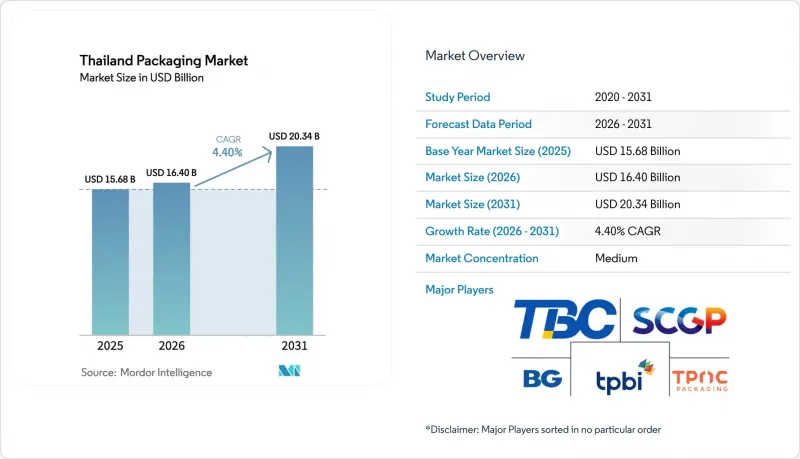
This report is Segmented by Material Type (Paper and Paperboard, Plastic, Metal, and Container Glass), Product Type (Paper and Paperboard Product, Plastic Product, Metal Product, and Container Glass Product), Packaging Format (Rigid, and Flexible), End-User Industry (Food, Beverage, Pharmaceutical and Medical, and More), and Geography. The Market Forecasts are Provided in Terms of Value (USD).
Thailand Packaging Market Trends and Insights
Rising Food and Beverage Output
Thailand shipped USD 32.8 billion worth of food products in 2024, a performance that lifts packaging demand because shelf-stable exports need multilayer barrier films that preserve flavour during long transit. Capacity-utilization in domestic food factories climbed to 78% in 2025, sustaining orders for corrugated shippers, stand-up pouches, and aseptic cartons. Hotels, restaurants, and institutional buyers spent USD 35.4 billion in 2025 as tourism rebounded, strengthening local pull for ready-to-eat meal kits that rely on microwaveable trays. The dual export-domestic engine allows converters to transfer resin cost swings into pricing without volume loss. Consequently, rising food throughput is expected to add 1.2 percentage points to the Thailand packaging market CAGR between 2026 and 2031.
Growth Of E-Commerce and Parcel Volumes
Courier leader Kerry Express handled 7 million-8 million parcels daily during 2025, reflecting a double-digit volume climb since 2022. Each parcel uses a polyethylene mailer or corrugated box, and the shift toward same-day service favours pre-formed, lightweight solutions that shorten pack-to-ship cycles. National gross-merchandise value touched THB 100 billion (USD 2.9 billion) in 2025, with fashion and health-and-beauty goods recording the highest reorder rates. Parcel carriers now request recyclable or biodegradable mailers to meet corporate climate pledges, spurring demand for paper-based bubble mailers and compostable air pillows. As the last-mile network saturates Bangkok and expands to provincial hubs, e-commerce will continue to contribute about 1 percentage point to market growth through 2028.
Single-Use-Plastic Bans and Eco Taxes
A nationwide prohibition on oxo-degradable bags, polystyrene food boxes, and plastic straws took effect on 1 January 2025, with fines up to THB 100,000 (USD 2,857) per infraction. Retailers pivoted to paper straws and bagasse containers that cost 20%-40% more, squeezing food-service margins. The ban removed roughly 50,000 metric tons of annual polystyrene demand, forcing extruders to idle lines or retool toward polypropylene. Planned eco-tax surcharges of THB 2-THB 5 per kilogram (USD 0.06-USD 0.14) on virgin resin could deepen the cost burden. Combined, these factors shave 0.6 percentage points from the Thailand packaging market CAGR in the near term.
Other drivers and restraints analyzed in the detailed report include:
- Demand For Convenient and Flexible Packs
- Sustainability And Circular-Economy Mandates
- Volatile Petrochemical Resin Prices
For complete list of drivers and restraints, kindly check the Table Of Contents.
Segment Analysis
Plastic captured 42.18% of value in 2025, yet recycled PET is racing ahead at a 4.92% CAGR, underlining the pivot to circular feedstock as global brands chase 25%-50% post-consumer-resin targets. The Thailand packaging market size for rPET bottles alone is projected to grow faster than virgin equivalents because Indorama Ventures commissioned a 50,000 metric-ton food-grade line in late 2025. Polypropylene and high-density polyethylene grow in the low-4% range but face eco-tax headwinds, while polystyrene demand collapsed post-ban.
Paper and paperboard represented about 28% of 2025 value, buoyed by 5.2% output growth at domestic mills that meet surging e-commerce box orders. Metal held 18%, its advance tied to Thai Beverage Can and Ball Corporation investments in lightweight aluminium technology. Glass followed at 12%, with BG Container Glass banking on furnace-upgrade efficiencies but conceding share to lighter PET bottles. Altogether, material dynamics demonstrate how sustainability premiums and logistics economics reshape the Thailand packaging market.
Bags accounted for 28.24% of 2025 revenue, yet pouches grow quicker at 5.01% as consumers favour resealable, shelf-standing formats. The Thailand packaging market share for pouches benefits from 12%-15% converter margins, higher than commodity bag lines, because of zipper and spout features. Films and wraps rise 4.7% thanks to export palletization and greenhouse farming in the Eastern Economic Corridor.
Rigid plastics bottles, jars, and caps collectively post a 4.2% CAGR, aided by beverage and personal-care demand. Tethered caps add USD 0.01-USD 0.02 each yet prevent littering and meet forthcoming EPR rules. Corrugated boxes, folding cartons, and molded-fiber takeaway packs round out paper products, leveraging the January 2025 foam ban to win food-service contracts. The product landscape signals a continuing tilt toward value-added formats within the Thailand packaging market.
Complete Report Scope:
- By Material Type
- Paper and Paperboard
- Plastic
- Polypropylene (PP)
- HDPE and LDPE
- PET
- PVC
- PS
- Other Plastics
- Metal
- Container Glass
- By Product Type
- Paper and Paperboard Product
- Folding Carton and Rigid Boxes
- Corrugated Boxes and Containers
- Single-Use Paper Products
- Other Paper and Paperboard Types
- Plastic Product
- Rigid Plastics
- Bottles and Jars
- Caps and Closures
- Bulk-Grade Products
- Other Rigid Plastics
- Flexible Plastics
- Pouches
- Bags
- Films and Wraps
- Other Flexible Plastics
- Rigid Plastics
- Metal Product
- Cans
- Caps and Closures
- Aerosol Containers
- Other Metal Products
- Container Glass Product
- Bottles
- Jars
- Paper and Paperboard Product
- By Packaging Format
- Rigid Packaging Format
- Flexible Packaging Format
- By End-User Industry
- Food
- Beverage
- Pharmaceutical and Medical
- Personal Care and Cosmetics
- Industrial and Chemical
- Agriculture
- Automotive
- Other End-User Industries
List of Companies Covered in this Report:
- SCG Packaging Public Co. Ltd
- BG Container Glass Public Co. Ltd
- TPAC Packaging Public Co. Ltd
- Thai Beverage Can Co. Ltd
- TBPI Public Co. Ltd
- Eastern Polypack Co. Ltd
- Huhtamaki Oyj
- Amcor plc
- Sealed Air Corporation
- TOPPAN Inc.
- Thai Packaging Industry PCL
- Berli Jucker Public Company Limited
- Ball Corporation
- Crown Holdings, Inc.
- Alpla Werke Alwin Lehner GmbH & Co KG
- Oji Packaging (Thailand) Ltd
- Siam Toppan Packaging Co. Ltd
- Thai Cane Paper Public Co. Ltd
- DNP Asia Co. Ltd
- Printpack Asia Ltd
Additional Benefits:
- The market estimate (ME) sheet in Excel format
- 3 months of analyst support
TABLE OF CONTENTS
1 INTRODUCTION
- 1.1 Study Assumptions and Market Definition
- 1.2 Scope of the Study
2 RESEARCH METHODOLOGY
3 EXECUTIVE SUMMARY
4 MARKET LANDSCAPE
- 4.1 Market Overview
- 4.2 Market Drivers
- 4.2.1 Rising Food and Beverage Output
- 4.2.2 Growth of E-commerce and Parcel Volumes
- 4.2.3 Demand for Convenient and Flexible Packs
- 4.2.4 Sustainability and Circular-Economy Mandates
- 4.2.5 BOI Incentives for Packaging Automation
- 4.2.6 Cannabis-Infused Food and Beverage Requires Child-Safe Packs
- 4.3 Market Restraints
- 4.3.1 Single-Use-Plastic Bans and Eco Taxes
- 4.3.2 Volatile Petrochemical Resin Prices
- 4.3.3 Shortage of Food-Grade rPET Feedstock
- 4.3.4 Low-Cost Import Competition From Vietnam and China
- 4.4 Impact of Macroeconomic Factors on the Market
- 4.5 Industry Value-Chain Analysis
- 4.6 Regulatory Landscape
- 4.7 Technological Outlook
- 4.8 Porter's Five Forces Analysis
- 4.8.1 Bargaining Power of Suppliers
- 4.8.2 Bargaining Power of Buyers
- 4.8.3 Threat of New Entrants
- 4.8.4 Threat of Substitutes
- 4.8.5 Competitive Rivalry
5 MARKET SIZE AND GROWTH FORECASTS (VALUE)
- 5.1 By Material Type
- 5.1.1 Paper and Paperboard
- 5.1.2 Plastic
- 5.1.2.1 Polypropylene (PP)
- 5.1.2.2 HDPE and LDPE
- 5.1.2.3 PET
- 5.1.2.4 PVC
- 5.1.2.5 PS
- 5.1.2.6 Other Plastics
- 5.1.3 Metal
- 5.1.4 Container Glass
- 5.2 By Product Type
- 5.2.1 Paper and Paperboard Product
- 5.2.1.1 Folding Carton and Rigid Boxes
- 5.2.1.2 Corrugated Boxes and Containers
- 5.2.1.3 Single-Use Paper Products
- 5.2.1.4 Other Paper and Paperboard Types
- 5.2.2 Plastic Product
- 5.2.2.1 Rigid Plastics
- 5.2.2.1.1 Bottles and Jars
- 5.2.2.1.2 Caps and Closures
- 5.2.2.1.3 Bulk-Grade Products
- 5.2.2.1.4 Other Rigid Plastics
- 5.2.2.2 Flexible Plastics
- 5.2.2.2.1 Pouches
- 5.2.2.2.2 Bags
- 5.2.2.2.3 Films and Wraps
- 5.2.2.2.4 Other Flexible Plastics
- 5.2.2.1 Rigid Plastics
- 5.2.3 Metal Product
- 5.2.3.1 Cans
- 5.2.3.2 Caps and Closures
- 5.2.3.3 Aerosol Containers
- 5.2.3.4 Other Metal Products
- 5.2.4 Container Glass Product
- 5.2.4.1 Bottles
- 5.2.4.2 Jars
- 5.2.1 Paper and Paperboard Product
- 5.3 By Packaging Format
- 5.3.1 Rigid Packaging Format
- 5.3.2 Flexible Packaging Format
- 5.4 By End-User Industry
- 5.4.1 Food
- 5.4.2 Beverage
- 5.4.3 Pharmaceutical and Medical
- 5.4.4 Personal Care and Cosmetics
- 5.4.5 Industrial and Chemical
- 5.4.6 Agriculture
- 5.4.7 Automotive
- 5.4.8 Other End-User Industries
6 COMPETITIVE LANDSCAPE
- 6.1 Market Concentration
- 6.2 Strategic Moves
- 6.3 Market Share Analysis
- 6.4 Company Profiles (includes Global Level Overview, Market Level Overview, Core Segments, Financials as available, Strategic Information, Market Rank/Share, Products and Services, Recent Developments)
- 6.4.1 SCG Packaging Public Co. Ltd
- 6.4.2 BG Container Glass Public Co. Ltd
- 6.4.3 TPAC Packaging Public Co. Ltd
- 6.4.4 Thai Beverage Can Co. Ltd
- 6.4.5 TBPI Public Co. Ltd
- 6.4.6 Eastern Polypack Co. Ltd
- 6.4.7 Huhtamaki Oyj
- 6.4.8 Amcor plc
- 6.4.9 Sealed Air Corporation
- 6.4.10 TOPPAN Inc.
- 6.4.11 Thai Packaging Industry PCL
- 6.4.12 Berli Jucker Public Company Limited
- 6.4.13 Ball Corporation
- 6.4.14 Crown Holdings, Inc.
- 6.4.15 Alpla Werke Alwin Lehner GmbH & Co KG
- 6.4.16 Oji Packaging (Thailand) Ltd
- 6.4.17 Siam Toppan Packaging Co. Ltd
- 6.4.18 Thai Cane Paper Public Co. Ltd
- 6.4.19 DNP Asia Co. Ltd
- 6.4.20 Printpack Asia Ltd
7 MARKET OPPORTUNITIES AND FUTURE OUTLOOK
- 7.1 White-Space and Unmet-Need Assessment

