PUBLISHER: Mordor Intelligence | PRODUCT CODE: 2125491

PUBLISHER: Mordor Intelligence | PRODUCT CODE: 2125491
Offshore Oilfield Services - Market Share Analysis, Industry Trends & Statistics, Growth Forecasts (2026 - 2031)
According to Mordor Intelligence, offshore oilfield services market size in 2026 is estimated at USD 45.46 billion, growing from 2025 value of USD 42.57 billion with 2031 projections showing USD 63.13 billion, growing at 6.78% CAGR over 2026-2031.
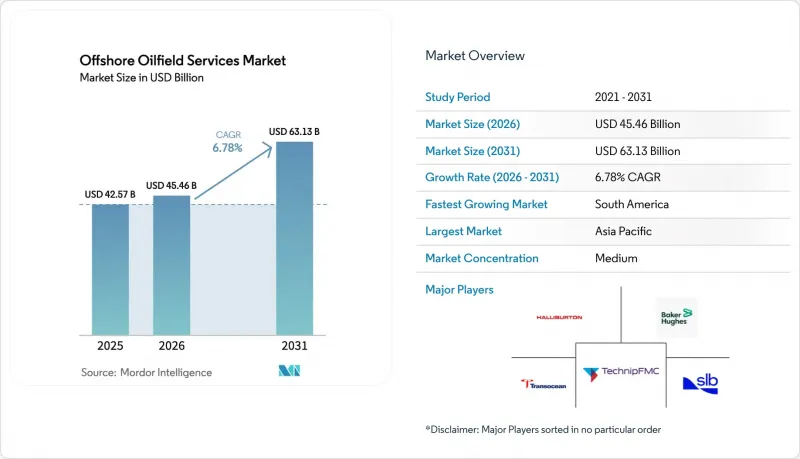
This report is Segmented by Service Type (Drilling Services, Completion Services, Production and Intervention Services, and Other Services), Water Depth (Shallow Water, Deepwater, and Ultra-Deepwater), and Geography (North America, Europe, Asia-Pacific, South America, and Middle East and Africa). The Market Sizes and Forecasts are Provided in Terms of Value (USD).
Global Offshore Oilfield Services Market Trends and Insights
Up-cycle in Deep- & Ultra-Deepwater Drilling Commitments
Drillship utilisation is on track to hit 97% in 2025, a sharp reversal from the lows of 2020, as projects such as SLB's USD 800 million Trion contract in Mexico and BP's Kaskida development re-enter execution phases. Namibia's recent multi-billion-barrel finds add fresh acreage to the deepwater pipeline. Contractors lean on dual-BOP drillships, dynamic positioning, and subsea processing to unlock once uneconomic resources. Operators, confident in long-run demand, accept longer lead times in exchange for scalable barrels and inject digital twins to keep well costs predictable. Ultra-deepwater reservoirs above 5,000 ft therefore emerge as core acreage for future production growth.
Supply-Demand Crunch for Modern Jack-ups & 7G Drillships
Seventh-generation drillships now command day rates near USD 500,000 and secure multi-year deals, exemplified by Noble Corporation's fleet expansion and USD 7.5 billion backlog following its Diamond Offshore purchase. Jack-up utilisation is projected to be 86% in 2025 across Southeast Asia and the Middle East, where shallow-water demand remains resilient. Limited newbuild activity since 2015, combined with the accelerated scrapping of older rigs, underpins the tightness. Operators therefore lock in rigs earlier and for longer terms, while contractors fast-track reactivations and invest in dual-activity upgrades to capture premium pricing.
Semi-Sub Day-Rate Compression Amid Fleet Over-Capacity
Fifth- and sixth-generation semi-submersibles face muted demand as deepwater clients pivot to more versatile drillships. Several Gulf of Mexico units roll off contract in 2025 without timely follow-up work, pulling regional utilisation below fleet averages. Operating costs for semi-submersibles remain higher than those of drillships at comparable water depths, limiting their competitiveness outside specific harsh-environment niches. Contractors defer upgrades and, in some cases, recycle ageing units to stabilise supply. The imbalance weighs on profitability and acts as a drag on new technology investment.
Other drivers and restraints analyzed in the detailed report include:
- National Energy-Security Push in Asia & MENA
- Digital-First Integrated Service Contracts
- ESG-Driven Capital Rationing by Western Lenders
For complete list of drivers and restraints, kindly check the Table Of Contents.
Segment Analysis
Drilling services continued to lead the offshore oilfield services market with 40.12% revenue share in 2025, supported by capital-intensive rigs that remain indispensable for field development. The offshore oilfield services market size tied to drilling is driven by long-cycle deepwater projects that require high-specification assets for several years. High day-rates improve contractor margins and enable reinvestment in dual-activity and automation upgrades. Completion and workover scopes expand as designs become more complex, while data-rich logging guides stimulation programs that enhance recovery factors.
Production and intervention services are poised for a 7.25% CAGR through 2031 as operators maximise output from existing wells using coiled-tubing, wireline, and hydraulic intervention packages. This pivot aligns with capital discipline, offering shorter payback windows compared with new field developments. Ancillary services-such as seismic, aviation, offshore support vessels, and decommissioning-add resilience to the offshore oilfield services market, broadening contractor portfolios. Seadrill's merger talks with Transocean exemplify the sector's consolidation drive, aiming for operating synergies and balanced exposure across drilling and production services.
Complete Report Scope:
- By Service Type
- Drilling Services
- Completion Services (Cementing, Hydraulic Fracturing)
- Production and Intervention Services
- Other Services (OSV, seismic, decomm., aviation)
- By Water Depth
- Shallow Water (Below 400 ft)
- Deepwater (400 to 5,000 ft)
- Ultra-deepwater (Above 5,000 ft)
- By Geography
- North America
- United States
- Canada
- Mexico
- Europe
- Germany
- United Kingdom
- Norway
- Russia
- Rest of Europe
- Asia-Pacific
- China
- India
- Thailand
- Vietnam
- Australia
- Rest of Asia-Pacific
- South America
- Brazil
- Trinidad and Tobago
- Rest of South America
- Middle East and Africa
- Saudi Arabia
- United Arab Emirates
- Qatar
- Egypt
- Nigeria
- Angola
- Namibia
- Rest of Middle East and Africa
- North America
Geography Analysis
Asia-Pacific accounted for 47.15% of 2025 revenue, a leadership position anchored by China's drive for supply security, Southeast Asia's mature brownfields, and Australia's emerging USD 60 billion decommissioning opportunity. CNOOC plans to exceed 2 million BOE per day in 2025, backed by RMB 125-135 billion (USD 17.4-18.8 billion) capital expenditure focused on Bozhong 26-6, Kenli 10-2, and Yellowtail. New Chinese rigs, such as Meng Xiang, lift domestic capability and reduce reliance on foreign units, while long-term charters secure drilling capacity for LNG-expansion projects.
South America is the fastest-growing region, projected to grow at a 7.62% CAGR. Petrobras has earmarked USD 111 billion for the 2025-2029 period, with the Buzios 7 and Mero phases requiring extensive subsea, FPSO, and well-construction services. Guyana is expected to reach an output of 800,000 bpd by 2025, creating significant demand for subsea trees, support vessels, and topside modifications. Suriname and Trinidad add exploration upside, sustaining multi-rig campaigns that feed the regional project queue.
North America's Gulf of Mexico retains a deepwater core of high-productivity assets, benefiting the offshore oilfield services market through steady appraisal wells and brownfield redevelopments. Europe balances the decline in the North Sea with a growing decommissioning backlog that requires plug-and-abandonment expertise. The Middle East and Africa see diversified growth: Qatar, UAE, and Saudi Arabia invest in gas capacity, while Namibia, Angola, and Nigeria court exploration budgets for frontier plays.
- Schlumberger
- Halliburton
- Baker Hughes
- Weatherford
- Transocean
- Valaris
- Seadrill
- Noble Corp
- China Oilfield Services (COSL)
- TechnipFMC
- Subsea 7
- Saipem
- ADES Holding
- Shelf Drilling
- Nabors Industries
- Expro Group
- Oceaneering Intl.
- Petrofac
- Borr Drilling
- KCA Deutag
- Fluor E&C
Additional Benefits:
- The market estimate (ME) sheet in Excel format
- 3 months of analyst support
TABLE OF CONTENTS
1 Introduction
- 1.1 Study Assumptions & Market Definition
- 1.2 Scope of the Study
2 Research Methodology
3 Executive Summary
4 Market Landscape
- 4.1 Market Overview
- 4.2 Market Drivers
- 4.2.1 Up-cycle in deep- & ultra-deepwater drilling commitments
- 4.2.2 Supply-demand crunch for modern Jack-ups & 7G drillships
- 4.2.3 National energy-security push in Asia & MENA (long-term charters)
- 4.2.4 Digital-first integrated service contracts (real-time well-site ops)
- 4.2.5 Decommissioning wave in mature basins (UKCS, Australia)
- 4.2.6 Mandatory methane abatement credits for OSVs
- 4.3 Market Restraints
- 4.3.1 SEMI-sub day-rate compression amid fleet over-capacity
- 4.3.2 FX-driven cost inflation for crew & consumables
- 4.3.3 ESG-driven capital rationing by Western lenders
- 4.3.4 Chronic shortage of HPHT-graded BOP spare parts
- 4.4 Supply-Chain Analysis
- 4.5 Regulatory Landscape
- 4.6 Technological Outlook
- 4.7 Porter's Five Forces
- 4.7.1 Bargaining Power of Suppliers
- 4.7.2 Bargaining Power of Buyers
- 4.7.3 Threat of New Entrants
- 4.7.4 Threat of Substitutes
- 4.7.5 Competitive Rivalry
5 Market Size & Growth Forecasts
- 5.1 By Service Type
- 5.1.1 Drilling Services
- 5.1.2 Completion Services (Cementing, Hydraulic Fracturing)
- 5.1.3 Production and Intervention Services
- 5.1.4 Other Services (OSV, seismic, decomm., aviation)
- 5.2 By Water Depth
- 5.2.1 Shallow Water (Below 400 ft)
- 5.2.2 Deepwater (400 to 5,000 ft)
- 5.2.3 Ultra-deepwater (Above 5,000 ft)
- 5.3 By Geography
- 5.3.1 North America
- 5.3.1.1 United States
- 5.3.1.2 Canada
- 5.3.1.3 Mexico
- 5.3.2 Europe
- 5.3.2.1 Germany
- 5.3.2.2 United Kingdom
- 5.3.2.3 Norway
- 5.3.2.4 Russia
- 5.3.2.5 Rest of Europe
- 5.3.3 Asia-Pacific
- 5.3.3.1 China
- 5.3.3.2 India
- 5.3.3.3 Thailand
- 5.3.3.4 Vietnam
- 5.3.3.5 Australia
- 5.3.3.6 Rest of Asia-Pacific
- 5.3.4 South America
- 5.3.4.1 Brazil
- 5.3.4.2 Trinidad and Tobago
- 5.3.4.3 Rest of South America
- 5.3.5 Middle East and Africa
- 5.3.5.1 Saudi Arabia
- 5.3.5.2 United Arab Emirates
- 5.3.5.3 Qatar
- 5.3.5.4 Egypt
- 5.3.5.5 Nigeria
- 5.3.5.6 Angola
- 5.3.5.7 Namibia
- 5.3.5.8 Rest of Middle East and Africa
- 5.3.1 North America
6 Competitive Landscape
- 6.1 Market Concentration
- 6.2 Strategic Moves (M&A, Partnerships, PPAs)
- 6.3 Market Share Analysis (Market Rank/Share for key companies)
- 6.4 Company Profiles (includes Global level Overview, Market level overview, Core Segments, Financials as available, Strategic Information, Products & Services, and Recent Developments)
- 6.4.1 Schlumberger
- 6.4.2 Halliburton
- 6.4.3 Baker Hughes
- 6.4.4 Weatherford
- 6.4.5 Transocean
- 6.4.6 Valaris
- 6.4.7 Seadrill
- 6.4.8 Noble Corp
- 6.4.9 China Oilfield Services (COSL)
- 6.4.10 TechnipFMC
- 6.4.11 Subsea 7
- 6.4.12 Saipem
- 6.4.13 ADES Holding
- 6.4.14 Shelf Drilling
- 6.4.15 Nabors Industries
- 6.4.16 Expro Group
- 6.4.17 Oceaneering Intl.
- 6.4.18 Petrofac
- 6.4.19 Borr Drilling
- 6.4.20 KCA Deutag
- 6.4.21 Fluor E&C
7 Market Opportunities & Future Outlook
- 7.1 White-Space & Unmet-Need Assessment

