PUBLISHER: Mordor Intelligence | PRODUCT CODE: 2125506

PUBLISHER: Mordor Intelligence | PRODUCT CODE: 2125506
Europe Intralogistics Automation - Market Share Analysis, Industry Trends & Statistics, Growth Forecasts (2026 - 2031)
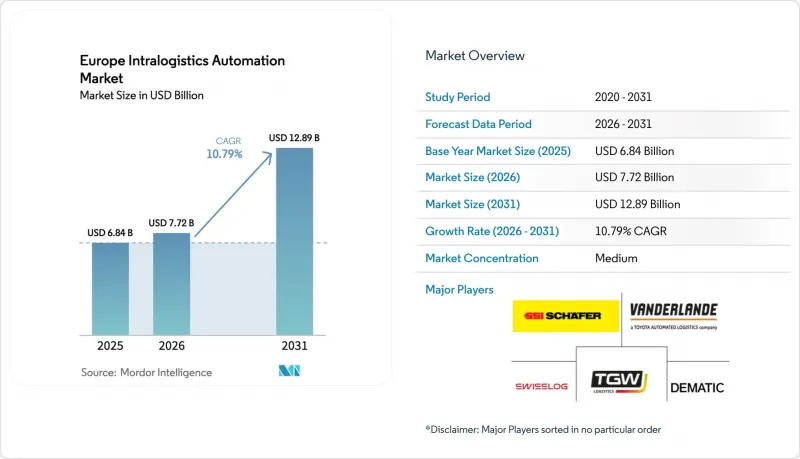
According to Mordor Intelligence, the Europe intralogistics automation market size is expected to increase from USD 6.84 billion in 2025 to USD 7.72 billion in 2026 and reach USD 12.89 billion by 2031, growing at a CAGR of 10.79% over 2026-2031.
This report is Segmented by Product Type (Mobile Robots, Automated Sorting Systems, and More), End-User Industry (Airport, Post and Parcel, General Manufacturing, Automotive, and More), Component (Hardware, Software, and Services), Function (Storage, Order Picking and Retrieval, and More), and Geography (United Kingdom, Germany, and More). The Market Forecasts are Provided in Terms of Value (USD).
Europe Intralogistics Automation Market Trends and Insights
E-Commerce Boom And Omnichannel Fulfilment Pressure
Online retail penetration reached 18.3% of total Western European sales in 2025, intensifying the race to keep inventory within 20 kilometers of demand hotspots. Micro-fulfillment centers rely on goods-to-person shuttles that cut order cycle time to 90 seconds and raise storage density fourfold, enabling a single 5,000 m2 dark store to ship 10,000 daily orders. Grocery leaders such as Carrefour adopted cube-storage grids in dense urban nodes, freeing scarce floor space for last-mile staging. High-speed sorters now process up to 50,000 parcels per hour, a capability vital as cross-border parcel volumes grew 23% year-on-year in 2025. Omnichannel workflows require real-time slotting algorithms that only automated orchestration platforms can execute at scale.
Labour Shortages And Wage Inflation Across EU27
A structural shortfall of 2.1 million logistics workers in 2025 pushed fully loaded labor costs per FTE to over EUR 35,000 (USD 39,550) in 19 member states. Germany alone reported 387,000 vacancies in Q4 2025. Autonomous mobile robots allow one worker to supervise 8-12 stations, effectively quadrupling productivity. Wage convergence eroded Eastern Europe's labor arbitrage, prompting Polish 3PLs to pilot robot fleets in 2025. The European Commission projects logistics labor supply to contract 0.3% annually through 2030, widening the automation imperative.
High Capex And Long ROI Horizons
Turnkey AS/RS projects for a 30,000 m2 DC cost EUR 8-12 million (USD 9.04-13.56 million) and repay in 4.5-6 years. SMEs, which control 64% of European warehouse capacity, often lack access to sub-3% financing, delaying adoption despite strong labor-saving cases. Robotics-as-a-Service leases at EUR 2,500-4,000 (USD 2,825-4,520) per robot per month reduce barriers but still demand three-year commitments and facility retrofits. Forty-one percent of operators cited "uncertain demand" when deferring automation in the 2025 EIB survey. Southern Europe trails Northern peers by 30-40 percentage points in penetration as fragmented ownership structures slow board-level approvals.
Other drivers and restraints analyzed in the detailed report include:
- Rapid Advances In AI-Powered Mobile Robotics And IoT
- 5G And Private-LTE Roll-Outs Enabling Real-Time Orchestration
- Legacy IT And OT Integration Complexity
For complete list of drivers and restraints, kindly check the Table Of Contents.
Segment Analysis
Automated storage and retrieval systems delivered 26.71% of Europe intralogistics automation market share in 2025, reflecting entrenched cube-storage grids that quadruple space efficiency in urban micro-fulfillment centers. Yet the segment's single-purpose nature limits redeployability when product profiles shift. Mobile robots are projected to surpass the overall Europe intralogistics automation market at an 11.91% CAGR through 2031, buoyed by lease-based models that let operators scale fleets seasonally and move assets between facilities in weeks. Subscription pricing simplifies board approvals and preserves capital for expansion initiatives.
Mobile robots also benefit from VDA 5050-driven interoperability, which allows heterogeneous fleets to coexist, minimizing the vendor-lock risk that once favored monolithic AS/RS investments. Automated sorting systems dominate parcel hubs that must process 50,000 parcels per hour during Cyber Week peaks, while palletizing cells with vision-guided grippers cut case cycle times to eight seconds. Although automated conveyors remain the backbone for long-haul internal transport, operators increasingly supplement fixed tracks with mobile robots to create flexible "matrix layouts" capable of overnight reconfiguration for new product launches.
Retail, warehousing, and distribution accounted for 29.43% of revenue in 2025 and will lead growth at a 12.02% CAGR, driven by omnichannel businesses striving for two-hour delivery in dense urban areas. The segment's dependence on piece-level picking aligns with mobile-robot advantages, reinforcing its outsized contribution to the Europe intralogistics automation market. Post-and-parcel operators continue to invest in cross-belt sorters that push Europe intralogistics automation market size upward each holiday season.
Automotive suppliers, while representing a smaller revenue slice, deploy some of the continent's most sophisticated just-in-sequence systems, demanding 99.8% on-time accuracy that manual tuggers cannot match. Food and beverage facilities add stainless-steel mobile robots to navigate chilled zones, raising unit-cost premiums but trimming compliance risk. General manufacturing favors raw-material sequencing solutions with sub-four-year paybacks, whereas airport baggage handling remains a high-value niche, as European hubs race to cut mishandled-bag rates by one-third ahead of the 2028 travel surge.
Complete Report Scope:
- By Product Type
- Mobile Robots
- Automated Storage and Retrieval Systems (AS/RS)
- Automated Sorting Systems
- Palletising and De-Palletising Systems
- Automated Conveyors
- Order-Picking Systems
- By End-User Industry
- Airport
- Post and Parcel
- General Manufacturing
- Automotive
- Food and Beverage
- Retail, Warehousing and Distribution
- Other End-User Industries
- By Component
- Hardware
- Software
- Services
- By Function
- Storage
- Order Picking and Retrieval
- Sorting and Consolidation
- Packaging and Palletising
- Transportation and Conveyance
- By Country
- United Kingdom
- Germany
- France
- Italy
- Spain
- Rest of Europe
List of Companies Covered in this Report:
- Swisslog Holding AG
- TGW Logistics Group GmbH
- Vanderlande Industries B.V.
- SSI Schafer AG
- Dematic GmbH (KION Group)
- Daifuku Co., Ltd.
- Exotec SAS
- AutoStore ASA
- ABB Ltd.
- Honeywell International Inc.
- Interroll Holding AG
- Jungheinrich Aktiengesellschaft
- Kardex Holding AG
- BEUMER Group GmbH and Co. KG
- KNAPP AG
- KUKA Aktiengesellschaft
- Linde Material Handling GmbH
- Murata Machinery, Ltd.
- Ocado Group plc
- Toyota Industries Corporation
- Viastore Systems GmbH
- WITRON Logistik + Informatik GmbH
Additional Benefits:
- The market estimate (ME) sheet in Excel format
- 3 months of analyst support
TABLE OF CONTENTS
1 INTRODUCTION
- 1.1 Study Assumptions and Market Definition
- 1.2 Scope of the Study
2 RESEARCH METHODOLOGY
3 EXECUTIVE SUMMARY
4 MARKET LANDSCAPE
- 4.1 Market Overview
- 4.2 Impact of Macroeconomic Factors on the Market
- 4.3 Industry Value / Supply-Chain Analysis
- 4.4 Market Drivers
- 4.4.1 E-Commerce Boom and Omnichannel Fulfilment Pressure
- 4.4.2 Labour Shortages and Wage Inflation Across EU27
- 4.4.3 Rapid Advances in AI-Powered Mobile Robotics and IoT
- 4.4.4 5G and Private-LTE Roll-Outs Enabling Real-Time Orchestration
- 4.4.5 EU Green Deal Incentives for Low-Carbon Intralogistics
- 4.4.6 Interoperability Standards (VDA 5050) Enabling Multi-Vendor Integration
- 4.5 Market Restraints
- 4.5.1 High Capex and Long ROI Horizons
- 4.5.2 Legacy IT and OT Integration Complexity
- 4.5.3 Rising Cyber-Security Threats to Networked Robotics
- 4.5.4 Grid Power Availability Bottlenecks in Logistics Hubs
- 4.6 Regulatory Landscape
- 4.7 Technological Outlook
- 4.8 Porter's Five Forces Analysis
- 4.8.1 Bargaining Power of Suppliers
- 4.8.2 Bargaining Power of Buyers
- 4.8.3 Threat of New Entrants
- 4.8.4 Threat of Substitutes
- 4.8.5 Intensity of Competitive Rivalry
- 4.9 Adjacent Market Influence Analysis
- 4.9.1 Stretch-Wrapping Machines Market
- 4.9.2 Goods Elevator Market
5 MARKET SIZE AND GROWTH FORECASTS (VALUE)
- 5.1 By Product Type
- 5.1.1 Mobile Robots
- 5.1.2 Automated Storage and Retrieval Systems (AS/RS)
- 5.1.3 Automated Sorting Systems
- 5.1.4 Palletising and De-Palletising Systems
- 5.1.5 Automated Conveyors
- 5.1.6 Order-Picking Systems
- 5.2 By End-User Industry
- 5.2.1 Airport
- 5.2.2 Post and Parcel
- 5.2.3 General Manufacturing
- 5.2.4 Automotive
- 5.2.5 Food and Beverage
- 5.2.6 Retail, Warehousing and Distribution
- 5.2.7 Other End-User Industries
- 5.3 By Component
- 5.3.1 Hardware
- 5.3.2 Software
- 5.3.3 Services
- 5.4 By Function
- 5.4.1 Storage
- 5.4.2 Order Picking and Retrieval
- 5.4.3 Sorting and Consolidation
- 5.4.4 Packaging and Palletising
- 5.4.5 Transportation and Conveyance
- 5.5 By Country
- 5.5.1 United Kingdom
- 5.5.2 Germany
- 5.5.3 France
- 5.5.4 Italy
- 5.5.5 Spain
- 5.5.6 Rest of Europe
6 COMPETITIVE LANDSCAPE
- 6.1 Market Concentration
- 6.2 Strategic Moves
- 6.3 Market Share Analysis
- 6.4 Company Profiles (includes Global Level Overview, Market Level Overview, Core Segments, Financials as available, Strategic Information, Market Rank/Share, Products and Services, Recent Developments)
- 6.4.1 Swisslog Holding AG
- 6.4.2 TGW Logistics Group GmbH
- 6.4.3 Vanderlande Industries B.V.
- 6.4.4 SSI Schafer AG
- 6.4.5 Dematic GmbH (KION Group)
- 6.4.6 Daifuku Co., Ltd.
- 6.4.7 Exotec SAS
- 6.4.8 AutoStore ASA
- 6.4.9 ABB Ltd.
- 6.4.10 Honeywell International Inc.
- 6.4.11 Interroll Holding AG
- 6.4.12 Jungheinrich Aktiengesellschaft
- 6.4.13 Kardex Holding AG
- 6.4.14 BEUMER Group GmbH and Co. KG
- 6.4.15 KNAPP AG
- 6.4.16 KUKA Aktiengesellschaft
- 6.4.17 Linde Material Handling GmbH
- 6.4.18 Murata Machinery, Ltd.
- 6.4.19 Ocado Group plc
- 6.4.20 Toyota Industries Corporation
- 6.4.21 Viastore Systems GmbH
- 6.4.22 WITRON Logistik + Informatik GmbH
7 MARKET OPPORTUNITIES AND FUTURE OUTLOOK
- 7.1 White-Space and Unmet-Need Assessment

