PUBLISHER: Mordor Intelligence | PRODUCT CODE: 2125565

PUBLISHER: Mordor Intelligence | PRODUCT CODE: 2125565
China Active Pharmaceutical Ingredients - Market Share Analysis, Industry Trends & Statistics, Growth Forecasts (2026 - 2031)
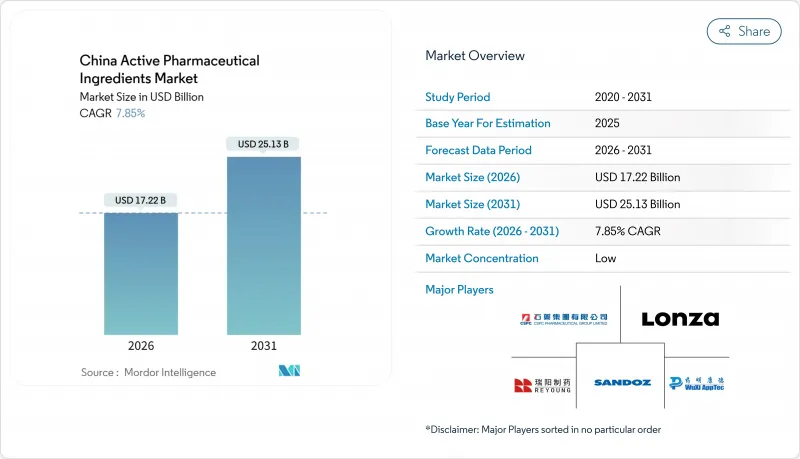
According to Mordor Intelligence, the China active pharmaceutical ingredients market size is estimated at USD 17.22 billion in 2026, and is expected to reach USD 25.13 billion by 2031, at a CAGR of 7.85% during the forecast period (2026-2031).
This report is Segmented by Business Mode (Captive API and Merchant API), Synthesis Type (Synthetic and Biotech), Drug Type (Generic and Branded), and Application (Cardiology, Oncology, Pulmonology, Neurology, Orthopedic, Ophthalmology, and Other Applications). The Report Offers the Value (USD) for the Above Segments.
China Active Pharmaceutical Ingredients Market Trends and Insights
Rising Prevalence Of Chronic & Lifestyle Diseases
Cardiovascular disease, diabetes, and cancer account for more than 80% of Chinese mortality, and 75% of citizens aged 60 plus manage at least one chronic condition. The burden guarantees sustained ordering of statins, metformin precursors, and oncology intermediates despite VBP price compressions. Diagnosed diabetes cases reached 140 million, locking in high baseline demand for antidiabetic APIs. Provincial cancer-screening mandates introduced under Healthy China 2030 further accelerate orders for PD-1 and kinase inhibitor intermediates. Because the population aged 65 plus will top 300 million by 2030, demand for neurology and osteoporosis APIs is projected to remain resilient across the forecast window.
Growing Domestic Use Of Biologics & Biosimilars
China initiated 4,382 innovative drug programs between 2015 and 2024, and 18 Chinese-origin products won overseas approvals, catalyzing local demand for monoclonal-antibody and recombinant-protein APIs. Kelun-BPC invested in ADC intermediates, while Luye Pharma advanced nanomedicine capabilities to retain more value margins that generic VBP has eroded. Streamlined biosimilar review rules introduced in 2020 helped trastuzumab follow-ons capture sizeable domestic share within 18 months. Cytiva's 2025 index rated China 5.72 in biomanufacturing capacity and reported that 61% of surveyed sponsors plan to increase regional sourcing. These indicators underpin the 11.85% CAGR outlook for biotech APIs over 2026-2031.
Drug-Price Control & National Volume-Based Procurement
The 2024 VBP extension to oncology triggered API cost-down requests that erased 1.6 percentage points from market CAGR projections. CSPC's bulk-drug revenue dipped 1.6% year-over-year in 2024 despite higher volumes, illustrating margin erosion. The policy accelerates commoditization by neutralizing brand differentiation, forcing suppliers toward complex peptides and HPAPIs where VBP leverage is weaker.
Other drivers and restraints analyzed in the detailed report include:
- Yuan Depreciation Widens Export Price Advantage
- Supply-Chain Friend-Shoring Boosts China CDMO Orders
- Fierce Competition & Stricter GMP / Environmental Rules
For complete list of drivers and restraints, kindly check the Table Of Contents.
Segment Analysis
Merchant players captured 58.55% of 2025 revenue in the China active pharmaceutical ingredients market and are tracking an 8.25% CAGR to 2031. Western pharma is outsourcing to preserve R&D budgets, and multi-client portfolios help spread fixed costs. WuXi's Taixing complex, spanning 169 acres with over 1,000 m3 reactors, demonstrates the scale advantage. Captive facilities risk low utilization whenever pipeline assets fail or patents expire, while merchant suppliers can redeploy capacity quickly. However, reliance on a concentrated foreign client base leaves merchant firms vulnerable to geopolitical shocks such as the Biosecure Act suspension wave that dented WuXi Advanced Therapies revenue in 2024.
The merchant model also eases geographic diversification. Asymchem's U.K. acquisition and Pharmaron's British sites allow Chinese CDMOs to list Western regulatory addresses while retaining low-cost mainland production. High-potency and peptide lines command premium pricing, insulating margins from VBP, and are the focal points of most new merchant CAPEX through 2031.
Synthetic chemistry still holds 70.53% of the 2025 market value in the China active pharmaceutical ingredients market, yet biotech APIs are scaling at an 11.85% CAGR courtesy of an accelerated biologics pipeline. Mammalian cell-culture capacity is expanding in Suzhou and Shanghai parks, with Cytiva rating Chinese biomanufacturing at 5.72 in its 2025 index.
Biotech APIs earn 3-5 times the unit price of small molecules, cushioning suppliers against input price swings. Synthetic APIs face shrinking spreads as VBP covers more molecules, nudging chemistries toward chiral intermediates and HPAPIs where specialized containment justifies higher quotations.
Complete Report Scope:
- By Business Mode
- Captive API
- Merchant API
- By Synthesis Type
- Synthetic
- Biotech
- By Drug Type
- Generic
- Branded
- By Application
- Cardiology
- Oncology
- Pulmonology
- Neurology
- Orthopedic
- Ophthalmology
- Other Applications
List of Companies Covered in this Report:
- Asymchem Laboratories (Tianjin) Co., Ltd.
- Chengdu Tianyin Pharmaceutical Co., Ltd.
- CSPC Pharmaceutical Group Ltd.
- Hangzhou Zhongmei Huadong Pharmaceutical Co., Ltd.
- Kelun-BPC
- Lonza Guangzhou Ltd.
- Luye Pharma Group Ltd.
- Nanjing Kingfriend Biochemical Pharmaceutical Co., Ltd.
- Northeast Pharmaceutical Group Co., Ltd.
- Pharmaron Beijing Co., Ltd.
- Porton Pharma Solutions Ltd.
- Shandong Xinhua Pharmaceutical Co., Ltd.
- Shenzhen Hepalink Pharmaceutical Co., Ltd.
- STA Pharma (WuXi)
- WuXi AppTec (STA Pharmaceutical)
- Zhejiang Garden Biopharmaceutical Co., Ltd.
- Zhejiang Hisun Pharmaceutical Co., Ltd.
- Zhejiang Huahai Pharmaceutical Co., Ltd.
- Zhejiang Medicine Co., Ltd.
- Zhejiang NHU
- Reyoung Pharmaceuticals
- Sandoz Group AG
Additional Benefits:
- The market estimate (ME) sheet in Excel format
- 3 months of analyst support
TABLE OF CONTENTS
1 Introduction
- 1.1 Study Assumptions & Market Definition
- 1.2 Scope of the Study
2 Research Methodology
3 Executive Summary
4 Market Landscape
- 4.1 Market Overview
- 4.2 Market Drivers
- 4.2.1 Rising prevalence of chronic & lifestyle diseases
- 4.2.2 Growing domestic use of biologics & biosimilars
- 4.2.3 Yuan depreciation widens export price advantage
- 4.2.4 Supply-chain friend-shoring boosts China CDMO orders
- 4.2.5 Government policies favoring local pharmaceutical manufacturing
- 4.2.6 Rising demand for affordable generics
- 4.3 Market Restraints
- 4.3.1 Drug-price control & national volume-based procurement
- 4.3.2 Fierce competition & stricter GMP / environmental rules
- 4.3.3 Emerging US/EU tariffs on critical-drug raw materials
- 4.3.4 Volatile coal & solvent prices squeezing small producers
- 4.4 Supply-Chain Analysis
- 4.5 Regulatory Landscape
- 4.6 Technological Outlook
- 4.7 Porter's Five Forces
- 4.7.1 Threat of New Entrants
- 4.7.2 Bargaining Power of Buyers
- 4.7.3 Bargaining Power of Suppliers
- 4.7.4 Threat of Substitutes
- 4.7.5 Intensity of Competitive Rivalry
5 Market Size & Growth Forecasts (Value, USD)
- 5.1 By Business Mode
- 5.1.1 Captive API
- 5.1.2 Merchant API
- 5.2 By Synthesis Type
- 5.2.1 Synthetic
- 5.2.2 Biotech
- 5.3 By Drug Type
- 5.3.1 Generic
- 5.3.2 Branded
- 5.4 By Application
- 5.4.1 Cardiology
- 5.4.2 Oncology
- 5.4.3 Pulmonology
- 5.4.4 Neurology
- 5.4.5 Orthopedic
- 5.4.6 Ophthalmology
- 5.4.7 Other Applications
6 Competitive Landscape
- 6.1 Market Concentration
- 6.2 Market Share Analysis
- 6.3 Company Profiles (includes Global level Overview, Market level overview, Core Segments, Financials as available, Strategic Information, Market Rank/Share for key companies, Products & Services, and Recent Developments)
- 6.3.1 Asymchem Laboratories (Tianjin) Co., Ltd.
- 6.3.2 Chengdu Tianyin Pharmaceutical Co., Ltd.
- 6.3.3 CSPC Pharmaceutical Group Ltd.
- 6.3.4 Hangzhou Zhongmei Huadong Pharmaceutical Co., Ltd.
- 6.3.5 Kelun-BPC
- 6.3.6 Lonza Guangzhou Ltd.
- 6.3.7 Luye Pharma Group Ltd.
- 6.3.8 Nanjing Kingfriend Biochemical Pharmaceutical Co., Ltd.
- 6.3.9 Northeast Pharmaceutical Group Co., Ltd.
- 6.3.10 Pharmaron Beijing Co., Ltd.
- 6.3.11 Porton Pharma Solutions Ltd.
- 6.3.12 Shandong Xinhua Pharmaceutical Co., Ltd.
- 6.3.13 Shenzhen Hepalink Pharmaceutical Co., Ltd.
- 6.3.14 STA Pharma (WuXi)
- 6.3.15 WuXi AppTec (STA Pharmaceutical)
- 6.3.16 Zhejiang Garden Biopharmaceutical Co., Ltd.
- 6.3.17 Zhejiang Hisun Pharmaceutical Co., Ltd.
- 6.3.18 Zhejiang Huahai Pharmaceutical Co., Ltd.
- 6.3.19 Zhejiang Medicine Co., Ltd.
- 6.3.20 Zhejiang NHU Co., Ltd.
- 6.3.21 Reyoung Pharmaceuticals
- 6.3.22 Sandoz Group AG
7 Market Opportunities & Future Outlook
- 7.1 White-space & Unmet-Need Assessment

