PUBLISHER: Mordor Intelligence | PRODUCT CODE: 2125594

PUBLISHER: Mordor Intelligence | PRODUCT CODE: 2125594
Dry Pet Food - Market Share Analysis, Industry Trends & Statistics, Growth Forecasts (2026 - 2031)
According to Mordor Intelligence, the dry pet food market size is expected to grow from USD 48.10 billion in 2025 to USD 52.25 billion in 2026 and is forecast to reach USD 78.99 billion by 2031 at 8.62% CAGR over 2026-2031.
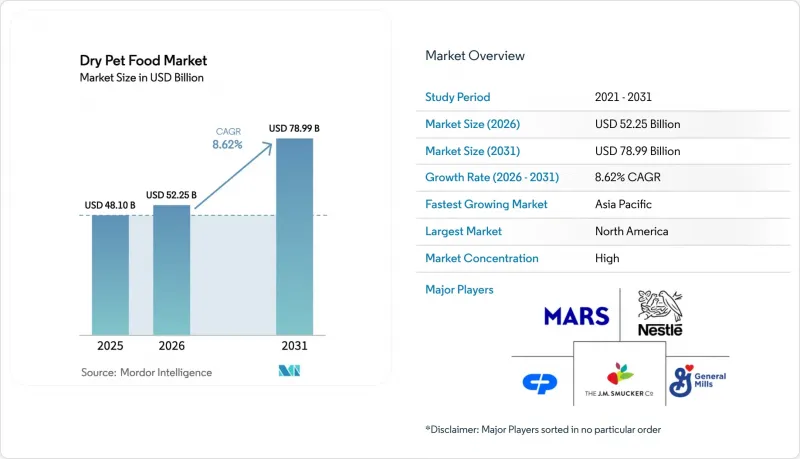
This report is Segmented by Animal Type (Dogs, Cats, and More ), by Product Type (Kibble, Freeze-Dried, and More), by Ingredient Type (Protein, Cereals and Cereal Derivatives, and More), by Distribution Channel (Specialized Pet Shops, Online Channels, and More), and by Geography (North America, Europe, and More). The Market Forecasts are Provided in Terms of Value (USD).
Global Dry Pet Food Market Trends and Insights
Increasing Trend of Pet Humanization
Pet humanization fundamentally reshapes purchasing decisions as owners increasingly view companions as family members requiring premium nutrition comparable to human food standards. This behavioral shift drives demand for organic, non-GMO, and human-grade ingredients, with pet parents willing to pay 25-30% premiums for products positioned as health-enhancing . The trend accelerates in developed markets where disposable income supports discretionary spending on pet wellness, creating opportunities for brands that successfully communicate functional benefits. Veterinary partnerships become crucial as humanization extends to preventive healthcare, with therapeutic diets gaining acceptance among owners seeking medical-grade nutrition solutions. The phenomenon particularly influences millennial and Gen Z demographics, who delay traditional life milestones while investing heavily in pet care, suggesting sustained long-term growth potential.
Growth of E-commerce and DTC Models
Digital commerce transformation accelerates as subscription-based models capture recurring revenue streams while reducing customer acquisition costs for manufacturers. Online channels grew 35% in 2024, with direct-to-consumer brands like Ollie and The Farmer's Dog leveraging personalization algorithms to create customized feeding plans. This shift enables smaller brands to bypass traditional retail gatekeepers and access consumers directly, intensifying competition for established players reliant on brick-and-mortar distribution. The convenience factor resonates particularly with urban professionals who value automated delivery schedules and portion-controlled packaging. The model requires significant investment in logistics infrastructure and customer service capabilities, creating barriers for companies without adequate digital transformation resources.
Rising Raw-material and Logistics Costs
Commodity price inflation creates margin pressure as key ingredients, including meat meals, grains, and functional additives, experience sustained cost increases. Livestock feed costs rose 15-20% in 2024, directly impacting protein ingredient pricing for pet food manufacturers who face difficult decisions between margin compression and consumer price increases . Transportation costs compound the challenge as fuel price volatility and driver shortages increase distribution expenses, particularly affecting smaller regional players with limited logistics scale. The inflationary environment forces strategic decisions about ingredient sourcing, with some manufacturers exploring alternative protein sources or reformulating products to maintain price points.
Other drivers and restraints analyzed in the detailed report include:
- Premiumization and Functional Nutrition Demand
- Accelerating Urban Single-pet Households
- Stringent Sustainability Mandates on Packaging
For complete list of drivers and restraints, kindly check the Table Of Contents.
Segment Analysis
Dogs generated 45.60% of the 2025 dry pet food market share, the largest slice of the dry pet food market, reflecting higher caloric intake due to body mass. The growth divergence between dogs and cats reflects demographic shifts in pet ownership patterns, with younger consumers increasingly favoring cats due to lifestyle compatibility and lower maintenance requirements. Therapeutic nutrition drives premium pricing in both segments, though cats show higher price sensitivity in mass-market channels. Innovation focuses on palatability enhancement for cats, whose selective eating behaviors create formulation challenges compared to dogs' broader acceptance of varied ingredients and textures.
Cats are projected to compound at 7.45% annually through 2031, driven by urban adoption patterns and increasing awareness of feline-specific nutritional requirements. In 2024, 32% of United States households owned a cat. The cat segment benefits from premiumization trends as owners recognize the importance of species-appropriate nutrition, particularly for indoor cats requiring specialized formulations to address hairball control and urinary health . Other animals, including small mammals and birds, represent niche opportunities with specialized nutritional needs but limited scale potential.
Kibble accounted for 57.20% of the dry pet food market size in 2025, supported by cost efficiency and automated production scalability. As competition intensifies, major manufacturers acquire niche freeze-dry pioneers to secure technology know-how and shorten time to market. Premium pricing for freeze-dried formulas, often three times that of mid-market kibble, enhances gross margins and offsets smaller volumes. Brands reformulate kibble with probiotic coatings to convey functional benefits without leaving the mainstream price band. Packaging upgrades, such as resealable pouches, extend freshness and encourage bulk shopping. The diversification of processing methods broadens brand portfolios, cushioning exposure to any single consumer trend within the dry pet food market.
Freeze-dried SKUs, though smaller in volume, are forecast to achieve a 9.25% CAGR through 2031, as owners associate low-temperature processing with nutrient retention. Baked biscuits sustain demand in training and treat occasions but rarely serve as primary meals. Semi-moist products decline because shoppers scrutinize sugar and humectant content, reflecting clean-label priorities. Extruders now feature energy-recovery systems that lower operating costs and reduce emissions.
Complete Report Scope:
- By Animal Type
- Dogs
- Cats
- Other Animals
- By Product Type
- Kibble
- Freeze-Dried
- Others
- By Ingredient Type
- Protein
- Animal-derived
- Plant-derived
- Cereals and Cereal Derivatives
- Others
- Protein
- By Distribution Channel
- Specialized Pet Shops
- Supermarkets/Hypermarkets
- Online Channels
- Veterinary Clinics
- Other Channels
- By Geography
- North America
- United States
- Canada
- Mexico
- Rest of North America
- Europe
- Germany
- United Kingdom
- France
- Spain
- Italy
- Netherlands
- Russia
- Rest of Europe
- Asia-Pacific
- Australia
- China
- Japan
- India
- South Korea
- Rest of Asia-Pacific
- South America
- Brazil
- Argentina
- Chile
- Rest of South America
- Middle East
- Saudi Arabia
- United Arab Emirates
- Turkey
- Rest of Middle East
- Africa
- South Africa
- Egypt
- Nigeria
- Rest of Africa
- North America
Geography Analysis
North America controlled 40.10% of the dry pet food market in 2025, as premiumization offsets category maturity. The United States remains the global spending leader, with subscription services and therapeutic formulas anchoring value growth. Canada benefits from cross-border e-commerce, while Mexico exhibits double-digit online uptake driven by mobile adoption and youthful demographics.
Asia-Pacific delivers the fastest trajectory at 7.95% CAGR through 2031, underpinned by rapid urbanization in China, India, and Southeast Asia. Disposable income gains fuel Western feeding practices, and single-pet households boost per-animal outlays. China is the largest contributor in absolute terms, whereas Japan and South Korea sustain higher average selling prices owing to entrenched premium segments. Regulatory coalitions across Asia-Pacific markets aim to harmonize labeling, enabling regional-scale efficiencies for multinationals.
Europe represented significant share in 2024 amid stringent environmental and safety regulations. Germany and the United Kingdom dominate the market in terms of volumes, while the Nordic countries are pioneers in insect-based adoption. Extended producer responsibility rules expedite recyclable packaging innovation. Strict health-claim substantiation standards elevate trust and set benchmarks emulated by other regions, reinforcing Europe's status as a regulatory pacesetter in the dry pet food industry.
- Mars, Incorporated
- Nestle S.A.
- Colgate-Palmolive Company
- General Mills Inc.
- Clearlake Capital Group L.P.
- Wellness Pet Company Inc.
- Diamond Pet Foods
- Archer Daniels Midland Company
- Alphia Inc.
- Unicharm Corporation
- Sunshine Mills Inc.
- Simmons Foods Inc.
- Farmina Pet Foods Holding B.V.
- Affinity Petcare S.A.
- J.M. Smucker Company
Additional Benefits:
- The market estimate (ME) sheet in Excel format
- 3 months of analyst support
TABLE OF CONTENTS
1 Introduction
- 1.1 Study Assumptions and Market Definition
- 1.2 Scope of the Study
2 Research Methodology
3 Executive Summary
4 Market Landscape
- 4.1 Market Overview
- 4.2 Market Drivers
- 4.2.1 Increasing Trend of Pet Humanization
- 4.2.2 Growth of E-commerce and DTC Models
- 4.2.3 Premiumization and Functional Nutrition Demand
- 4.2.4 Accelerating Urban Single-pet Households
- 4.2.5 Rise of Clean-label and Limited-ingredient Diets
- 4.2.6 AI-enabled Personalization Platforms
- 4.3 Market Restraints
- 4.3.1 Rising Raw-material and Logistics Costs
- 4.3.2 Stringent Sustainability Mandates on Packaging
- 4.3.3 Protein-sourcing Volatility
- 4.3.4 Regulatory Scrutiny on Nutrient Claims
- 4.4 Regulatory Landscape
- 4.5 Technological Outlook
- 4.6 Porter's Five Forces Analysis
- 4.6.1 Threat of New Entrants
- 4.6.2 Bargaining Power of Buyers/Consumers
- 4.6.3 Bargaining Power of Suppliers
- 4.6.4 Threat of Substitute Products
- 4.6.5 Intensity of Competitive Rivalry
5 Market Size and Growth Forecasts (Value)
- 5.1 By Animal Type
- 5.1.1 Dogs
- 5.1.2 Cats
- 5.1.3 Other Animals
- 5.2 By Product Type
- 5.2.1 Kibble
- 5.2.2 Freeze-Dried
- 5.2.3 Others
- 5.3 By Ingredient Type
- 5.3.1 Protein
- 5.3.1.1 Animal-derived
- 5.3.1.2 Plant-derived
- 5.3.2 Cereals and Cereal Derivatives
- 5.3.3 Others
- 5.3.1 Protein
- 5.4 By Distribution Channel
- 5.4.1 Specialized Pet Shops
- 5.4.2 Supermarkets/Hypermarkets
- 5.4.3 Online Channels
- 5.4.4 Veterinary Clinics
- 5.4.5 Other Channels
- 5.5 By Geography
- 5.5.1 North America
- 5.5.1.1 United States
- 5.5.1.2 Canada
- 5.5.1.3 Mexico
- 5.5.1.4 Rest of North America
- 5.5.2 Europe
- 5.5.2.1 Germany
- 5.5.2.2 United Kingdom
- 5.5.2.3 France
- 5.5.2.4 Spain
- 5.5.2.5 Italy
- 5.5.2.6 Netherlands
- 5.5.2.7 Russia
- 5.5.2.8 Rest of Europe
- 5.5.3 Asia-Pacific
- 5.5.3.1 Australia
- 5.5.3.2 China
- 5.5.3.3 Japan
- 5.5.3.4 India
- 5.5.3.5 South Korea
- 5.5.3.6 Rest of Asia-Pacific
- 5.5.4 South America
- 5.5.4.1 Brazil
- 5.5.4.2 Argentina
- 5.5.4.3 Chile
- 5.5.4.4 Rest of South America
- 5.5.5 Middle East
- 5.5.5.1 Saudi Arabia
- 5.5.5.2 United Arab Emirates
- 5.5.5.3 Turkey
- 5.5.5.4 Rest of Middle East
- 5.5.6 Africa
- 5.5.6.1 South Africa
- 5.5.6.2 Egypt
- 5.5.6.3 Nigeria
- 5.5.6.4 Rest of Africa
- 5.5.1 North America
6 Competitive Landscape
- 6.1 Market Concentration
- 6.2 Strategic Moves
- 6.3 Market Share Analysis
- 6.4 Company Profiles ((Includes Global Level Overview, Market Level Overview, Core Segments, Financials As Available, Strategic Information, Market Rank/Share for Key Companies, Products and Services, and Recent Developments))
- 6.4.1 Mars, Incorporated
- 6.4.2 Nestle S.A.
- 6.4.3 Colgate-Palmolive Company
- 6.4.4 General Mills Inc.
- 6.4.5 Clearlake Capital Group L.P.
- 6.4.6 Wellness Pet Company Inc.
- 6.4.7 Diamond Pet Foods
- 6.4.8 Archer Daniels Midland Company
- 6.4.9 Alphia Inc.
- 6.4.10 Unicharm Corporation
- 6.4.11 Sunshine Mills Inc.
- 6.4.12 Simmons Foods Inc.
- 6.4.13 Farmina Pet Foods Holding B.V.
- 6.4.14 Affinity Petcare S.A.
- 6.4.15 J.M. Smucker Company
7 Market Opportunities and Future Outlook

