PUBLISHER: Mordor Intelligence | PRODUCT CODE: 2125605

PUBLISHER: Mordor Intelligence | PRODUCT CODE: 2125605
China Battery Manufacturing Equipment - Market Share Analysis, Industry Trends & Statistics, Growth Forecasts (2026 - 2031)
According to Mordor Intelligence, the China battery manufacturing equipment market size is expected to grow from USD 9.82 billion in 2025 to USD 10.52 billion in 2026 and is forecast to reach USD 14.84 billion by 2031 at 7.13% CAGR over 2026-2031.
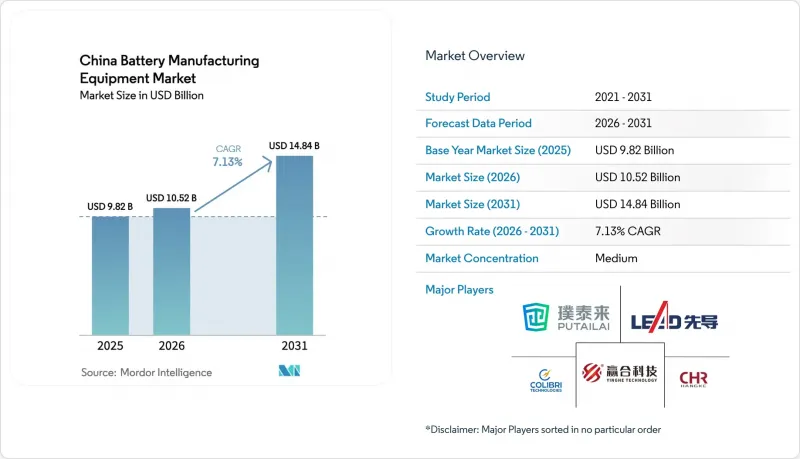
This report is Segmented by Battery Chemistry (Lithium-Ion, Solid-State, Flow Batteries, and More), Machine Type (Coating and Drying Systems, Formation and Testing Lines, Assembly and Handling Robots, and More), Automation Level (Fully-Automatic, AI-Supervised "lights-Out" Lines, and More), and End-User (Automotive OEMs and Tier-1s, Energy Storage System Integrators, and More).
China Battery Manufacturing Equipment Market Trends and Insights
Rapid EV-Led Gigafactory Expansion
China produced 9.5 million electric vehicles in 2024, spurring CATL to add 200 GWh of annual capacity by 2026 and BYD to plan 150 GWh over the same horizon. Each gigafactory wave requires USD 3-4 billion of fresh machinery, favoring suppliers able to deliver turnkey lines within 12-18 months. Jiangsu, Guangdong, and Sichuan host dense supply chains, enabling just-in-time installation that entrenches local vendors. Provincial incentives further accelerate deployments by offsetting up to 30% of qualifying equipment costs. As a result, the Chinese battery manufacturing equipment market enjoys near-term order visibility despite nationwide capacity utilization below 50%.
AI-Driven Yield-Improvement Software Bundling
Bundling machine-vision analytics with hardware lifts average selling prices 15-20% and locks customers into multi-year service contracts. Wuxi Lead reports first-pass yields of 96-97% on AI-supervised lines versus 92-93% on conventional systems, translating into USD 8-10 million in annual savings for a 10 GWh plant. Real-time defect detection shrinks downtime, while data feedback loops inform cell chemistry tweaks, deepening vendor-client ties. Suppliers lacking native software capabilities must acquire startups or license algorithms, both of which dilute margins and reinforce the competitive moat of full-stack integrators.
Equipment Over-Capacity After 2023-24 Capex Spree
Nationwide utilization fell to 47% in 2023 after a two-year installation boom, leaving vendors with idle inventory and forcing discounts that sliced working-capital buffers. Commodity mixers, slitters, and coaters face the deepest glut, while MIIT guidelines now discourage fresh builds unless tied to quality upgrades. Provincial enforcement remains uneven because local authorities still prioritize employment, prolonging oversupply and intensifying competition within the Chinese battery manufacturing equipment market.
Other drivers and restraints analyzed in the detailed report include:
- Surging Demand for Sodium-Ion Pilot Equipment
- Solid-State Pilot-Line Investments
- Intensifying Price-Cut Wars Among Chinese OEMs
For complete list of drivers and restraints, kindly check the Table Of Contents.
Segment Analysis
Solid-state equipment revenues are projected to climb at a 30.24% CAGR, reflecting China's CNY 6 billion commitment to pilot builds that could reach 3-5 GWh by 2026. In contrast, lithium-ion retained 84.62% of the Chinese battery manufacturing equipment market share in 2025 due to entrenched EV and consumer electronics demand. Sodium-ion demand is accelerating as retrofit-friendly tooling appeals to budget-conscious producers, while flow batteries gain traction in grid-scale storage. Lead-acid and nickel-based chemistries remain niche but stable, serving industrial and aerospace use cases.
Strong policy backing and co-development alliances between Wuxi Lead, Putailai, and Tier-1 cell makers underpin rapid solid-state adoption. Equipment designs feature solvent-free coating, vacuum deposition, and high-pressure calendaring that few vendors presently master, making early movers well-positioned to capture the next wave of China battery manufacturing equipment market expansion.
Coating and drying systems generated 20.12% of 2025 revenue, reflecting their capital intensity and precision requirements. Assembly and handling robots, however, post the quickest 16.15% CAGR as producers automate labor-heavy stacking and packaging to offset wage inflation. The Chinese battery manufacturing equipment market size for robots, therefore, expands rapidly alongside cell format diversification.
Laser notching and high-precision cutting benefit from large-format cell architectures that demand tighter dimensional control. Formation and testing lines integrate AI diagnostics to catch early-life defects, reducing warranty provisions for EV makers. Meanwhile, recycling and black-mass processing equipment gains policy tailwinds from the 95% material-recovery mandate effective 2028, broadening revenue opportunities beyond primary battery production.
Complete Report Scope:
- By Battery Chemistry
- Lithium-ion
- Solid-state
- Sodium-ion
- Lead-acid
- Nickel-based
- Flow Batteries (Zn-Br, Vanadium etc.)
- By Machine Type
- Coating and Drying Systems
- Calendaring Presses
- Mixing and Homogenizers
- Slitting Machines
- Laser Notching and Cutting
- Electrode Stacking
- Vacuum Drying and Degassing
- Electro-lyte Filling
- Assembly and Handling Robots
- Formation and Testing Lines
- Packaging and Sealing
- Recycling and Black-mass Processing Equipment
- By Automation Level
- Manual/Lab-scale
- Semi-automatic
- Fully-automatic
- AI-supervised "lights-out" lines
- By End-User
- Automotive OEMs and Tier-1s
- Energy Storage System Integrators
- Consumer Electronics
- Industrial and Power Tools
- Aerospace and Defense
- Other End Users
List of Companies Covered in this Report:
- Wuxi Lead Intelligent Equipment Co., Ltd.
- Shenzhen Yinghe Technology Co., Ltd.
- HangKe Technology Co., Ltd.
- Durr AG
- Xiamen Tmax Battery Equipments Ltd.
- Xiamen TOB New Energy Technology Co., Ltd.
- Xiamen ACEY New Energy Technology
- Schuler AG
- Hitachi Ltd.
- Andritz AG
- Shenzhen Colibri Technologies
- Putailai (PTL) Intelligent Equipment
- Manz AG
- NAURA Technology Group
Additional Benefits:
- The market estimate (ME) sheet in Excel format
- 3 months of analyst support
TABLE OF CONTENTS
1 Introduction
- 1.1 Study Assumptions & Market Definition
- 1.2 Scope of the Study
2 Research Methodology
3 Executive Summary
4 Market Landscape
- 4.1 Market Overview
- 4.2 Market Drivers
- 4.2.1 Rapid EV?led gigafactory expansion
- 4.2.2 Government "Made-in-China 2025" automation subsidies
- 4.2.3 Vertical integration by Tier-1 cell makers
- 4.2.4 Solid-state pilot-line investments
- 4.2.5 AI-driven yield-improvement software bundling
- 4.2.6 Surging demand for sodium-ion pilot equipment
- 4.3 Market Restraints
- 4.3.1 Equipment over-capacity after 2023-24 capex spree
- 4.3.2 Intensifying price-cut wars among Chinese OEMs
- 4.3.3 Scarcity of senior automation engineers
- 4.3.4 Export-control risks on US/?EU process IP
- 4.4 Supply-Chain Analysis
- 4.5 Regulatory Landscape
- 4.6 Technological Outlook
- 4.7 Porter's Five Forces
- 4.7.1 Threat of New Entrants
- 4.7.2 Bargaining Power of Suppliers
- 4.7.3 Bargaining Power of Buyers
- 4.7.4 Threat of Substitutes
- 4.7.5 Competitive Rivalry
- 4.8 PESTLE Analysis
5 Market Size & Growth Forecasts
- 5.1 By Battery Chemistry
- 5.1.1 Lithium-ion
- 5.1.2 Solid-state
- 5.1.3 Sodium-ion
- 5.1.4 Lead-acid
- 5.1.5 Nickel-based
- 5.1.6 Flow Batteries (Zn-Br, Vanadium etc.)
- 5.2 By Machine Type
- 5.2.1 Coating and Drying Systems
- 5.2.2 Calendaring Presses
- 5.2.3 Mixing and Homogenizers
- 5.2.4 Slitting Machines
- 5.2.5 Laser Notching and Cutting
- 5.2.6 Electrode Stacking
- 5.2.7 Vacuum Drying and Degassing
- 5.2.8 Electro-lyte Filling
- 5.2.9 Assembly and Handling Robots
- 5.2.10 Formation and Testing Lines
- 5.2.11 Packaging and Sealing
- 5.2.12 Recycling and Black-mass Processing Equipment
- 5.3 By Automation Level
- 5.3.1 Manual/Lab-scale
- 5.3.2 Semi-automatic
- 5.3.3 Fully-automatic
- 5.3.4 AI-supervised "lights-out" lines
- 5.4 By End-User
- 5.4.1 Automotive OEMs and Tier-1s
- 5.4.2 Energy Storage System Integrators
- 5.4.3 Consumer Electronics
- 5.4.4 Industrial and Power Tools
- 5.4.5 Aerospace and Defense
- 5.4.6 Other End Users
6 Competitive Landscape
- 6.1 Market Concentration
- 6.2 Strategic Moves (M&A, Partnerships, PPAs)
- 6.3 Market Share Analysis (Market Rank/Share for key companies)
- 6.4 Company Profiles (includes Global level Overview, Market level overview, Core Segments, Financials as available, Strategic Information, Products & Services, and Recent Developments)
- 6.4.1 Wuxi Lead Intelligent Equipment Co., Ltd.
- 6.4.2 Shenzhen Yinghe Technology Co., Ltd.
- 6.4.3 HangKe Technology Co., Ltd.
- 6.4.4 Durr AG
- 6.4.5 Xiamen Tmax Battery Equipments Ltd.
- 6.4.6 Xiamen TOB New Energy Technology Co., Ltd.
- 6.4.7 Xiamen ACEY New Energy Technology
- 6.4.8 Schuler AG
- 6.4.9 Hitachi Ltd.
- 6.4.10 Andritz AG
- 6.4.11 Shenzhen Colibri Technologies
- 6.4.12 Putailai (PTL) Intelligent Equipment
- 6.4.13 Manz AG
- 6.4.14 NAURA Technology Group
7 Market Opportunities & Future Outlook
- 7.1 White-space & Unmet-Need Assessment

