PUBLISHER: Mordor Intelligence | PRODUCT CODE: 2125608

PUBLISHER: Mordor Intelligence | PRODUCT CODE: 2125608
India Manufacturing - Market Share Analysis, Industry Trends & Statistics, Growth Forecasts (2026 - 2031)
According to Mordor Intelligence, the India manufacturing market size is projected to be USD 1.63 trillion in 2025, USD 1.74 trillion in 2026, and reach USD 2.47 trillion by 2031, growing at a CAGR of 7.26% from 2026 to 2031.
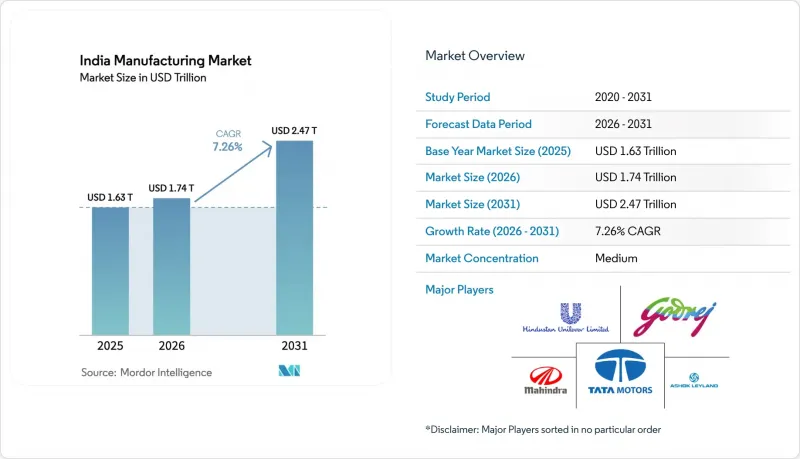
This report is Segmented by Ownership (Public Sector, and Others), by End-User Industry (Automotive & Auto Components, and Others), by Plant Size (Large Enterprises), and by Geography (North India, and Others). The Market Forecasts are Provided in Terms of Value (USD).
India Manufacturing Market Trends and Insights
Expanded PLI 2.0 Incentives Covering Green Hydrogen, Advanced Chemistry Batteries & Semiconductors
PLI 2.0 has lined up USD 26 billion for sunrise sectors and ties 50% of subsidies to incremental sales, so recipients must close long-term offtake deals before ground-breaking. Three wafer fabs targeted for Gujarat and Karnataka will lift monthly capacity to 85,000 wafers by 2027, while battery incentives backed plans for 50 GWh of cells by 2028. Hydrogen awards cover 1.2 million t/y of electrolyzers and have already drawn USD 4 billion of private spending pledges. Staggered payouts (20% upfront, 80% performance-linked) lower fiscal risk, yet smaller firms face liquidity gaps during ramp-up. Overall, the scheme locks in a multi-year domestic-demand floor that will ripple across component supply chains.
Quad Supply-Chain Realignment ("China + 1") Funnelling OEM Orders to India
FDI in manufacturing climbed to USD 22 billion in 2025, 34% above the previous year, as Apple and Samsung deepened India assembly footprints. The Quad supply-chain-resilience initiative earmarks USD 5 billion of concessional credit, tilting orders for mid-tier electronics and auto parts toward Indian vendors. Foxconn and Pegatron now employ 87,000 workers, while Samsung moved 30% of global washer output to Noida. Yet imported displays and sensors mean only 38% of handset value is locally added, indicating scope for deeper backward integration.
Persistent Logistics Bottlenecks: Port Dwell Times & Hinterland Rail Share less than 30%
Average port dwell fell to 2.8 days in 2025, yet remains double Colombo's and triple Singapore's, hiking inventory costs for exporters. Jawaharlal Nehru Port saw seven-day queues in monsoon peaks, pushing electronics shippers to costly air freight. Rail's cargo share languishes at 27.3% because only one-fifth of parks have sidings, while rake turnaround is 5.2 days versus China's 2.8 days. Completion of the Eastern Freight Corridor slipped 18 months due to land disputes, delaying anticipated 30% freight-cost cuts. Unless last-mile links keep pace with trunk corridors, India's logistics penalty will persist.
Other drivers and restraints analyzed in the detailed report include:
- Domestic Consumption Surge from Tier-2/3 Urbanization and E-Commerce Warehousing Growth
- Fast-Track Industrial-Corridor Connectivity via Gati Shakti Projects
- Land-Acquisition Delays Despite State Reforms, Prolonging Project Lead Times
For complete list of drivers and restraints, kindly check the Table Of Contents.
Segment Analysis
Private firms commanded a 71.68% India manufacturing market share in 2025, while private MSMEs will outpace the broader market at 10.04% CAGR through 2031. Digital invoice discounting and PLI subsidies let Dixon Technologies lift revenue to USD 2.04 billion by onboarding 14 global brands. Public-sector units, burdened by legacy pensions, saw Bharat Heavy Electricals' new orders dip 11% in FY 2025. Joint-sector and cooperative ventures together held barely 10% but face restricted capital access. The India manufacturing market, therefore, leans on agile private players for growth while state enterprises stabilize heavy-industry baselines.
Regulatory liberalization, including automatic 100% FDI and licensing abolition for most categories, has entrenched private dominance. The India manufacturing market size generated by Dixon, Ather, and similar firms keeps broadening as localized sourcing climbs. Cooperatives struggle under controlled cane pricing, amassing USD 2.64 billion in farmer arrears that crimp tech upgrades. Looking ahead, MSMEs will exploit digital credit and GST compliance histories to win OEM mandates, cementing a two-tier structure of nimble suppliers feeding scale integrators.
Complete Report Scope:
- By Ownership
- Public Sector
- Private Sector
- Joint Sector
- Cooperative Sector
- By End-user Industry
- Automotive & Auto Components
- Textile & Apparel
- Electronics & Electricals
- Food & Beverages
- Pharmaceuticals & Healthcare
- Construction Materials
- Chemicals
- Aerospace & Defence
- Metals
- Machinery and Capital Goods
- Others (Furniture, etc.)
- By Plant Size
- Large Enterprises
- Medium Enterprises
- Small & Micro (MSMEs)
- By Geography
- North India
- West India
- South India
- East & North-East India
List of Companies Covered in this Report:
- Reliance Industries Ltd
- Tata Motors Ltd
- Mahindra & Mahindra Ltd
- Maruti Suzuki India Ltd
- Tata Steel Ltd
- Larsen & Toubro Ltd
- JSW Steel Ltd
- Hindustan Unilever Ltd
- Godrej Group
- Ashok Leyland Ltd
- Hero MotoCorp Ltd
- TVS Motor Company Ltd
- Bharat Forge Ltd
- Bharat Electronics Ltd
- Bosch Ltd (India)
- Dixon Technologies (India) Ltd
- Vedanta Ltd
- Aditya Birla Group (Hindalco, UltraTech)
- Apollo Tyres Ltd
- MRF Ltd
- Ather Energy Pvt Ltd
Additional Benefits:
- The market estimate (ME) sheet in Excel format
- 3 months of analyst support
TABLE OF CONTENTS
1 Introduction
- 1.1 Study Assumptions & Market Definition
- 1.2 Scope of the Study
2 Research Methodology
3 Executive Summary
4 Market Landscape
- 4.1 Market Overview
- 4.2 Market Drivers
- 4.2.1 Expanded PLI 2.0 incentives covering green hydrogen, advanced chemistry batteries & semiconductors
- 4.2.2 Quad supply-chain realignment ("China + 1") funnelling OEM orders to India
- 4.2.3 Domestic consumption surge from tier-2/3 urbanisation and e-commerce warehousing growth
- 4.2.4 Fast-track industrial-corridor connectivity via Gati Shakti multimodal logistics projects
- 4.2.5 Defence-procurement offset obligations catalysing precision-manufacturing capacity
- 4.2.6 Mandatory ESG disclosure (BRSR) accelerating investment in energy-efficient Industry 4.0 retrofits
- 4.3 Market Restraints
- 4.3.1 Persistent logistics bottlenecks port dwell times & hinterland rail share less than 30 %
- 4.3.2 Land-acquisition delays despite state reforms, prolonging project lead times
- 4.3.3 Volatile critical-mineral prices (copper, lithium) squeezing input-cost margins
- 4.3.4 Acute shortage of semiconductor-fab talent & clean-room engineers
- 4.4 Government Initiatives & Schemes
- 4.5 Recent Investments & Developments
- 4.6 Manufacturing Clusters (state-wise)
- 4.7 Historical Evolution of Indian Manufacturing
- 4.8 Impact of Geopolitical Events on the Market
- 4.9 Value / Supply-Chain Analysis
- 4.10 Regulatory Landscape
- 4.11 Technological Outlook (Industry 4.0, Additive Mfg, AI)
- 4.12 Industry Attractiveness - Porter's Five Forces
- 4.12.1 Threat of New Entrants
- 4.12.2 Bargaining Power of Buyers
- 4.12.3 Bargaining Power of Suppliers
- 4.12.4 Threat of Substitutes
- 4.12.5 Competitive Rivalry
5 Market Size & Growth Forecasts (Value, In USD Billion)
- 5.1 By Ownership
- 5.1.1 Public Sector
- 5.1.2 Private Sector
- 5.1.3 Joint Sector
- 5.1.4 Cooperative Sector
- 5.2 By End-user Industry
- 5.2.1 Automotive & Auto Components
- 5.2.2 Textile & Apparel
- 5.2.3 Electronics & Electricals
- 5.2.4 Food & Beverages
- 5.2.5 Pharmaceuticals & Healthcare
- 5.2.6 Construction Materials
- 5.2.7 Chemicals
- 5.2.8 Aerospace & Defence
- 5.2.9 Metals
- 5.2.10 Machinery and Capital Goods
- 5.2.11 Others (Furniture, etc.)
- 5.3 By Plant Size
- 5.3.1 Large Enterprises
- 5.3.2 Medium Enterprises
- 5.3.3 Small & Micro (MSMEs)
- 5.4 By Geography
- 5.4.1 North India
- 5.4.2 West India
- 5.4.3 South India
- 5.4.4 East & North-East India
6 Competitive Landscape
- 6.1 Market Concentration
- 6.2 Strategic Moves
- 6.3 Market Share Analysis
- 6.4 Company Profiles (includes Global level Overview, Market level overview, Core Segments, Financials as available, Strategic Information, Products & Services, and Recent Developments)
- 6.4.1 Reliance Industries Ltd
- 6.4.2 Tata Motors Ltd
- 6.4.3 Mahindra & Mahindra Ltd
- 6.4.4 Maruti Suzuki India Ltd
- 6.4.5 Tata Steel Ltd
- 6.4.6 Larsen & Toubro Ltd
- 6.4.7 JSW Steel Ltd
- 6.4.8 Hindustan Unilever Ltd
- 6.4.9 Godrej Group
- 6.4.10 Ashok Leyland Ltd
- 6.4.11 Hero MotoCorp Ltd
- 6.4.12 TVS Motor Company Ltd
- 6.4.13 Bharat Forge Ltd
- 6.4.14 Bharat Electronics Ltd
- 6.4.15 Bosch Ltd (India)
- 6.4.16 Dixon Technologies (India) Ltd
- 6.4.17 Vedanta Ltd
- 6.4.18 Aditya Birla Group (Hindalco, UltraTech)
- 6.4.19 Apollo Tyres Ltd
- 6.4.20 MRF Ltd
- 6.4.21 Ather Energy Pvt Ltd
7 Market Opportunities & Future Outlook
- 7.1 White-space & Unmet-need Assessment

