PUBLISHER: Mordor Intelligence | PRODUCT CODE: 2125727

PUBLISHER: Mordor Intelligence | PRODUCT CODE: 2125727
Europe SOC As A Service (SOCaaS) - Market Share Analysis, Industry Trends & Statistics, Growth Forecasts (2026 - 2031)
According to Mordor Intelligence, the Europe SOC as a Service market size is projected to be USD 3.54 billion in 2025, USD 4.14 billion in 2026, and reach USD 8.18 billion by 2031, growing at a CAGR of 14.59% from 2026 to 2031.
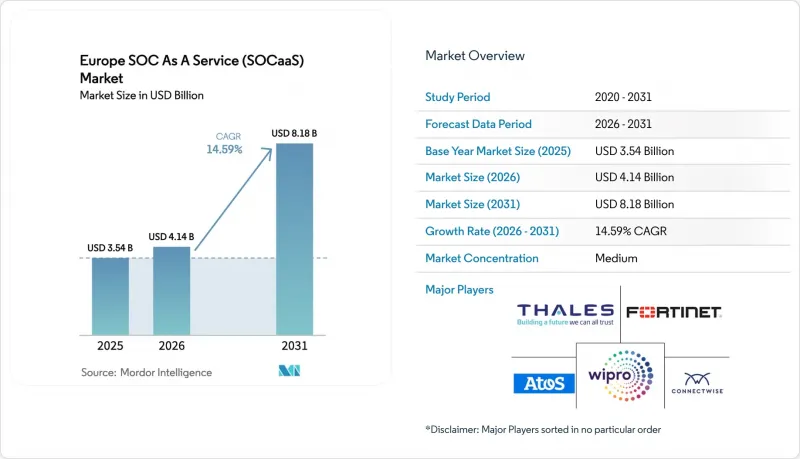
This report is Segmented by Organization Size (Small and Medium-Sized Enterprises, and Large Enterprises), End User (IT and Telecom, BFSI, and More), Service Type (Managed Detection and Response, and More), Deployment Mode (Cloud, On-Premise, and Hybrid), Security Type (Network Security, Endpoint Security, and More), and Geography. The Market Forecasts are Provided in Terms of Value (USD).
Europe SOC As A Service (SOCaaS) Market Trends and Insights
EU NIS2 Compliance Mandate
NIS2 widened the pool of regulated entities from roughly 2,000 to more than 160,000, compelling even mid-sized utilities, hospitals, and transport operators to maintain continuous monitoring or face fines up to EUR 10 million (USD 10.7 million). As few of these organizations can staff an in-house SOC around the clock, providers offering audit ready dashboards and automated incident reporting enjoy a sustained demand floor. German and French regulators reinforce the directive with national data-residency rules, effectively steering contracts toward vendors running data centers inside each country. Compared with the United States three-day reporting allowance, Europe's 24-hour window increases urgency and justifies premium pricing for AI enhanced detection.
Rapid Cloud Migration Among SMEs
Eurostat recorded that 45% of EU firms with 10-249 employees used cloud services in 2024, up from 38% three years earlier. This expansion dissolves the traditional perimeter, exposing identity and API layers that legacy firewalls miss. Budget constrained SMEs rarely field a dedicated security professional yet face the same ransomware surge as larger peers. Onboarding to SOCaaS platforms that auto-discover workloads inside Microsoft 365 or Google Workspace therefore offers high protection for a predictable monthly fee. Average total cost of ownership, including tooling and staff, runs roughly one-sixth of an in-house build, creating a clear economic argument.
Cyber Talent Scarcity
Europe lacked roughly 350,000 cybersecurity professionals in 2025, and median hiring time for a tier-two analyst exceeded four months in major economies. Wage inflation raises provider costs, and some vendors cap new customer intake until staffing pipelines catch up. Solutions include near-shoring to Romania and Bulgaria, heavy automation, and university partnerships like Orange Cyberdefense's dual-track master's program targeting 200 graduates per year by 2027. Despite these tactics, limited headcount slows onboarding speed and can constrain service quality during major incident surges.
Other drivers and restraints analyzed in the detailed report include:
- Generative-AI Threat Hunting
- XDR Bundling by Telcos and MSPs
- Data Residency and Sovereignty Rules
For complete list of drivers and restraints, kindly check the Table Of Contents.
Segment Analysis
Small and medium-sized enterprises account for a modest portion of total spending today, yet they are forecast to grow at a 15.68% CAGR between 2026 and 2031, overtaking large enterprises in incremental demand. Many SMEs came under NIS2 jurisdiction only in 2024, triggering a scramble for affordable 24x7 monitoring. Arctic Wolf's fixed-fee bundle at USD 5,000 per month, launched in 2025, removes unpredictable event-volume pricing and resonates with firms managing fewer than 250 users. In contrast, large enterprises that already run internal SOCs primarily outsource burst capacity or specialized functions, which tempers their growth rate. Nonetheless, big firms still represent 58.38% of Europe's SOC As A Service market share in 2025 because their infrastructures span multiple data centers, clouds, and operational technology networks.
Providers deploy separate go-to-market motions. For SMEs, vendors stress time to value, guided setup wizards, and pre-configured playbooks that attach to Microsoft 365 and Salesforce without professional services. For global conglomerates, contracts revolve around bespoke service level agreements, threat intelligence subscriptions, and executive tabletop exercises. As a result, the Europe SOC As A Service market size captured by SMEs is expected to almost triple by 2031, while large enterprise spending roughly doubles.
Banking financial services and insurance entities remain the top spenders, holding 24.53% of revenue in 2025 thanks to the Digital Operational Resilience Act. Yet healthcare is the fastest climber, advancing at 15.01% CAGR through 2031. Ransomware campaigns targeting hospitals rose 210% between 2023 and 2025, forcing clinical networks that historically underinvested in cybersecurity to sign multi-year SOCaaS contracts. Insurance renewals now require documented 24x7 monitoring, driving up funnel conversion.
Meanwhile, manufacturing firms struggle to integrate legacy programmable logic controllers that lack logging, slowing uptake but opening niche demand for OT aware offerings like Fortinet's 2025 FortiSOC launch. Government buyers expand as national budgets allocate ring fenced funds, but procurement fragmentation across municipalities tempers immediate adoption.
Complete Report Scope:
- By Organization Size
- Small and Medium-Sized Enterprises
- Large Enterprises
- By End User
- IT and Telecom
- BFSI
- Retail and Consumer Goods
- Healthcare
- Manufacturing
- Government
- Other End Users
- By Service Type
- Managed Detection and Response
- Security Monitoring
- Vulnerability Assessment
- Incident Response
- Threat Intelligence
- Managed SIEM
- Other Service Types
- By Deployment Mode
- Cloud
- On-Premise
- Hybrid
- By Security Type
- Network Security
- Endpoint Security
- Application Security
- Cloud Security
- Other Security Types
- By Country
- Germany
- United Kingdom
- France
- Italy
- Spain
- Netherlands
- Austria
- Belgium
- Sweden
- Rest of Europe
List of Companies Covered in this Report:
- IBM Corporation
- SecureWorks Inc.
- Fortinet Inc.
- Atos SE
- Thales Group
- Wipro Limited
- Cloudflare Inc.
- ConnectWise LLC
- Sophos Limited
- Ontinue Inc.
- PlusServer GmbH
- Teceze Limited
- Arctic Wolf Networks Inc.
- Rapid7 Inc.
- Orange Cyberdefense SA
- NTT Security Holdings Corporation
- Accenture PLC
- Telefonica Tech S.L.U.
- Deloitte Touche Tohmatsu Limited
- KPMG International Limited
Additional Benefits:
- The market estimate (ME) sheet in Excel format
- 3 months of analyst support
TABLE OF CONTENTS
1 INTRODUCTION
- 1.1 Study Assumptions and Market Definition
- 1.2 Scope of the Study
2 RESEARCH METHODOLOGY
3 EXECUTIVE SUMMARY
4 MARKET LANDSCAPE
- 4.1 Market Overview
- 4.2 Impact of Macroeconomic Factors
- 4.3 Industry Value-Chain Analysis
- 4.4 Regulatory Landscape
- 4.5 Technological Outlook
- 4.6 Porter's Five Forces Analysis
- 4.6.1 Threat of New Entrants
- 4.6.2 Bargaining Power of Buyers
- 4.6.3 Bargaining Power of Suppliers
- 4.6.4 Threat of Substitutes
- 4.6.5 Competitive Rivalry
- 4.7 Market Drivers
- 4.7.1 Rise in Adoption of Pay-per-Use Opex Model
- 4.7.2 Rapid Cloud Migration Among SMEs
- 4.7.3 Mounting Cyber-Insurance Prerequisites for 24x7 Monitoring
- 4.7.4 EU NIS2 Directive Amplifying Compliance Demand
- 4.7.5 Generative AI-Powered Threat Hunting Capabilities
- 4.7.6 Surge in Managed XDR Bundling by Telcos and MSPs
- 4.7.7 Increasing Availability of Sovereign European Clouds
- 4.8 Market Restraints
- 4.8.1 Data Residency and Sovereignty Complexities
- 4.8.2 Scarcity of European SOC-Grade Cyber Talent
- 4.8.3 Hidden Long-Term TCO in Multi-Tenant SIEM
- 4.8.4 Integration Friction with Legacy OT Environments
5 MARKET SIZE AND GROWTH FORECASTS (VALUE)
- 5.1 By Organization Size
- 5.1.1 Small and Medium-Sized Enterprises
- 5.1.2 Large Enterprises
- 5.2 By End User
- 5.2.1 IT and Telecom
- 5.2.2 BFSI
- 5.2.3 Retail and Consumer Goods
- 5.2.4 Healthcare
- 5.2.5 Manufacturing
- 5.2.6 Government
- 5.2.7 Other End Users
- 5.3 By Service Type
- 5.3.1 Managed Detection and Response
- 5.3.2 Security Monitoring
- 5.3.3 Vulnerability Assessment
- 5.3.4 Incident Response
- 5.3.5 Threat Intelligence
- 5.3.6 Managed SIEM
- 5.3.7 Other Service Types
- 5.4 By Deployment Mode
- 5.4.1 Cloud
- 5.4.2 On-Premise
- 5.4.3 Hybrid
- 5.5 By Security Type
- 5.5.1 Network Security
- 5.5.2 Endpoint Security
- 5.5.3 Application Security
- 5.5.4 Cloud Security
- 5.5.5 Other Security Types
- 5.6 By Country
- 5.6.1 Germany
- 5.6.2 United Kingdom
- 5.6.3 France
- 5.6.4 Italy
- 5.6.5 Spain
- 5.6.6 Netherlands
- 5.6.7 Austria
- 5.6.8 Belgium
- 5.6.9 Sweden
- 5.6.10 Rest of Europe
6 COMPETITIVE LANDSCAPE
- 6.1 Market Concentration
- 6.2 Strategic Moves
- 6.3 Market Share Analysis
- 6.4 Company Profiles (includes Global Level Overview, Market Level Overview, Core Segments, Financials as available, Strategic Information, Market Rank/Share, Products and Services, Recent Developments)
- 6.4.1 IBM Corporation
- 6.4.2 SecureWorks Inc.
- 6.4.3 Fortinet Inc.
- 6.4.4 Atos SE
- 6.4.5 Thales Group
- 6.4.6 Wipro Limited
- 6.4.7 Cloudflare Inc.
- 6.4.8 ConnectWise LLC
- 6.4.9 Sophos Limited
- 6.4.10 Ontinue Inc.
- 6.4.11 PlusServer GmbH
- 6.4.12 Teceze Limited
- 6.4.13 Arctic Wolf Networks Inc.
- 6.4.14 Rapid7 Inc.
- 6.4.15 Orange Cyberdefense SA
- 6.4.16 NTT Security Holdings Corporation
- 6.4.17 Accenture PLC
- 6.4.18 Telefonica Tech S.L.U.
- 6.4.19 Deloitte Touche Tohmatsu Limited
- 6.4.20 KPMG International Limited
7 MARKET OPPORTUNITIES AND FUTURE OUTLOOK
- 7.1 White-Space and Unmet-Need Assessment

