PUBLISHER: Mordor Intelligence | PRODUCT CODE: 2125739

PUBLISHER: Mordor Intelligence | PRODUCT CODE: 2125739
Cosmetic And Fragrance Retail Chain - Market Share Analysis, Industry Trends & Statistics, Growth Forecasts (2026 - 2031)
According to Mordor Intelligence, the cosmetics and fragrance retail chain market size is expected to grow from USD 190.28 billion in 2025 to USD 196.03 billion in 2026 and is forecast to reach USD 227.64 billion by 2031 at 3.02% CAGR over 2026-2031.
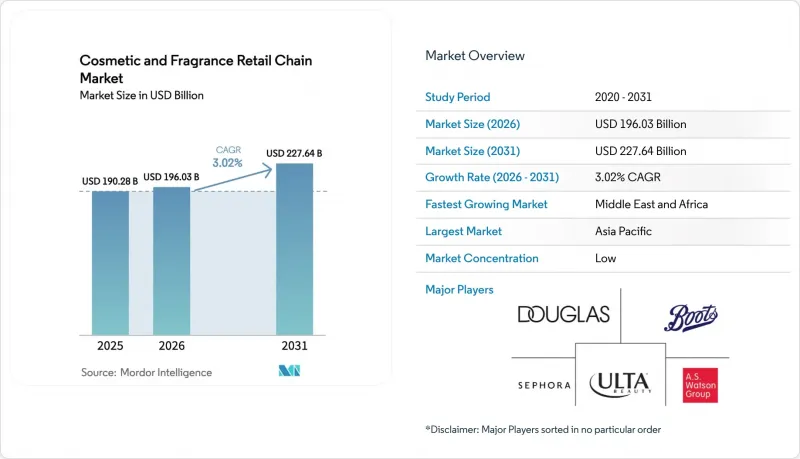
This report is Segmented by Product Type (Hair Care, Skin Care, Make-Up Products, Deodorants, Fragrances), Category (Mass, Premium), End User (Men, Women, Unisex), and Geography (North America, South America, Europe, Asia-Pacific, Middle East and Africa). The Market Forecasts are Provided in Terms of Value (USD).
Global Cosmetic And Fragrance Retail Chain Market Trends and Insights
Experiential Retail-tainment Formats Driving Footfall
Chains redesign flagship locations into mini entertainment hubs that mix tutorials, cafe corners, and selfie zones to counter e-commerce substitution. Sephora's Beauty Studio concept more than doubled average dwell time to 28 minutes and lifted basket values by 35% in Los Angeles and Shanghai stores in 2025. A.S. Watson pumped USD 250 million into 6,000 Asia redesigns, layering QR-code-enabled discovery and O+O journeys that funnel app engagement. Chinese newcomer Harmay placed cinema-themed outlets inside Universal Studios Beijing, creating Instagrammable set pieces that amplify free social media reach. Immersive formats convert passive browsing into interactive discovery, encouraging impulse purchases across categories. They also feed loyalty apps with rich behavioural data that sharpens future targeting. As landlords seek foot-traffic magnets, retailers parlay these experience centers into favorable lease terms that reduce occupancy costs.
Omnichannel Loyalty Ecosystems
Modern loyalty programs evolve from discount engines into data-rich platforms that underpin retail media networks. Sephora's Beauty Insider surpassed 38 million members by mid-2025 and now delivers 25% of total sales through personalized offers. Ulta Beauty's Ultamate Rewards integrates credit cards, virtual consultations, and early-access drops, driving 95% of the revenue and tripling customer lifetime value for top-tier members. These ecosystems generate ad inventory for brands eager to pay premium CPMs for highly segmented audiences. Transactional data also guides dynamic pricing and localized merchandising, shrinking stockouts and markdowns. As privacy regulations tighten, chains owning opt-in data gain durable advantages over social-media marketing. The resulting switching costs lock shoppers into closed loops that competitors find hard to disrupt.
Inflation-Driven Trading-Down
Persistent cost-of-living pressures steer shoppers from prestige fragrances into value skincare and private-label bath goods. In 2025, private-label penetration at leading chains rose to 18% of category sales, capturing customers with 30-50% lower price points. Retailers launched tiered assortments that preserve volume but shave gross margin by roughly 150 basis points. Promotional stacking and buy-one-get-one events keep foot traffic stable yet risk brand dilution. Mass brands capitalize on the shift by touting dermatologist-backed claims that mimic prestige positioning at friendlier prices. Over time, trading down may ease as wages catch up, but the episode underscores revenue sensitivity to macro shocks. Chains hedge by flexing SKU depth and maintaining agile supply to pivot between tiers.
Other drivers and restraints analyzed in the detailed report include:
- AI-Enabled Hyper-Personalization & Virtual Try-On
- Cross-Border E-Commerce & Same-Day Delivery
- Stricter Sustainability Regulations
For complete list of drivers and restraints, kindly check the Table Of Contents.
Segment Analysis
Skin care retained a 39.02% slice of the cosmetics and fragrance retail chain market share in 2025, underpinned by daily routine stickiness and science-driven launches that command premium pricing . The category's resilience buffered chains during pandemic cycles and now fuels steady upgrade flows to serums and derm-actives. Innovation, such as RXRa-activating complexes, demonstrated 8.90% wrinkle reduction in clinical trials, justifying fresh price ladders that lift average selling prices. Fragrance, while smaller, is forecast to post an 7.95% CAGR, linking scent layering and limited-edition drops to collectability dynamics. Hair care's loyal user base provides recurring revenue yet faces commoditization absent novel claims like microbiome-friendly formulas. Color cosmetics recover gradually as office attendance normalizes, though screen-time skincare blends blur traditional category lines. Deodorants stay flat but are strategic for cross-selling kits that raise basket size.
Second-order effects reinforce category interplay across channels. AI skin analyzers push regimen bundles that increase units per transaction while lowering return risk. Fragrance discovery kits in subscription boxes introduce niche houses, translating curiosity into full-size store purchases. Premium sample-size walls meet travel demand and encourage trial at lower entry costs. Category adjacencies spur store-within-store storytelling: for example, shower gels scented to match flagship perfumes. As virtual avatars proliferate, digital-first launches arrive online and then backfill into physical shelves, reversing historical cadence. Ultimately, product-type breadth enables chains to balance cyclical weaknesses and maintain customer engagement throughout the year.
Complete Report Scope:
- By Product Type
- Hair Care
- Skin Care
- Make-Up Products
- Deodorants
- Fragrances
- By Category
- Mass
- Premium
- By End User
- Men
- Women
- Unisex
- By Geography
- North America
- United States
- Canada
- Mexico
- South America
- Brazil
- Peru
- Chile
- Argentina
- Rest of South America
- Europe
- United Kingdom
- Germany
- France
- Spain
- Italy
- BENELUX (Belgium, Netherlands, Luxembourg)
- NORDICS (Denmark, Finland, Iceland, Norway, Sweden)
- Rest of Europe
- Asia-Pacific
- India
- China
- Japan
- Australia
- South Korea
- South-East Asia (Singapore, Malaysia, Thailand, Indonesia, Vietnam, Philippines)
- Rest of Asia-Pacific
- Middle East and Africa
- United Arab Emirates
- Saudi Arabia
- South Africa
- Nigeria
- Rest of Middle East and Africa
- North America
Geography Analysis
Asia-Pacific delivered 35.78% of global revenue in 2025, with digital ecosystems like Douyin enabling domestic brands to scale rapidly to billion-yuan benchmarks. High mobile penetration synchronizes live-streamed tutorials with one-click conversion, shrinking the path to purchase. Korea's beauty tourism lures nearly 800,000 medical visitors annually, who then stock up on skincare souvenirs that ripple through retail sales. China's tier-2 and tier-3 cities power incremental store openings as coastal markets saturate, underpinning steady expansion. Meanwhile, Japan and Australia provide mature-market stability, buttressing regional EBIT margins. Local players such as Olive Young exemplify O+O excellence, compelling global peers to localize assortments and app UX.
Middle East & Africa posts the fastest 9.48% CAGR to 2031, fueled by youthful demographics and a cultural affinity for fragrance gifting traditions. GCC e-commerce adoption accelerates click-and-collect demand as extreme temperatures drive indoor mall traffic year-round. Duty-free hubs at Dubai and Doha airports amplify prestige perfume exposure, becoming trial funnels into domestic retail. North Africa's expanding middle class seeks affordable luxuries, prompting value-tier launches from Western brands. Sustainable packaging resonates due to rising environmental awareness, but must coexist with ornate aesthetics favoured in gift culture. Political stability gains in markets like Saudi Arabia unlock real estate flagship-format at flagships, accelerating store penetration.
Europe and North America hold mature but innovation-driven positions, where experiential upgrades and sustainability mandates define competitive edge. EU PPWR standards impose recycled-content thresholds, compelling packaging redesigns that add differentiation for early adopters. In North America, the exit of Ulta shop-in-shops at Target in 2026 opens shelf space for private brands, repricing concessions across the channel. Prestige disciples gravitate to department-store revamps such as Saks-Neiman consolidation moves that promise broader assortments and cross-border shipping. Across both continents, data privacy frameworks pressure performance marketing budgets, reinforcing the value of retailer-owned media channels.
- Sephora (LVMH)
- Ulta Beauty
- A.S. Watson Group (-Watsons / Superdrug / ICI Paris XL ...)
- Douglas
- Boots UK (Walgreens Boots Alliance)
- Marionnaud
- ICI Paris XL
- Superdrug
- The Perfume Shop
- Shoppers Drug Mart
- Falabella-SISLEY Beauty (Latin America)
- Natura-&-Co / The Body Shop Retail
- Lotte Duty Free Beauty (South Korea)
- Harmay
- Wow Colour
- Flaconi
- Eveandboy
- Clicks Group (South Africa)
- DM-Drogerie Markt
- Muller Drogerie
- Rossmann
- Nykaa Retail
- KK Beauty (Japan)
- Sa Sa International
- Farmacias Similares Beauty (Mexico)
Additional Benefits:
- The market estimate (ME) sheet in Excel format
- 3 months of analyst support
TABLE OF CONTENTS
1 Introduction
- 1.1 Study Assumptions & Market Definition
- 1.2 Scope of the Study
2 Research Methodology
3 Executive Summary
4 Market Landscape
- 4.1 Market Overview
- 4.2 Market Drivers
- 4.2.1 Experiential "retail-tainment" store formats driving footfall
- 4.2.2 Omnichannel loyalty ecosystems (>=50 M+ members at leading chains)
- 4.2.3 Prestige-brand shop-in-shop partnerships with mass retailers
- 4.2.4 AI-enabled hyper-personalisation & virtual try-on conversion uplift
- 4.2.5 Cross-border e-commerce & same-day delivery fulfilment expansion
- 4.2.6 Emerging-market middle-class spend on premium beauty
- 4.3 Market Restraints
- 4.3.1 Inflation-driven "trading-down" to mass & private label
- 4.3.2 Grey-market leakage eroding selective distribution pricing power
- 4.3.3 Stricter sustainability regulations increasing compliance costs
- 4.3.4 Intensifying online price transparency compressing margins
- 4.4 Value / Supply-Chain Analysis
- 4.5 Regulatory Landscape
- 4.6 Technological Outlook
- 4.7 Porter's Five Forces
- 4.7.1 Threat of New Entrants
- 4.7.2 Bargaining Power of Suppliers
- 4.7.3 Bargaining Power of Buyers
- 4.7.4 Threat of Substitutes
- 4.7.5 Competitive Rivalry
5 Market Size & Growth Forecasts
- 5.1 By Product Type
- 5.1.1 Hair Care
- 5.1.2 Skin Care
- 5.1.3 Make-Up Products
- 5.1.4 Deodorants
- 5.1.5 Fragrances
- 5.2 By Category
- 5.2.1 Mass
- 5.2.2 Premium
- 5.3 By End User
- 5.3.1 Men
- 5.3.2 Women
- 5.3.3 Unisex
- 5.4 By Geography
- 5.4.1 North America
- 5.4.1.1 United States
- 5.4.1.2 Canada
- 5.4.1.3 Mexico
- 5.4.2 South America
- 5.4.2.1 Brazil
- 5.4.2.2 Peru
- 5.4.2.3 Chile
- 5.4.2.4 Argentina
- 5.4.2.5 Rest of South America
- 5.4.3 Europe
- 5.4.3.1 United Kingdom
- 5.4.3.2 Germany
- 5.4.3.3 France
- 5.4.3.4 Spain
- 5.4.3.5 Italy
- 5.4.3.6 BENELUX (Belgium, Netherlands, Luxembourg)
- 5.4.3.7 NORDICS (Denmark, Finland, Iceland, Norway, Sweden)
- 5.4.3.8 Rest of Europe
- 5.4.4 Asia-Pacific
- 5.4.4.1 India
- 5.4.4.2 China
- 5.4.4.3 Japan
- 5.4.4.4 Australia
- 5.4.4.5 South Korea
- 5.4.4.6 South-East Asia (Singapore, Malaysia, Thailand, Indonesia, Vietnam, Philippines)
- 5.4.4.7 Rest of Asia-Pacific
- 5.4.5 Middle East and Africa
- 5.4.5.1 United Arab Emirates
- 5.4.5.2 Saudi Arabia
- 5.4.5.3 South Africa
- 5.4.5.4 Nigeria
- 5.4.5.5 Rest of Middle East and Africa
- 5.4.1 North America
6 Competitive Landscape
- 6.1 Market Concentration
- 6.2 Strategic Moves
- 6.3 Market Share Analysis
- 6.4 Company Profiles {(includes Global level Overview, Market level overview, Core Segments, Financials as available, Strategic Information, Market Rank/Share for key companies, Products & Services, and Recent Developments)}
- 6.4.1 Sephora (LVMH)
- 6.4.2 Ulta Beauty
- 6.4.3 A.S. Watson Group (-Watsons / Superdrug / ICI Paris XL ...)
- 6.4.4 Douglas
- 6.4.5 Boots UK (Walgreens Boots Alliance)
- 6.4.6 Marionnaud
- 6.4.7 ICI Paris XL
- 6.4.8 Superdrug
- 6.4.9 The Perfume Shop
- 6.4.10 Shoppers Drug Mart
- 6.4.11 Falabella-SISLEY Beauty (Latin America)
- 6.4.12 Natura-&-Co / The Body Shop Retail
- 6.4.13 Lotte Duty Free Beauty (South Korea)
- 6.4.14 Harmay
- 6.4.15 Wow Colour
- 6.4.16 Flaconi
- 6.4.17 Eveandboy
- 6.4.18 Clicks Group (South Africa)
- 6.4.19 DM-Drogerie Markt
- 6.4.20 Muller Drogerie
- 6.4.21 Rossmann
- 6.4.22 Nykaa Retail
- 6.4.23 KK Beauty (Japan)
- 6.4.24 Sa Sa International
- 6.4.25 Farmacias Similares Beauty (Mexico)
7 Market Opportunities & Future Outlook
- 7.1 ESG-driven refill/re-use retail formats monetising circular beauty
- 7.2 Cross-border retail media networks leveraging 1st-party beauty data

