PUBLISHER: Mordor Intelligence | PRODUCT CODE: 2072568

PUBLISHER: Mordor Intelligence | PRODUCT CODE: 2072568
Coffee Beauty Products - Market Share Analysis, Industry Trends & Statistics, Growth Forecasts (2025 - 2030)
According to Mordor Intelligence, the coffee-based beauty products market size is estimated to be USD 0.95 billion in 2025 and is forecast to reach USD 1.24 billion by 2030, expanding at a 5.42% CAGR.
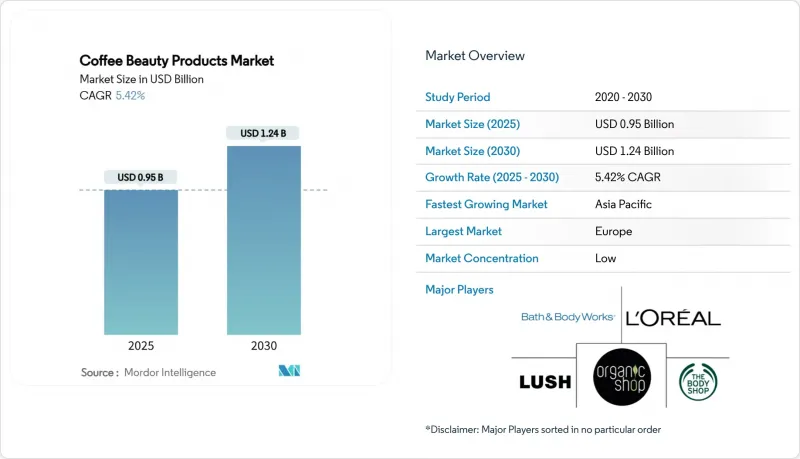
This report is Segmented by Product Type (Skin Care, Hair Care, Body Care, Fragrances), Category (Mass, Premium), End User (Women, Men, Unisex), Distribution Channel (Supermarkets/Hypermarkets, Health and Beauty Stores, Online Retail Stores, Other Distribution Channels), and Geography (North America, Europe, Asia-Pacific, and More). The Market Forecasts are Provided in Terms of Value (USD).
Global Coffee Beauty Products Market Trends and Insights
Rising demand for clean-label caffeine-based skin care
Consumer demand for clean-label caffeine-based skincare products continues to increase as buyers seek natural and transparent personal care solutions that deliver effective results. Caffeine's antioxidant and anti-inflammatory properties help reduce puffiness and improve circulation, attracting health-conscious consumers looking for visible skin benefits without synthetic ingredients. The clean-label movement emphasizes ingredient transparency, ethical sourcing, and the elimination of harmful substances like parabens and sulfates. This aligns with caffeine's natural properties, enhancing its market appeal. Social media platforms and influencer marketing have increased consumer awareness and confidence in caffeine-infused skincare products, particularly among Millennials and Generation Z consumers. Companies such as Frank Body and Bean Body Care demonstrate market success through their targeted coffee-based formulations that combine effectiveness with natural ingredients. Additionally, caffeine's versatility in addressing anti-aging and skin revitalization has led to its incorporation in various products, including creams, serums, and masks within the clean-beauty category. The growth of e-commerce platforms has improved global accessibility to these specialized products, contributing to market expansion. The increasing popularity of caffeine in skincare reflects a broader consumer shift toward wellness-focused, clean-label personal care products that provide scientifically supported results while meeting sustainability and ethical standards. The market for caffeine-based skincare products is expected to grow at a higher rate than the overall beauty market in the next ten years.
Growing awareness of caffeine skin benefits
Consumer awareness regarding caffeine's skin benefits continues to drive market expansion in beauty and personal care segments. Caffeine's proven effectiveness in reducing puffiness, brightening under-eye circles, and protecting against environmental damage has established its position in skincare formulations. As an antioxidant and vasoconstrictor, caffeine reduces inflammation, tightens blood vessels, and prevents free-radical damage, making it valuable for anti-aging and skin revitalization products. Millennials and Gen Z consumers, focused on natural skincare solutions, are drawn to caffeine-based products that deliver results without harsh chemicals. The ingredient's documented ability to enhance microcirculation and provide temporary skin-tightening effects meets this consumer demand. Beauty brands have expanded their caffeine-based product lines to include eye creams, face masks, and serums. For instance, Revluk's coffee-infused face scrub demonstrates the market's use of caffeine's firming and brightening properties. Caffeine's reputation for reducing redness and improving skin luminosity has established it as a key ingredient in both daily skincare routines and specialized treatments. The market growth is supported by increased transparency in ingredient effectiveness and sustainable sourcing practices. Both niche brands and major beauty companies continue to educate consumers about caffeine's benefits, contributing to its increasing prominence in advanced skincare formulations globally.
Fluctuations in raw material supply and price swings
Supply chain disruptions and commodity price increase create significant operational challenges in the coffee beauty products industry during 2024. Coffee commodity prices have increased substantially, with Arabica beans rising by approximately 58% and Robusta by around 70% year-over-year . These increases stem from adverse climatic conditions, including droughts and erratic weather patterns affecting major producers such as Brazil, Vietnam, and Indonesia. The sharp rise in coffee prices directly impacts formulation costs across market segments, increasing the expenses for specialty coffee extracts and upcycled ingredients. Supply chain disruptions from reduced exports and poor harvests further affect availability and cost stability. The rising input costs reduce profit margins and particularly affect smaller and niche coffee beauty brands dependent on coffee-derived raw materials. The scarcity and price increases of high-quality Arabica coffee grounds, a common ingredient in exfoliating scrubs, affect product pricing and shelf life considerations. These issues highlight the market's sensitivity to external commodity factors, affecting growth potential despite increasing consumer demand for coffee-based personal care products. The industry may need to explore alternative solutions, including innovative sourcing methods, synthetic or lab-grown coffee actives, and enhanced supply chain resilience to control production costs and support market growth globally.
Other drivers and restraints analyzed in the detailed report include:
- Sustainable beauty trends
- Social media and influencer endorsements
- Allergenicity and caffeine-sensitivity concerns
For complete list of drivers and restraints, kindly check the Table Of Contents.
Segment Analysis
Skin care holds a 35.77% market share in 2024, driven by coffee's proven effectiveness in anti-aging and antioxidant applications. The hair care segment is growing at a 6.05% CAGR through 2030 as research validates its benefits beyond traditional scalp stimulation. Recent studies in 2024 demonstrate caffeine's ability to inhibit aging-related enzymes, including collagenase and elastase, while providing tyrosinase inhibition for managing hyperpigmentation. Face creams and lotions are the primary skin care products, utilizing caffeine's proven benefits in enhancing microcirculation and reducing dark circles. Besides, scrubs and exfoliators benefit from coffee grounds' natural exfoliating properties combined with antioxidant benefits. Also, hair care's growth is supported by research showing coffee bean residue extract promotes hair growth through autophagy activation, demonstrating efficacy similar to minoxidil with better safety outcomes. Shampoos incorporate caffeine for scalp benefits, while conditioners and masks use coffee oil derivatives to improve moisture retention and enhance shine.
Meanwhile, body care maintains consistent growth through coffee scrub products, while body lotions and butters use coffee extracts for cellulite reduction and skin firming, supported by research on enhanced lipolysis and microcirculation. The fragrance segment, though smaller, offers premium product opportunities by utilizing coffee's aromatic properties in perfumes and deodorants. Consumer familiarity with coffee's sensory characteristics facilitates acceptance of these topical applications. Research in 2024 shows a 300% improvement in caffeine absorption through electric field-induced lipid vesicles, enabling effective delivery without chemical enhancers while maintaining clean-label standards.
In 2024, mass market products hold a dominant 70.04% share of the global coffee beauty products market, highlighting a clear segmentation between mass and premium offerings. This dominance is primarily driven by competitive pricing and extensive distribution networks. Companies in the mass segment are utilizing coffee waste valorization, converting upcycled coffee grounds into cost-effective and sustainable cosmetic ingredients. This strategy not only supports price competitiveness but also aligns with the preferences of environmentally conscious consumers, reinforced by strong sustainability messaging. By leveraging the economics of upcycling, businesses ensure that coffee-based beauty products remain affordable while maintaining their commitment to sustainability.
Meanwhile, the premium segment is expanding rapidly, with a 7.29% CAGR projected through 2030. This growth is fueled by consumers prioritizing ingredient transparency, ethical sourcing, and clinically validated formulations over price considerations. Premium coffee beauty brands benefit from COSMOS certification, which facilitates compliance by emphasizing natural-origin ingredients, offering a competitive edge over synthetic alternatives. Certifications such as Fair Trade and Rainforest Alliance further enhance the appeal of these brands, attracting ethically driven consumers willing to pay a premium for verified sustainable sourcing. This dual-market dynamic enables premium innovations, such as clinically validated caffeine serums, to drive technological advancements and enhance category credibility, ultimately influencing product development and accessibility across the broader market.
Complete Report Scope:
- By Product Type
- Skin Care
- Face Creams and Lotions
- Scrubs and Exfoliators
- Masks and Peels
- Hair Care
- Shampoos
- Conditioners and Masks
- Others
- Body Care
- Body Scrubs
- Body Lotions and Butters
- Fragrances
- Perfumes
- Deodorants/Body Mists
- Skin Care
- By Category
- Mass
- Premium
- By End User
- Women
- Men
- Unisex
- By Distribution Channel
- Supermarkets/Hypermarkets
- Health and Beauty Stores
- Online Retail Stores
- Other Distribution Channels
- By Geography
- North America
- United States
- Canada
- Rest of North America
- Europe
- Germany
- United Kingdom
- Italy
- France
- Spain
- Rest of Europe
- Asia-Pacific
- China
- India
- Japan
- Australia
- Rest of Asia-Pacific
- South America
- Brazil
- Rest of South America
- Middle East and Africa
- South Africa
- United Arab Emirates
- Rest of Middle East and Africa
- North America
Geography Analysis
Europe accounts for 32.19% market share in 2024, supported by regulations promoting natural ingredients and consumer acceptance of premium pricing for sustainable products. The COSMOS certification mandate of 95% organic plant content for organic cosmetic certification enhances the market position of coffee-derived ingredients versus synthetic alternatives, according to Ecocert . Germany maintains regional market leadership through its established consumer base and natural product distribution channels, while the United Kingdom benefits from Food Standards Agency regulations on caffeine safety in consumer products. France's established luxury beauty market supports premium coffee-based formulations with clinical validation, supported by L'Oreal's target to reach 95% renewable ingredient sourcing by 2030. Italy and Spain's established coffee markets facilitate consumer adoption of coffee-based personal care products, while regional Fair Trade certification awareness supports product differentiation through ethical sourcing practices.
Asia-Pacific demonstrates a 6.24% CAGR through 2030, driven by urbanization, higher disposable incomes, and digital adoption that supports ingredient marketing to beauty-focused consumers. China generates significant volume growth through middle-class expansion and increased premium beauty product adoption. Japan's developed beauty market and established coffee consumption support the coffee-based personal care market growth. The Japan External Trade Organization's 2024 cosmetics webinar series on Korean beauty market insights facilitates knowledge transfer across Asia-Pacific markets. India's market expansion results from urban development and increased personal care expenditure, while Australia provides market stability through clear regulations and natural product market acceptance. Hong Kong's cosmetics market shows increased demand for natural and organic products, with e-commerce adoption enabling market access for coffee-based brands.
North America holds the largest market share in coffee beauty products, supported by established distribution networks and increasing demand for natural beauty solutions. The United States market expansion stems from consumer health awareness and targeted marketing of coffee-based skincare benefits. Moreover, South America shows market growth driven by rising consumption of coffee-based beauty products, particularly in scrubs and haircare segments. The region's expanding middle-class population supports demand for organic beauty products. Besides, the Middle East and Africa market demonstrates steady development in the coffee beauty segment. Growing e-commerce platforms and increasing consumer preference for premium beauty products drive market growth, despite regional infrastructure constraints.
- LOreal Group
- The Body Shop
- Lush Cosmetics
- Bath & Body Works, LLC.
- Pep Technologies Pvt Ltd (mCaffeine)
- Terre de Mars
- Frank Body
- The Organic Shop
- JAVA Skin Care
- Bean Body
- Callyssee
- UpCircle Beauty
- Gabi+Skin
- BEOX Professional
- Klarif Company
- Good Chemistry
- Naples Soap Company
- M3 Naturals
- Alfheim Beauty
- The Coffee Scrub Co,
Additional Benefits:
- The market estimate (ME) sheet in Excel format
- 3 months of analyst support
TABLE OF CONTENTS
1 INTRODUCTION
- 1.1 Study Assumptions and Market Definition
- 1.2 Scope of the Study
2 RESEARCH METHODOLOGY
3 EXECUTIVE SUMMARY
4 MARKET DYNAMICS
- 4.1 Market Overview
- 4.2 Market Drivers
- 4.2.1 Rising demand for clean-label caffeine-based skin care
- 4.2.2 Growing awareness of caffeine skin benefits
- 4.2.3 Sustainable beauty trends
- 4.2.4 Social media and influencer endorsements
- 4.2.5 Holistic self-care and wellness trends
- 4.2.6 Male grooming adoption
- 4.3 Market Restraints
- 4.3.1 Fluctuations in raw material supply and price swings
- 4.3.2 Allergenicity and caffeine-sensitivity concerns
- 4.3.3 Intense competition from non-coffee botanical claims
- 4.3.4 Limited clinical proof versus synthetic actives
- 4.4 Value Chain Analysis
- 4.5 Regulatory Landscape
- 4.6 Technological Outlook
- 4.7 Porter's Five Forces Analysis
- 4.7.1 Threat of New Entrants
- 4.7.2 Bargaining Power of Suppliers
- 4.7.3 Bargaining Power of Buyers
- 4.7.4 Threat of Substitutes
- 4.7.5 Competitive Rivalry
5 MARKET SIZE AND GROWTH FORECASTS (VALUE)
- 5.1 By Product Type
- 5.1.1 Skin Care
- 5.1.1.1 Face Creams and Lotions
- 5.1.1.2 Scrubs and Exfoliators
- 5.1.1.3 Masks and Peels
- 5.1.2 Hair Care
- 5.1.2.1 Shampoos
- 5.1.2.2 Conditioners and Masks
- 5.1.2.3 Others
- 5.1.3 Body Care
- 5.1.3.1 Body Scrubs
- 5.1.3.2 Body Lotions and Butters
- 5.1.4 Fragrances
- 5.1.4.1 Perfumes
- 5.1.4.2 Deodorants/Body Mists
- 5.1.1 Skin Care
- 5.2 By Category
- 5.2.1 Mass
- 5.2.2 Premium
- 5.3 By End User
- 5.3.1 Women
- 5.3.2 Men
- 5.3.3 Unisex
- 5.4 By Distribution Channel
- 5.4.1 Supermarkets/Hypermarkets
- 5.4.2 Health and Beauty Stores
- 5.4.3 Online Retail Stores
- 5.4.4 Other Distribution Channels
- 5.5 By Geography
- 5.5.1 North America
- 5.5.1.1 United States
- 5.5.1.2 Canada
- 5.5.1.3 Rest of North America
- 5.5.2 Europe
- 5.5.2.1 Germany
- 5.5.2.2 United Kingdom
- 5.5.2.3 Italy
- 5.5.2.4 France
- 5.5.2.5 Spain
- 5.5.2.6 Rest of Europe
- 5.5.3 Asia-Pacific
- 5.5.3.1 China
- 5.5.3.2 India
- 5.5.3.3 Japan
- 5.5.3.4 Australia
- 5.5.3.5 Rest of Asia-Pacific
- 5.5.4 South America
- 5.5.4.1 Brazil
- 5.5.4.2 Rest of South America
- 5.5.5 Middle East and Africa
- 5.5.5.1 South Africa
- 5.5.5.2 United Arab Emirates
- 5.5.5.3 Rest of Middle East and Africa
- 5.5.1 North America
6 COMPETITIVE LANDSCAPE
- 6.1 Market Concentration
- 6.2 Strategic Moves
- 6.3 Market Share Analysis
- 6.4 Company Profiles (includes Global level Overview, Market level overview, Core Segments, Financials as available, Strategic Information, Market Rank/Share for key companies, Products & Services, and Recent Developments)
- 6.4.1 LOreal Group
- 6.4.2 The Body Shop
- 6.4.3 Lush Cosmetics
- 6.4.4 Bath & Body Works, LLC.
- 6.4.5 Pep Technologies Pvt Ltd (mCaffeine)
- 6.4.6 Terre de Mars
- 6.4.7 Frank Body
- 6.4.8 The Organic Shop
- 6.4.9 JAVA Skin Care
- 6.4.10 Bean Body
- 6.4.11 Callyssee
- 6.4.12 UpCircle Beauty
- 6.4.13 Gabi+Skin
- 6.4.14 BEOX Professional
- 6.4.15 Klarif Company
- 6.4.16 Good Chemistry
- 6.4.17 Naples Soap Company
- 6.4.18 M3 Naturals
- 6.4.19 Alfheim Beauty
- 6.4.20 The Coffee Scrub Co,
7 MARKET OPPORTUNITIES AND FUTURE OUTLOOK

