PUBLISHER: Mordor Intelligence | PRODUCT CODE: 2125746

PUBLISHER: Mordor Intelligence | PRODUCT CODE: 2125746
Vietnam Electric Vehicle - Market Share Analysis, Industry Trends & Statistics, Growth Forecasts (2026 - 2031)
According to Mordor Intelligence, the Vietnam electric vehicle market size in 2026 is estimated at USD 3.71 billion, growing from the 2025 value of USD 3.12 billion, with 2031 projections showing USD 8.84 billion, growing at 18.95% CAGR over 2026-2031.
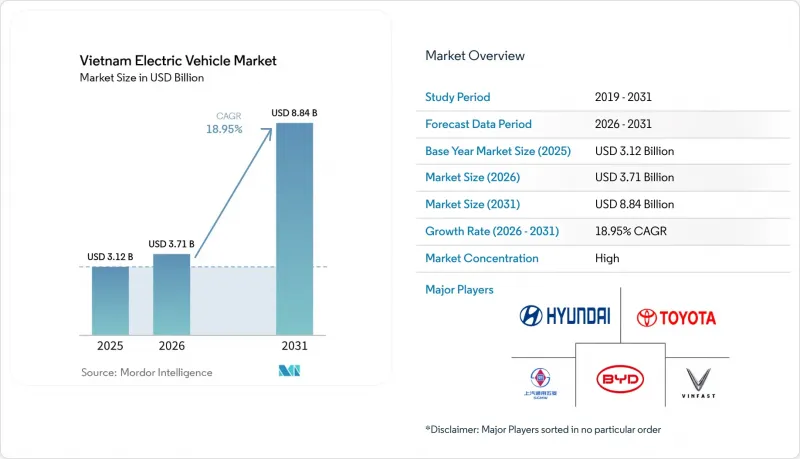
This report is Segmented by Vehicle Type (Passenger Cars, Commercial Vehicles, and More), Propulsion (Battery Electric Vehicles, Plug-In Hybrid Electric Vehicles, and More), Driving Range (Below 200 Km, 200 To 400 Km, and More), Battery Type (LFP, and More), End User (Private Ownership and More), and Region. The Market Forecasts are Provided in Terms of Value (USD) and Volume (Units).
Vietnam Electric Vehicle Market Trends and Insights
Domestic Manufacturing Scale-up
VinFast targets roughly 80% domestic content by 2026 while expanding installed capacity to about 500,000 vehicles by 2027 and up to 1 million units annually by 2030. This scale-up is designed to compress per-unit component costs, deepen supplier localization, and reduce exposure to exchange-rate volatility tied to imported parts. Parallel investment plans from Chery and Geely further strengthen Vietnam's position as an emerging regional assembly and export hub. However, high-value components such as advanced semiconductors, power electronics, and battery management systems continue to rely significantly on imports due to limited domestic fabrication capability. Long-term procurement and offtake agreements led by VinFast provide local suppliers with stronger demand visibility, supporting fresh capital expenditure, technology transfer, and faster ecosystem localization.
Government Incentives and Tax Rebates
The national incentive framework extends full registration-fee exemptions for battery electric vehicles through February 2027, materially lowering upfront acquisition costs for consumers and fleet operators. In parallel, import duties remain at 0% for vehicles sourced from ASEAN member states under prevailing regional trade agreements, reducing retail prices by more than VND 100 million per unit for qualifying models. Preferential EV charging tariffs set at approximately 2,204 VND/kWh further improve lifetime operating economics, narrowing payback periods versus internal combustion alternatives and strengthening the total cost of ownership proposition, underscoring multi-tier policy coordination. Continuity beyond 2027 depends on reaching cost parity, exposing the market to fiscal-policy rollover risk.
Sparse Public Charging Infrastructure
While charging infrastructure remains relatively dense across tier-one urban clusters, coverage declines sharply along rural and inter-city corridors, constraining long-distance travel viability and limiting demand for models exceeding sub-200 km range brackets. This uneven distribution restricts broader geographic market expansion beyond metropolitan centers. V-Green has committed approximately USD 404 million to accelerate nationwide station deployment, yet permitting cycles, grid integration timelines, and construction lead times suggest near-term bottlenecks will persist. Seasonal electricity demand spikes further expose grid stress risks, prompting government directives focused on strengthening transmission capacity and ensuring power-supply resilience to support sustained EV penetration.
Other drivers and restraints analyzed in the detailed report include:
- Rising Environmental Awareness and Net-Zero Targets
- Electric Two-wheeler Ecosystem Spill-over
- High Up-front Vehicle Cost vs Average Income
For complete list of drivers and restraints, kindly check the Table Of Contents.
Segment Analysis
Passenger cars accounted for 67.65% of total revenue in 2025, maintaining leadership in overall market contribution, while buses recorded the fastest expansion trajectory at a 33.11% CAGR. The bus segment is expected to scale rapidly through 2028 as provincial electrification mandates unlock sizeable public tenders and structured procurement cycles. Although private ownership dominates the current vehicle base, commercial operators are increasingly shaping incremental demand. Large-scale deployments in Ho Chi Minh City and the central-district electrification roadmap in Hanoi are creating predictable bulk orders that strengthen supplier visibility and manufacturing planning.
High daily utilization rates in fleet operations amplify total-cost-of-ownership advantages, positioning commercial buyers as early adopters of advanced battery chemistries and high-capacity fast-charging solutions. Meanwhile, two-wheelers continue serving commuter flows across peri-urban and rural corridors, indirectly improving charging-station utilization economics that also support four-wheeler penetration. Over the forecast horizon, passenger-car revenue share is likely to moderate slightly despite rising absolute volumes, as buses and electric vans gain policy-driven traction in public transport modernization and last-mile logistics networks.
Battery electric vehicles (BEVs) accounted for 70.82% of the total market share in 2025, clearly outperforming hybrid and plug-in hybrid alternatives. This lead is expected to widen as BEV volumes expand at a projected 27.85% CAGR, supported by a national policy framework that prioritizes full electrification over transitional drivetrain technologies. Hybrids retain selective demand among peri-urban users seeking extended range flexibility, yet comparatively limited fiscal incentives constrain broader uptake. Fuel-cell vehicles remain largely at a pilot stage due to minimal hydrogen infrastructure and high deployment costs.
VinFast's concentrated BEV-focused product strategy reinforces the pure-electric positioning in consumer perception, while nationwide charging incentives further strengthen adoption momentum. International automakers may introduce plug-in hybrid variants as a hedge against residual range anxiety, but regulatory direction continues to favor fully electric platforms. Continuous battery improvements are reducing charging times and improving energy density, narrowing the functional gap that once justified hybrid premiums. Consequently, the Vietnam electric vehicle market is progressing along a direct-to-BEV trajectory rather than following the phased hybrid transition observed in several mature economies.
Complete Report Scope:
- By Vehicle Type
- Passenger Cars
- Commercial Vehicles
- Two-Wheelers
- Buses
- By Propulsion
- Battery Electric Vehicles (BEV)
- Plug-in Hybrid Electric Vehicles (PHEV)
- Hybrid Electric Vehicles (HEV)
- Fuel-Cell Electric Vehicles (FCEV)
- By Driving Range
- Below 200 km
- 200 to 400 km
- Above 400 km
- By Battery Type
- LFP
- NMC/NCA
- Others
- By End User
- Private Ownership
- Commercial Fleet/Ride-Hailing
- Government and Public Transport
- By Region
- Northern Vietnam
- Central Vietnam
- Southern Vietnam
List of Companies Covered in this Report:
- VinFast Auto Ltd.
- Hyundai Motor Company
- Toyota Motor Corporation
- BYD Auto Co. Ltd
- SAIC-GM-Wuling Automobile Co., Ltd.
- Tesla Inc.
- Mercedes-Benz Group AG
- Kia Corporation
- Nissan Motor Co. Ltd
- Honda Motor Co. Ltd
- MG Motor (China)
- Chery Automobile Co.
- Great Wall Motor (Haval)
- Volvo Car AB
- Selex Motors (VN)
- Dat Bike (VN)
- Foxconn EV Charging (VN)
- VinES Battery (VN)
- ABB Vietnam (Chargers)
- Delta Electronics (VN)
Additional Benefits:
- The market estimate (ME) sheet in Excel format
- 3 months of analyst support
TABLE OF CONTENTS
1 Introduction
- 1.1 Study Assumptions and Market Definition
- 1.2 Scope of the Study
2 Research Methodology
3 Executive Summary
4 Market Landscape
- 4.1 Market Overview
- 4.2 Market Drivers
- 4.2.1 Domestic Manufacturing Scale-up (VinFast and Imports)
- 4.2.2 Government Incentives and Tax Rebates
- 4.2.3 Rising Environmental Awareness and Net-Zero Targets
- 4.2.4 Electric Two-Wheeler Ecosystem Spill-Over
- 4.2.5 Falling Battery Pack Prices
- 4.2.6 Preferential EV-Charging Tariff Structure
- 4.3 Market Restraints
- 4.3.1 Sparse Public Charging Infrastructure
- 4.3.2 High Up-Front Vehicle Cost Vs Average Income
- 4.3.3 Limited Mid-Range Model Availability
- 4.3.4 Grid Capacity Constraints At Peak Hours
- 4.4 Value/Supply-Chain Analysis
- 4.5 Regulatory Landscape
- 4.6 Technological Outlook
- 4.7 Porters Five Forces
- 4.7.1 Threat of New Entrants
- 4.7.2 Bargaining Power of Buyers
- 4.7.3 Bargaining Power of Suppliers
- 4.7.4 Threat of Substitutes
- 4.7.5 Competitive Rivalry
- 4.8 EV Charging Infrastructure Development
5 Market Size and Growth Forecasts (Value (USD) and Volume (Units))
- 5.1 By Vehicle Type
- 5.1.1 Passenger Cars
- 5.1.2 Commercial Vehicles
- 5.1.3 Two-Wheelers
- 5.1.4 Buses
- 5.2 By Propulsion
- 5.2.1 Battery Electric Vehicles (BEV)
- 5.2.2 Plug-in Hybrid Electric Vehicles (PHEV)
- 5.2.3 Hybrid Electric Vehicles (HEV)
- 5.2.4 Fuel-Cell Electric Vehicles (FCEV)
- 5.3 By Driving Range
- 5.3.1 Below 200 km
- 5.3.2 200 to 400 km
- 5.3.3 Above 400 km
- 5.4 By Battery Type
- 5.4.1 LFP
- 5.4.2 NMC/NCA
- 5.4.3 Others
- 5.5 By End User
- 5.5.1 Private Ownership
- 5.5.2 Commercial Fleet/Ride-Hailing
- 5.5.3 Government and Public Transport
- 5.6 By Region
- 5.6.1 Northern Vietnam
- 5.6.2 Central Vietnam
- 5.6.3 Southern Vietnam
6 Competitive Landscape
- 6.1 Market Concentration
- 6.2 Strategic Moves
- 6.3 Market Share Analysis
- 6.4 Company Profiles (Includes Global Level Overview, Market Level Overview, Core Segments, Financials as Available, Strategic Information, Market Rank/Share for Key Companies, Products and Services, SWOT Analysis, and Recent Developments)
- 6.4.1 VinFast Auto Ltd.
- 6.4.2 Hyundai Motor Company
- 6.4.3 Toyota Motor Corporation
- 6.4.4 BYD Auto Co. Ltd
- 6.4.5 SAIC-GM-Wuling Automobile Co., Ltd.
- 6.4.6 Tesla Inc.
- 6.4.7 Mercedes-Benz Group AG
- 6.4.8 Kia Corporation
- 6.4.9 Nissan Motor Co. Ltd
- 6.4.10 Honda Motor Co. Ltd
- 6.4.11 MG Motor (China)
- 6.4.12 Chery Automobile Co.
- 6.4.13 Great Wall Motor (Haval)
- 6.4.14 Volvo Car AB
- 6.4.15 Selex Motors (VN)
- 6.4.16 Dat Bike (VN)
- 6.4.17 Foxconn EV Charging (VN)
- 6.4.18 VinES Battery (VN)
- 6.4.19 ABB Vietnam (Chargers)
- 6.4.20 Delta Electronics (VN)
7 Market Opportunities and Future Outlook
- 7.1 White-space and Unmet-Need Assessment

