PUBLISHER: Mordor Intelligence | PRODUCT CODE: 2125750

PUBLISHER: Mordor Intelligence | PRODUCT CODE: 2125750
Photo Printing - Market Share Analysis, Industry Trends & Statistics, Growth Forecasts (2026 - 2031)
According to Mordor Intelligence, the photo printing market size was valued at USD 26.61 billion in 2025 and estimated to grow from USD 27.76 billion in 2026 to reach USD 34.34 billion by 2031, at a CAGR of 4.33% during the forecast period (2026-2031).
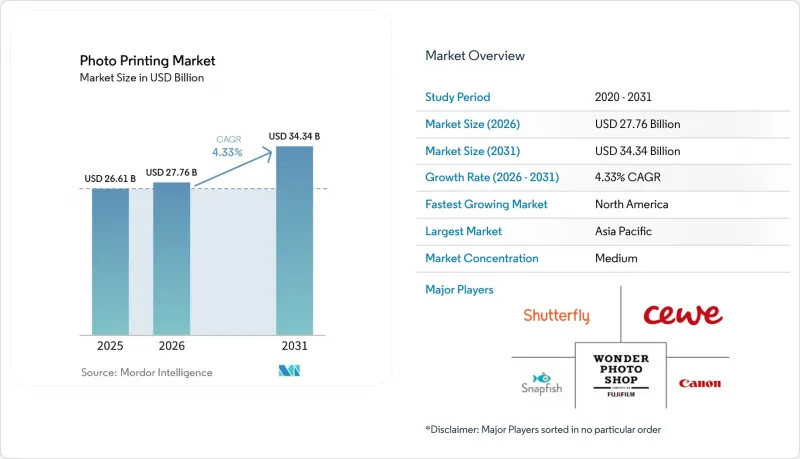
This report is Segmented by Product Type (Photo Prints, Photobooks, and More), by Print Technology (Inkjet, Dye-Sublimation, and More), by Distribution Channel (Online Platforms, Retail Photo Labs, and More), by End User (Individual / Consumer, Professional Photographers, and More), by Print Material (Paper, Canvas, and More), by Geography (North America, South America, and More).
Global Photo Printing Market Trends and Insights
Growth of Photo Printing Market in North America
The North American photo printing market has experienced consistent growth in recent years. The surge in mobile photography and the widespread sharing of images on social media are driving consumers to transform their digital snapshots into physical prints. This trend, along with the rising popularity of home and small office photo printers, as well as the increased use of photo kiosks and online printing services, is fueling the market's growth.
The United States dominates the region's photo printing landscape, accounting for over 80% of the revenue. Meanwhile, Canada, with its tech-savvy populace, is the second-largest market, witnessing a rising appetite for personalized photo merchandise. The industry is witnessing a surge in e-commerce and m-commerce platforms tailored for photo printing services. Moreover, there is a notable uptick in adopting large-format, high-quality photo printing for home decor and professional applications. Additionally, the sector is witnessing a trend toward integrating AI and machine learning to elevate photo editing and personalization capabilities.
Smartphone-led photo explosion
Smartphones now dominate everyday imaging, creating a reservoir of high-resolution content that consumers increasingly want in physical form. Post-pandemic surveys in Japan show nearly 40% of teenagers and more than 30% of adults in their twenties and thirties feeling a stronger urge to photograph outings and social occasions, reinforcing demand for prints. Professional studios also monetize mobile shots through hybrid packages that raise average order value. Enhanced mobile apps shorten the path from capture to checkout, and cross-device cloud sync ensures users can finish orders on larger screens when preferred. Parents remain a key cohort, routinely translating milestone moments into photobooks, calendars, and wall decor.
Digital sharing replaces physical prints
Social platforms offer instant gratification, unlimited reach, and zero incremental cost, tempting younger cohorts to bypass printing. Cloud archives supply perpetual backups, further eroding the perceived need for physical products. Yet overlap persists; many users still order prints for gifting, decor, or archival integrity. Vendors fight attrition by emphasizing tactile value, color fidelity, and permanence beyond scrolling feeds.
Other drivers and restraints analyzed in the detailed report include:
- Demand for photobooks and photo gifts
- E-commerce and app-based ordering
- High price sensitivity and commoditization
For complete list of drivers and restraints, kindly check the Table Of Contents.
Segment Analysis
In 2025, Photo Prints retained the largest slice at 54.02%, but Wall Decor on metal and acrylic is expanding 10.74% annually, signaling a shift toward high-impact display pieces. The photo printing market size for wall decor is forecast to widen rapidly as consumers treat personal images as interior design elements. Metal prints deliver superior vibrancy and scratch resistance, while acrylic adds depth and gloss that paper cannot replicate. Suppliers leverage these differentiators to lift average selling prices and offset commoditized print segments. Photobooks keep steady momentum because narrative collections satisfy the desire for organized storytelling. Cards spike seasonally, and calendars plateau as mobile planners supplant desk formats. Overall, category mix continues to favor premium, emotion-laden products that buffer revenue against price wars in standard prints.
The strategy pays dividends in mature markets where discretionary spending is high and buyers chase unique aesthetics. Meanwhile, mainstream formats still underpin volume, granting producers scale efficiencies. Diversifying into decor and giftable thus balances risk, stabilizes margins, and meets the evolving tastes of digitally native buyers seeking distinctive physical expressions.
Inkjet accounted for 46.20% revenue in 2025 and remains the workhorse across labs and at-home units, yet dye-sublimation's 9.05% CAGR reflects its edge in durability, color consistency, and instant-dry output. The photo printing market share held by dye-sublimation is expected to rise as kiosk operators and event photographers prioritise smudge-proof finishes.
Silver-halide wet labs keep a foothold in fine-art circles, prized for archival longevity. Digital toner presses cater to bulk commercial runs where per-page cost trumps substrate flexibility. Inkjet vendors are countering with higher-density nozzles and eco-solvent inks; Epson's new printhead factory quadruples capacity to sustain global demand. Technology selection now revolves around matching resolution, media compatibility, and throughput to specific use cases rather than pursuing a single dominant process.
Complete Report Scope:
- By Product Type
- Photo Prints
- Photobooks
- Photo Cards
- Calendars
- Wall Decor (Canvas, Metal, etc.)
- Personalized Photo Gifts
- By Print Technology
- Inkjet
- Dye-sublimation
- Silver-Halide (Wet Lab)
- Digital Press / Toner
- By Distribution Channel
- Online Platforms
- Retail Photo Labs
- Instant Kiosks
- Mail-order Services
- By End User
- Individual / Consumer
- Professional Photographers
- Corporate / Enterprise
- By Print Material
- Paper
- Canvas
- Metal
- Acrylic
- Wood and Fabric
- By Geography
- North America
- Canada
- United States
- Mexico
- South America
- Brazil
- Peru
- Chile
- Argentina
- Rest of South America
- Asia-Pacific
- India
- China
- Japan
- Australia
- South Korea
- South East Asia (Singapore, Malaysia, Thailand, Indonesia, Vietnam, and Philippines)
- Rest of Asia-Pacific
- Europe
- United Kingdom
- Germany
- France
- Spain
- Italy
- BENELUX (Belgium, Netherlands, and Luxembourg)
- NORDICS (Denmark, Finland, Iceland, Norway, and Sweden)
- Rest of Europe
- Middle East and Africa
- United Arab Emirates
- Saudi Arabia
- South Africa
- Nigeria
- Rest of Middle East and Africa
- North America
Geography Analysis
North America generated 31.95% of 2025 revenue on the back of entrenched consumer print habits, high household incomes, and mature e-commerce logistics. Growth is slower than global averages because of market saturation and digital-first millennials, yet premium decor categories and AI-driven convenience are keeping the region in positive territory. Regulatory focus on sustainable chemistry is pushing suppliers toward water-based inks and recyclable packaging, fueling product innovation.
Europe mirrors North America in maturity but places sharper emphasis on eco-credentials. Legislative pressure around hazardous chemicals and single-use plastics encourages vendors to upscale to environmentally preferable substrates and coatings. Demand remains steady for photobooks and seasonal cards, with Germany, France, and the United Kingdom anchoring volume. Subscription models resonate with time-pressed families seeking automated memory archiving.
Asia-Pacific is the headline growth story, posting 6.94% CAGR through 2031 as rising middle-class incomes, prolific smartphone usage, and a burgeoning gifting culture converge. Consumers in China gravitate toward personalized decor as part of home-improvement spending waves, while India's premiumization trend lifts average order value for customized gifts. Japan's youth photography resurgence supports incremental domestic demand. Local players often pair mobile payment methods with vernacular interfaces, lowering barriers for first-time print buyers. The geographic mix therefore balances mature-market premium upselling with emerging-market volume gains.
- Shutterfly
- CEWE
- Fujifilm
- Snapfish
- Canon
- HP
- Epson
- Walgreens Photo
- Costco Photo Center
- Mixbook
- Kodak Moments
- Amazon Prints
- Vistaprint
- Printique (AdoramaPix)
- Mpix
- Bay Photo
- Nations Photo Lab
- Photobox
- Blurb
- Chatbooks
- Artifact Uprising
- Persnickety Prints*
Additional Benefits:
- The market estimate (ME) sheet in Excel format
- 3 months of analyst support
TABLE OF CONTENTS
1 Introduction
- 1.1 Study Assumptions & Market Definition
- 1.2 Scope of the Study
2 Research Methodology
3 Executive Summary
4 Market Landscape
- 4.1 Market Overview
- 4.2 Market Drivers
- 4.2.1 Smartphone-Led Photo Explosion
- 4.2.2 Demand For Photobooks And Photo Gifts
- 4.2.3 E-Commerce And App-Based Ordering
- 4.2.4 AI-Generated Image Curation Boosts Print Volumes
- 4.2.5 Subscription "Memory-Box" Print Services
- 4.2.6 Blockchain-Verified Limited-Edition Prints
- 4.3 Market Restraints
- 4.3.1 Digital Sharing Replaces Physical Prints
- 4.3.2 High Price Sensitivity And Commoditization
- 4.3.3 Tightening Sustainability Rules On Photo Chemicals
- 4.3.4 Specialty Paper Supply-Chain Bottlenecks
- 4.4 Value / Supply-Chain Analysis
- 4.5 Regulatory Landscape
- 4.6 Technological Outlook
- 4.7 Porter's Five Forces
- 4.7.1 Threat of New Entrants
- 4.7.2 Bargaining Power of Suppliers
- 4.7.3 Bargaining Power of Buyers
- 4.7.4 Threat of Substitutes
- 4.7.5 Competitive Rivalry
5 Market Size & Growth Forecasts
- 5.1 By Product Type
- 5.1.1 Photo Prints
- 5.1.2 Photobooks
- 5.1.3 Photo Cards
- 5.1.4 Calendars
- 5.1.5 Wall Decor (Canvas, Metal, etc.)
- 5.1.6 Personalized Photo Gifts
- 5.2 By Print Technology
- 5.2.1 Inkjet
- 5.2.2 Dye-sublimation
- 5.2.3 Silver-Halide (Wet Lab)
- 5.2.4 Digital Press / Toner
- 5.3 By Distribution Channel
- 5.3.1 Online Platforms
- 5.3.2 Retail Photo Labs
- 5.3.3 Instant Kiosks
- 5.3.4 Mail-order Services
- 5.4 By End User
- 5.4.1 Individual / Consumer
- 5.4.2 Professional Photographers
- 5.4.3 Corporate / Enterprise
- 5.5 By Print Material
- 5.5.1 Paper
- 5.5.2 Canvas
- 5.5.3 Metal
- 5.5.4 Acrylic
- 5.5.5 Wood and Fabric
- 5.6 By Geography
- 5.6.1 North America
- 5.6.1.1 Canada
- 5.6.1.2 United States
- 5.6.1.3 Mexico
- 5.6.2 South America
- 5.6.2.1 Brazil
- 5.6.2.2 Peru
- 5.6.2.3 Chile
- 5.6.2.4 Argentina
- 5.6.2.5 Rest of South America
- 5.6.3 Asia-Pacific
- 5.6.3.1 India
- 5.6.3.2 China
- 5.6.3.3 Japan
- 5.6.3.4 Australia
- 5.6.3.5 South Korea
- 5.6.3.6 South East Asia (Singapore, Malaysia, Thailand, Indonesia, Vietnam, and Philippines)
- 5.6.3.7 Rest of Asia-Pacific
- 5.6.4 Europe
- 5.6.4.1 United Kingdom
- 5.6.4.2 Germany
- 5.6.4.3 France
- 5.6.4.4 Spain
- 5.6.4.5 Italy
- 5.6.4.6 BENELUX (Belgium, Netherlands, and Luxembourg)
- 5.6.4.7 NORDICS (Denmark, Finland, Iceland, Norway, and Sweden)
- 5.6.4.8 Rest of Europe
- 5.6.5 Middle East and Africa
- 5.6.5.1 United Arab Emirates
- 5.6.5.2 Saudi Arabia
- 5.6.5.3 South Africa
- 5.6.5.4 Nigeria
- 5.6.5.5 Rest of Middle East and Africa
- 5.6.1 North America
6 Competitive Landscape
- 6.1 Market Concentration
- 6.2 Strategic Moves
- 6.3 Market Share Analysis
- 6.4 Company Profiles (includes Global level Overview, Market level overview, Core Segments, Financials as available, Strategic Information, Market Rank/Share for key companies, Products & Services, and Recent Developments)
- 6.4.1 Shutterfly
- 6.4.2 CEWE
- 6.4.3 Fujifilm
- 6.4.4 Snapfish
- 6.4.5 Canon
- 6.4.6 HP
- 6.4.7 Epson
- 6.4.8 Walgreens Photo
- 6.4.9 Costco Photo Center
- 6.4.10 Mixbook
- 6.4.11 Kodak Moments
- 6.4.12 Amazon Prints
- 6.4.13 Vistaprint
- 6.4.14 Printique (AdoramaPix)
- 6.4.15 Mpix
- 6.4.16 Bay Photo
- 6.4.17 Nations Photo Lab
- 6.4.18 Photobox
- 6.4.19 Blurb
- 6.4.20 Chatbooks
- 6.4.21 Artifact Uprising
- 6.4.22 Persnickety Prints*
7 Market Opportunities & Future Outlook
- 7.1 White-space & Unmet-need Assessment

