PUBLISHER: Mordor Intelligence | PRODUCT CODE: 2125754

PUBLISHER: Mordor Intelligence | PRODUCT CODE: 2125754
Textile Printing - Market Share Analysis, Industry Trends & Statistics, Growth Forecasts (2026 - 2031)
According to Mordor Intelligence, the textile printing market size is expected to grow from USD 122.99 billion in 2025 to USD 127.69 billion in 2026 and is forecast to reach USD 154.01 billion by 2031 at 3.82% CAGR over 2026-2031.
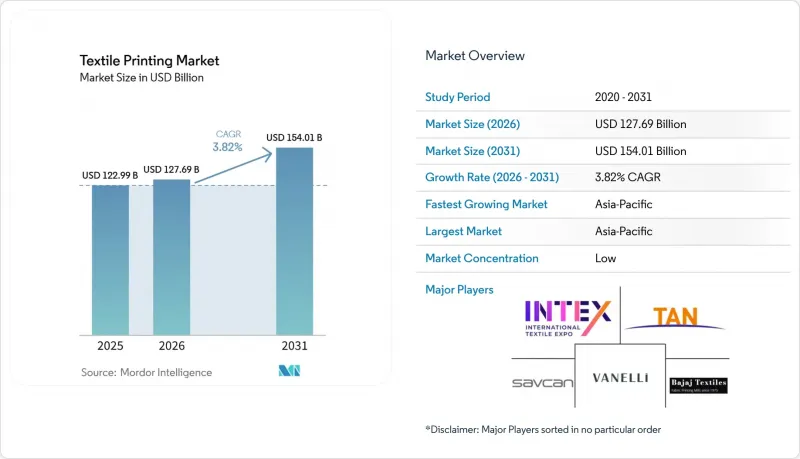
This report is Segmented by Fabric Type (Woven Printed Fabrics, Knitted Printed Fabrics, and More), by Printing Technology (Rotary Screen Printing, Digital Textile Printing, and More), by Fabric Material (Natural, Synthetic, Others), by End-Use Industry (Apparel, Home Textiles, and More), and by Geography (North America, South America, and More). The Market Forecasts are Provided in Terms of Value (USD).
Global Textile Printing Market Trends and Insights
E-Commerce, Print-on-Demand, and Sample-to-Production Workflows
Print-on-demand platforms handled approximately 150 million customized garments globally in 2025, changing the economics of sample and bulk orders. Digital platforms enable individual-unit verification at marginal cost and reduce the design write-off risk associated with trial runs. BELLA+CANVAS and Stakes Manufacturing announced a partnership in April 2025 to provide retail-quality digital printing at scale through Made-in-the-USA and nearshore production models. The partnership addressed demand from brands seeking to reduce tariff exposure from offshore production. The textile printing market increasingly requires connected design tools, automated file-to-print systems, and reliable digital output. These capabilities shorten the sample-to-bulk cycle and can shift customer preference toward responsive converters.
Shorter Fashion Calendars and Print-Design Turnover
Global apparel retailers have reduced design-to-shelf windows, creating demand for printing methods capable of handling smaller, more frequent orders. Fast-fashion operators pushed lead times from an average of 12 weeks toward under 3 weeks. Rotary screen printers need screen engraving and setup for each new colorway, which can slow down rapid design changes. Hybrid converters can use analog capacity for volume-based runs and digital lines for seasonal variations. Digital systems lower the cost of design iteration while retailer expectations for design variety continue to rise. Print-design files can be activated, amended, and retired without the scrap costs of unused screens, making them a reusable digital inventory.
Capital Intensity of Integrated Printing and Finishing Lines
Digital textile printing lines require capital expenditure from USD 200,000 for entry-level machines to over USD 1 million for high-speed single-pass systems. These costs exclude pre-treatment and downstream fixation infrastructure used in reactive and pigment workflows. Mid-tier converters in South Asia and Southeast Asia often require a full balance-sheet commitment to replace lower-cost rotary screen lines. Printhead generations turn over every 4 to 6 years, which creates a recurring capital requirement. Delayed adopters may face client specifications requiring digital capabilities, while early adopters absorb financing costs during periods of volatile material and energy prices. The constraint is acute for small- and medium-sized printers in Bangladesh, India, and Turkey that supply fast-fashion buyers on thin operating margins.
Other drivers and restraints analyzed in the detailed report include:
- Water, Chemical, and Wastewater Reduction in Fabric Processing
- Nearshore Production and Regional Supply-Chain Resilience
- Volatile Dye, Ink, Energy, and Base-Fabric Costs
For complete list of drivers and restraints, kindly check the Table Of Contents.
Segment Analysis
Woven printed fabrics accounted for 54% of the textile printing market size in 2025, making them the leading substrate format. Home furnishings, formal apparel, traditional sari fabrics, furnishing fabrics, and industrial uses support their position. Woven constructions provide dimensional predictability in applications that require stable behavior during printing, washing, or mechanical stress. Their range of possible constructions also supports decorative and functional requirements. The textile printing market size for woven formats reflects the established role of woven formats in large-volume applications. Home textile producers and industrial users continue to value their stability when precise fabric behavior is required. Traditional apparel categories in South Asia also support recurring demand for woven formats. The segment remains important for suppliers operating high-throughput printing lines.
Knitted printed fabrics are projected to grow at 5.60% CAGR from 2026 to 2031. Athleisure, activewear, and casual wear support this expansion because these categories depend on stretch and comfort. RSWM Ltd. committed INR 92 crore (USD 11 million) in October 2025 to add a printed knits product line at its LNJ Knits facilities. The project expanded total knitting capacity by 20% from 750 MT to 900 MT per month and targeted a fashion knitted segment estimated at 30% to 35% of total knitted fabric demand. Nonwoven fabrics serve medical, agricultural, and industrial packaging uses. Coated and laminated fabrics serve automotive seating, luggage, and protective outerwear where abrasion and water resistance are needed. Digital printing on knitted substrates is more difficult because extensible fabric can distort pattern registration. Printhead and ink-chemistry advances through 2025 narrowed this performance gap for polyester knit constructions. These advances broadened the addressable base for converters serving athleisure supply chains.
Rotary screen printing retained 55.40% of the textile printing market share by technology in 2025. It remained the primary volume process for long-run repeat patterns in home furnishings, sari fabrics, and industrial production. Its throughput advantage of 80-100 meters per minute supported orders exceeding 1,000 meters. Major hubs in China, India, and Turkey have operated and amortized rotary screen equipment over long periods. The technology's global share reflects this installed base and its efficiency in repeat-volume orders. It remains appropriate where colorways and order sizes are stable. Rotary screen printing also serves buyers who require scale rather than frequent design adjustments. This established base means analog printing remains an important part of the textile printing market.
Digital textile printing is projected to grow at 5.90% CAGR from 2026 to 2031, the fastest rate among printing technologies. Shorter runs, lower minimum orders, and sustainability requirements support its adoption. Single-pass systems in 2026 achieve production speeds of 75 meters per minute. Dye sublimation remains important for polyester-rich sportswear and soft signage products. Flatbed screen printing serves luxury branded merchandise and artisanal home-textile runs that require individual screen control. Transfer, flock, foil, and discharge methods remain relevant for premium products with tactile effects. The Creditex S.A.A. study found digital textile printing favorable across multiple environmental measures for a 16-color design on 1,000 meters of cotton fabric. This gives procurement teams evidence for reviewing supplier specifications.
Complete Report Scope:
- By Printed Fabric Type
- Woven Printed Fabrics
- Knitted Printed Fabrics
- Nonwoven Printed Fabrics
- Coated & Laminated Printed Fabrics
- Others
- By Printing Technology
- Rotary Screen Printing
- Flatbed Screen Printing
- Digital Textile Printing
- Dye Sublimation Printing
- Specialty Printing (Transfer, Flock, Foil, Discharge, etc.)
- Others
- By Fabric Material
- Natural Fibre (Cotton, Wool, Silk, etc.)
- Synthetic Fibre (Polyester, Nylon, Rayon/Viscose, etc.)
- Others (Blended & Recycled Fibers, High-Performance Fibres, etc.)
- By End-use Industry
- Apparel and Fashion
- Home Textiles
- Sportswear and Performance Textiles
- Technical and Industrial Textiles
- Automotive Textiles
- Healthcare and Protective Textiles
- Others (Soft Signage and Display Fabrics)
- By Geography
- North America
- United States
- Canada
- Mexico
- South America
- Brazil
- Argentina
- Rest of South America
- Europe
- Germany
- Italy
- United Kingdom
- France
- Spain
- BENELUX (Belgium, Netherlands, and Luxembourg)
- NORDICS (Denmark, Finland, Iceland, Norway, and Sweden)
- Rest of Europe
- Asia-Pacific
- China
- India
- Japan
- South Korea
- Bangladesh
- ASEAN (Indonesia, Thailand, Philippines, Malaysia, Vietnam)
- Rest of Asia-Pacific
- Middle East and Africa
- Saudi Arabia
- United Arab Emirates
- Qatar
- Kuwait
- Turkey
- Egypt
- South Africa
- Nigeria
- Rest of Middle East and Africa
- North America
Geography Analysis
Asia-Pacific accounted for 45.60% of the global textile printing market share in 2025 and is projected to grow at a 4.50% CAGR from 2026 to 2031. The textile printing market in Asia-Pacific is centered on China, which has the largest regional concentration of rotary screen and digital capacity, including Shaoxing, Hangzhou, and Guangzhou. The China Textile and Apparel Council projected that China's digital inkjet printing output will exceed 7 billion meters by 2030, accounting for more than 30% of global digital printing volume. Stricter environmental requirements are encouraging the adoption of water-efficient digital systems, while India is upgrading capacity through capital expenditure reimbursement programs. Surat and Tiruppur serve domestic fast-fashion and export apparel production, while Bangladesh, South Korea, Japan, and ASEAN economies add to demand.
Europe generates a high share of value relative to volume through premium home textiles and digitally printed apparel fabrics. The textile printing market in Europe draws on production in Italy, the Nordics, and France, while Germany, the United Kingdom, and Spain are important for short-run apparel printing. Confindustria Moda reported EUR 58.39 billion (USD 63.06 billion) in revenue for the Italian textile and apparel sector in 2025, and EUR 36.9 billion (USD 39.85 billion) in exports. Separate textile collection applied since January 2025, and the European Parliament approved extended producer responsibility schemes in September 2025. Turkey's technical textile exports reached USD 1.963 billion in the first 10 months of 2025, and its location gives suppliers a nearshore advantage.
The textile printing market in North America is growing in on-demand production, e-commerce fulfillment, and athleisure as 2025 tariffs encouraged domestic and nearshore capacity in Mexico and Central America. The textile printing market in the USMCA region benefits from demand for faster fulfillment and closer production locations. South America remains less developed, although Benninger AG and Grupo NS announced a July 2026 partnership to improve Brazilian dyeing, printing, and finishing productivity. Middle East and Africa is an emerging area supported by Gulf Cooperation Council investment, while Turkey also serves North African and Gulf markets.
- Bajaj Textiles
- Subhagyam Prints Pvt. Ltd.
- Savcan Textile
- Tan Group
- INTEKS International Textile
- Vespa Textiles and CizgiTeks
- Vanelli Textile
- Soletex Technical Textile
- KVS Tekstil
- Ilay Textile
- Seride S.r.l.
- Santee Print Works
- New Focus Textiles
- Hangzhou FY Textile Digital Printing Co., Ltd.
- Zhejiang Wondray Textile Printing and Dyeing Co., Ltd.
- Jiangsu Maolun Textile Technology Co., Ltd.
- Huzhou Meixin Digital Printing Co., Ltd.
- Hongtao Textile
- Muhammad Textile Manufacturing
- CottonBee
Additional Benefits:
- The market estimate (ME) sheet in Excel format
- 3 months of analyst support
TABLE OF CONTENTS
1 INTRODUCTION
- 1.1 Study Assumptions and Market Definition
- 1.2 Scope of the Study
2 RESEARCH METHODOLOGY
3 EXECUTIVE SUMMARY
4 MARKET LANDSCAPE
- 4.1 Market Overview
- 4.2 Market Drivers
- 4.2.1 Shorter Fashion Calendars and Print-Design Turnover
- 4.2.2 Demand for Customized and Low-Minimum-Order Fabrics
- 4.2.3 E-Commerce, Print-on-Demand, and Sample-to-Production Workflows
- 4.2.4 Water, Chemical, and Wastewater Reduction in Fabric Processing
- 4.2.5 Nearshore Production and Regional Supply-Chain Resilience
- 4.2.6 Digital Color Management and Faster Sampling-to-Bulk Conversion
- 4.3 Market Restraints
- 4.3.1 Capital Intensity of Integrated Printing and Finishing Lines
- 4.3.2 Volatile Dye, Ink, Energy, and Base-Fabric Costs
- 4.3.3 Skilled Operator and Color-Management Shortages
- 4.3.4 Qualification, Compliance, and Reproducibility Burden for Printed Fabrics
- 4.4 Value and Supply-Chain Analysis
- 4.5 Regulatory and Compliance Landscape
- 4.6 Technology Adoption and Innovation Landscape
- 4.7 Insights on Printing Processes and Production Workflow
- 4.8 Insights on Fabric and Substrate Trends
- 4.9 Sustainability and ESG Trends in Textile Printing
- 4.10 Spotlight on Global Trade Analysis
- 4.11 Investment and Capacity Expansion Trends
- 4.12 Innovation and Product Development Landscape
- 4.13 Impact Assessment of Geoplotical Events on the Textile Printing Market
5 MARKET SIZE AND GROWTH FORECASTS
- 5.1 By Printed Fabric Type
- 5.1.1 Woven Printed Fabrics
- 5.1.2 Knitted Printed Fabrics
- 5.1.3 Nonwoven Printed Fabrics
- 5.1.4 Coated & Laminated Printed Fabrics
- 5.1.5 Others
- 5.2 By Printing Technology
- 5.2.1 Rotary Screen Printing
- 5.2.2 Flatbed Screen Printing
- 5.2.3 Digital Textile Printing
- 5.2.4 Dye Sublimation Printing
- 5.2.5 Specialty Printing (Transfer, Flock, Foil, Discharge, etc.)
- 5.2.6 Others
- 5.3 By Fabric Material
- 5.3.1 Natural Fibre (Cotton, Wool, Silk, etc.)
- 5.3.2 Synthetic Fibre (Polyester, Nylon, Rayon/Viscose, etc.)
- 5.3.3 Others (Blended & Recycled Fibers, High-Performance Fibres, etc.)
- 5.4 By End-use Industry
- 5.4.1 Apparel and Fashion
- 5.4.2 Home Textiles
- 5.4.3 Sportswear and Performance Textiles
- 5.4.4 Technical and Industrial Textiles
- 5.4.5 Automotive Textiles
- 5.4.6 Healthcare and Protective Textiles
- 5.4.7 Others (Soft Signage and Display Fabrics)
- 5.5 By Geography
- 5.5.1 North America
- 5.5.1.1 United States
- 5.5.1.2 Canada
- 5.5.1.3 Mexico
- 5.5.2 South America
- 5.5.2.1 Brazil
- 5.5.2.2 Argentina
- 5.5.2.3 Rest of South America
- 5.5.3 Europe
- 5.5.3.1 Germany
- 5.5.3.2 Italy
- 5.5.3.3 United Kingdom
- 5.5.3.4 France
- 5.5.3.5 Spain
- 5.5.3.6 BENELUX (Belgium, Netherlands, and Luxembourg)
- 5.5.3.7 NORDICS (Denmark, Finland, Iceland, Norway, and Sweden)
- 5.5.3.8 Rest of Europe
- 5.5.4 Asia-Pacific
- 5.5.4.1 China
- 5.5.4.2 India
- 5.5.4.3 Japan
- 5.5.4.4 South Korea
- 5.5.4.5 Bangladesh
- 5.5.4.6 ASEAN (Indonesia, Thailand, Philippines, Malaysia, Vietnam)
- 5.5.4.7 Rest of Asia-Pacific
- 5.5.5 Middle East and Africa
- 5.5.5.1 Saudi Arabia
- 5.5.5.2 United Arab Emirates
- 5.5.5.3 Qatar
- 5.5.5.4 Kuwait
- 5.5.5.5 Turkey
- 5.5.5.6 Egypt
- 5.5.5.7 South Africa
- 5.5.5.8 Nigeria
- 5.5.5.9 Rest of Middle East and Africa
- 5.5.1 North America
6 COMPETITIVE LANDSCAPE
- 6.1 Market Concentration
- 6.2 Strategic Moves
- 6.2.1 Digital-Printing Line Installation and Capacity Expansion
- 6.2.2 Vertical Integration of Weaving, Dyeing, Printing, and Finishing
- 6.2.3 Nearshore Production, Contract Manufacturing, and Regional Warehousing
- 6.2.4 Sustainability Certifications and Closed-Loop Processing
- 6.3 Market Share Analysis
- 6.4 Company Profiles (includes Global Level Overview, Market Level Overview, Core Segments, Financials as available, Strategic Information, Products and Services, Recent Developments)
- 6.4.1 Bajaj Textiles
- 6.4.2 Subhagyam Prints Pvt. Ltd.
- 6.4.3 Savcan Textile
- 6.4.4 Tan Group
- 6.4.5 INTEKS International Textile
- 6.4.6 Vespa Textiles and CizgiTeks
- 6.4.7 Vanelli Textile
- 6.4.8 Soletex Technical Textile
- 6.4.9 KVS Tekstil
- 6.4.10 Ilay Textile
- 6.4.11 Seride S.r.l.
- 6.4.12 Santee Print Works
- 6.4.13 New Focus Textiles
- 6.4.14 Hangzhou FY Textile Digital Printing Co., Ltd.
- 6.4.15 Zhejiang Wondray Textile Printing and Dyeing Co., Ltd.
- 6.4.16 Jiangsu Maolun Textile Technology Co., Ltd.
- 6.4.17 Huzhou Meixin Digital Printing Co., Ltd.
- 6.4.18 Hongtao Textile
- 6.4.19 Muhammad Textile Manufacturing
- 6.4.20 CottonBee
7 MARKET OPPORTUNITIES AND FUTURE OUTLOOK
- 7.1 White-Space and Unmet-Need Assessment

