PUBLISHER: Mordor Intelligence | PRODUCT CODE: 2154231

PUBLISHER: Mordor Intelligence | PRODUCT CODE: 2154231
North America Refining Catalysts - Market Share Analysis, Industry Trends & Statistics, Growth Forecasts (2026 - 2031)
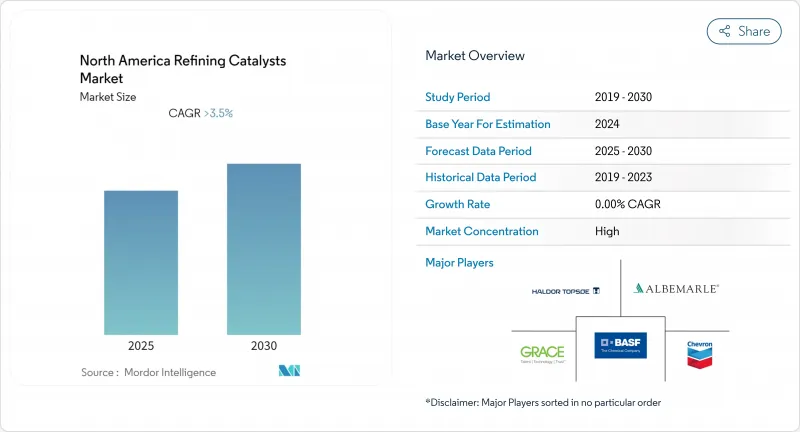
According to Mordor Intelligence, the North America refining catalysts market size was valued at USD 1.67 billion in 2025 and is estimated to grow from USD 1.74 billion in 2026 to reach USD 2.13 billion by 2031, at a CAGR of 4.17% during the forecast period (2026-2031).
North America Refining Catalysts Market Trends and Insights
Tightening Sulfur and Fuel Quality Standards
The Environmental Protection Agency Tier 3 gasoline program requires a 10 wt ppm annual average sulfur limit for gasoline supplied to the United States. Fluid catalytic cracking naphtha formed a large part of the gasoline pool and contributed a substantial share of gasoline sulfur, which made fluid catalytic cracking-train hydroprocessing an important compliance point. Increasing hydrotreater severity can reduce olefins and lower octane, which can require higher-cost blending components. This operating balance supports demand for catalysts that improve activity while preserving selectivity. Many United States refineries relied on fluid catalytic cracking gasoline post-treaters without a feed pre-treater, leaving them more exposed when fuel specifications became tighter. Compliance costs also create an incentive to manage sulfur performance closely, supporting recurring catalyst demand in the North America refining catalysts market.
Refinery Modernization and Secondary-Unit Debottlenecking
Investment in secondary-unit capacity remains a catalyst-demand driver across the United States Gulf Coast. Valero Energy Corp. planned targeted upgrades to increase the AVU-146 crude distillation unit at Port Arthur, Texas, from 235,000 barrels per day (bpd) to 260,000 bpd, with work beginning in early 2026. Exxon Mobil Corporation also announced a Baytown, Texas, complex reconfiguration that is planned to start up in 2028. Higher throughput through existing catalyst beds can shorten cycle lengths and bring forward replacement needs. That effect supports the North America refining catalysts market, even where projects do not add a new catalyst unit. Maintenance activity can also create concentrated catalyst purchases when complex units are taken offline and reloaded.
Volatility in Nickel, Molybdenum and Precious-Metal Costs
Nickel and molybdenum are important cost inputs for nickel-molybdenum and cobalt-molybdenum hydroprocessing catalysts. Price changes in those metals can directly affect catalyst pricing and procurement budgets. Suppliers may use raw-material index-linked agreements rather than fixed annual prices when input costs move sharply. That approach transfers part of the commodity-price exposure to refinery buyers. Platinum and palladium used in alumina-based noble-metal catalysts also expose suppliers to a geographically concentrated metal supply. These cost movements can constrain margins and complicate purchasing decisions across the North America refining catalysts market.
Other drivers and restraints analyzed in the detailed report include:
- Heavier and More Contaminated Crude Processing
- Renewable Diesel and Sustainable Aviation Fuel Co-Processing
- Refining Margin Volatility and Deferred Turnarounds
For complete list of drivers and restraints, kindly check the Table Of Contents.
Segment Analysis
Zeolites held 32.67% of the North America refining catalysts market in 2025, reflecting their role as active cracking components in fluid catalytic cracking catalysts and as shape-selective materials in hydrocracking formulations. The North America refining catalysts market size for zeolites also benefits from refinery demand for upgraded performance in cracking and conversion units. Nickel-molybdenum formulations are used for deep hydrodesulfurization and distillate hydrotreating. Cobalt-molybdenum grades are used in the selective hydrodesulfurization of fluid catalytic cracking naphtha, where refiners seek to limit olefin saturation and protect octane. Alumina-based noble-metal catalysts serve selective hydrogenation and reforming applications. Their high precious-metal content limits their use to a smaller, premium-priced application base.
Zeolites are projected to advance at a 4.36% CAGR through 2031. Growing fluid catalytic cracking integration with petrochemical operations supports demand for ZSM-5 additives designed for higher propylene production. Bio-feed co-processing in hydrocrackers also requires zeolites with suitable pore structures and hydrothermal stability. Steam formed from feed oxygenates can cause framework dealumination under conventional operating conditions. Zeolyst International offers the Opal Renew portfolio for renewable-fuel catalyst demand. Ketjen reported that its SaFeGuard catalyst improved fluid catalytic cracking catalyst accessibility by 77% in a 30-day trial, demonstrating the relevance of heavy-feed-tolerant formulations.
Complete Report Scope:
- By Product Type
- Zeolites
- CoMo
- NiMo
- Alumina-Based Noble Metal
- NiW
- Other Products
- By Process
- Fluid Catalytic Cracking
- Hydrotreating
- Gasoline
- Kerosene
- Diesel
- Vacuum Gas Oil
- Catalytic-Cracking Gasoline
- Residual Feed
- Residue Fluid Catalytic Cracking
- Hydrocracking
- By Geography
- United States
- Canada
- Mexico
List of Companies Covered in this Report:
- Albemarle Corporation
- Axens
- BASF
- CLARIANT
- DuPont
- Evonik Industries AG
- Honeywell International Inc.
- JGC C&C
- Johnson Matthey
- Topsoe
- W. R. Grace & Co.-Conn
- Zeolyst International
Additional Benefits:
- The market estimate (ME) sheet in Excel format
- 3 months of analyst support
TABLE OF CONTENTS
1 Introduction
- 1.1 Study Assumptions and Market Definition
- 1.2 Scope of the Study
2 Research Methodology
3 Executive Summary
4 Market Landscape
- 4.1 Market Overview
- 4.2 Market Drivers
- 4.2.1 Tightening Sulfur and Fuel Quality Standards
- 4.2.2 Refinery Modernization and Secondary-Unit Debottlenecking
- 4.2.3 Heavier and More Contaminated Crude Processing
- 4.2.4 Renewable Diesel and Sustainable Aviation Fuel Co-Processing
- 4.2.5 FCC Yield Optimization and Petrochemical Integration
- 4.3 Market Restraints
- 4.3.1 Volatility in Nickel, Molybdenum and Precious-Metal Costs
- 4.3.2 Refining Margin Volatility and Deferred Turnarounds
- 4.3.3 Shorter Catalyst Cycles from Phosphorus and Alkali Contamination
- 4.4 Value Chain Analysis
- 4.5 Porter's Five Forces Analysis
- 4.5.1 Threat of New Entrants
- 4.5.2 Bargaining Power of Suppliers
- 4.5.3 Bargaining Power of Buyers
- 4.5.4 Threat of Substitutes
- 4.5.5 Competitive Rivalry
5 Market Size and Growth Forecasts (Value)
- 5.1 By Product Type
- 5.1.1 Zeolites
- 5.1.2 CoMo
- 5.1.3 NiMo
- 5.1.4 Alumina-Based Noble Metal
- 5.1.5 NiW
- 5.1.6 Other Products
- 5.2 By Process
- 5.2.1 Fluid Catalytic Cracking
- 5.2.2 Hydrotreating
- 5.2.2.1 Gasoline
- 5.2.2.2 Kerosene
- 5.2.2.3 Diesel
- 5.2.2.4 Vacuum Gas Oil
- 5.2.2.5 Catalytic-Cracking Gasoline
- 5.2.2.6 Residual Feed
- 5.2.3 Residue Fluid Catalytic Cracking
- 5.2.4 Hydrocracking
- 5.3 By Geography
- 5.3.1 United States
- 5.3.2 Canada
- 5.3.3 Mexico
6 Competitive Landscape
- 6.1 Market Concentration
- 6.2 Strategic Moves
- 6.3 Market Share (%)/Ranking Analysis
- 6.4 Company Profiles (includes Global Overview, Market Overview, Core Segments, Financials as available, Strategic Information, Products and Services, and Recent Developments)
- 6.4.1 Albemarle Corporation
- 6.4.2 Axens
- 6.4.3 BASF
- 6.4.4 CLARIANT
- 6.4.5 DuPont
- 6.4.6 Evonik Industries AG
- 6.4.7 Honeywell International Inc.
- 6.4.8 JGC C&C
- 6.4.9 Johnson Matthey
- 6.4.10 Topsoe
- 6.4.11 W. R. Grace & Co.-Conn
- 6.4.12 Zeolyst International
7 Market Opportunities and Future Outlook
- 7.1 White-Space and Unmet-Need Assessment

