PUBLISHER: Mordor Intelligence | PRODUCT CODE: 2154234

PUBLISHER: Mordor Intelligence | PRODUCT CODE: 2154234
Europe Refining Catalysts - Market Share Analysis, Industry Trends & Statistics, Growth Forecasts (2026 - 2031)
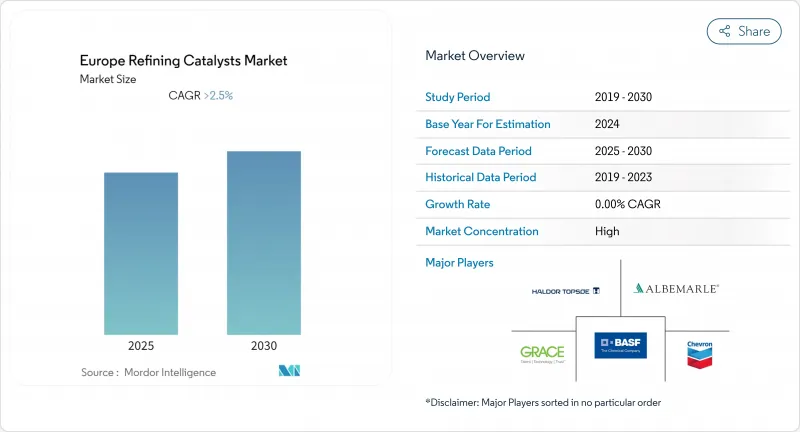
According to Mordor Intelligence, the Europe refining catalysts market size was valued at USD 1.26 billion in 2025 and is estimated to grow from USD 1.31 billion in 2026 to USD 1.60 billion by 2031, at a CAGR of 4.09% during the forecast period (2026-2031).
Europe Refining Catalysts Market Trends and Insights
Stricter European Fuel-Sulfur and Emissions Requirements
Diesel and gasoline sold across the European Union must comply with a maximum sulfur content of 10 parts per million under the Fuel Quality Directive. This requirement supports demand for hydrotreating catalyst capacity and performance at European refineries. It also creates varying requirements across the European refining catalysts market. Refineries producing conventional ultra-low-sulfur diesel use established cobalt-molybdenum and nickel-molybdenum formulations. Refineries processing biogenic co-feeds require formulations that tolerate higher oxygen levels and trace-metal contamination. Honeywell UOP has expanded its hydrotreating portfolio for fluid catalytic cracking (FCC) pretreatment, diesel, kerosene, and vacuum gas oil applications, reflecting the broader product requirements created by compliance standards.
Catalyst Replacement and Debottlenecking in Aging Refineries
European refining assets include many aging facilities, where catalyst replacement cycles coincide with debottlenecking activities. FCC units generally require catalyst replacement every two to five years, while fixed-bed hydroprocessing reactors operate on longer cycles. Capacity reductions since 2024 have shifted more throughput to refineries that remain operational. Higher throughput can accelerate catalyst deactivation and shorten replacement schedules. A broader crude slate can also increase FCC catalyst top-up requirements and support demand for metals-tolerant hydroprocessing grades. The European refining catalysts market therefore presents upgrade opportunities at complex sites, where application engineering and high-activity products differ from standard catalyst supply.
European Refinery Rationalization and Declining Fossil-Fuel Demand
European refinery closures have reduced the installed base of catalyst-consuming units. The International Energy Agency (IEA) expects at least 1 million barrels per day of European refining capacity to be at risk of closure by 2030. Since early 2024, closures have removed 400,000-500,000 barrels per day from the operating network. These closures include the Grangemouth refinery in Scotland, Shell's Wesseling plant, and a reduction in distillation capacity at BP's Gelsenkirchen site. However, the impact on catalyst demand may not directly correspond to the decline in refining throughput. Surviving refineries are increasingly adopting fluid catalytic cracking (FCC), hydrocracking, and deep hydrotreatment configurations, which consume more catalyst per barrel than simpler refinery operations. Consequently, the Europe refining catalysts market may experience lower demand for basic hydrotreating catalysts, while demand for high-performance FCC and hydrocracking catalyst grades remains comparatively stable.
Other drivers and restraints analyzed in the detailed report include:
- Hydrocracking and Hydrotreating for Crude-Slate Flexibility
- Co-Processing of Waste and Bio-Based Feedstocks
- High Manufacturing Costs and Pressure on Refinery Margins
For complete list of drivers and restraints, kindly check the Table Of Contents.
Segment Analysis
Zeolites held 32.86% of regional demand in 2025 and are projected to grow at a CAGR of 4.46% through 2031. Their position reflects their role as active cracking components in fluid catalytic cracking (FCC) and hydrocracking. Ultra-stable Y zeolite (USY) provides the active cracking function in FCC units. Its large supercage structure supports the cracking of macromolecular hydrocarbons in heavy oil. ZSM-5 improves light-olefin and aromatic selectivity and can be co-loaded with USY to shift the product mix toward gasoline or propylene. BASF has received a patent for phosphorus-stabilized MSE (Mobile Seven Eleven)-framework zeolites for FCC applications, indicating improved hydrothermal stability at higher cracking severity.
Zeolyst International has introduced its Opal Renew zeolite line for processing renewable fuels, extending zeolite applications to biogenic feedstocks. CoMo and NiMo formulations remain important for hydrotreating gasoline, kerosene, diesel, vacuum gas oil, FCC gasoline, and residual feeds. Their established supply chains, regeneration practices, and broad supplier base make them a core component of hydrotreating catalyst consumption. Alumina-based noble-metal catalysts represent a smaller, higher-margin segment in catalytic reforming. NiW grades are used in high-pressure hydrocracking applications that require stronger nitrogen resistance. As refineries blend feedstocks with higher oxygen and metals content, the Europe refining catalysts industry places greater emphasis on modified zeolitic and bimetallic formulations that offer longer campaign stability.
Complete Report Scope:
- By Product Type
- CoMo
- NiMo
- Alumina-Based Noble Metal
- NiW
- Zeolites
- Other Products
- By Process
- Hydrotreating
- Gasoline
- Kerosene
- Diesel
- Vacuum Gas Oil
- Catalytic-Cracking Gasoline
- Residual Feed
- Fluid Catalytic Cracking
- Residue Fluid Catalytic Cracking
- Hydrocracking
- Hydrotreating
- By Geography
- Germany
- United Kingdom
- Italy
- France
- Spain
- Russia
- Rest of Europe
List of Companies Covered in this Report:
- Albemarle Corporation
- Axens
- BASF
- Chevron Corporation
- CLARIANT
- DuPont
- Evonik Industries AG
- Exxon Mobil Corporation
- Heraeus Group
- Honeywell International Inc.
- JGC C&C
- Johnson Matthey
- Topsoe
- W. R. Grace & Co.
- Zeolyst International
Additional Benefits:
- The market estimate (ME) sheet in Excel format
- 3 months of analyst support
TABLE OF CONTENTS
1 Introduction
- 1.1 Study Assumptions and Market Definition
- 1.2 Scope of the Study
2 Research Methodology
3 Executive Summary
4 Market Landscape
- 4.1 Market Overview
- 4.2 Market Drivers
- 4.2.1 Stricter European Fuel-Sulfur and Emissions Requirements
- 4.2.2 Catalyst Replacement and Debottlenecking in Aging Refineries
- 4.2.3 Hydrocracking and Hydrotreating for Crude-Slate Flexibility
- 4.2.4 Co-Processing of Waste and Bio-Based Feedstocks
- 4.2.5 Digital Catalyst Monitoring and Performance Optimization
- 4.3 Market Restraints
- 4.3.1 European Refinery Rationalization and Declining Fossil-Fuel Demand
- 4.3.2 High Manufacturing Costs and Pressure on Refinery Margins
- 4.3.3 Precious-Metal and Strategic-Metal Price Volatility
- 4.4 Value Chain Analysis
- 4.5 Porter's Five Forces Analysis
- 4.5.1 Bargaining Power of Suppliers
- 4.5.2 Bargaining Power of Buyers
- 4.5.3 Threat of New Entrants
- 4.5.4 Threat of Substitutes
- 4.5.5 Competitive Rivalry
- 4.6 Regulatory Landscape
- 4.7 Technological Outlook
5 Market Size and Growth Forecasts (Value)
- 5.1 By Product Type
- 5.1.1 CoMo
- 5.1.2 NiMo
- 5.1.3 Alumina-Based Noble Metal
- 5.1.4 NiW
- 5.1.5 Zeolites
- 5.1.6 Other Products
- 5.2 By Process
- 5.2.1 Hydrotreating
- 5.2.1.1 Gasoline
- 5.2.1.2 Kerosene
- 5.2.1.3 Diesel
- 5.2.1.4 Vacuum Gas Oil
- 5.2.1.5 Catalytic-Cracking Gasoline
- 5.2.1.6 Residual Feed
- 5.2.2 Fluid Catalytic Cracking
- 5.2.3 Residue Fluid Catalytic Cracking
- 5.2.4 Hydrocracking
- 5.2.1 Hydrotreating
- 5.3 By Geography
- 5.3.1 Germany
- 5.3.2 United Kingdom
- 5.3.3 Italy
- 5.3.4 France
- 5.3.5 Spain
- 5.3.6 Russia
- 5.3.7 Rest of Europe
6 Competitive Landscape
- 6.1 Market Concentration
- 6.2 Strategic Moves
- 6.3 Market Share (%)/Ranking Analysis
- 6.4 Company Profiles (includes Global Overview, Market Overview, Core Segments, Financials as available, Strategic Information, Products and Services, and Recent Developments)
- 6.4.1 Albemarle Corporation
- 6.4.2 Axens
- 6.4.3 BASF
- 6.4.4 Chevron Corporation
- 6.4.5 CLARIANT
- 6.4.6 DuPont
- 6.4.7 Evonik Industries AG
- 6.4.8 Exxon Mobil Corporation
- 6.4.9 Heraeus Group
- 6.4.10 Honeywell International Inc.
- 6.4.11 JGC C&C
- 6.4.12 Johnson Matthey
- 6.4.13 Topsoe
- 6.4.14 W. R. Grace & Co.
- 6.4.15 Zeolyst International
7 Market Opportunities and Future Outlook
- 7.1 White-Space and Unmet-Need Assessment

