PUBLISHER: Mordor Intelligence | PRODUCT CODE: 2154240

PUBLISHER: Mordor Intelligence | PRODUCT CODE: 2154240
Middle East Riot Control System - Market Share Analysis, Industry Trends & Statistics, Growth Forecasts (2026 - 2031)
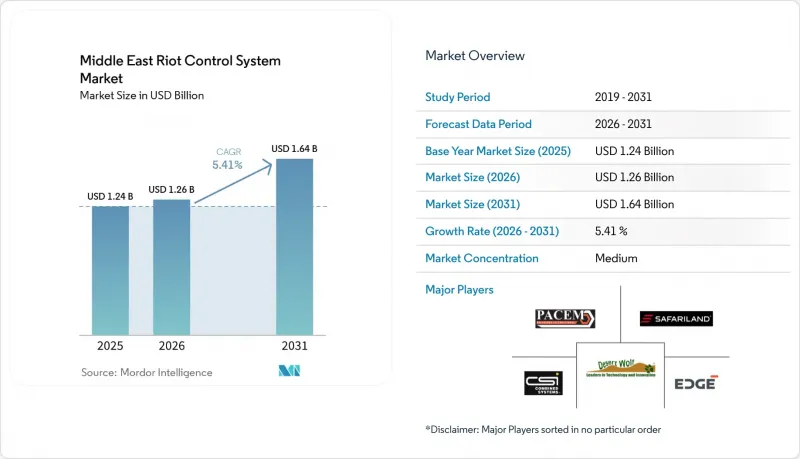
According to Mordor Intelligence, the Middle East riot control system market size was valued at USD 1.24 billion in 2025 and is forecast to grow from USD 1.26 billion in 2026 to reach USD 1.64 billion by 2031, at a 5.41% CAGR during the forecast period (2026-2031).
Middle East Riot Control System Market Trends and Insights
Escalating Civil-Unrest Incidents Post-2025
Iranian protests that began in December 2025 had extended across all 31 provinces by January 2026, placing sustained demand on deployed security forces. The events highlighted how prolonged operations can consume less-lethal munitions, protective equipment, and related supplies faster than normal replacement plans allow, especially when deployments span multiple locations simultaneously. The Middle East riot control system market, therefore, benefits when agencies review readiness levels and replenish equipment after periods of elevated use. Regional governments near Iran and Syria may assess domestic policing and border requirements together when instability spreads across neighboring areas, reducing the separation between preparedness budgets that had previously been managed independently. That approach supports purchases of scalable systems, including modular ammunition and acoustic hailing equipment, rather than only one-time consumables. It also makes delivery speed, local inventory, and supplier support more important in the Middle East riot control system market.
Intensifying Border Security Programs
Saudi Arabia announced a 43-nation maritime defense coalition in July 2026 covering the Bab al-Mandab Strait, the Red Sea, and the Gulf of Aden, with headquarters in Riyadh. The coalition gives border and maritime security a more permanent place in regional capability planning, rather than treating these requirements solely as a short-term response to a specific incident. Units that manage maritime patrols and land crossings may also support urban crowd-management operations when needed, which means their training, mobility, communications, and equipment requirements can overlap. This operating model broadens demand for portable, multi-role equipment in the Middle East riot control equipment market, especially equipment suitable for rapid redeployment without a separate support structure. Migration pressure affecting Red Sea and Mediterranean routes also increases the value of systems that can move quickly between border and domestic assignments. Suppliers with products suited to several operational environments can address a wider set of procurement requirements.
EU-Style Export Licensing Pressure on Middle East Suppliers
Council Decision (CFSP) 2025/779 took effect in April 2025 and strengthened the controls governing the export of military technology and equipment from EU member states. The decision requires licensing authorities to consider the risk that equipment could be used for internal repression or serious human-rights violations, bringing country conditions and end-use controls closer to the center of export review. Riot control agents listed under ML7 of the EU Common Military List are directly relevant to this framework. The Middle East riot control system market may face longer procurement schedules when buyers rely on European suppliers for irritants, electroshock systems, or acoustic devices. Agencies may respond by planning inventory further in advance or by assessing suppliers with non-EU supply chains. However, that choice can introduce separate requirements for qualification, maintenance, and operator familiarity. Production within the UAE can also become more attractive, as it reduces dependence on imports and supports local industrial policy.
Other drivers and restraints analyzed in the detailed report include:
- GCC Smart-City Policing Budgets
- Emergence of Bio-degradable Irritant Payloads
- Scarcity of UHMWPE and Aramid Fibers
For complete list of drivers and restraints, kindly check the Table Of Contents.
Segment Analysis
Personal protective equipment accounted for 54.87% of the Middle East riot control system market share in 2025. This segment includes ballistic vests, ceramic plate carriers, helmets, gas masks, ballistic shields, and face shields. Its demand is supported by the size of standing police and security forces in GCC countries, Israel, and other regional markets. Routine replacement is required because equipment is used in training, field deployment, and periodic compliance upgrades, with each of these activities placing wear on textiles, visors, fasteners, filters, and protective plates. Purchases can also be linked to ballistic protection standards, including NIJ and VPAM requirements, which can lead agencies to replace equipment even before it is fully exhausted in service. These factors give the protective-equipment category a stable role in the industry.
Offensive equipment is forecast to expand at a CAGR of 6.17% from 2026 to 2031. The Middle East riot control system market size for offensive equipment is supported by demand for area-denial systems, directed-energy devices, electro-shock platforms, and other graduated-response tools. Israel approved a Police Ordinance Amendment in 2026 that allows the deployment of water cannon only with clean water and requires audiovisual documentation for every use. This requirement supports interest in foam cannons and water-based alternatives, where chemical payloads face additional scrutiny. It also places greater value on equipment that enables agencies to provide a documented and proportionate response without altering the core operational purpose of water cannon deployment.
Ammunition categories include rubber bullets, bean bag rounds, sponge grenades, and wax bullets, and suppliers are improving accuracy and range. Gases and sprays continue to command significant volume due to cost and operator familiarity, while flashbang and sting grenades remain relevant for smaller, specialized uses. The coexistence of these products means procurement can still include conventional consumables even as agencies evaluate alternatives with lower environmental persistence.
Complete Report Scope:
- By Product Type
- Personal Protective Equipment
- Vests
- Helmets
- Gas Masks
- Shields
- Offensive Equipment
- Area Denial
- Anti-vehicle
- Anti-personnel
- Ammunition
- Rubber Bullets
- Wax Bullets
- Plastic Bullets
- Bean Bag Rounds
- Sponge Grenades
- Explosives
- Flashbang Grenades
- Sting Grenades
- Gases and Sprays
- Water Cannons
- Scent-based Weapons
- Tear Gas
- Pepper Spray
- Directed Energy Weapons
- Electro-shock Weapons
- Other Offensive Equipment
- Area Denial
- Personal Protective Equipment
- By End-User
- Law Enforcement
- Special Forces
- By Technology
- Electronic and Sonic Weapons
- Kinetic Impact Weapons
- Chemical Agents
- Others
- By Geography
- Saudi Arabia
- United Arab Emirates
- Israel
- Rest of Middle East
List of Companies Covered in this Report:
- Axon Enterprise, Inc.
- Safariland, LLC
- Combined Systems, Inc.
- EDGE Group PJSC
- Genasys, Inc.
- Pacem Solution International, LLC
- Rheinmetall AG
- Desert Wolf
- Etienne Lacroix Group
- Revelyst, Inc.
- NonLethal Technologies, Inc.
- FN HERSTAL (FN Browning Group)
- DAEKWANG CHEMICAL Co., Ltd.
- Byrna Technologies Inc.
Additional Benefits:
- The market estimate (ME) sheet in Excel format
- 3 months of analyst support
TABLE OF CONTENTS
1 INTRODUCTION
- 1.1 Study Assumptions and Market Definition
- 1.2 Research Methodology
2 RESEARCH METHODOLOGY
3 EXECUTIVE SUMMARY
4 MARKET LANDSCAPE
- 4.1 Market Overview
- 4.2 Market Drivers
- 4.2.1 Escalating civil-unrest incidents post-2025
- 4.2.2 Intensifying border-security programs (Red Sea and Sahel)
- 4.2.3 GCC smart-city policing budgets (e.g., NEOM)
- 4.2.4 Procurement subsidies via the Tawazun Economic Program
- 4.2.5 Emergence of bio-degradable irritant payloads
- 4.2.6 Rapid miniaturization of acoustic hailing devices
- 4.3 Market Restraints
- 4.3.1 EU-style export licensing pressure on MEA suppliers
- 4.3.2 Scarcity of UHMWPE and aramid fibers
- 4.3.3 Tightened ESG screening by sovereign-wealth funds
- 4.3.4 Heightened public-perception risk after 2024 Sudan footage
- 4.4 Value Chain Analysis
- 4.5 Regulatory Landscape
- 4.6 Technological Outlook
- 4.7 Porter's Five Forces Analysis
- 4.7.1 Threat of New Entrants
- 4.7.2 Bargaining Power of Suppliers
- 4.7.3 Bargaining Power of Buyers
- 4.7.4 Threat of Substitutes
- 4.7.5 Intensity of Competitive Rivalry
5 MARKET SIZE AND GROWTH FORECASTS (VALUE)
- 5.1 By Product Type
- 5.1.1 Personal Protective Equipment
- 5.1.1.1 Vests
- 5.1.1.2 Helmets
- 5.1.1.3 Gas Masks
- 5.1.1.4 Shields
- 5.1.2 Offensive Equipment
- 5.1.2.1 Area Denial
- 5.1.2.1.1 Anti-vehicle
- 5.1.2.1.2 Anti-personnel
- 5.1.2.2 Ammunition
- 5.1.2.2.1 Rubber Bullets
- 5.1.2.2.2 Wax Bullets
- 5.1.2.2.3 Plastic Bullets
- 5.1.2.2.4 Bean Bag Rounds
- 5.1.2.2.5 Sponge Grenades
- 5.1.2.3 Explosives
- 5.1.2.3.1 Flashbang Grenades
- 5.1.2.3.2 Sting Grenades
- 5.1.2.4 Gases and Sprays
- 5.1.2.4.1 Water Cannons
- 5.1.2.4.2 Scent-based Weapons
- 5.1.2.4.3 Tear Gas
- 5.1.2.4.4 Pepper Spray
- 5.1.2.5 Directed Energy Weapons
- 5.1.2.6 Electro-shock Weapons
- 5.1.2.7 Other Offensive Equipment
- 5.1.2.1 Area Denial
- 5.1.1 Personal Protective Equipment
- 5.2 By End-User
- 5.2.1 Law Enforcement
- 5.2.2 Special Forces
- 5.3 By Technology
- 5.3.1 Electronic and Sonic Weapons
- 5.3.2 Kinetic Impact Weapons
- 5.3.3 Chemical Agents
- 5.3.4 Others
- 5.4 By Geography
- 5.4.1 Saudi Arabia
- 5.4.2 United Arab Emirates
- 5.4.3 Israel
- 5.4.4 Rest of Middle East
6 COMPETITIVE LANDSCAPE
- 6.1 Market Concentration
- 6.2 Strategic Moves
- 6.3 Market Share Analysis
- 6.4 Company Profiles (includes Global level Overview, Market level overview, Core Segments, Financials as available, Strategic Information, Market Rank/Share for key companies, Products and Services, and Recent Developments)
- 6.4.1 Axon Enterprise, Inc.
- 6.4.2 Safariland, LLC
- 6.4.3 Combined Systems, Inc.
- 6.4.4 EDGE Group PJSC
- 6.4.5 Genasys, Inc.
- 6.4.6 Pacem Solution International, LLC
- 6.4.7 Rheinmetall AG
- 6.4.8 Desert Wolf
- 6.4.9 Etienne Lacroix Group
- 6.4.10 Revelyst, Inc.
- 6.4.11 NonLethal Technologies, Inc.
- 6.4.12 FN HERSTAL (FN Browning Group)
- 6.4.13 DAEKWANG CHEMICAL Co., Ltd.
- 6.4.14 Byrna Technologies Inc.
7 MARKET OPPORTUNITIES AND FUTURE OUTLOOK
- 7.1 White-space and Unmet-Need Assessment

