PUBLISHER: Mordor Intelligence | PRODUCT CODE: 2154241

PUBLISHER: Mordor Intelligence | PRODUCT CODE: 2154241
North America Riot Control System - Market Share Analysis, Industry Trends & Statistics, Growth Forecasts (2026 - 2031)
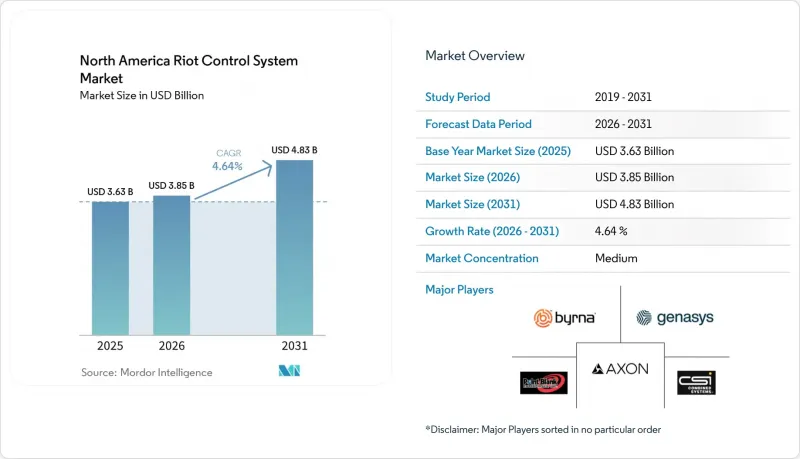
According to Mordor Intelligence, the North America riot control system market size was valued at USD 3.85 billion in 2026 and is estimated to reach USD 4.83 billion by 2031, at a 4.64% CAGR during the forecast period (2026-2031).
North America Riot Control System Market Trends and Insights
Escalating Civil Unrest Reshapes Agency Procurement Timelines
The North America riot control system market is supported by a higher volume of demonstrations and a broader geographic spread of protest activity. The Crowd Counting Consortium recorded more than 10,700 protests in the US during 2025, 133% higher than the 4,588 it recorded in 2017. The Consortium also reported activity in more than 60% of US counties by June 2025. ACLED recorded more than 1,500 demonstration events during August 2025, with activity concentrated around immigration-enforcement operations in Los Angeles, Chicago, and Newark. Heavy use of consumable munitions can exhaust inventories before a normal annual procurement cycle ends. Smaller suburban and rural agencies, therefore, face a need for entry-level protective equipment and less-lethal launchers for the first time when demonstrations expand beyond established metropolitan locations.
Federal and Provincial Funding Creates Multi-Year Procurement Runway
The North America riot control system market benefits when federal and provincial funding reduces delays in equipment renewal. Congress limited reductions in FY2026 DOJ grant funding to 1%, retaining USD 4.84 billion in criminal justice grants after an initial 15% reduction proposal. The COPS FY2026 Technology and Equipment Program provides USD 401.41 million in noncompetitive invitational grants for law-enforcement equipment and technology that meets National Institute of Standards and Technology requirements. Individual awards can reach USD 20 million, supporting integrated purchases rather than narrow product replacements. In Canada, the National Police Federation called in April 2026 for a Public Safety Procurement Strategy and Secretariat to address expired equipment and fragmented procurement overruns affecting the RCMP. A reform process could produce a concentrated replacement cycle as agencies address accumulated equipment needs.
Human-Rights Scrutiny Constrains Specific Product Categories
The North America riot control system market faces tighter scrutiny when equipment is associated with preventable injuries or poorly controlled deployments. Physicians for Human Rights and the UC Berkeley Human Rights Center documented 412 verified incidents of crowd-control weapon misuse across 16 US cities from June 2025 through May 2026. The review documented 203 injuries, including blindings and traumatic brain injuries, and reported that DHS agencies accounted for 64% of incidents. Scattershot projectiles and concentrated chemical munitions face greater legislative and reputational exposure than electroshock or acoustic systems. PHR also found that nearly 100 journalists were shot with less-lethal weapons during Los Angeles anti-ICE protests in the summer of 2025. Manufacturers of precise, compliant products may be better placed as agencies move away from legacy bulk-dispersal tools.
Other drivers and restraints analyzed in the detailed report include:
- Non-Lethal Preference Reshapes Procurement Doctrine
- Border-Security Spill-Over Expands the Addressable Market
- High Costs and Lifecycle Economics Exclude Smaller Agencies
For complete list of drivers and restraints, kindly check the Table Of Contents.
Segment Analysis
Offensive equipment held 59.63% of the North America riot control system market share in 2025, supported by replenishment of kinetic munitions, area-denial systems, and electroshock devices. Federal agencies use these products at a high operational tempo, which creates repeat purchases of consumable equipment. CBP sought less-lethal specialty munitions across 123 product types, with projected volumes above 242,000 pyrotechnic canisters and 100,000 impact munitions. Directed-energy and electroshock platforms are the most active subcategories within offensive equipment. ICE's G.L.O.V.E. purchase and the Navy's non-lethal diversionary grenade procurement reflect institutional interest in lower-lethality tools. Gases and sprays face greater scrutiny after documented misuse incidents. This is directing product development toward more precise dispersal methods and clearer safety controls.
Personal protective equipment is the fastest-growing product category in the North America riot control system market and is projected to expand at a 5.92% CAGR from 2026 to 2031. Officer-safety mandates are extending into border-enforcement roles, while certification requirements require agencies to replace noncompliant equipment. The qualification process can take 18-24 months, which favors established US suppliers such as Point Blank Enterprises, Blackhawk, and United Tactical Supply. Extended aramid-fiber lead times divide suppliers into those with secure long-term fiber agreements and those with delayed order fulfillment. The July 2026 executive order on defense supply chains directs prime contractors to map critical supply chains from raw materials to finished products. This can strengthen domestic sourcing efforts for ballistic composites over the next 3-5 years.
Complete Report Scope:
- By Product Type
- Personal Protective Equipment
- Vests
- Helmets
- Gas Masks
- Shields
- Offensive Equipment
- Area Denial
- Anti-vehicle
- Anti-personnel
- Ammunition
- Rubber Bullets
- Wax Bullets
- Plastic Bullets
- Bean Bag Rounds
- Sponge Grenades
- Explosives
- Flashbang Grenades
- Sting Grenades
- Gases and Sprays
- Water Cannons
- Scent-based Weapons
- Tear Gas
- Pepper Spray
- Directed Energy Weapons
- Electro-shock Weapons
- Other Offensive Equipment
- Area Denial
- Personal Protective Equipment
- By End-User
- Law Enforcement
- Special Forces
- By Technology
- Electronic and Sonic Weapons
- Kinetic Impact Weapons
- Chemical Agents
- Others
- By Geography
- United States
- Canada
- Mexico
List of Companies Covered in this Report:
- Axon Enterprise Inc.
- Safariland, LLC
- Combined Systems, Inc.
- EDGE Group PJSC
- Genasys, Inc.
- Pacem Solution International, LLC
- Rheinmetall AG
- Desert Wolf
- Etienne Lacroix Group
- Revelyst, Inc.
- NonLethal Technologies, Inc.
- FN HERSTAL (FN Browning Group)
- Katmerciler A.S.
- STREIT Group
- Byrna Technologies Inc.
- United Tactical Supply
- Point Blank Enterprises, Inc.
Additional Benefits:
- The market estimate (ME) sheet in Excel format
- 3 months of analyst support
TABLE OF CONTENTS
1 INTRODUCTION
- 1.1 Study Assumptions and Market Definition
- 1.2 Research Methodology
2 RESEARCH METHODOLOGY
3 EXECUTIVE SUMMARY
4 MARKET LANDSCAPE
- 4.1 Market Overview
- 4.2 Market Drivers
- 4.2.1 Escalating civil unrest and protest frequency
- 4.2.2 Federal and provincial funding boosts for law-enforcement modernization
- 4.2.3 Preference for non-lethal options to reduce liability and fatalities
- 4.2.4 Border-security spill-over procurement for crowd-control gear
- 4.2.5 AI-enabled situational-awareness platforms bundled with gear sales
- 4.2.6 Climate-protest surge creating demand spikes for mobile gear inventory
- 4.3 Market Restraints
- 4.3.1 Intensifying human-rights and legal scrutiny on use-of-force tools
- 4.3.2 High up-front and lifecycle costs of next-gen equipment
- 4.3.3 Section 889 import restrictions limiting electronics sourcing
- 4.3.4 Advanced-composite material supply bottlenecks extending lead-times
- 4.4 Value Chain Analysis
- 4.5 Regulatory Landscape
- 4.6 Technological Outlook
- 4.7 Porter's Five Forces Analysis
- 4.7.1 Threat of New Entrants
- 4.7.2 Bargaining Power of Suppliers
- 4.7.3 Bargaining Power of Buyers
- 4.7.4 Threat of Substitutes
- 4.7.5 Intensity of Competitive Rivalry
5 MARKET SIZE AND GROWTH FORECASTS (VALUE)
- 5.1 By Product Type
- 5.1.1 Personal Protective Equipment
- 5.1.1.1 Vests
- 5.1.1.2 Helmets
- 5.1.1.3 Gas Masks
- 5.1.1.4 Shields
- 5.1.2 Offensive Equipment
- 5.1.2.1 Area Denial
- 5.1.2.1.1 Anti-vehicle
- 5.1.2.1.2 Anti-personnel
- 5.1.2.2 Ammunition
- 5.1.2.2.1 Rubber Bullets
- 5.1.2.2.2 Wax Bullets
- 5.1.2.2.3 Plastic Bullets
- 5.1.2.2.4 Bean Bag Rounds
- 5.1.2.2.5 Sponge Grenades
- 5.1.2.3 Explosives
- 5.1.2.3.1 Flashbang Grenades
- 5.1.2.3.2 Sting Grenades
- 5.1.2.4 Gases and Sprays
- 5.1.2.4.1 Water Cannons
- 5.1.2.4.2 Scent-based Weapons
- 5.1.2.4.3 Tear Gas
- 5.1.2.4.4 Pepper Spray
- 5.1.2.5 Directed Energy Weapons
- 5.1.2.6 Electro-shock Weapons
- 5.1.2.7 Other Offensive Equipment
- 5.1.2.1 Area Denial
- 5.1.1 Personal Protective Equipment
- 5.2 By End-User
- 5.2.1 Law Enforcement
- 5.2.2 Special Forces
- 5.3 By Technology
- 5.3.1 Electronic and Sonic Weapons
- 5.3.2 Kinetic Impact Weapons
- 5.3.3 Chemical Agents
- 5.3.4 Others
- 5.4 By Geography
- 5.4.1 United States
- 5.4.2 Canada
- 5.4.3 Mexico
6 COMPETITIVE LANDSCAPE
- 6.1 Market Concentration
- 6.2 Strategic Moves
- 6.3 Market Share Analysis
- 6.4 Company Profiles (includes Global level Overview, Market level Overview, Core Segments, Financials as available, Strategic Information, Market Rank/Share for key companies, Products and Services, and Recent Developments)
- 6.4.1 Axon Enterprise Inc.
- 6.4.2 Safariland, LLC
- 6.4.3 Combined Systems, Inc.
- 6.4.4 EDGE Group PJSC
- 6.4.5 Genasys, Inc.
- 6.4.6 Pacem Solution International, LLC
- 6.4.7 Rheinmetall AG
- 6.4.8 Desert Wolf
- 6.4.9 Etienne Lacroix Group
- 6.4.10 Revelyst, Inc.
- 6.4.11 NonLethal Technologies, Inc.
- 6.4.12 FN HERSTAL (FN Browning Group)
- 6.4.13 Katmerciler A.S.
- 6.4.14 STREIT Group
- 6.4.15 Byrna Technologies Inc.
- 6.4.16 United Tactical Supply
- 6.4.17 Point Blank Enterprises, Inc.
7 MARKET OPPORTUNITIES AND FUTURE OUTLOOK
- 7.1 White-space and Unmet-Need Assessment

