PUBLISHER: Mordor Intelligence | PRODUCT CODE: 2154250

PUBLISHER: Mordor Intelligence | PRODUCT CODE: 2154250
Car Subscription - Market Share Analysis, Industry Trends & Statistics, Growth Forecasts (2026 - 2031)
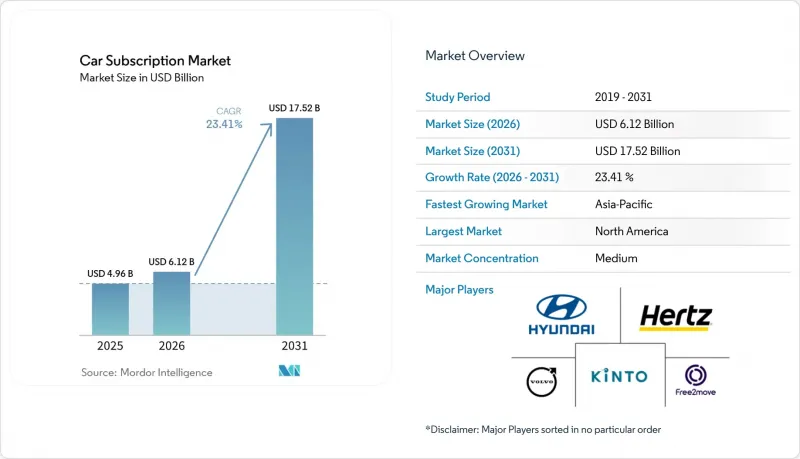
According to Mordor Intelligence, the car subscription market was valued at USD 4.96 billion in 2025 and is estimated to grow from USD 6.12 billion in 2026 to reach USD 17.52 billion by 2031, at a CAGR of 23.41% during the forecast period (2026-2031).
Global Car Subscription Market Trends and Insights
Rising Preference for Flexible, Hassle-Free Vehicle Access
Consumers are showing less interest in long-term vehicle ownership commitments, increasing the relevance of the car subscription market across mature and developing mobility ecosystems. Cost transparency is a key driver, as a bundled monthly fee combines the vehicle, insurance, maintenance, and taxes into a single payment. This structure reduces uncertainty around financing, resale risk, and repair costs. Car subscriptions lower barriers for consumers seeking newer vehicles or electric vehicles (EVs) without a full purchase commitment, expanding the addressable customer base. Rapid digital onboarding shortens retail timelines, making subscriptions resemble digital service purchases and positioning them as a consumption model.
OEM and Captive Financing Push to Retain Lifetime Customer Value
Subscription models reshape the handoff between OEMs and dealers by enabling manufacturers to maintain relationships with customers after vehicle delivery. In the car subscription market, recurring monthly billing generates data on usage, retention, upgrades, and service behavior, helping refine pricing and targeting. Toyota's KINTO reached first-time profitability in Sweden in 2025 while expanding its customer and registered-user base. KINTO Italia recorded growth in long-term registrations in 2025, with electrified vehicles comprising the majority. These results show why captives view subscriptions as a retention layer supporting sales, fleet management, remarketing, and electrification. Operators integrating refurbishment, resale discipline, and residual-value management can sustain an advantage.
Thin Unit-Economics and Residual-Value Risk
The car subscription market faces a core operating challenge: revenue must cover fleet acquisition, insurance, maintenance, logistics, refurbishment, and depreciation. This cost structure leaves little room for error when utilization declines, particularly for newer programs without stable scale. EV-heavy fleets face further pressure as resale assumptions can shift rapidly with changes in battery technology, incentives, and used-vehicle demand. Providers deploy vehicles across subscription, rental, and sales channels to sustain asset earnings when subscriber demand softens. However, this strategy requires pricing, rapid turnaround, and disciplined remarketing capabilities that many smaller entrants lack. Until residual-value insurance and secondary-market liquidity improve, the market will expand cautiously rather than through unrestricted fleet growth.
Other drivers and restraints analyzed in the detailed report include:
- EV-Specific Depreciation Mitigation via Subscription Models
- SaaS Platform Proliferation Lowering Entry Barriers
- Low Consumer Awareness and Trust in New Models
For complete list of drivers and restraints, kindly check the Table Of Contents.
Segment Analysis
OEM/captive operators accounted for 58.10% of revenue in 2025, securing the leading position in the car subscription market through direct access to vehicle inventory, financing, insurance partnerships, and dealer support. This advantage shortens delivery timelines and reduces the sourcing challenges faced by independent providers. Brand familiarity also increases consumer confidence in bundled monthly pricing and recurring service commitments. Consequently, captive operators can meet mobility demand while retaining customers who might otherwise leave the brand between vehicle purchase cycles.
Mobility providers will emerge as the fastest-growing group, with a projected CAGR of 27.45% through 2031. They aggregate supply, deploy app-based experiences, and scale with lower balance-sheet intensity than captive models. Technology companies integrate subscription tools, enabling white-label launches for dealers. Software influences pricing, inventory visibility, and onboarding, shifting information advantages from OEM captives to third-party systems. This creates a market where software, experience, and fleet access matter nearly as much as vehicle ownership.
The 6-to-12-month tier accounted for 49.33% of the car subscription market size in 2025, reflecting preference for a tenure that balances flexibility and predictable fleet utilization. It supports relocation, project-based work, seasonal family needs, and EV trials without long-term ownership risks. For operators, it spreads onboarding, delivery, and servicing costs over enough time to support margins. It bridges short-term rentals and leasing commitments while generating data on driver behavior, vehicle wear, and renewals, improving pricing discipline.
The 1-to-6-month category is forecast to grow at a 30.35% CAGR through 2031, the fastest-growing tenure segment, as customers prioritize immediate access and minimal commitment. SIXT positions SIXT+ to convert renters into recurring users, reporting month-over-month retention . Short plans suit tourism, gig work, temporary assignments, and rapid access without lock-in. More-than-12-month plans improve utilization visibility and reduce churn costs. Long-term corporate contracts facilitate emissions tracking and allocate vehicle data to business units. Medium-term plans support revenue, while short-term plans drive growth.
Complete Report Scope:
- By Service Provider
- OEM/Captives
- Mobility Providers
- Technology Companies
- By Subscription Period
- 1 to 6 Months
- 6 to 12 Months
- More than 12 Months
- By Subscription Type
- Single Brand (Single-Brand Swap)
- Multi Brand
- By End User
- Private
- Corporate
- By Propulsion Type
- Internal-Combustion Engine (ICE)
- Electric Vehicle (EV)
- By Geography
- North America
- United States
- Canada
- Rest of North America
- South America
- Brazil
- Argentina
- Rest of South America
- Europe
- Germany
- United Kingdom
- France
- Spain
- Italy
- Poland
- Russia
- Rest of Europe
- Asia-Pacific
- China
- India
- Japan
- South Korea
- Australia
- Malaysia
- Rest of Asia-Pacific
- Middle East and Africa
- United Arab Emirates
- Saudi Arabia
- South Africa
- Rest of Middle East and Africa
- North America
Geography Analysis
North America accounted for 40.16% of the car subscription market size in 2025, making it the largest regional contributor. Early OEM launches, mature credit systems, and urban consumers comfortable with access-based spending support demand. The United States remains the largest country market, supported by provider scale, financing familiarity, and digital onboarding. Canada is gaining momentum as EV-supportive policies and consumer awareness strengthen flexible access models. Compared with other regions, North America remains more concentrated among OEM-captive and platform-led offerings than independent local specialists.
Europe stands out for program density and regulatory alignment, creating a market structure distinct from North America. Established OEM financing systems, stricter emissions requirements, and urban mobility frameworks favor products positioned between leasing and rental. Germany remains a key operating base, while the Netherlands, Italy, Spain, Norway, and the United Kingdom shape demand through EV adoption, SME mobility needs, and digitally managed fleet offerings. SIXT identifies subscriptions as a recurring-revenue contributor within its mobility portfolio, reflecting their role in wider service platforms.
Asia-Pacific is forecast to expand at a 31.45% CAGR through 2031, the fastest rate. Toyota's KINTO and India's OEM-led launches support adoption. South America and the Middle East and Africa remain earlier-stage, while differing maturity keeps provider strategies localized.
- Daimler AG (Mercedes-Benz Mobility)
- Toyota Motor Corporation (Kinto)
- Volvo Cars
- Hyundai Motor Company
- Free2Move
- Porsche AG
- Lynk and Co.
- Autonomy Inc.
- Sixt SE
- Hertz Global Holdings, Inc.
- FlexClub
- Facedrive Inc. (Steer)
Additional Benefits:
- The market estimate (ME) sheet in Excel format
- 3 months of analyst support
TABLE OF CONTENTS
1 Introduction
- 1.1 Study Assumptions and Market Definition
- 1.2 Scope of the Study
2 Research Methodology
3 Executive Summary
4 Market Landscape
- 4.1 Market Overview
- 4.2 Market Drivers
- 4.2.1 Rising Preference for Flexible, Hassle-Free Vehicle Access
- 4.2.2 OEM and Captive Financing Push to Retain Lifetime Customer Value
- 4.2.3 EV-Specific Depreciation Mitigation via Subscription Models
- 4.2.4 SaaS Platform Proliferation Lowering Entry Barriers
- 4.2.5 White-Label Dealer Platforms Scaling in Emerging Markets
- 4.2.6 Road-Usage-Pricing Pilots Nudging "Access Over Ownership"
- 4.3 Market Restraints
- 4.3.1 Thin Unit-Economics and Residual-Value Risk
- 4.3.2 Low Consumer Awareness and Trust in New Models
- 4.3.3 Lack of Residual-Value Insurance in Developing Regions
- 4.3.4 OEM Channel-Conflict Curbs Multi-Brand Supply
- 4.4 Value Supply Chain Analysis
- 4.5 Regulatory Landscape
- 4.6 Technological Outlook
- 4.7 Porter's Five Forces Analysis
- 4.7.1 Threat of New Entrants
- 4.7.2 Bargaining Power of Suppliers
- 4.7.3 Bargaining Power of Buyers
- 4.7.4 Threat of Substitutes
- 4.7.5 Competitive Rivalry
5 Market Size and Growth Forecasts (Value (USD))
- 5.1 By Service Provider
- 5.1.1 OEM/Captives
- 5.1.2 Mobility Providers
- 5.1.3 Technology Companies
- 5.2 By Subscription Period
- 5.2.1 1 to 6 Months
- 5.2.2 6 to 12 Months
- 5.2.3 More than 12 Months
- 5.3 By Subscription Type
- 5.3.1 Single Brand (Single-Brand Swap)
- 5.3.2 Multi Brand
- 5.4 By End User
- 5.4.1 Private
- 5.4.2 Corporate
- 5.5 By Propulsion Type
- 5.5.1 Internal-Combustion Engine (ICE)
- 5.5.2 Electric Vehicle (EV)
- 5.6 By Geography
- 5.6.1 North America
- 5.6.1.1 United States
- 5.6.1.2 Canada
- 5.6.1.3 Rest of North America
- 5.6.2 South America
- 5.6.2.1 Brazil
- 5.6.2.2 Argentina
- 5.6.2.3 Rest of South America
- 5.6.3 Europe
- 5.6.3.1 Germany
- 5.6.3.2 United Kingdom
- 5.6.3.3 France
- 5.6.3.4 Spain
- 5.6.3.5 Italy
- 5.6.3.6 Poland
- 5.6.3.7 Russia
- 5.6.3.8 Rest of Europe
- 5.6.4 Asia-Pacific
- 5.6.4.1 China
- 5.6.4.2 India
- 5.6.4.3 Japan
- 5.6.4.4 South Korea
- 5.6.4.5 Australia
- 5.6.4.6 Malaysia
- 5.6.4.7 Rest of Asia-Pacific
- 5.6.5 Middle East and Africa
- 5.6.5.1 United Arab Emirates
- 5.6.5.2 Saudi Arabia
- 5.6.5.3 South Africa
- 5.6.5.4 Rest of Middle East and Africa
- 5.6.1 North America
6 Competitive Landscape
- 6.1 Market Concentration
- 6.2 Strategic Moves
- 6.3 Market Share Analysis
- 6.4 Company Profiles (includes Global Level Overview, Market Level Overview, Core Segments, Financials as Available, Strategic Information, Market Rank/Share for Key Companies, Products and Services, SWOT Analysis, and Recent Developments)
- 6.4.1 Daimler AG (Mercedes-Benz Mobility)
- 6.4.2 Toyota Motor Corporation (Kinto)
- 6.4.3 Volvo Cars
- 6.4.4 Hyundai Motor Company
- 6.4.5 Free2Move
- 6.4.6 Porsche AG
- 6.4.7 Lynk and Co.
- 6.4.8 Autonomy Inc.
- 6.4.9 Sixt SE
- 6.4.10 Hertz Global Holdings, Inc.
- 6.4.11 FlexClub
- 6.4.12 Facedrive Inc. (Steer)
7 Market Opportunities and Future Outlook
- 7.1 White-space and Unmet-Need Assessment

