PUBLISHER: Mordor Intelligence | PRODUCT CODE: 2154305

PUBLISHER: Mordor Intelligence | PRODUCT CODE: 2154305
AI In Telecommunication - Market Share Analysis, Industry Trends & Statistics, Growth Forecasts (2026 - 2031)
According to Mordor Intelligence, the AI in telecommunication market size is expected to increase from USD 4.18 billion in 2025 to USD 5.78 billion in 2026 and reach USD 29.17 billion by 2031, expanding at a CAGR of 38.23% over 2026-2031.
5G Standalone deployment and Open RAN adoption are increasing the number of network settings that operators must manage. This report is Segmented by Component (Solutions, and Services), Deployment Mode (On-Premises, and More), Technology (Machine Learning, Natural Language Processing, and More), Application (Customer Analytics, Network Security, and More), Operator Type (Mobile Network Operators, Fixed and Internet Service Providers, and More), and Geography. The Market Forecasts are Provided in Terms of Value (USD).
Global AI In Telecommunication Market Trends and Insights
5G Standalone and Open RAN Complexity Driving AI Network Automation
5G Standalone and Open RAN designs have increased the settings that operators need to control across the radio network. Rule-based tools cannot manage this level of change across large networks with the same speed as AI systems. Ericsson launched an AI in RAN software subscription in June 2026, with reported gains of up to 20% in downlink throughput and 10% in spectral efficiency across more than 15 live deployments. The software includes an AI-native scheduler for link adaptation and AI-managed beamforming, and it operates on existing hardware. Nokia introduced an AI-native RAN platform in July 2026 that reported more than 20% spectral efficiency gains today and targets more than 100% improvement by 2028. These offers show how the AI in telecommunication market is becoming part of the radio software stack rather than a separate analytics purchase.
Rising Demand for Zero-Touch Operations and Network Reliability
Operators are putting AI into fault detection, root-cause analysis, and remediation to reduce the need for manual network intervention. NTT Docomo introduced a commercial AI agent system for mobile network maintenance in February 2026. The system analyzes traffic and alarm data from more than 1 million network devices in real time and is expected to reduce fault response time by 50%. NTT Docomo also deployed Nokia MantaRay AutoPilot on a public cloud in June 2026 for AI-driven network quality optimization. Google Cloud's autonomous network operations framework supported Deutsche Telekom's MINDR program and reduced mean time to repair by 25% in early deployments. Rakuten Mobile's Level 4 Autonomous Network certification on its commercial Open RAN network shows that cloud-native network design can support higher levels of operational autonomy.
Data Privacy, Sovereignty, and AI Governance Requirements
The European Union AI Act entered full application on August 2026, setting binding requirements for high-risk AI systems. Relevant telecom uses can include network security scoring, customer risk profiling, and AI-supported network management decisions. Operators must address data governance, model transparency, and human oversight before deploying these systems across European markets. India is phasing in its Digital Personal Data Protection Act from November 2025 to May 2027. These requirements can require AI pipelines to keep sensitive financial, biometric, and network data within national boundaries. The result is a more segmented AI in telecommunication market, where regional data-center capacity and hybrid deployment options carry greater weight.
Other drivers and restraints analyzed in the detailed report include:
- Growing Need for AI-Enabled Customer Experience and Churn Reduction
- AI-Driven Energy Optimization Under Rising Network Power Costs
- Legacy Network Integration and Interoperability Complexity
For complete list of drivers and restraints, kindly check the Table Of Contents.
Segment Analysis
Solutions accounted for 65.87% of component revenue in 2025, giving them the leading position in the AI in telecommunication market. Operators have favored established software tools and platforms over developing every AI system internally within the AI (artificial intelligence) in telecommunication market. These offerings connect AI models with OSS, BSS, and RAN workflows. Amdocs introduced its aOS agentic operating system in February 2026 to work above existing BSS and OSS stacks. The platform approach supports coordination across vendor environments without replacing the full network software estate.
Services are projected to expand at a 39.74% CAGR through 2031, making them the fastest-growing component. Operators without internal MLOps teams need support for deployment, tuning, monitoring, and retraining across live networks. IBM expanded its collaboration with NVIDIA in March 2026 for GPU-native analytics, document processing, and on-premises AI deployment. These functions become more important when AI moves beyond a pilot. Managed services can also replace one-time projects with contracts tied to model performance and defined service outcomes.
Cloud held 58.48% of deployment revenue in 2025 and is projected to expand at a 39.41% CAGR through 2031. This combination makes cloud both the largest and fastest-growing deployment mode. Public cloud platforms provide scalable computing capacity, integrated AI tools, and open interfaces for model development in the artificial intelligence in telecommunication market. NTT Docomo and NEC began Japan's first commercial 5G Core service on AWS in February 2026. Their AI and GitOps-based automated network construction reduced build time by 80%.
On-premises deployment remains relevant where data residency rules or latency needs limit public-cloud use. Hybrid and edge configurations serve AI-managed beamforming and real-time fraud detection that cannot tolerate a delayed link to a centralized cloud. This creates a division between cloud-based model training and edge-based inference. The approach uses centralized capacity for training while locating time-sensitive decisions close to the network. It may reduce cloud's current advantage as AI-capable edge hardware becomes more accessible.
Complete Report Scope:
- By Component
- Solutions
- Software Tools
- Platforms
- Services
- Professional Services
- Managed Services
- Solutions
- By Deployment Mode
- Cloud
- On-Premises
- Hybrid and Edge
- By Technology
- Machine Learning
- Deep Learning
- Natural Language Processing
- Computer Vision
- By Application
- Customer Analytics
- Network Security
- Network Optimization
- Virtual Assistance and Chatbots
- Other Applications
- By Operator Type
- Mobile Network Operators
- Fixed and Internet Service Providers
- Over-the-Top Service Providers
- By Geography
- North America
- United States
- Canada
- Mexico
- South America
- Brazil
- Argentina
- Rest of South America
- Europe
- United Kingdom
- Germany
- France
- Spain
- Italy
- Russia
- Rest of Europe
- Asia-Pacific
- China
- Japan
- South Korea
- India
- Australia and New Zealand
- Rest of Asia-Pacific
- Middle East
- Gulf Cooperation Council
- Turkey
- Israel
- Rest of Middle East
- Africa
- South Africa
- Nigeria
- Rest of Africa
- North America
Geography Analysis
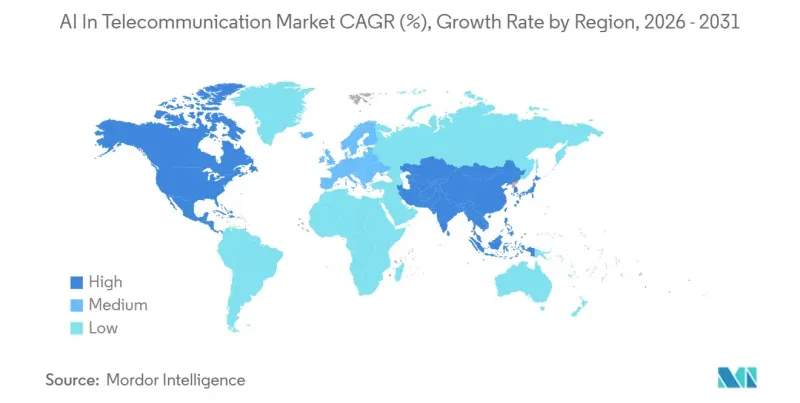
North America held 42.37% of the AI in telecommunication market share in 2025, supported by large operator programs and mature cloud ecosystems. The artificial intelligence in telecommunication market benefits from the concentration of cloud ecosystems and tier-1 operator programs in the United States. AT&T introduced OTel 2.0 in July 2026, an open-source telecom AI model trained on more than 400 billion telecom tokens. AMD, Microsoft, Dell, and Red Hat contributed through the GSMA Open Telco AI program. This reflects a shift in which operators contribute models and benchmarks rather than only purchase AI products. Canada and Mexico are following the United States through network automation initiatives and 5G rollout.
Asia-Pacific is projected to expand at a 39.21% CAGR through 2031, making it the fastest-growing region. China Mobile allocated CNY 9.8 billion (USD 1.4 billion), to 5G-Advanced upgrades across more than 400,000 base stations in 2025. Airtel is building an AI-ready data center campus in Visakhapatnam and targets 56 edge data centers through Nxtra. SK Telecom and NVIDIA announced a gigawatt-scale AI Cloud in July 2026. NTT Docomo is combining commercial cloud core deployment, AI-led maintenance, and AI-enabled multiband frequency-control research for 6G.
Europe has a significant position through operator programs in Germany, the United Kingdom, Finland, and the Netherlands. The Middle East is led by the GCC, where 5G subscription penetration reached 53% at the end of 2025 and is forecast to approach 90% by 2031. South America remains at an earlier stage, with Brazil leading network modernization and 5G expansion. Africa is a longer-term opportunity centered on South Africa and Nigeria, where 5G is forecast to rise from 4% of mobile subscriptions in 2024 to 25% by 2030.
- International Business Machines Corporation
Additional Benefits:
- The market estimate (ME) sheet in Excel format
- 3 months of analyst support
TABLE OF CONTENTS
1 INTRODUCTION
- 1.1 Study Assumptions and Market Definition
- 1.2 Scope of the Study
2 RESEARCH METHODOLOGY
3 EXECUTIVE SUMMARY
4 MARKET LANDSCAPE
- 4.1 Market Overview
- 4.2 Impact of Macroeconomic Factors on the Market
- 4.3 Market Drivers
- 4.3.1 5G Standalone and Open RAN Complexity Driving AI Network Automation
- 4.3.2 Rising Demand for Zero-Touch Operations and Network Reliability
- 4.3.3 Growing Need for AI-Enabled Customer Experience and Churn Reduction
- 4.3.4 AI-Driven Energy Optimization Under Rising Network Power Costs
- 4.3.5 Telco-Specific Foundation Models and Agentic Network Operations
- 4.3.6 Edge-Cloud Convergence Enabling Low-Latency Telecom AI Monetization
- 4.4 Market Restraints
- 4.4.1 Data Privacy, Sovereignty, and AI Governance Requirements
- 4.4.2 Legacy Network Integration and Interoperability Complexity
- 4.4.3 Shortage of Telco-Grade AI and MLOps Talent
- 4.4.4 Inference Economics and Uncertain 5G Return on Investment
- 4.5 Industry Value Chain Analysis
- 4.6 Regulatory Landscape
- 4.7 Porter's Five Forces Analysis
- 4.7.1 Bargaining Power of Buyers
- 4.7.1.1 Bargaining Power of Suppliers
- 4.7.1.2 Threat of New Entrants
- 4.7.1.3 Threat of Substitutes
- 4.7.1.4 Competitive Rivalry
- 4.7.1 Bargaining Power of Buyers
- 4.8 AI in Telecommunication Use-Case Library
- 4.8.1 Network Slicing Automation
- 4.8.2 Zero-Touch Service Assurance
- 4.8.3 Generative AI Chatbots and Voice Assistants for Customer Experience
- 4.8.4 Dynamic Spectrum Management
- 4.8.5 Autonomous Network Orchestration and Self-Healing
- 4.8.6 Fraud Management and Revenue Assurance
- 4.8.7 Predictive Maintenance and Field-Service Optimization
- 4.8.8 AI-Assisted Network Planning and Digital Twins
5 MARKET SIZE AND GROWTH FORECASTS
- 5.1 By Component
- 5.1.1 Solutions
- 5.1.1.1 Software Tools
- 5.1.1.2 Platforms
- 5.1.2 Services
- 5.1.2.1 Professional Services
- 5.1.2.2 Managed Services
- 5.1.1 Solutions
- 5.2 By Deployment Mode
- 5.2.1 Cloud
- 5.2.2 On-Premises
- 5.2.3 Hybrid and Edge
- 5.3 By Technology
- 5.3.1 Machine Learning
- 5.3.2 Deep Learning
- 5.3.3 Natural Language Processing
- 5.3.4 Computer Vision
- 5.4 By Application
- 5.4.1 Customer Analytics
- 5.4.2 Network Security
- 5.4.3 Network Optimization
- 5.4.4 Virtual Assistance and Chatbots
- 5.4.5 Other Applications
- 5.5 By Operator Type
- 5.5.1 Mobile Network Operators
- 5.5.2 Fixed and Internet Service Providers
- 5.5.3 Over-the-Top Service Providers
- 5.6 By Geography
- 5.6.1 North America
- 5.6.1.1 United States
- 5.6.1.2 Canada
- 5.6.1.3 Mexico
- 5.6.2 South America
- 5.6.2.1 Brazil
- 5.6.2.2 Argentina
- 5.6.2.3 Rest of South America
- 5.6.3 Europe
- 5.6.3.1 United Kingdom
- 5.6.3.2 Germany
- 5.6.3.3 France
- 5.6.3.4 Spain
- 5.6.3.5 Italy
- 5.6.3.6 Russia
- 5.6.3.7 Rest of Europe
- 5.6.4 Asia-Pacific
- 5.6.4.1 China
- 5.6.4.2 Japan
- 5.6.4.3 South Korea
- 5.6.4.4 India
- 5.6.4.5 Australia and New Zealand
- 5.6.4.6 Rest of Asia-Pacific
- 5.6.5 Middle East
- 5.6.5.1 Gulf Cooperation Council
- 5.6.5.2 Turkey
- 5.6.5.3 Israel
- 5.6.5.4 Rest of Middle East
- 5.6.6 Africa
- 5.6.6.1 South Africa
- 5.6.6.2 Nigeria
- 5.6.6.3 Rest of Africa
- 5.6.1 North America
6 COMPETITIVE LANDSCAPE
- 6.1 Market Concentration
- 6.2 Strategic Moves
- 6.3 Market Share Analysis
- 6.4 Company Profiles (includes Global Level Overview, Market Level Overview, Core Segments, Financials as available, Strategic Information, Market Rank/Share, Products and Services, Recent Developments)
- 6.4.1 International Business Machines Corporation
- 6.4.1.1 Microsoft Corporation
- 6.4.1.2 Google LLC
- 6.4.1.3 Intel Corporation
- 6.4.1.4 NVIDIA Corporation
- 6.4.1.5 Cisco Systems, Inc.
- 6.4.1.6 Telefonaktiebolaget LM Ericsson
- 6.4.1.7 Nokia Corporation
- 6.4.1.8 Huawei Technologies Co., Ltd.
- 6.4.1.9 ZTE Corporation
- 6.4.1.10 Samsung SDS Co., Ltd.
- 6.4.1.11 AT&T Inc.
- 6.4.1.12 Juniper Networks, Inc.
- 6.4.1.13 NEC Corporation
- 6.4.1.14 Ciena Corporation
- 6.4.1.15 Rakuten Symphony, Inc.
- 6.4.1.16 Amdocs Limited
- 6.4.1.17 Salesforce, Inc.
- 6.4.1.18 Subex Limited
- 6.4.1.19 Mavenir Systems, Inc.
- 6.4.1.20 Infosys Limited
- 6.4.1.21 Tech Mahindra Limited
- 6.4.1.22 DeepSig Inc.
- 6.4.1.23 Amazon Web Services, Inc.
- 6.4.1.24 Oracle Corporation
- 6.4.1.25 Hewlett Packard Enterprise Company
- 6.4.1.26 Netcracker Technology Corporation
- 6.4.1.27 Parallel Wireless, Inc.
- 6.4.1.28 TEOCO Corporation
- 6.4.1 International Business Machines Corporation
7 MARKET OPPORTUNITIES AND FUTURE OUTLOOK
- 7.1 White-Space and Unmet-Need Assessment

