PUBLISHER: Mordor Intelligence | PRODUCT CODE: 2154882

PUBLISHER: Mordor Intelligence | PRODUCT CODE: 2154882
QoE Analytics For Telecom Operators - Market Share Analysis, Industry Trends & Statistics, Growth Forecasts (2026 - 2031)
According to Mordor Intelligence, the QoE analytics for telecom operators market size was valued at USD 2.89 billion in 2026 and is estimated to reach USD 4.434 billion by 2031, at a CAGR of 8.96% during the forecast period 2026-2031.
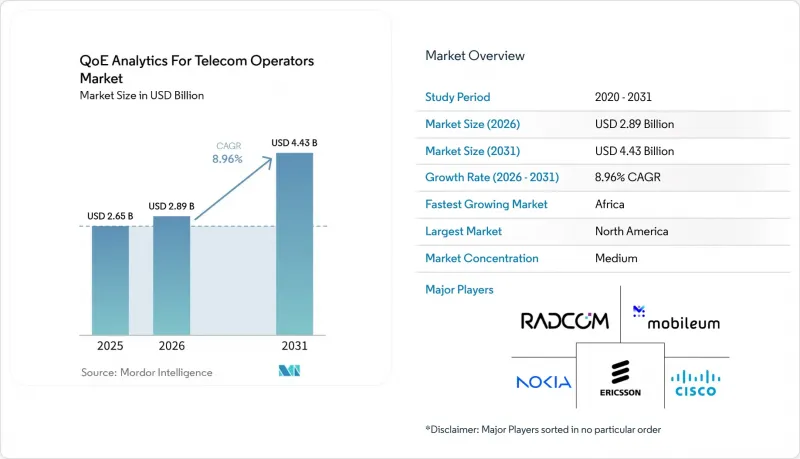
5G standalone architecture is increasing the volume and variety of telemetry that operators must interpret across radio, transport, and core networks. This report is Segmented by Component (Software, and Services), Deployment Mode (Cloud, On-Premises, and Hybrid), Analytics Type (Descriptive Analytics, and More), Application (Network Performance Management, and More), Operator Type (Fixed-Line Operators, and More), Organization Size (Large Enterprise, and SMEs), and Geography. The Market Forecasts are Provided in Terms of Value (USD).
Global QoE Analytics For Telecom Operators Market Trends and Insights
Shift Toward AI-Driven Closed-Loop Service Assurance
The QoE analytics for telecom operators market is benefiting from a shift away from rules-based alerts toward systems that detect, diagnose, and address network conditions with limited manual intervention. This approach extends analytics from a reporting function into an operational layer that can support service assurance decisions. RADCOM launched Neura in February 2026, with agents for customer experience, service quality, and network optimization that operate on its full-traffic analysis infrastructure. The platform can process traffic at up to 800 Gbps on a commercial off-the-shelf server, which supports deployments that require high data throughput. Recommendation M.3389, published in March 2025, set requirements for AI-based customer experience management in telecom services. This standard supports procurement requirements for operators that need governed and explainable AI-based customer experience processes.
5G Standalone Network Complexity and Telemetry Growth
5G standalone networks use cloud-native service-based functions that create distinct telemetry streams across the core, user plane, policy layer, and radio network. The QoE analytics for the telecom operators market addresses the need to correlate these streams at the subscriber level when an experience issue occurs. Network slicing adds a further requirement because operators must validate service-level agreements for each enterprise slice. NTT Docomo deployed Nokia MantaRay AutoPilot in June 2026 for AI-driven RAN quality optimization on a public cloud. The deployment used 15-minute closed-loop cycles instead of the earlier daily cycle and supported NTT Docomo's Autonomous Network Level 4 objective. KT and Samsung also validated AI RAN optimization on a commercial 5G network in South Korea during 2025, using user-level AI configurations to predict service disruptions.
Subscriber Data Privacy and Data-Residency Constraints
Subscriber-level QoE platforms use information that can include device location, application use, session records, and behavior linked to SIM identities. Europe's General Data Protection Regulation and similar rules in Southeast Asia and the Middle East restrict where this information can be processed and stored. The QoE analytics for telecom operators market must therefore support architectures that keep identifiable data within an operator's required territory. 3GPP network data analytics specifications require subscriber-level data aggregation in the 5G core, which can create practical tension with cross-border data restrictions. Operators in regulated markets may choose on-premises or hybrid designs, increasing their capital needs and integration work. AWS documented an edge architecture in 2026 that processes and redacts subscriber identifiers before cloud inference workloads receive data.
Other drivers and restraints analyzed in the detailed report include:
- Rising Subscriber Churn and Retention Economics
- Expansion of Streaming, Gaming, and Latency-Sensitive Services
- High Integration Complexity Across OSS, BSS, and Multivendor Networks
For complete list of drivers and restraints, kindly check the Table Of Contents.
Segment Analysis
Software accounted for 72.13% of the QoE analytics for telecom operators' market share in 2025, reflecting the move from hardware probes toward platforms that process network traffic in software. Software can examine encrypted and unencrypted traffic while connecting performance information with experience indicators. Customer experience management, predictive analytics, and prescriptive analytics are receiving greater attention as operators move beyond historical network reports. Predictive and prescriptive analytics within software is projected to expand at a 9.16% CAGR through 2031. The QoE analytics for the telecom operators market size for software is supported by platforms that can recommend a corrective action before service degradation reaches a subscriber. This function gives operators a way to focus engineering attention on likely experience failures rather than every network event.
Services retain a complementary role because many deployments require integration, ongoing support, and operational expertise. Managed services are relevant for operators that need the platform's capabilities but do not intend to create a large internal analytics team. The QoE analytics for the telecom operators industry is also moving toward ready-to-use applications that reduce the need for bespoke model development. Nokia's Experience Prescriptions provides cloud-native applications that combine anomaly detection and root-cause analysis within one subscriber experience workflow. ITU-T Recommendation M.3389 provides a recognized baseline for AI-based customer experience management, which can favor software platforms over custom-built tools. Procurement decisions increasingly turn on whether software can work across the full network estate and meet applicable governance requirements.
Cloud deployment is projected to expand at a 9.22% CAGR through 2031 as operators seek flexible capacity for 5G standalone telemetry. Traffic volumes can change sharply during congestion or major events, making permanent infrastructure capacity less efficient for some workloads. The QoE analytics for the telecom operators market supports cloud designs that use consumption-based pricing and can scale without a large upfront commitment. Cloud delivery can also shorten access to analytical tools where a provider manages platform upgrades centrally. Its value depends on whether an operator can use cloud resources without compromising data-residency requirements.
Hybrid deployment remains important where subscriber-identifiable data must stay on premises, while anonymized data and inference workloads can use cloud resources. On-premises deployment continues to be the default for some tier-1 operators in China and the Middle East because sovereignty requirements restrict public-cloud processing of subscriber telemetry. Nokia expanded its Google Cloud collaboration in 2026 to provide its analytics stack as a software-as-a-service application, on Google Distributed Cloud on premises, and in hybrid configurations. Polystar's deployment for MasOrange combined a centralized on-premises bare-metal installation with Kubernetes-based processing on Google Cloud. The QoE analytics for telecom operators market therefore does not treat hybrid delivery as a temporary arrangement. It provides a long-term way to balance privacy, performance, and operating cost across a converged network.
Complete Report Scope:
- By Component
- Software
- Network Analytics
- Performance Monitoring Tools
- Customer Experience Management
- Predictive and Prescriptive Analytics
- Other Softwares
- Services
- Professional Services
- Managed Services
- Support and Maintenance Services
- Software
- By Deployment Mode
- Cloud
- On-Premises
- Hybrid
- By Analytics Type
- Descriptive Analytics
- Diagnostic Analytics
- Predictive Analytics
- Prescriptive Analytics
- Other Analytics Types
- By Application
- Network Performance Management
- Service Quality Monitoring
- Customer Experience Management
- Churn Prediction and Retention Management
- Root-Cause Analysis and Anomaly Detection
- Network Investment and Capacity Planning
- Other Applications
- By Operator Type
- Mobile Network Operators
- Fixed-Line Operators
- Converged Operators
- Cable Operators
- Other Operator Types
- By Organization Size
- Large Enterprise
- Small and Medium-Sized Operators
- By Geography
- North America
- United States
- Canada
- Mexico
- South America
- Brazil
- Argentina
- Colombia
- Chile
- Rest of South America
- Europe
- United Kingdom
- Germany
- France
- Italy
- Spain
- Russia
- Rest of Europe
- Asia-Pacific
- China
- Japan
- India
- South Korea
- Australia
- Southeast Asia
- Rest of Asia-Pacific
- Middle East
- Saudi Arabia
- United Arab Emirates
- Qatar
- Israel
- Turkey
- Rest of Middle East
- Africa
- South Africa
- Egypt
- Nigeria
- Morocco
- Rest of Africa
- North America
Geography Analysis
North America held 28.27% of 2025 revenue, making it the largest regional share in the QoE analytics for telecom operators market. Early 5G standalone activity, competitive national carriers, and established data-driven network practices support demand in the region. Operators were early users of cloud-native OSS designs, creating a stronger fit for platforms that connect with DevOps and AIOps workflows. Europe ranked second, with spending concentrated in the United Kingdom, Germany, France, and Nordic countries. GDPR affects both platform architecture and procurement timing, favoring suppliers that can support on-premises and hybrid models. CONNECT Europe reported that 5G coverage reached most of the European population by the end of the reporting period, while adoption accounted for a significant share of mobile connections.
The difference between European coverage and adoption increases the need for operators to show service quality that customers can recognize. Deutsche Telekom worked with Google Cloud in February 2026 on an AI agent for autonomous RAN operations, targeting lower operating costs and improved customer experience. Asia-Pacific is another high-activity region, led by Japan, South Korea, China, and India, though each country has a different level of 5G standalone maturity. NTT Docomo deployed Nokia MantaRay AutoPilot in June 2026 as a cloud-hosted AI quality optimization system for a national commercial network. Its October 2025 CNX rollout used AI to quantify subscriber-perceived communication quality. India's 5G subscriber expansion through Reliance Jio and Bharti Airtel is also creating demand for experience differentiation in a price-sensitive environment.
Africa is projected to expand at a 9.71% CAGR through 2031, the fastest regional rate in the QoE analytics for telecom operators market. GSMA Intelligence recorded the expansion of commercial 5G services across several African markets. It projected strong growth in 5G connections in Africa over the coming years. Egypt's National Spectrum Strategy and Morocco's tower expansion plan add to the near-term infrastructure pipeline. Gulf Cooperation Council operators create premium demand for slice analytics and subscriber-level monetization, while South America is at an earlier stage as operators modernize legacy OSS and BSS environments.
- Ericsson
- Nokia Corporation
- Cisco Systems, Inc.
- Mobileum Inc.
- RADCOM Ltd.
- NETSCOUT SYSTEMS, INC.
- Infovista S.A.S.
- MedUX
- Ookla, LLC
- Rohde & Schwarz GmbH & Co KG
- VIAVI Solutions Inc.
- Keysight Technologies, Inc.
- Spirent Communications plc
- EXFO Inc.
- TEOCO Corporation
- Subex Limited
- Huawei Technologies Co., Ltd.
- Samsung Electronics Co., Ltd.
- Amdocs Limited
- Oracle Corporation
- Broadcom Inc.
- ZTE Corporation
- Sandvine Corporation
Additional Benefits:
- The market estimate (ME) sheet in Excel format
- 3 months of analyst support
TABLE OF CONTENTS
1 INTRODUCTION
- 1.1 Study Assumptions and Market Definition
- 1.2 Scope of the Study
2 RESEARCH METHODOLOGY
3 EXECUTIVE SUMMARY
4 MARKET LANDSCAPE
- 4.1 Market Overview
- 4.2 Market Drivers
- 4.2.1 5G Standalone Network Complexity and Telemetry Growth
- 4.2.2 Rising Subscriber Churn and Retention Economics
- 4.2.3 Expansion of Streaming, Gaming, and Latency-Sensitive Services
- 4.2.4 Shift Toward AI-Driven Closed-Loop Service Assurance
- 4.2.5 Subscriber-Level Experience Monetization
- 4.2.6 Experience Analytics for Network Slice and Edge-Service Validation
- 4.3 Market Restraints
- 4.3.1 Subscriber Data Privacy and Data-Residency Constraints
- 4.3.2 High Integration Complexity Across OSS/BSS and Multivendor Networks
- 4.3.3 Limited Availability of Consistent QoE Labels Across Devices and Applications
- 4.3.4 Operator Resistance to Automated Decisions Without Explainable Evidence
- 4.4 Industry Value Chain Analysis
- 4.5 Impact of Macroeconomic Factors on the Market
- 4.6 Regulatory Landscape
- 4.7 Technological Outlook
- 4.8 Porter's Five Forces Analysis
- 4.8.1 Bargaining Power of Suppliers
- 4.8.2 Bargaining Power of Buyers
- 4.8.3 Threat of New Entrants
- 4.8.4 Threat of Substitutes
- 4.8.5 Competitive Rivalry
- 4.9 Pricing Analysis
5 MARKET SIZE AND GROWTH FORECASTS (VALUE)
- 5.1 By Component
- 5.1.1 Software
- 5.1.1.1 Network Analytics
- 5.1.1.2 Performance Monitoring Tools
- 5.1.1.3 Customer Experience Management
- 5.1.1.4 Predictive and Prescriptive Analytics
- 5.1.1.5 Other Softwares
- 5.1.2 Services
- 5.1.2.1 Professional Services
- 5.1.2.2 Managed Services
- 5.1.2.3 Support and Maintenance Services
- 5.1.1 Software
- 5.2 By Deployment Mode
- 5.2.1 Cloud
- 5.2.2 On-Premises
- 5.2.3 Hybrid
- 5.3 By Analytics Type
- 5.3.1 Descriptive Analytics
- 5.3.2 Diagnostic Analytics
- 5.3.3 Predictive Analytics
- 5.3.4 Prescriptive Analytics
- 5.3.5 Other Analytics Types
- 5.4 By Application
- 5.4.1 Network Performance Management
- 5.4.2 Service Quality Monitoring
- 5.4.3 Customer Experience Management
- 5.4.4 Churn Prediction and Retention Management
- 5.4.5 Root-Cause Analysis and Anomaly Detection
- 5.4.6 Network Investment and Capacity Planning
- 5.4.7 Other Applications
- 5.5 By Operator Type
- 5.5.1 Mobile Network Operators
- 5.5.2 Fixed-Line Operators
- 5.5.3 Converged Operators
- 5.5.4 Cable Operators
- 5.5.5 Other Operator Types
- 5.6 By Organization Size
- 5.6.1 Large Enterprise
- 5.6.2 Small and Medium-Sized Operators
- 5.7 By Geography
- 5.7.1 North America
- 5.7.1.1 United States
- 5.7.1.2 Canada
- 5.7.1.3 Mexico
- 5.7.2 South America
- 5.7.2.1 Brazil
- 5.7.2.2 Argentina
- 5.7.2.3 Colombia
- 5.7.2.4 Chile
- 5.7.2.5 Rest of South America
- 5.7.3 Europe
- 5.7.3.1 United Kingdom
- 5.7.3.2 Germany
- 5.7.3.3 France
- 5.7.3.4 Italy
- 5.7.3.5 Spain
- 5.7.3.6 Russia
- 5.7.3.7 Rest of Europe
- 5.7.4 Asia-Pacific
- 5.7.4.1 China
- 5.7.4.2 Japan
- 5.7.4.3 India
- 5.7.4.4 South Korea
- 5.7.4.5 Australia
- 5.7.4.6 Southeast Asia
- 5.7.4.7 Rest of Asia-Pacific
- 5.7.5 Middle East
- 5.7.5.1 Saudi Arabia
- 5.7.5.2 United Arab Emirates
- 5.7.5.3 Qatar
- 5.7.5.4 Israel
- 5.7.5.5 Turkey
- 5.7.5.6 Rest of Middle East
- 5.7.6 Africa
- 5.7.6.1 South Africa
- 5.7.6.2 Egypt
- 5.7.6.3 Nigeria
- 5.7.6.4 Morocco
- 5.7.6.5 Rest of Africa
- 5.7.1 North America
6 COMPETITIVE LANDSCAPE
- 6.1 Market Concentration
- 6.2 Strategic Moves
- 6.3 Market Share Analysis
- 6.4 Company Profiles (includes Global Level Overview, Market Level Overview, Core Segments, Financials as available, Strategic Information, Market Rank/Share, Products and Services, Recent Developments)
- 6.4.1 Ericsson
- 6.4.2 Nokia Corporation
- 6.4.3 Cisco Systems, Inc.
- 6.4.4 Mobileum Inc.
- 6.4.5 RADCOM Ltd.
- 6.4.6 NETSCOUT SYSTEMS, INC.
- 6.4.7 Infovista S.A.S.
- 6.4.8 MedUX
- 6.4.9 Ookla, LLC
- 6.4.10 Rohde & Schwarz GmbH & Co KG
- 6.4.11 VIAVI Solutions Inc.
- 6.4.12 Keysight Technologies, Inc.
- 6.4.13 Spirent Communications plc
- 6.4.14 EXFO Inc.
- 6.4.15 TEOCO Corporation
- 6.4.16 Subex Limited
- 6.4.17 Huawei Technologies Co., Ltd.
- 6.4.18 Samsung Electronics Co., Ltd.
- 6.4.19 Amdocs Limited
- 6.4.20 Oracle Corporation
- 6.4.21 Broadcom Inc.
- 6.4.22 ZTE Corporation
- 6.4.23 Sandvine Corporation
7 MARKET OPPORTUNITIES AND FUTURE OUTLOOK
- 7.1 White-Space and Unmet-Need Assessment

