PUBLISHER: Mordor Intelligence | PRODUCT CODE: 2154362

PUBLISHER: Mordor Intelligence | PRODUCT CODE: 2154362
Private Networks For Oil and Gas - Market Share Analysis, Industry Trends & Statistics, Growth Forecasts (2026 - 2031)
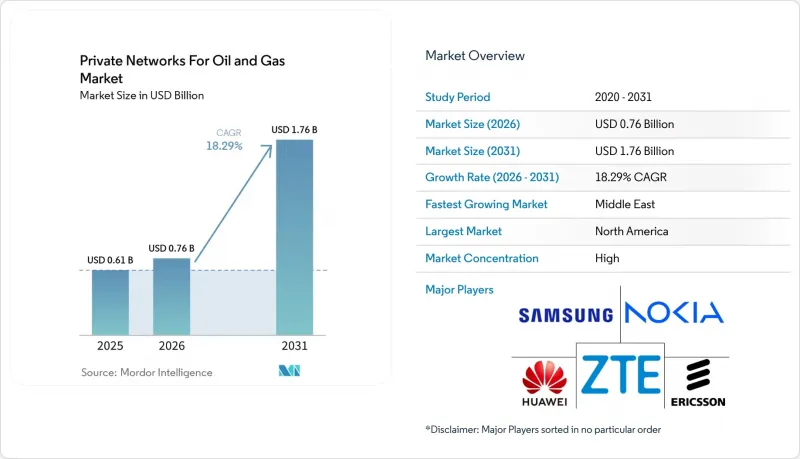
According to Mordor Intelligence, the private networks for Oil and Gas Market size is projected to expand from USD 0.61 billion in 2025 to USD 0.76 billion in 2026, and to USD 1.76 billion by 2031, registering a CAGR of 18.29% between 2026 and 2031.
Global Private Networks For Oil and Gas Market Trends and Insights
Digital Oilfield and Industrial Automation Investment
Digital oilfield programs are increasing the need for dedicated networks at production sites. Autonomous inspection, digital twins, and reservoir workflows need dependable capacity and low delay. Legacy Wi-Fi and public cellular services often cannot provide consistent coverage across large or remote assets. Subsea fiber and onshore control links can support wider platform connectivity. The Private Networks for Oil and Gas Market benefits when operators use one network to support equipment data, visual inspection, and operational control. Operators can then extend the same platform to related digital operating systems.
Mission-Critical Worker Safety and Emergency Response
Safety applications provide a direct reason to deploy private cellular coverage. Push-to-talk services, personnel tracking, wearables, and man-down alerts require reliable service in hazardous locations. Public networks may not provide the necessary coverage or service control at offshore sites and remote fields. Video-enabled communications can also help teams coordinate during an emergency. This demand broadens the Private Networks for Oil and Gas Market beyond equipment monitoring and routine data collection. It also makes a clear operational case for coverage across active work areas.
High Capital Cost and Long Payback for Remote Sites
Remote deployments require more than radios and field devices. They can require new power systems, backhaul links, hazardous-area equipment, and specialist installation teams. These requirements raise the cost of each remote well pad, deepwater platform, or Arctic site. Long mobilization cycles can further delay the point at which a project begins to generate savings. Large operators can spread these costs across several platforms or field assets. Smaller operators may instead prefer managed services or shared infrastructure, which can delay their commitment to Private Networks for the Oil and Gas Market at low-use sites.
Other drivers and restraints analyzed in the detailed report include:
- Low-Latency Connectivity for Autonomous and Remote Operations
- Methane, Emissions, and Process Safety Monitoring Requirements
- Limited Spectrum Availability Across Offshore and Cross-Border Assets
For complete list of drivers and restraints, kindly check the Table Of Contents.
Segment Analysis
Hardware held 48.71% of the Private Networks for Oil and Gas Market in 2025. Base stations, radio units, rugged devices, and hazardous-area equipment account for much of the initial investment. Offshore and remote sites often require specialized equipment capable of operating in harsh conditions. These requirements keep hardware spending high at the start of a project. Initial coverage design and field installation remain central to the buying decision.
Software and platform are forecast to grow at a CAGR of 19.26% through 2031. Operators use these tools for network control, security, spectrum management, and data processing. The Private Networks for Oil and Gas industry is creating demand for managed services where operators lack radio-frequency skills. Integration partners can combine network services with asset monitoring and workforce applications. Software and services can become more important after initial network construction.
Private 5G held 42.72% of the Private Networks for Oil and Gas Market share in 2025. It supports faster data transfer and more consistent performance for demanding applications. These capabilities suit remote inspection, connected cameras, drones, and control functions. Private 5G also offers a clear upgrade path for operators with existing private LTE sites. The leading share shows that private 5G has moved beyond limited proof-of-concept projects.
Private 5G is forecast to grow at a CAGR of 20.27% through 2031. Private LTE remains useful where reliable coverage matters more than very low delay. A phased migration can help operators retain useful LTE assets while adding 5G where operating needs justify it. Hybrid networks can support legacy dispatch and supervisory control needs during this transition. This approach recognizes that not every site requires the same performance level.
Complete Report Scope:
- By Component
- Hardware
- Software and Platforms
- Services
- By Network Type
- Private LTE
- Private 5G
- Hybrid and Other Private Wireless Networks
- By Deployment Mode
- On-Premises
- Cloud-Managed
- By Application
- Remote Monitoring and Control
- Asset Management and Predictive Maintenance
- Pipeline Integrity and SCADA Connectivity
- Worker Safety and Connected Worker
- Other Applications
- By End User
- Upstream
- Midstream
- Downstream
- By Geography
- North America
- United States
- Canada
- Mexico
- South America
- Brazil
- Argentina
- Chile
- Rest of South America
- Europe
- Germany
- United Kingdom
- France
- Italy
- Spain
- Rest of Europe
- Asia-Pacific
- China
- Japan
- India
- South Korea
- Australia
- Rest of Asia-Pacific
- Middle East
- United Arab Emirates
- Saudi Arabia
- Qatar
- Rest of Middle East
- Africa
- South Africa
- Egypt
- Nigeria
- Rest of Africa
- North America
Geography Analysis
North America held 38.43% of the Private Networks for Oil and Gas Market share in 2025. The Gulf of Mexico, the Permian Basin, and Canadian offshore assets support demand. Existing private LTE sites are laying the groundwork for 5G upgrades. Tampnet and Nokia are extending offshore coverage in the Gulf of Mexico across 120 active base stations. South America is also expanding through offshore fiber and private connectivity projects in Brazil and Mexico.
The Middle East is forecast to grow at a CAGR of 20.19% through 2031. National oil companies are building networks as part of wider automation programs. ADNOC and e& announced a private 5G network spanning 11,000 square kilometers and connecting more than 12,000 wells and pipelines. The scale of these deployments supports dedicated connectivity as a core operating platform. It also creates a large base for safety, automation, and data applications in the Private Networks for Oil and Gas Market.
Europe remains important because of the mature North Sea offshore infrastructure. Asia-Pacific has separate growth paths in China, India, and Malaysia. Africa remains a smaller opportunity where remote-site economics and specialist availability constrain expansion. The Private Networks for Oil and Gas Market has different regional paths because spectrum access, field conditions, and operator investment models vary widely.
- Nokia Corporation
- Telefonaktiebolaget LM Ericsson
- Huawei Investment and Holding Co., Ltd.
- Cisco Systems, Inc.
- Motorola Solutions, Inc.
- Samsung Electronics Co., Ltd.
- ZTE Corporation
- Hewlett Packard Enterprise Company
- Siemens Aktiengesellschaft
- Schneider Electric SE
- ABB Ltd
- Hitachi Energy Ltd.
- General Electric Company
- Honeywell International Inc.
- Rockwell Automation, Inc.
- Baker Hughes Company
- Tampnet AS
- Speedcast International Limited
- Redline Communications Inc.
- Rajant Corporation
- Moxa Inc.
Additional Benefits:
- The market estimate (ME) sheet in Excel format
- 3 months of analyst support
TABLE OF CONTENTS
1 INTRODUCTION
- 1.1 Study Assumptions and Market Definition
- 1.2 Scope of the Study
2 RESEARCH METHODOLOGY
3 EXECUTIVE SUMMARY
4 MARKET LANDSCAPE
- 4.1 Market Overview
- 4.2 Market Drivers
- 4.2.1 Digital Oilfield and Industrial Automation Investment
- 4.2.2 Mission-Critical Worker Safety and Emergency Response
- 4.2.3 Low-Latency Connectivity for Autonomous and Remote Operations
- 4.2.4 Regulatory Pressure for Methane, Emissions, and Process Safety Monitoring
- 4.2.5 Private Edge Computing for Real-Time AI and Digital Twins
- 4.2.6 Brownfield Wireless Replacement and Connected-Worker Programs
- 4.3 Market Restraints
- 4.3.1 High Capital Cost and Long Payback for Remote Sites
- 4.3.2 Limited Spectrum Availability Across Offshore and Cross-Border Assets
- 4.3.3 Cybersecurity Exposure Across IT, OT, and Edge Domains
- 4.3.4 Shortage of Radio-Frequency and Industrial-Networking Specialists
- 4.4 Impact of Macroeconomic Factors on the Market
- 4.5 Industry Value-Chain Analysis
- 4.6 Technology Outlook
- 4.7 Regulatory Landscape
- 4.8 Porter's Five Forces Analysis
- 4.8.1 Threat of New Entrants
- 4.8.2 Bargaining Power of Suppliers
- 4.8.3 Bargaining Power of Buyers
- 4.8.4 Threat of Substitutes
- 4.8.5 Intensity of Competitive Rivalry
5 MARKET SIZE AND GROWTH FORECASTS (VALUE)
- 5.1 By Component
- 5.1.1 Hardware
- 5.1.2 Software and Platforms
- 5.1.3 Services
- 5.2 By Network Type
- 5.2.1 Private LTE
- 5.2.2 Private 5G
- 5.2.3 Hybrid and Other Private Wireless Networks
- 5.3 By Deployment Mode
- 5.3.1 On-Premises
- 5.3.2 Cloud-Managed
- 5.4 By Application
- 5.4.1 Remote Monitoring and Control
- 5.4.2 Asset Management and Predictive Maintenance
- 5.4.3 Pipeline Integrity and SCADA Connectivity
- 5.4.4 Worker Safety and Connected Worker
- 5.4.5 Other Applications
- 5.5 By End User
- 5.5.1 Upstream
- 5.5.2 Midstream
- 5.5.3 Downstream
- 5.6 By Geography
- 5.6.1 North America
- 5.6.1.1 United States
- 5.6.1.2 Canada
- 5.6.1.3 Mexico
- 5.6.2 South America
- 5.6.2.1 Brazil
- 5.6.2.2 Argentina
- 5.6.2.3 Chile
- 5.6.2.4 Rest of South America
- 5.6.3 Europe
- 5.6.3.1 Germany
- 5.6.3.2 United Kingdom
- 5.6.3.3 France
- 5.6.3.4 Italy
- 5.6.3.5 Spain
- 5.6.3.6 Rest of Europe
- 5.6.4 Asia-Pacific
- 5.6.4.1 China
- 5.6.4.2 Japan
- 5.6.4.3 India
- 5.6.4.4 South Korea
- 5.6.4.5 Australia
- 5.6.4.6 Rest of Asia-Pacific
- 5.6.5 Middle East
- 5.6.5.1 United Arab Emirates
- 5.6.5.2 Saudi Arabia
- 5.6.5.3 Qatar
- 5.6.5.4 Rest of Middle East
- 5.6.6 Africa
- 5.6.6.1 South Africa
- 5.6.6.2 Egypt
- 5.6.6.3 Nigeria
- 5.6.6.4 Rest of Africa
- 5.6.1 North America
6 COMPETITIVE LANDSCAPE
- 6.1 Market Concentration
- 6.2 Strategic Moves
- 6.3 Market Share Analysis
- 6.4 Company Profiles (includes Global Level Overview, Market Level Overview, Core Segments, Financials as available, Strategic Information, Market Rank/Share, Products and Services, Recent Developments)
- 6.4.1 Nokia Corporation
- 6.4.2 Telefonaktiebolaget LM Ericsson
- 6.4.3 Huawei Investment and Holding Co., Ltd.
- 6.4.4 Cisco Systems, Inc.
- 6.4.5 Motorola Solutions, Inc.
- 6.4.6 Samsung Electronics Co., Ltd.
- 6.4.7 ZTE Corporation
- 6.4.8 Hewlett Packard Enterprise Company
- 6.4.9 Siemens Aktiengesellschaft
- 6.4.10 Schneider Electric SE
- 6.4.11 ABB Ltd
- 6.4.12 Hitachi Energy Ltd.
- 6.4.13 General Electric Company
- 6.4.14 Honeywell International Inc.
- 6.4.15 Rockwell Automation, Inc.
- 6.4.16 Baker Hughes Company
- 6.4.17 Tampnet AS
- 6.4.18 Speedcast International Limited
- 6.4.19 Redline Communications Inc.
- 6.4.20 Rajant Corporation
- 6.4.21 Moxa Inc.
7 MARKET OPPORTUNITIES AND FUTURE OUTLOOK
- 7.1 White-Space and Unmet-Need Assessment

