PUBLISHER: Mordor Intelligence | PRODUCT CODE: 2154409

PUBLISHER: Mordor Intelligence | PRODUCT CODE: 2154409
South America Jewelry - Market Share Analysis, Industry Trends & Statistics, Growth Forecasts (2026 - 2031)
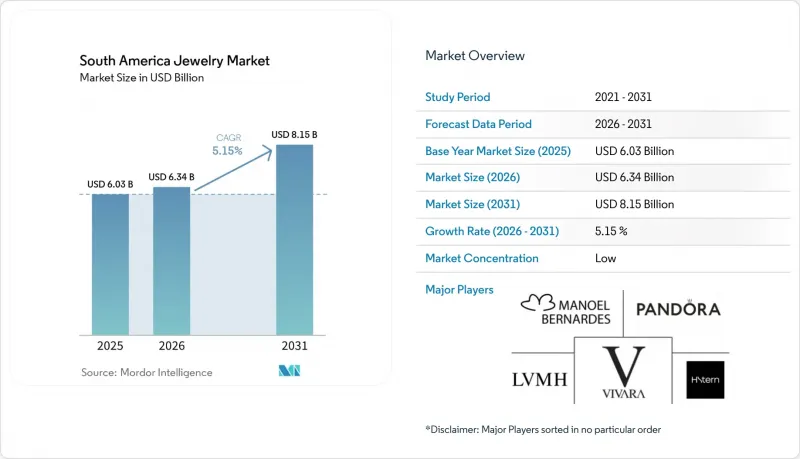
According to Mordor Intelligence, the South America jewelry market was valued at USD 6.03 billion in 2025 and is estimated to increase from USD 6.34 billion in 2026 to USD 8.15 billion by 2031, registering a CAGR of 5.15% during the forecast period (2026-2031).
South America Jewelry Market Trends and Insights
Tourism-Driven Jewelry Purchases
International tourism is increasingly driving jewelry demand across South America, as visitors allocate their spending toward premium, artisanal, and locally distinctive jewelry that reflects the region's cultural heritage and craftsmanship. According to the Organization for Economic Co-operation and Development (OECD), Argentina received 5.7 million international tourists in 2025, creating a sizable consumer base for jewelry purchases among travelers. Tourist destinations, airports, hotels, shopping districts, and duty-free retail outlets enable jewelry brands and local artisans to reach international consumers seeking souvenirs, gemstones, handcrafted pieces, and high-value jewelry. As travel activity expands and destination-based retail channels develop, the region's jewelry market is likely to benefit from incremental sales opportunities that extend beyond domestic consumer demand.
Rising Adoption of Lab-Grown Diamonds and Alternative Materials
South America's GDP per capita is projected to reach approximately USD 11.73 thousand in 2025, according to the International Monetary Fund (IMF), reflecting a sizable and evolving consumer base for accessible luxury products. This economic environment is creating opportunities for jewelry brands to cater to consumers who seek aspirational products yet remain price-sensitive. Lab-grown diamonds and jewelry made from alternative materials offer an attractive value proposition by providing the visual appeal of traditional precious-stone jewelry at relatively lower price points. Their affordability, contemporary designs, and perceived sustainability are particularly supporting demand among younger consumers, first-time jewelry buyers, and price-conscious shoppers. As disposable income and consumer spending capacity vary significantly across countries in the region, these alternatives enable jewelry brands to expand their addressable customer base, offer products across a broader range of price segments, and maintain a premium yet fashion-oriented appeal.
High and Volatile Precious Metal Prices
High and volatile prices of gold, silver, and other precious metals are raising production costs and reducing the affordability of jewelry for consumers across South America. As raw material expenses increase, manufacturers and retailers may need to raise product prices to protect margins, which can discourage discretionary purchases and lead consumers to postpone buying decisions. These price pressures are also encouraging shoppers to opt for lighter-weight pieces, lower-karat gold jewelry, silver products, and mixed-material designs that offer a similar aesthetic at a more accessible price point. In addition, frequent fluctuations in precious metal prices create challenges for jewelry manufacturers and retailers in managing inventory, forecasting demand, setting prices, and maintaining stable profit margins. Consequently, the growing preference for affordable alternatives may constrain demand for traditional precious-metal jewelry, particularly among price-sensitive consumer segments.
Other drivers and restraints analyzed in the detailed report include:
- Strong Cultural and Ceremonial Significance of Jewelry
- Expansion of Affordable Luxury and Fashion Jewelry
- Counterfeit and Imitation Jewelry
For complete list of drivers and restraints, kindly check the Table Of Contents.
Segment Analysis
Rings accounted for 27.08% of the South America jewelry market by product type in 2025, making them the largest product category. Strong demand across everyday wear, gifting, and ceremonial occasions continues to support the category's market leadership. Wedding and engagement jewelry remains a key driver of demand, particularly in countries with strong traditions surrounding marriage-related purchases. The popularity of gold, gemstone, and personalized ring designs further broadens the category's appeal across different consumer segments. Manufacturers and retailers are also introducing lightweight, affordable designs to meet the needs of price-conscious consumers.
Necklaces are projected to be the fastest-growing product category, recording a CAGR of 6.43% during the forecast period from 2026 to 2031. Rising consumer interest in statement, fashion, and versatile jewelry is expected to drive demand for necklaces across the region. Younger consumers increasingly prefer contemporary, personalized, and layered designs that align with their individual style preferences. The expansion of e-commerce platforms is also improving access to a broader range of domestic and international jewelry brands. These factors are expected to support sustained growth in necklace sales across the South America jewelry market.
Precious metals accounted for 67.43% of the South America jewelry market by material in 2025, retaining their position as the largest material category. Gold, silver, and other precious metals remain popular choices for everyday jewelry, ceremonial pieces, and gifting occasions across the region. Consumers prefer these materials because of their durability, refined appearance, and ability to retain value over time. Their cultural significance, particularly for weddings, religious events, and traditional celebrations, further supports sustained demand. The investment appeal of precious metals also continues to influence purchasing decisions among South American consumers.
Base metals are projected to be the fastest-growing material segment, registering a CAGR of 6.01% during 2026-2031. Growing demand for affordable and fashion-oriented jewelry is driving the adoption of products made from base metals across the region. These materials allow manufacturers to offer contemporary, lightweight, and versatile designs at accessible price points. The segment is particularly appealing to younger consumers and price-sensitive buyers who seek frequently changing styles. Expanding availability through specialty stores, mass retailers, and online platforms is expected to further support growth during the forecast period.
Complete Report Scope:
- By Product Type
- Rings
- Necklaces
- Earrings
- Bracelets
- Chains and Pendants
- Others
- By Material
- Precious Metals
- Base Metals
- Mixed Materials
- By Category
- Fine
- Costume
- By End User
- Kids
- Adults
- By Distribution Channel
- Online Retail Stores
- Offline Retail Stores
- By Country
- Brazil
- Argentina
- Colombia
- Chile
- Peru
- Venezuela
- Rest of South America
List of Companies Covered in this Report:
- Vivara Participacoes S.A.
- HStern Industria e Comercio SA
- Manoel Bernardes S.A.
- Monte Carlo Joias
- Rommanel
- Sauer
- Pandora A/S
- LVMH Moet Hennessy Louis Vuitton SE
- Compagnie Financiere Richemont SA
- Swarovski Group
- Kering S.A.
- Morana
- Bulgari S.p.A.
- Tiffany & Co.
- TOUS
- Buccellati Holding Italia S.p.A.
- Belatriz Joias
- Ouro Fino Joias
- Vivacy Joias
- HS Semi-Joias
Additional Benefits:
- The market estimate (ME) sheet in Excel format
- 3 months of analyst support
TABLE OF CONTENTS
1 INTRODUCTION
- 1.1 Study Assumptions and Market Definition
- 1.2 Scope of the Study
2 RESEARCH METHODOLOGY
3 EXECUTIVE SUMMARY
4 MARKET LANDSCAPE
- 4.1 Market Overview
- 4.2 Market Drivers
- 4.2.1 Tourism-driven jewelry purchases
- 4.2.2 Rising adoption of lab-grown diamonds and alternative materials
- 4.2.3 Strong cultural and ceremonial significance of jewelry
- 4.2.4 Expansion of affordable luxury and fashion jewelry
- 4.2.5 Growing interest in sustainable and ethically sourced jewelry
- 4.2.6 Expansion of branded retail and modern shopping centers
- 4.3 Market Restraints
- 4.3.1 High and volatile precious metal prices
- 4.3.2 Complex import duties and taxation
- 4.3.3 Counterfeit and imitation jewelry
- 4.3.4 Supply-chain and gemstone provenance challenges
- 4.4 Regulatory Outlook
- 4.5 Consumer Behavior Analysis
- 4.6 Porter's Five Forces
- 4.6.1 Threat of New Entrants
- 4.6.2 Bargaining Power of Buyers
- 4.6.3 Bargaining Power of Suppliers
- 4.6.4 Threat of Substitute Products
- 4.6.5 Intensity of Competitive Rivalry
5 MARKET SIZE AND GROWTH FORECASTS (VALUE)
- 5.1 By Product Type
- 5.1.1 Rings
- 5.1.2 Necklaces
- 5.1.3 Earrings
- 5.1.4 Bracelets
- 5.1.5 Chains and Pendants
- 5.1.6 Others
- 5.2 By Material
- 5.2.1 Precious Metals
- 5.2.2 Base Metals
- 5.2.3 Mixed Materials
- 5.3 By Category
- 5.3.1 Fine
- 5.3.2 Costume
- 5.4 By End User
- 5.4.1 Kids
- 5.4.2 Adults
- 5.5 By Distribution Channel
- 5.5.1 Online Retail Stores
- 5.5.2 Offline Retail Stores
- 5.6 By Country
- 5.6.1 Brazil
- 5.6.2 Argentina
- 5.6.3 Colombia
- 5.6.4 Chile
- 5.6.5 Peru
- 5.6.6 Venezuela
- 5.6.7 Rest of South America
6 COMPETITIVE LANDSCAPE
- 6.1 Market Concentration
- 6.2 Strategic Moves
- 6.3 Market Share Analysis
- 6.4 Company Profiles (includes Global-level Overview, Market-level Overview, Core Segments, Financials (if available), Strategic Information, Market Rank/Share, Products and Services, Recent Developments)
- 6.4.1 Vivara Participacoes S.A.
- 6.4.2 HStern Industria e Comercio SA
- 6.4.3 Manoel Bernardes S.A.
- 6.4.4 Monte Carlo Joias
- 6.4.5 Rommanel
- 6.4.6 Sauer
- 6.4.7 Pandora A/S
- 6.4.8 LVMH Moet Hennessy Louis Vuitton SE
- 6.4.9 Compagnie Financiere Richemont SA
- 6.4.10 Swarovski Group
- 6.4.11 Kering S.A.
- 6.4.12 Morana
- 6.4.13 Bulgari S.p.A.
- 6.4.14 Tiffany & Co.
- 6.4.15 TOUS
- 6.4.16 Buccellati Holding Italia S.p.A.
- 6.4.17 Belatriz Joias
- 6.4.18 Ouro Fino Joias
- 6.4.19 Vivacy Joias
- 6.4.20 HS Semi-Joias
7 MARKET OPPORTUNITIES AND FUTURE OUTLOOK

