PUBLISHER: Mordor Intelligence | PRODUCT CODE: 2154426

PUBLISHER: Mordor Intelligence | PRODUCT CODE: 2154426
Connected Worker Platforms - Market Share Analysis, Industry Trends & Statistics, Growth Forecasts (2026 - 2031)
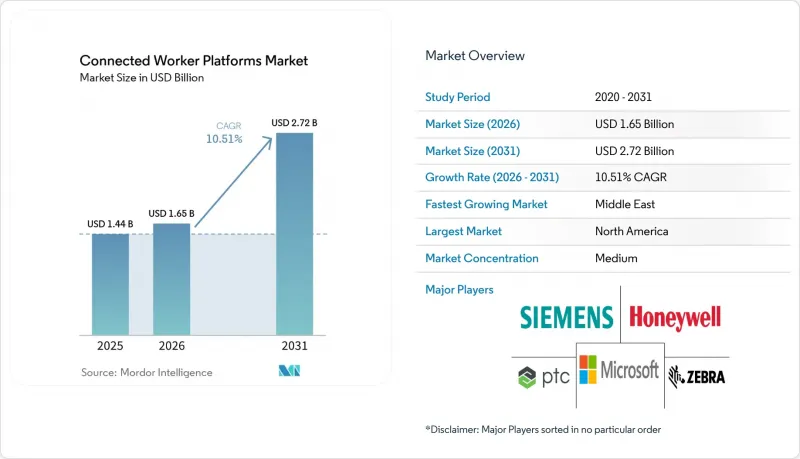
According to Mordor Intelligence, the connected worker platforms market size is projected to be USD 1.44 billion in 2025, USD 1.65 billion in 2026, and reach USD 2.72 billion by 2031, growing at a CAGR of 10.51% from 2026 to 2031.
Global Connected Worker Platforms Market Trends and Insights
Industrial Digital Transformation and Industry 4.0 Adoption
Manufacturers are moving from separate digital pilots toward programs that link production, maintenance, quality, and workforce processes. This transition supports the connected worker platforms market because frontline applications supply the information needed to make broader digital systems useful in daily operations. The Manufacturing Leadership Council reported in 2026 that smart factory investment had become a competitiveness priority rather than a limited innovation activity. Rockwell Automation reported that 87% of German manufacturers considered digital transformation essential in 2026, and respondents allocated 29% of operating budgets to industrial technology. This investment gives the connected worker platforms market a place in wider plans for data collection and production improvement. The operational data created through usage, work instructions, and exception reporting can support analytics and production improvement programs.
Worker Safety and Compliance Digitization
Safety and compliance requirements are giving frontline digitization a more immediate business case in many industrial settings. The Occupational Safety and Health Administration required covered establishments to electronically submit 2025 injury and illness data by March 2, 2026. OSHA listed a maximum penalty of USD 16,131 for a serious violation in 2026, increasing the value of reliable compliance records and timely corrective action. May 19, 2026, update deadline for safety data sheets under the Hazard Communication Standard also increased the need for controlled document management and training records. Connected worker applications can consolidate field observations, checklists, alerts, and training confirmations into a single audit trail. This gives the connected worker platforms market a compliance-led route to adoption where productivity projects have not yet received approval.
High Upfront Implementation and Integration Costs
Implementation costs remain a major obstacle, particularly for mid-sized plants that lack dedicated industrial technology teams. Many sites use enterprise resource planning and manufacturing execution systems that were built before current application programming interfaces became common. Connecting these systems to work orders, asset records, and safety files can require tailored middleware and specialized services. Innovapptive reported that its deployment at an Indorama Ventures facility generated more than USD 12 million in EBITDA gains, while illustrating the scale of operational change needed for a full deployment. Pilot results can also be difficult to extend across departments because information technology, operations technology, and human resources teams must align. This friction limits the connected worker market among buyers who cannot absorb the project cost and governance work.
Other drivers and restraints analyzed in the detailed report include:
- Skilled-Labor Shortages and Faster Time-to-Proficiency Requirements
- 5G, Industrial IoT, and Edge-Computing Convergence
- Worker Privacy, Labor Relations, and Acceptance Risks
For complete list of drivers and restraints, kindly check the Table Of Contents.
Segment Analysis
Software accounted for 57.78% of revenue in the connected worker sector in 2025. This position reflected the shift from hardware-centered purchases toward workflow, analytics, and skills-management subscriptions. Software gives vendors recurring revenue, feature updates, and broader adoption across customer sites. It also lets customers add use cases without replacing the physical devices frontline workers use. The software segment is projected to expand at a 12.63% CAGR through 2031, supported by AI-enabled tools for skills analysis, guided work, and predictive compliance activities.
Hardware remains necessary because many workers use rugged displays, scanners, wearables, and tablets in demanding environments. Its contribution to customer value declines when a platform is sold under a multiyear software agreement. Services are gaining relevance as buyers need support with integration, workforce change, and operational governance. Providers increasingly package these activities as managed support rather than one-time implementation assignments. Augmentir launched its Industrial AI Agent Studio in April 2025, enabling manufacturers to create AI agents within frontline workflows and supporting premium software subscriptions.
Cloud-based deployment accounted for 63.59% of revenue in the connected worker sector in 2025. The model avoids on-site server investment and lets suppliers deliver updates without local information technology intervention. It also makes it easier to extend analytics and collaboration functions across a distributed facility network. These benefits have made cloud platforms the standard option for many new deployments. Cloud-based solutions are projected to expand at a 13.02% CAGR through 2031 as organizations become more comfortable with cloud tools.
Hybrid configurations offer a middle route for enterprises with uneven technology maturity or strict data controls. They can keep selected operational technology data within the facility while sending training, collaboration, and analytical data to cloud services. Kuehne+Nagel completed the global rollout of its cloud-native contract logistics platform at more than 1,000 sites in April 2026. The deployment showed that complex multisite operations can transition to shared digital platforms at scale. On-premises models still matter in defense, critical infrastructure, and regulated pharmaceutical settings, but their addressable opportunity is narrower.
Complete Report Scope:
- By Offering
- Hardware
- Software
- Services
- By Deployment
- Cloud-Based
- Hybrid
- On-Premises
- By Connectivity Type
- Wi-Fi
- 5G and Cellular
- Bluetooth
- RFID and NFC
- Other Connectivity Types
- By Application
- Remote Assistance and Collaboration
- Workforce Safety and Compliance
- Training and Skill Development
- Task Management and Productivity Optimization
- Predictive and Preventive Maintenance
- Inventory and Asset Management
- Other Applications
- By Organization Size
- Large Enterprises
- Small and Medium Enterprises
- By End-User Industry
- Manufacturing
- Mining
- Oil and Gas
- Construction
- Healthcare and Pharmaceuticals
- Utilities and Energy
- Retail and Warehousing
- Other End-user Industries
- By Geography
- North America
- United States
- Canada
- Mexico
- South America
- Brazil
- Argentina
- Rest of South America
- Europe
- Germany
- United Kingdom
- France
- Italy
- Spain
- Russia
- Rest of Europe
- Asia-Pacific
- China
- India
- Japan
- South Korea
- Australia
- Rest of Asia-Pacific
- Middle East
- Saudi Arabia
- United Arab Emirates
- Turkey
- Rest of Middle East
- Africa
- South Africa
- Nigeria
- Rest of Africa
- North America
Geography Analysis
North America held 36.62% of revenue in 2025. The region's large manufacturing base, mature cloud environment, and safety compliance requirements supported its leading position. The US Bureau of Labor Statistics reported 495,000 manufacturing job openings in January 2026. This shortage reinforces demand for tools that guide new personnel and retain process knowledge. The connected worker platforms market also benefits from Mexico's nearshoring manufacturing growth as automotive and electronics producers standardize operations across regional supply chains.
Europe remained the second-largest regional opportunity, with Germany as its industrial anchor. German manufacturers placed a high value on digital transformation and industrial technology spending in 2026. The European Union's occupational safety and health framework requires employers to manage work-related risks and provide appropriate information and training. Asia-Pacific offers the connected worker platforms market a significant opportunity because China, Japan, South Korea, and Australia combine industrial activity with smart-factory investment. Japan's aging workforce and Australia's remote mining operations make knowledge capture and offline-capable tools particularly relevant.
The Middle East is projected to expand at a 14.27% CAGR through 2031, the fastest rate among geographic segments. Saudi Arabia's Vision 2030 and the United Arab Emirates' industrial programs are promoting technology adoption. The United Arab Emirates launched its National Industrial Transformation Track in February 2026 with the World Economic Forum to accelerate Industry 4.0 adoption at 100 industrial companies. Africa and South America remain earlier-stage markets, but the connected worker platforms market can find focused demand at asset-intensive sites in Brazil, Argentina, Nigeria, and South Africa.
- Honeywell International Inc.
- Siemens AG
- Zebra Technologies Corporation
- PTC Inc.
- Microsoft Corporation
- Augmentir, Inc.
- Tulip Interfaces Inc.
- Innovapptive Inc.
- Librestream Technologies Inc.
- Poka Inc.
- RealWear, Inc.
- RedZone, Inc.
- SymphonyAI
- Parsable, Inc.
- QAD Inc.
- Workerbase GmbH
- Zaptic Limited
- Dozuki
- MaintainX, Inc.
- SafetyCulture Pty Ltd
Additional Benefits:
- The market estimate (ME) sheet in Excel format
- 3 months of analyst support
TABLE OF CONTENTS
1 INTRODUCTION
- 1.1 Study Assumptions and Market Definition
- 1.2 Scope of the Study
2 RESEARCH METHODOLOGY
3 EXECUTIVE SUMMARY
4 MARKET LANDSCAPE
- 4.1 Market Overview
- 4.2 Market Drivers
- 4.2.1 Industrial Digital Transformation and Industry 4.0 Adoption
- 4.2.2 Worker Safety and Compliance Digitization
- 4.2.3 Skilled-Labor Shortages and Faster Time-to-Proficiency Requirements
- 4.2.4 5G, Industrial IoT and Edge-Computing Convergence
- 4.2.5 AI-Based Hazard Detection and Predictive Work Guidance
- 4.2.6 Digital Capture of Tribal Knowledge Before Workforce Retirement
- 4.3 Market Restraints
- 4.3.1 High Upfront Implementation and Integration Costs
- 4.3.2 Worker Privacy, Labor Relations and Acceptance Risks
- 4.3.3 Legacy-System Interoperability Gaps
- 4.3.4 Battery, Durability and Connectivity Limitations in Harsh Sites
- 4.4 Industry Value-Chain Analysis
- 4.5 Regulatory Landscape
- 4.6 Technological Outlook
- 4.7 Porter's Five Forces Analysis
- 4.7.1 Bargaining Power of Suppliers
- 4.7.2 Bargaining Power of Buyers
- 4.7.3 Threat of New Entrants
- 4.7.4 Threat of Substitutes
- 4.7.5 Competitive Rivalry
5 MARKET SIZE AND GROWTH FORECASTS (VALUE)
- 5.1 By Offering
- 5.1.1 Hardware
- 5.1.2 Software
- 5.1.3 Services
- 5.2 By Deployment
- 5.2.1 Cloud-Based
- 5.2.2 Hybrid
- 5.2.3 On-Premises
- 5.3 By Connectivity Type
- 5.3.1 Wi-Fi
- 5.3.2 5G and Cellular
- 5.3.3 Bluetooth
- 5.3.4 RFID and NFC
- 5.3.5 Other Connectivity Types
- 5.4 By Application
- 5.4.1 Remote Assistance and Collaboration
- 5.4.2 Workforce Safety and Compliance
- 5.4.3 Training and Skill Development
- 5.4.4 Task Management and Productivity Optimization
- 5.4.5 Predictive and Preventive Maintenance
- 5.4.6 Inventory and Asset Management
- 5.4.7 Other Applications
- 5.5 By Organization Size
- 5.5.1 Large Enterprises
- 5.5.2 Small and Medium Enterprises
- 5.6 By End-User Industry
- 5.6.1 Manufacturing
- 5.6.2 Mining
- 5.6.3 Oil and Gas
- 5.6.4 Construction
- 5.6.5 Healthcare and Pharmaceuticals
- 5.6.6 Utilities and Energy
- 5.6.7 Retail and Warehousing
- 5.6.8 Other End-user Industries
- 5.7 By Geography
- 5.7.1 North America
- 5.7.1.1 United States
- 5.7.1.2 Canada
- 5.7.1.3 Mexico
- 5.7.2 South America
- 5.7.2.1 Brazil
- 5.7.2.2 Argentina
- 5.7.2.3 Rest of South America
- 5.7.3 Europe
- 5.7.3.1 Germany
- 5.7.3.2 United Kingdom
- 5.7.3.3 France
- 5.7.3.4 Italy
- 5.7.3.5 Spain
- 5.7.3.6 Russia
- 5.7.3.7 Rest of Europe
- 5.7.4 Asia-Pacific
- 5.7.4.1 China
- 5.7.4.2 India
- 5.7.4.3 Japan
- 5.7.4.4 South Korea
- 5.7.4.5 Australia
- 5.7.4.6 Rest of Asia-Pacific
- 5.7.5 Middle East
- 5.7.5.1 Saudi Arabia
- 5.7.5.2 United Arab Emirates
- 5.7.5.3 Turkey
- 5.7.5.4 Rest of Middle East
- 5.7.6 Africa
- 5.7.6.1 South Africa
- 5.7.6.2 Nigeria
- 5.7.6.3 Rest of Africa
- 5.7.1 North America
6 COMPETITIVE LANDSCAPE
- 6.1 Market Concentration
- 6.2 Strategic Moves
- 6.3 Market Share Analysis
- 6.4 Company Profiles (includes Global Level Overview, Market Level Overview, Core Segments, Financials as available, Strategic Information, Market Rank/Share, Products and Services, Recent Developments)
- 6.4.1 Honeywell International Inc.
- 6.4.2 Siemens AG
- 6.4.3 Zebra Technologies Corporation
- 6.4.4 PTC Inc.
- 6.4.5 Microsoft Corporation
- 6.4.6 Augmentir, Inc.
- 6.4.7 Tulip Interfaces Inc.
- 6.4.8 Innovapptive Inc.
- 6.4.9 Librestream Technologies Inc.
- 6.4.10 Poka Inc.
- 6.4.11 RealWear, Inc.
- 6.4.12 RedZone, Inc.
- 6.4.13 SymphonyAI
- 6.4.14 Parsable, Inc.
- 6.4.15 QAD Inc.
- 6.4.16 Workerbase GmbH
- 6.4.17 Zaptic Limited
- 6.4.18 Dozuki
- 6.4.19 MaintainX, Inc.
- 6.4.20 SafetyCulture Pty Ltd
7 MARKET OPPORTUNITIES AND FUTURE OUTLOOK
- 7.1 White-Space and Unmet-Need Assessment

