PUBLISHER: Mordor Intelligence | PRODUCT CODE: 2154459

PUBLISHER: Mordor Intelligence | PRODUCT CODE: 2154459
AR Head-Up Display (HUD) Software - Market Share Analysis, Industry Trends & Statistics, Growth Forecasts (2026 - 2031)
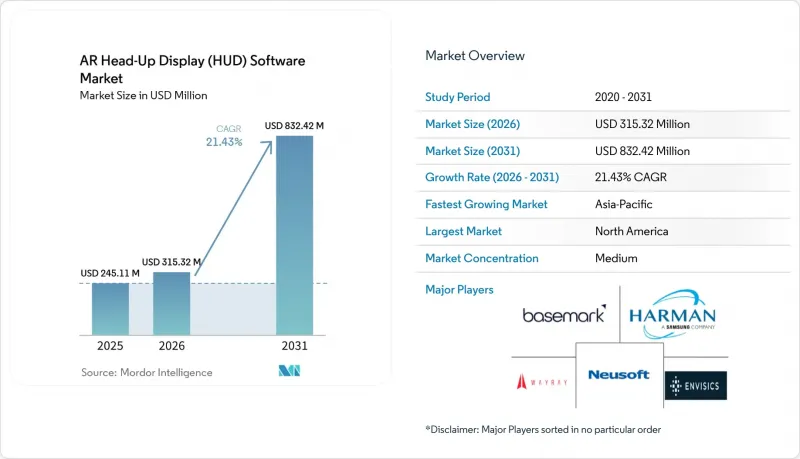
According to Mordor Intelligence, the AR head-up display (HUD) software market size is expected to increase from USD 245.11 million in 2025 to USD 315.32 million in 2026 and reach USD 832.42 million by 2031, expanding at a CAGR of 21.43% over 2026-2031.
Global AR Head-Up Display (HUD) Software Market Trends and Insights
ADAS-Linked Demand for Contextual Driver Guidance
ADAS requirements are making contextual windshield guidance more relevant to vehicle programs that prioritize driver attention. AR HUD software can present lane, collision, and route information within the driver's forward field of view. This requires the AR head-up display (HUD) software market to combine camera, radar, GPS, and other sensor inputs with stable real-time rendering. HARMAN stated that its Ready Vision AR HUD entered series production in European vehicles in 2026 and includes AI and machine-learning-based occlusion handling for ADAS visualization. Production deployment shows that these systems have moved beyond isolated concept vehicles, although each vehicle program still needs validation. Wider deployment can standardize software platforms, but it also raises price pressure among suppliers with comparable production credentials.
Software-Defined Vehicle Architectures Expand Deployable AR-HUD Functions
Software-defined vehicle architectures separate feature upgrades from the original hardware purchase cycle. This gives the AR head-up display (HUD) software market a route to deliver new visual functions through over-the-air updates during a vehicle's life. ISO/TS 20003:2026 sets human-machine interface requirements for over-the-air update sequences in passenger and commercial vehicles. Panasonic Automotive Systems integrated an over-the-air orchestration function across the HUD, instrument cluster, and infotainment system in the Mazda CX-5 introduced in Europe in December 2025. Hyundai Motor Group stated in 2026 that Pleos Connect is intended to reach 20 million vehicles by 2030 with continued AR and AI enhancements delivered over the air. These programs make lifecycle management a core part of software value because overlays can change as driver-assistance models improve.
Real-Time Registration and Latency Validation Burden
Accurate spatial overlays need very low latency between sensor input and displayed graphics. If an AR lane marker moves away from a painted road line during braking or a turn, the display can reduce trust and face safety review. The AR HUD software industry must integrate camera, radar, LiDAR, GPS, and inertial inputs while retaining consistent alignment. AUMOVIO presented a mirrorless 3D HUD concept at IAA Mobility in September 2025 that uses software-assisted image optimization to adapt to windshield curvature. The concept can reduce some vehicle-specific optical work, but sensor fusion and latency validation remain necessary for each program. This burden slows time to production for suppliers that do not already have several certified vehicle applications.
Other drivers and restraints analyzed in the detailed report include:
- Falling Computing and Sensor Costs Enable Mid-Range Vehicle Penetration
- Electric Vehicle Cockpit Differentiation Through Immersive Navigation
- High Integration Cost Across Windshield Optics and Vehicle Compute
For complete list of drivers and restraints, kindly check the Table Of Contents.
Segment Analysis
Operating System and Middleware Software held 38.43% of revenue in 2025, making it the largest software-type segment in the AR head-up display (HUD) software market. Every augmented-reality experience depends on a verified runtime that supports navigation overlays, ADAS visualization, and infotainment functions. BlackBerry QNX, Android Automotive OS, and proprietary Linux-based stacks compete for this role. Platform selection can lead to multiyear licensing revenue because a vehicle program normally uses the selected runtime for its production cycle. Panasonic Automotive Systems illustrated this connection when its cockpit controller coordinated HUD, cluster, and infotainment functions for Mazda's CX-5 from December 2025. The arrangement places middleware decisions early in the vehicle-development process. Custom Software holds a smaller role but serves premium programs that need a distinctive visual identity. Its higher per-unit development cost can limit use across a wide range of vehicle variants.
Development, Calibration and Testing Tools is projected to expand at a 22.31% CAGR through 2031, the highest rate within software type. More AR functions across more vehicle models increase the need for repeatable validation tools. Basemark updated Rocksolid AR Studio in August 2025 with Gemini AI, Google Maps, and Android Automotive integration. Its 2026 release added macOS support and production-ready reference projects. These releases allow designers to test visual functions before making a final hardware choice. VESA released DisplayPort Automotive Extension v1.1 at CES 2026 with a software emulator for validating display pipelines against functional safety and security profiles. Common tools can lower the burden of qualification, especially for suppliers seeking to work across more than one OEM platform.
AR Rendering and Composition accounted for 24.29% of revenue in 2025 and was the largest functional segment. The AR head-up display (HUD) software market relies on rendering engines to provide stable frame rates, correct perspective, and accurate placement of visual information. Other functions have limited usefulness if the displayed image is not clear and aligned. Navigation and Wayfinding and ADAS and Safety Visualization form the next major revenue bands because production programs currently focus on safety-related display functions. Vehicle and Sensor Data Integration is often bundled into tier-1 system deliveries rather than sold as a separate software license. This bundling moderates its direct revenue contribution while keeping it central to technical performance. Multiscreen HMI Orchestration is becoming more relevant as vehicle interiors use wider and multiple display layouts.
Over-the-Air Update and Lifecycle Management is projected to expand at a 22.02% CAGR through 2031. This function changes AR software from a one-time vehicle-program component into a service that can be maintained after purchase. ISO/TS 20003:2026 provides a common framework for the driver interface during over-the-air software updates. Siemens stated in April 2026 that over-the-air updates now extend beyond infotainment to ADAS perception models and safety-system software. LG Electronics announced a May 2026 partnership with Google that supports one system-on-chip driving multiple automotive displays. This increases the importance of HMI orchestration because each display must present a consistent experience. Lifecycle management can therefore become a recurring contractual function for suppliers in the AR head-up display (HUD) software market.
Complete Report Scope:
- By Software Type
- Custom Software
- Operating System and Middleware Software
- Development, Calibration and Testing Tools
- By Software Function
- AR Rendering and Composition
- Navigation and Wayfinding
- ADAS and Safety Visualization
- Vehicle and Sensor Data Integration
- Multiscreen HMI Orchestration
- Over-the-Air Update and Lifecycle Management
- By Application
- Navigation and Point-of-Interest Display
- Lane Guidance and Maneuver Visualization
- Collision Warning and Driver Assistance
- Traffic Sign Recognition and Speed Information
- Night Vision and Adverse-Weather Assistance
- Infotainment and Contextual Commerce
- By Vehicle Type
- Passenger Cars
- Light Commercial Vehicles
- Heavy Commercial Vehicles
- Robotaxis and Autonomous Shuttles
- Two-Wheelers and Micromobility Vehicles
- By End User
- Original Equipment Manufacturers
- Tier-1 and Tier-2 Automotive Suppliers
- Aftermarket and Retrofit Integrators
- By Geography
- North America
- United States
- Canada
- Mexico
- South America
- Brazil
- Argentina
- Rest of South America
- Europe
- United Kingdom
- Germany
- France
- Italy
- Spain
- Russia
- Rest of Europe
- Asia-Pacific
- China
- Japan
- India
- South Korea
- Australia
- Rest of Asia-Pacific
- Middle East
- United Arab Emirates
- Saudi Arabia
- Rest of Middle East
- Africa
- South Africa
- Egypt
- Rest of Africa
- North America
Geography Analysis
Asia-Pacific accounted for 34.39% of global revenue in 2025 and held the largest regional position in the AR head-up display (HUD) software market. The region is supported by China's new-energy vehicle production, intelligent cockpit adoption, and large passenger-car base. China's passenger-car AR HUD installations reached 4.39 million units in 2025, with a 19.11% fitment rate. Japan and South Korea contribute through Panasonic Automotive, Denso, and Hyundai Mobis programs that supply cockpit systems globally. These suppliers also embed software runtimes developed in their home markets into vehicles sold in North America and Europe. The region's volume supports local relationships among OEMs, software suppliers, and electronics manufacturers in the AR HUD software market. This makes Asia-Pacific central to current production deployment and future platform qualification.
North America and Europe are established AR head-up display (HUD) software market regions where regulation and demand for premium in-vehicle experiences support higher software content. In North America, the Cadillac VISTIQ and Lucid Gravity moved into 2025-2026 production programs that demonstrate the use of AR functions in premium electric vehicles. Europe has a sustained driver-assistance requirement through the EU General Safety Regulation II. Germany leads regional procurement through BMW, Volkswagen Group, and Mercedes-Benz programs. The United Kingdom, France, and Italy remain secondary software program markets. Russia's geopolitical conditions continue to limit access to Western AR software platforms. Regulatory attention to driver interaction also favors windshield-projected information when it can reduce the need to look across several cabin screens.
The Middle East is projected to expand at a 22.36% CAGR through 2031, making it the fastest-growing regional segment. Saudi Arabia's Vision 2030 mobility agenda and the UAE's luxury-vehicle base support demand for advanced cockpit features. Most vehicles carrying AR HUD systems are imported premium models from European and Asian brands. Revenue therefore depends more on imports and option uptake than on local vehicle production. South America offers a longer-term opportunity as Brazil's production base and connected-car adoption develop. Africa remains at an earlier stage, with South Africa as the most immediate market. Older fleets and import tariffs limit premium-vehicle penetration, which makes retrofitting a more practical near-term route in the region.
- Basemark Oy
- Envisics Ltd.
- WayRay AG
- CY Vision, Inc.
- DigiLens, Inc.
- Ceres Holographics Limited
- Epitone GmbH
- FUTURUS Technology Co., Ltd.
- E-Lead Electronic Co., Ltd.
- ADAYO Intelligent Equipment Co., Ltd.
- Neusoft Corporation
- OneSight Technology Co., Ltd.
- Jingwei Hirain Technologies Co., Ltd.
- Shanghai New Vision Automotive Electronics Co., Ltd.
- Zhejiang Chief Technology Co., Ltd.
- Tianma Microelectronics Co., Ltd.
- Coretronic Corporation
- Maxell, Ltd.
- Appotronics Corporation Limited
- MicroVision, Inc.
- Holographic Labs Limited
- Dispelix Oy
- Luminit LLC
- SeeReal Technologies S.A.
Additional Benefits:
- The market estimate (ME) sheet in Excel format
- 3 months of analyst support
TABLE OF CONTENTS
1 INTRODUCTION
- 1.1 Study Assumptions and Market Definition
- 1.2 Scope of the Study
2 RESEARCH METHODOLOGY
3 EXECUTIVE SUMMARY
4 MARKET LANDSCAPE
- 4.1 Market Overview
- 4.2 Impact of Macroeconomic Factors on the Market
- 4.3 Market Drivers
- 4.3.1 ADAS-Linked Demand for Contextual Driver Guidance
- 4.3.2 Software-Defined Vehicle Architectures Expand Deployable AR-HUD Functions
- 4.3.3 Falling Computing and Sensor Costs Enable Mid-Range Vehicle Penetration
- 4.3.4 Electric Vehicle Cockpit Differentiation Through Immersive Navigation
- 4.3.5 Multi-Plane Rendering Improves Depth-Aware Safety Communication
- 4.3.6 China-Led Intelligent Cockpit Adoption Accelerates AR-HUD Volume
- 4.4 Market Restraints
- 4.4.1 Real-Time Registration and Latency Validation Burden
- 4.4.2 High Integration Cost Across Windshield Optics and Vehicle Compute
- 4.4.3 Driver Distraction and Human-Factors Approval Risk
- 4.4.4 Cybersecurity and Data-Integrity Exposure in Sensor-Fused Overlays
- 4.5 Industry Value Chain Analysis
- 4.6 Regulatory Landscape
- 4.7 Technological Outlook
- 4.8 Porter's Five Forces Analysis
- 4.8.1 Threat of New Entrants
- 4.8.2 Bargaining Power of Suppliers
- 4.8.3 Bargaining Power of Buyers
- 4.8.4 Threat of Substitutes
- 4.8.5 Competitive Rivalry
5 MARKET SIZE AND GROWTH FORECASTS (VALUE)
- 5.1 By Software Type
- 5.1.1 Custom Software
- 5.1.2 Operating System and Middleware Software
- 5.1.3 Development, Calibration and Testing Tools
- 5.2 By Software Function
- 5.2.1 AR Rendering and Composition
- 5.2.2 Navigation and Wayfinding
- 5.2.3 ADAS and Safety Visualization
- 5.2.4 Vehicle and Sensor Data Integration
- 5.2.5 Multiscreen HMI Orchestration
- 5.2.6 Over-the-Air Update and Lifecycle Management
- 5.3 By Application
- 5.3.1 Navigation and Point-of-Interest Display
- 5.3.2 Lane Guidance and Maneuver Visualization
- 5.3.3 Collision Warning and Driver Assistance
- 5.3.4 Traffic Sign Recognition and Speed Information
- 5.3.5 Night Vision and Adverse-Weather Assistance
- 5.3.6 Infotainment and Contextual Commerce
- 5.4 By Vehicle Type
- 5.4.1 Passenger Cars
- 5.4.2 Light Commercial Vehicles
- 5.4.3 Heavy Commercial Vehicles
- 5.4.4 Robotaxis and Autonomous Shuttles
- 5.4.5 Two-Wheelers and Micromobility Vehicles
- 5.5 By End User
- 5.5.1 Original Equipment Manufacturers
- 5.5.2 Tier-1 and Tier-2 Automotive Suppliers
- 5.5.3 Aftermarket and Retrofit Integrators
- 5.6 By Geography
- 5.6.1 North America
- 5.6.1.1 United States
- 5.6.1.2 Canada
- 5.6.1.3 Mexico
- 5.6.2 South America
- 5.6.2.1 Brazil
- 5.6.2.2 Argentina
- 5.6.2.3 Rest of South America
- 5.6.3 Europe
- 5.6.3.1 United Kingdom
- 5.6.3.2 Germany
- 5.6.3.3 France
- 5.6.3.4 Italy
- 5.6.3.5 Spain
- 5.6.3.6 Russia
- 5.6.3.7 Rest of Europe
- 5.6.4 Asia-Pacific
- 5.6.4.1 China
- 5.6.4.2 Japan
- 5.6.4.3 India
- 5.6.4.4 South Korea
- 5.6.4.5 Australia
- 5.6.4.6 Rest of Asia-Pacific
- 5.6.5 Middle East
- 5.6.5.1 United Arab Emirates
- 5.6.5.2 Saudi Arabia
- 5.6.5.3 Rest of Middle East
- 5.6.6 Africa
- 5.6.6.1 South Africa
- 5.6.6.2 Egypt
- 5.6.6.3 Rest of Africa
- 5.6.1 North America
6 COMPETITIVE LANDSCAPE
- 6.1 Market Concentration
- 6.2 Strategic Moves
- 6.3 Market Share Analysis
- 6.4 Company Profiles (includes Global Level Overview, Market Level Overview, Core Segments, Financials as available, Strategic Information, Market Rank/Share, Products and Services, Recent Developments)
- 6.4.1 Basemark Oy
- 6.4.2 Envisics Ltd.
- 6.4.3 WayRay AG
- 6.4.4 CY Vision, Inc.
- 6.4.5 DigiLens, Inc.
- 6.4.6 Ceres Holographics Limited
- 6.4.7 Epitone GmbH
- 6.4.8 FUTURUS Technology Co., Ltd.
- 6.4.9 E-Lead Electronic Co., Ltd.
- 6.4.10 ADAYO Intelligent Equipment Co., Ltd.
- 6.4.11 Neusoft Corporation
- 6.4.12 OneSight Technology Co., Ltd.
- 6.4.13 Jingwei Hirain Technologies Co., Ltd.
- 6.4.14 Shanghai New Vision Automotive Electronics Co., Ltd.
- 6.4.15 Zhejiang Chief Technology Co., Ltd.
- 6.4.16 Tianma Microelectronics Co., Ltd.
- 6.4.17 Coretronic Corporation
- 6.4.18 Maxell, Ltd.
- 6.4.19 Appotronics Corporation Limited
- 6.4.20 MicroVision, Inc.
- 6.4.21 Holographic Labs Limited
- 6.4.22 Dispelix Oy
- 6.4.23 Luminit LLC
- 6.4.24 SeeReal Technologies S.A.
7 MARKET OPPORTUNITIES AND FUTURE OUTLOOK
- 7.1 White-Space and Unmet-Need Assessment

