PUBLISHER: Mordor Intelligence | PRODUCT CODE: 2154493

PUBLISHER: Mordor Intelligence | PRODUCT CODE: 2154493
Chatbot Marketing Services - Market Share Analysis, Industry Trends & Statistics, Growth Forecasts (2026 - 2031)
According to Mordor Intelligence, the chatbot marketing services market size is expected to increase from USD 3.57 billion in 2025 to USD 4.12 billion in 2026 and reach USD 11.38 billion by 2031, growing at a CAGR of 22.53% over 2026-2031.
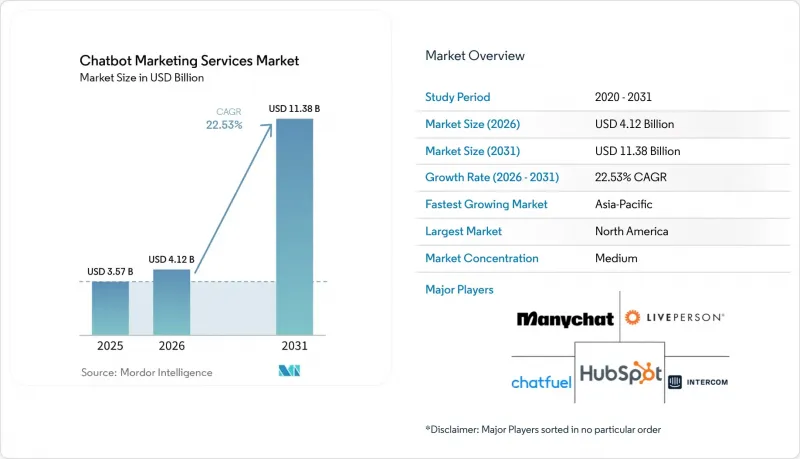
Global Chatbot Marketing Services Market Trends and Insights
Accelerating Shift Toward Conversational Commerce
Conversational commerce is turning marketing chatbots into measurable revenue tools for the chatbot marketing services market. A 2025 study of composite retail and e-commerce organizations found that WhatsApp-enabled conversational automation delivered 270% ROI over 3 years, along with a 55% increase in conversion rates and 50% higher customer engagement than SMS and email campaigns. The study also reported a 20% increase in average order value, which supports shifting marketing budgets toward conversational channels. In July 2026, Gupshup disclosed an enterprise deployment of Meta Business Agent on WhatsApp with Treebo Hospitality Ventures. The deployment supports catalog recommendations, lead qualification, appointment booking, and in-conversation sales completion in 1 thread. Providers that enable checkout completion can pursue budgets once assigned to standalone conversion optimization tools.
Advancements in Generative AI for Hyper-Personalized Engagement
Generative AI has reduced the manual scripting needed to sustain campaign conversations in the chatbot marketing services market. Earlier systems required extensive dialogue trees for each campaign variation, whereas large language model platforms can generate campaign-specific exchanges as needed. Bloomreach made its Loomi marketing agent generally available in June 2026. Its client, 260 Sample Sale, achieved a 2.4x higher conversion rate while reducing the targeted audience by 82%. Databricks introduced CustomerLake in June 2026 with Campaign Agents that analyze customer signals, recommend next actions, and update engagement logic. These capabilities lower the marginal cost of personalization and broaden access to sophisticated engagement tools beyond the largest enterprises.
Privacy Concerns Around Persistent Tracking
Persistent behavioral tracking supports long-term customer profiles, but it can conflict with data minimization requirements. The EU AI Act's transparency rules for certain AI systems took effect on August 2, 2026, including disclosure duties for customer-facing chatbot use cases. The GDPR permits penalties of up to EUR 20 million, USD 22.6 million at the stated 2025 average rate, or 4% of global annual revenue for some violations. European Data Protection Board guidance explains that conversational data used for model training requires an appropriate lawful basis and safeguards for purpose limitation. Consent-first data flows raise implementation cost and can extend deployment schedules. Vendors that invest in privacy management practices can use governance readiness to differentiate themselves with regulated enterprise buyers.
Other drivers and restraints analyzed in the detailed report include:
- Rising Adoption of Messaging Apps for Brand Interaction
- Cost Pressures Driving Marketing Automation
- Limited Multilingual Training Data for Niche Markets
For complete list of drivers and restraints, kindly check the Table Of Contents.
Segment Analysis
Design, Development, and Deployment held 25.54% of revenue in 2025, making it the largest service type. The position reflected the investment required to move enterprise buyers from rule-based systems to generative AI-based conversational infrastructure. Platform Subscription, Integration, and Implementation sustained recurring activity through licensing and martech connectivity needs. Strategy and Consulting served early buyers who needed architecture guidance. Managed Services supported organizations that preferred outsourced operational delivery. Other Service Types covered tailored models for particular vertical needs. Analytics and Optimization is projected to grow at a 24.73% CAGR from 2026 to 2031, exceeding the overall 22.59% rate.
The chatbot marketing services market size for analytics-related work is supported by a growing need to measure performance after deployment. Brands that implemented conversational tools in 2023 and 2024 are seeking conversion attribution, sentiment tracking, and cohort engagement analysis. They need more than uptime and response-rate measures. Twilio made Conversation Intelligence and Conversation Memory generally available at SIGNAL 2026, treating analytics as core platform infrastructure. Providers with deployment and analytics capabilities can increase work with existing clients rather than compete only for new accounts. Bloomreach's 2026 result for 260 Sample Sale illustrates how analytics-based targeting can tie a smaller audience to stronger conversion performance. This changes the client conversation from system implementation to ongoing outcome improvement.
Complete Report Scope:
- By Service Type
- Strategy and Consulting
- Design, Development, and Deployment
- Platform Subscription
- Managed Services
- Integration and Implementation
- Analytics and Optimization
- Other Service Types
- By Organization Size
- Large Enterprises
- Small and Medium Enterprises
- By End-User Industry
- Retail and E-commerce
- IT and Telecommunications
- BFSI
- Healthcare and Life Sciences
- Media and Entertainment
- Travel and Hospitality
- Manufacturing and Industrials
- Other End-User Industries
- By Geography
- North America
- United States
- Canada
- Mexico
- South America
- Brazil
- Argentina
- Chile
- Rest of South America
- Europe
- Germany
- United Kingdom
- France
- Italy
- Spain
- Rest of Europe
- Asia-Pacific
- China
- Japan
- India
- South Korea
- Australia
- Rest of Asia-Pacific
- Middle East
- United Arab Emirates
- Saudi Arabia
- Qatar
- Rest of Middle East
- Africa
- South Africa
- Egypt
- Nigeria
- Rest of Africa
- North America
Geography Analysis
North America accounted for 34.76% of regional revenue in 2025, the largest share. Established enterprise software systems, broad CRM use, and mature data governance practices support deep integration with marketing technology stacks. Retail and E-commerce, BFSI, and IT and Telecommunications continued to anchor enterprise procurement in the region. Salesforce's June 2026 agreement to acquire Fin for USD 3.6 billion shows how acquisitions are expanding platform capabilities. The United States accounts for most of the region's revenue. Canada and Mexico remain earlier-stage growth areas, particularly as English-French and English-Spanish conversational capabilities improve.
Europe retained meaningful revenue through technically advanced buyers in the United Kingdom, Germany, and France. Procurement specifications increasingly require data governance architecture alongside conversational AI delivery. This raises the minimum standard for providers operating in regulated enterprise accounts. Italy, Spain, and other European countries are growing from smaller bases through digital commerce and SME digitization. Asia-Pacific is projected to grow at a 23.46% CAGR from 2026 to 2031, the fastest regional rate. Mobile-first consumers in China, India, South Korea, Japan, and Australia support this chatbot marketing services market opportunity. Lupin's Anya launch shows the importance of language-specific healthcare deployments in India. Providers that can operate across India's 22 constitutionally recognized languages, Mandarin, Korean, and Japanese have a stronger position in this region.South America is supported by WhatsApp-first communication patterns and expanding digital commerce.
Brazil and Argentina are the main contributors, while Chile and other South American markets add incremental demand. The Middle East is led by the United Arab Emirates and Saudi Arabia, where digital transformation programs and mobile-native populations support enterprise interest. Qatar and other Middle Eastern countries remain earlier-stage markets for Arabic-language conversational marketing. Africa offers longer-term demand in South Africa, Nigeria, and Egypt because of mobile growth and younger populations. Multilingual data gaps and uneven digital infrastructure limit the near-term scale and quality of deployments across the region. These conditions leave the chatbot marketing services market dependent on local-language development and practical integration capacity.
- LivePerson Inc.
- Intercom Inc.
- ManyChat Inc.
- Chatfuel Inc.
- HubSpot Inc.
- Tidio Poland Sp. z o.o.
- Zendesk Inc.
- Twilio Inc.
- IBM Corporation
- Google LLC
- Meta Platforms Inc.
- Oracle Corporation
- Salesforce Inc.
- Freshworks Inc.
- Zoho Corporation Pvt. Ltd.
- SnatchBot Ltd.
- Cognigy GmbH
- Rulai Inc.
- Inbenta Holdings Inc.
Additional Benefits:
- The market estimate (ME) sheet in Excel format
- 3 months of analyst support
TABLE OF CONTENTS
1 INTRODUCTION
- 1.1 Study Assumptions and Market Definition
- 1.2 Scope of the Study
2 RESEARCH METHODOLOGY
3 EXECUTIVE SUMMARY
4 MARKET LANDSCAPE
- 4.1 Market Overview
- 4.2 Market Drivers
- 4.2.1 Accelerating Shift Toward Conversational Commerce
- 4.2.2 Advancements in Generative AI for Hyper-Personalized Engagement
- 4.2.3 Rising Adoption of Messaging Apps for Brand Interaction
- 4.2.4 Cost Pressures Driving Marketing Automation
- 4.2.5 Growing Integration of Chatbots With CDP and CRM Platforms
- 4.2.6 Expansion of Voice-Enabled Chatbots Across Smart Devices
- 4.3 Market Restraints
- 4.3.1 Privacy Concerns Around Persistent Tracking
- 4.3.2 Limited Multilingual Training Data for Niche Markets
- 4.3.3 Fragmented Regulation on Conversational AI Disclosures
- 4.3.4 High Churn of SME Clients Due to DIY Alternatives
- 4.4 Industry Value Chain Analysis
- 4.5 Regulatory Landscape
- 4.6 Technological Outlook
- 4.7 Impact of Macroeconomic Factors on the Market
- 4.8 Porter's Five Forces Analysis
- 4.8.1 Threat of New Entrants
- 4.8.2 Bargaining Power of Buyers
- 4.8.3 Bargaining Power of Suppliers
- 4.8.4 Threat of Substitutes
- 4.8.5 Industry Rivalry
5 MARKET SIZE AND GROWTH FORECASTS (VALUE)
- 5.1 By Service Type
- 5.1.1 Strategy and Consulting
- 5.1.2 Design, Development, and Deployment
- 5.1.3 Platform Subscription
- 5.1.4 Managed Services
- 5.1.5 Integration and Implementation
- 5.1.6 Analytics and Optimization
- 5.1.7 Other Service Types
- 5.2 By Organization Size
- 5.2.1 Large Enterprises
- 5.2.2 Small and Medium Enterprises
- 5.3 By End-User Industry
- 5.3.1 Retail and E-commerce
- 5.3.2 IT and Telecommunications
- 5.3.3 BFSI
- 5.3.4 Healthcare and Life Sciences
- 5.3.5 Media and Entertainment
- 5.3.6 Travel and Hospitality
- 5.3.7 Manufacturing and Industrials
- 5.3.8 Other End-User Industries
- 5.4 By Geography
- 5.4.1 North America
- 5.4.1.1 United States
- 5.4.1.2 Canada
- 5.4.1.3 Mexico
- 5.4.2 South America
- 5.4.2.1 Brazil
- 5.4.2.2 Argentina
- 5.4.2.3 Chile
- 5.4.2.4 Rest of South America
- 5.4.3 Europe
- 5.4.3.1 Germany
- 5.4.3.2 United Kingdom
- 5.4.3.3 France
- 5.4.3.4 Italy
- 5.4.3.5 Spain
- 5.4.3.6 Rest of Europe
- 5.4.4 Asia-Pacific
- 5.4.4.1 China
- 5.4.4.2 Japan
- 5.4.4.3 India
- 5.4.4.4 South Korea
- 5.4.4.5 Australia
- 5.4.4.6 Rest of Asia-Pacific
- 5.4.5 Middle East
- 5.4.5.1 United Arab Emirates
- 5.4.5.2 Saudi Arabia
- 5.4.5.3 Qatar
- 5.4.5.4 Rest of Middle East
- 5.4.6 Africa
- 5.4.6.1 South Africa
- 5.4.6.2 Egypt
- 5.4.6.3 Nigeria
- 5.4.6.4 Rest of Africa
- 5.4.1 North America
6 COMPETITIVE LANDSCAPE
- 6.1 Market Concentration
- 6.2 Strategic Moves
- 6.3 Market Share Analysis
- 6.4 Company Profiles (includes Global Level Overview, Market Level Overview, Core Segments, Financials as available, Strategic Information, Market Rank/Share, Products and Services, Recent Developments)
- 6.4.1 LivePerson Inc.
- 6.4.2 Intercom Inc.
- 6.4.3 ManyChat Inc.
- 6.4.4 Chatfuel Inc.
- 6.4.5 HubSpot Inc.
- 6.4.6 Tidio Poland Sp. z o.o.
- 6.4.7 Zendesk Inc.
- 6.4.8 Twilio Inc.
- 6.4.9 IBM Corporation
- 6.4.10 Google LLC
- 6.4.11 Meta Platforms Inc.
- 6.4.12 Oracle Corporation
- 6.4.13 Salesforce Inc.
- 6.4.14 Freshworks Inc.
- 6.4.15 Zoho Corporation Pvt. Ltd.
- 6.4.16 SnatchBot Ltd.
- 6.4.17 Cognigy GmbH
- 6.4.18 Rulai Inc.
- 6.4.19 Inbenta Holdings Inc.
7 MARKET OPPORTUNITIES AND FUTURE OUTLOOK
- 7.1 White-Space and Unmet-Need Assessment

