PUBLISHER: Mordor Intelligence | PRODUCT CODE: 2154506

PUBLISHER: Mordor Intelligence | PRODUCT CODE: 2154506
Clean Label Mold Inhibitors - Market Share Analysis, Industry Trends & Statistics, Growth Forecasts (2026 - 2031)
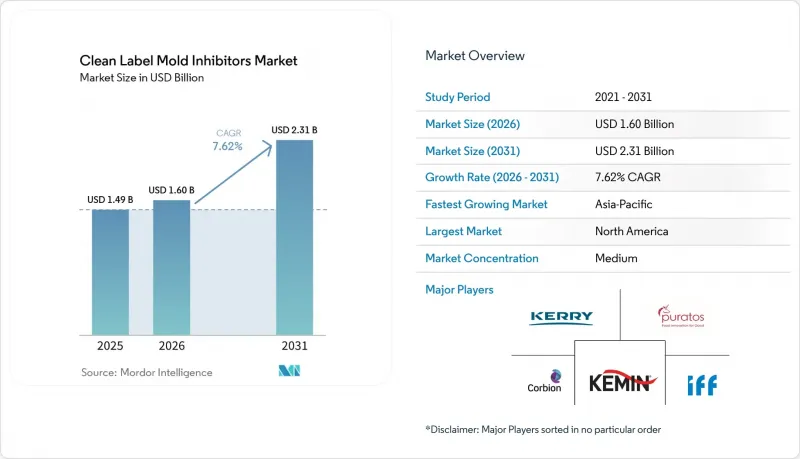
According to Mordor Intelligence, the clean label mold ingredients market size is projected to be USD 1.49 billion in 2025, USD 1.60 billion in 2026, and reach USD 2.31 billion by 2031, growing at a CAGR of 7.62% from 2026 to 2031.
Global Clean Label Mold Inhibitors Market Trends and Insights
Rising Demand for Clean-Label Food Ingredients
Retailer-led clean label mandates are accelerating the adoption of mold control ingredients, particularly across private-label bakery programs. Reformulation requirements to eliminate synthetic preservatives create coordinated demand across suppliers, driving large-scale changes within defined procurement and contract cycles. In North America and Europe, ingredient transparency is increasingly becoming a core sourcing and product-development criterion for brand owners. As a result, clean label mold inhibitors are transitioning from a premium-value formulation option to a mainstream requirement across industrial bread, tortillas, and packaged snack applications. The trend is further supported by food-waste reduction initiatives, as effective natural mold control helps extend product shelf life and reduce losses across distribution and retail channels.
Shift from Synthetic to Natural Preservatives
The clean label mold ingredients market is supported by an evolving regulatory and labeling environment that increases the visibility and scrutiny of synthetic food additives. EU Regulation 1169/2011 requires food information to be presented clearly, while the European Food Safety Authority (EFSA) continues to review permitted food additives . In August 2026, the U.S. Department of Health and Human Services (HHS) proposed mandatory notification requirements for substances used in food under self-affirmed Generally Recognized as Safe (GRAS) conclusions . Within this environment, buffered vinegar and cultured wheat systems offer established documentation that can support manufacturers in assessing regulatory compliance and commercialization pathways. The proposed U.S. requirements could strengthen the competitive position of ingredients supported by comprehensive safety dossiers, while newer cultured extracts may require additional notification and regulatory validation before market entry. Consequently, regulatory readiness and compliance documentation are becoming increasingly important product-selection criteria, integrating regulatory considerations directly into formulation and procurement decisions.
Higher Cost Versus Conventional Preservatives
Clean label mold inhibitors typically carry a 1.5-3.0x cost-in-use premium compared with conventional preservatives such as calcium propionate and potassium sorbate, creating a significant adoption barrier, particularly in price-sensitive markets. In addition, agricultural commodity volatility affecting inputs such as cultured wheat and cultured dextrose can increase procurement uncertainty relative to more standardized petrochemical-derived alternatives. To address this cost challenge, AB Mauri introduced BakeGard Ultra CL, a dried vinegar and cultured wheat flour blend positioned as a more cost-effective clean label preservation solution for bakeries. Such hybrid systems can improve market accessibility and support wider adoption, although competitive pricing may place additional pressure on supplier margins. Furthermore, sensory impact at higher inclusion levels remains a key formulation constraint, requiring manufacturers to optimize the balance between flavor, acidity, dosage levels, and mold inhibition performance.
Other drivers and restraints analyzed in the detailed report include:
- Expansion of Fermentation-Based Preservation Technologies
- Growing Packaged Bakery Product Consumption
- Variable Efficacy Across Food Applications
For complete list of drivers and restraints, kindly check the Table Of Contents.
Segment Analysis
Vinegar-based products accounted for 38.40% of the clean-label mold ingredients market in 2025, supported by regulatory familiarity and established use across industrial bread and tortilla production. Buffered vinegar systems can be integrated into high-speed mixing processes without significant modifications to existing bakery equipment, while availability in both dry and liquid formats provides flexibility across production lines. Fermented flour is projected to grow at an 8.02% CAGR through 2031, making it the fastest-growing ingredient type in the clean-label mold ingredients market. Research on sourdough-type fermentates found that selected cultures inhibited Aspergillus niger and Penicillium commune in bread for 10 days at a 0.5% inclusion rate. Corbion and Lallemand Baking offer cultured wheat solutions for commercial bakery applications, while Kemin markets SHIELD Pure as a concentrated fermentate for bread and tortilla producers. Starch-based systems provide an alternative for cakes, muffins, and tortillas, particularly where gluten-free positioning is required.
Complete Report Scope:
- By Ingredient Type
- Fermented Flour
- Vinegar-Based
- Starch-Based
- Organic-Acid Based
- Others
- By Form
- Powder
- Liquid
- By Application
- Food and Beverages
- Bakery and Confectionery
- Dairy and Dairy Alternatives
- Beverages
- Ready-To-Cook/Ready-To-Eat Foods
- Others
- Animal Feed
- Pharmaceuticals
- Personal Care and Cosmetics
- Food and Beverages
- By Geography
- North America
- United States
- Canada
- Mexico
- Rest of North America
- Europe
- Germany
- United Kingdom
- France
- Spain
- Italy
- Netherlands
- Rest of Europe
- Asia-Pacific
- China
- India
- Japan
- Australia
- Rest of Asia-Pacific
- South America
- Brazil
- Argentina
- Rest of South America
- Middle East and Africa
- United Arab Emirates
- South Africa
- Saudi Arabia
- Rest of Middle East and Africa
- North America
Geography Analysis
North America accounted for 36.20% of the clean-label mold ingredients market in 2025, making it the most established regional market for cultured wheat and vinegar-based mold inhibitors. Large-scale bread and tortilla manufacturers have incorporated these solutions into commercial production systems for several years. Established natural preservation systems may benefit from greater manufacturer familiarity with their food-use documentation and regulatory positioning. Retailer-driven ingredient standards further strengthen demand for recognizable preservation solutions, while Canada introduces additional compliance considerations through modernization of its Food and Drug Regulations.
Europe represents the second-largest regional market, supported by mature industrial bakery industries and continued emphasis on food additive transparency. Germany, the United Kingdom, and France remain key national markets, supported by established bakery reformulation programs. Suppliers operating across these markets must simultaneously address sensory performance, shelf-life requirements, and clean ingredient declarations, supporting demand for cultured flour, vinegar, and organic-acid-based preservation systems compatible with existing production processes.
South America is projected to expand at an 8.46% CAGR through 2031, driven primarily by demand growth in Brazil and Argentina. Packaged bakery expansion, urbanization, and increasing consumer attention to ingredient labels are strengthening demand for reliable ambient shelf-life solutions across broader distribution networks. Brazil's biological inputs sector also recorded significant activity in 2025, supporting wider acceptance of biological and naturally derived solutions. Asia-Pacific presents a similar growth opportunity as urbanization and changing purchasing patterns increase demand for shelf-stable packaged bakery products. Middle East and Africa remains an emerging market, with future demand supported by expanding bakery chains, international retail formats, and adoption of halal-compatible, fermentation-derived preservation ingredients.
- Corbion N.V.
- Kemin Industries
- Kerry Group
- Puratos
- DSM-Firmenich
- Cain Food Industries
- Sunson Biotechnology
- BioVeritas
- Associated British Foods plc
- BDF Natural Ingredients
- Lallemand LLC
- International Flavors & Fragrance, Inc.
- Lesaffre Corporation
- Cargill, Incorporated
- Tate & Lyle PLC
- Galactic SA
- J&K Ingredients Inc.
- Ribus, Inc.
- Sacco System
- BASF SE
Additional Benefits:
- The market estimate (ME) sheet in Excel format
- 3 months of analyst support
TABLE OF CONTENTS
1 INTRODUCTION
- 1.1 Study Assumptions and Market Definition
- 1.2 Scope of the Study
2 RESEARCH METHODOLOGY
3 EXECUTIVE SUMMARY
4 MARKET LANDSCAPE
- 4.1 Market Overview
- 4.2 Market Drivers
- 4.2.1 Rising demand for clean-label food ingredients
- 4.2.2 Shift from synthetic to natural preservatives
- 4.2.3 Increasing demand for extended shelf life
- 4.2.4 Growing packaged bakery product consumption
- 4.2.5 Expansion of fermentation-based preservation technologies
- 4.2.6 Rising focus on food waste reduction
- 4.3 Market Restraints
- 4.3.1 Higher cost versus conventional preservatives
- 4.3.2 Variable efficacy across food applications
- 4.3.3 Potential sensory impacts at higher dosages
- 4.3.4 Complex formulation and regulatory requirements
- 4.4 Supply-Chain Analysis
- 4.5 Regulatory Landscape
- 4.6 Porter's Five Forces Analysis
- 4.6.1 Bargaining Power of Buyers/Consumers
- 4.6.2 Bargaining Power of Suppliers
- 4.6.3 Threat of New Entrants
- 4.6.4 Threat of Substitute Products
- 4.6.5 Intensity of Competitive Rivalry
5 MARKET SIZE AND GROWTH FORECASTS (VALUE & VOLUME)
- 5.1 By Ingredient Type
- 5.1.1 Fermented Flour
- 5.1.2 Vinegar-Based
- 5.1.3 Starch-Based
- 5.1.4 Organic-Acid Based
- 5.1.5 Others
- 5.2 By Form
- 5.2.1 Powder
- 5.2.2 Liquid
- 5.3 By Application
- 5.3.1 Food and Beverages
- 5.3.1.1 Bakery and Confectionery
- 5.3.1.2 Dairy and Dairy Alternatives
- 5.3.1.3 Beverages
- 5.3.1.4 Ready-To-Cook/Ready-To-Eat Foods
- 5.3.1.5 Others
- 5.3.2 Animal Feed
- 5.3.3 Pharmaceuticals
- 5.3.4 Personal Care and Cosmetics
- 5.3.1 Food and Beverages
- 5.4 By Geography
- 5.4.1 North America
- 5.4.1.1 United States
- 5.4.1.2 Canada
- 5.4.1.3 Mexico
- 5.4.1.4 Rest of North America
- 5.4.2 Europe
- 5.4.2.1 Germany
- 5.4.2.2 United Kingdom
- 5.4.2.3 France
- 5.4.2.4 Spain
- 5.4.2.5 Italy
- 5.4.2.6 Netherlands
- 5.4.2.7 Rest of Europe
- 5.4.3 Asia-Pacific
- 5.4.3.1 China
- 5.4.3.2 India
- 5.4.3.3 Japan
- 5.4.3.4 Australia
- 5.4.3.5 Rest of Asia-Pacific
- 5.4.4 South America
- 5.4.4.1 Brazil
- 5.4.4.2 Argentina
- 5.4.4.3 Rest of South America
- 5.4.5 Middle East and Africa
- 5.4.5.1 United Arab Emirates
- 5.4.5.2 South Africa
- 5.4.5.3 Saudi Arabia
- 5.4.5.4 Rest of Middle East and Africa
- 5.4.1 North America
6 COMPETITIVE LANDSCAPE
- 6.1 Market Concentration
- 6.2 Strategic Moves
- 6.3 Market Ranking Analysis
- 6.4 Company Profiles (includes Global level Overview, Market level overview, Core Segments, Financials as available, Strategic Information, Market Rank/Share for key companies, Products and Services, and Recent Developments)
- 6.4.1 Corbion N.V.
- 6.4.2 Kemin Industries
- 6.4.3 Kerry Group
- 6.4.4 Puratos
- 6.4.5 DSM-Firmenich
- 6.4.6 Cain Food Industries
- 6.4.7 Sunson Biotechnology
- 6.4.8 BioVeritas
- 6.4.9 Associated British Foods plc
- 6.4.10 BDF Natural Ingredients
- 6.4.11 Lallemand LLC
- 6.4.12 International Flavors & Fragrance, Inc.
- 6.4.13 Lesaffre Corporation
- 6.4.14 Cargill, Incorporated
- 6.4.15 Tate & Lyle PLC
- 6.4.16 Galactic SA
- 6.4.17 J&K Ingredients Inc.
- 6.4.18 Ribus, Inc.
- 6.4.19 Sacco System
- 6.4.20 BASF SE
7 MARKET OPPORTUNITIES AND FUTURE OUTLOOK

