PUBLISHER: Mordor Intelligence | PRODUCT CODE: 2154510

PUBLISHER: Mordor Intelligence | PRODUCT CODE: 2154510
South America Artificial Lift Systems - Market Share Analysis, Industry Trends & Statistics, Growth Forecasts (2026 - 2031)
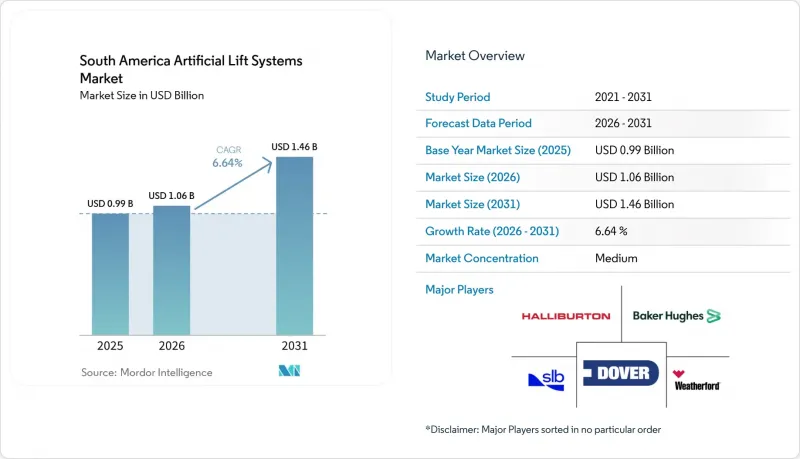
According to Mordor Intelligence, the South America artificial lift systems market size is projected to be USD 0.99 billion in 2025, USD 1.06 billion in 2026, and reach USD 1.46 billion by 2031, at a CAGR of 6.64% from 2026 to 2031.
South America Artificial Lift Systems Market Trends and Insights
Mature-Well Rejuvenation And Production-Life Extension
Mature producing fields across South America rely on artificial lift after natural reservoir pressure declines. This creates recurring demand for equipment replacement, repairs, and service work across established basins. Ecopetrol has addressed failure reduction and energy use in its artificial lifting systems, covering ESP, mechanical pumping, and progressive cavity pump installations in Colombia. The work shows why operators focus on pump reliability and energy performance as wells age. The South America artificial lift systems market therefore includes demand that is tied to preserving production, rather than only to new drilling. That base can support service activity when operators delay less essential expansion projects.
Mature wells also require a broader mix of lift methods because water production, fluid viscosity, and gas content vary across fields. Operators use ESPs where high fluid volumes justify the system, while rod lift and PCP systems remain relevant in many established onshore operations. Field teams must maintain these systems regularly because deferred repairs can result in lost output. Local service capacity is important when workovers or equipment changes are needed quickly. The South America artificial lift systems market benefits from this installed base because service contracts can continue through several intervention cycles. Suppliers that hold nearby inventory and experienced field crews can reduce downtime for operators.
Brazil Pre-Salt And Guyana Offshore Expansion
Brazil's pre-salt program remains a major source of offshore system demand in the region. Petrobras reported 2.56 million barrels of oil equivalent per day from its own pre-salt production in 2025. The company also reported that the Almirante Tamandare FPSO produced 270,000 barrels per day during 2025. These developments require equipment that can operate under deepwater pressure, high gas volumes, and demanding fluid conditions. The South America artificial lift systems market gains from projects where lift selection is incorporated into well and production-system design. Suppliers need to meet technical qualification requirements before they can participate in these projects.
Guyana adds another offshore development path to the regional demand base. ExxonMobil reported that Stabroek Block production reached 900,000 barrels per day in November 2025. The company stated that the Uaru FPSO began operations in 2026 with a design rate of 250,000 barrels per day. New projects increase the need for qualified completion, monitoring, and production-support systems across added well clusters. Offshore operators place high value on run life because subsea intervention can be difficult and expensive. This encourages the use of monitoring systems that identify operating issues before they require a major intervention.
Ultra-Deepwater Intervention And Workover Economics
Deepwater lift systems must operate reliably because replacement can require specialized vessels, subsea equipment, and detailed planning. This raises the cost of failures in Brazil's pre-salt fields and Guyana's offshore developments. A 2025 article in the Journal of Petroleum Technology discussed operating challenges for an ESP in the ultra-deepwater, heavy-oil Atlanta field in Brazil. The article described how heavy oil, gas conditions, and water depth complicate ESP operation. These conditions can shift investment toward run-life improvements and monitoring instead of frequent replacement activity. The South America artificial lift systems market must therefore balance the value of high-specification hardware against the cost of intervention.
Operators reduce this exposure by placing greater emphasis on equipment qualification and failure prevention. They may use redundant configurations or monitoring tools where the production risk is high. This approach can favor established suppliers with experience in demanding offshore applications. It can also lengthen purchasing processes because operators review reliability and service capability closely. High intervention costs can limit the willingness to test unproven systems in critical wells. The South America artificial lift systems market remains attractive for qualified providers, but entry into deepwater work requires significant technical credibility.
Other drivers and restraints analyzed in the detailed report include:
- Digital Lift Optimization And Remote Surveillance
- Automated Gas-Handling Retrofits In High-GOR Wells
- Specialty-Elastomer And Power-Electronics Bottlenecks
For complete list of drivers and restraints, kindly check the Table Of Contents.
Segment Analysis
Electric submersible pumps held 32.6% of the South America artificial lift systems market in 2025 and are forecast to grow at a 6.8% CAGR through 2031. ESPs serve high-volume wells across offshore and deep onshore applications. Their adaptability supports use from mature conventional wells to complex offshore completions. Petrobras uses artificial lift within its pre-salt production architecture, where equipment reliability is important. BW Energy's May 2025 Maromba decision included 6 initial horizontal production wells with downhole ESP systems.
Progressive cavity pumps remain important in onshore operations with viscous fluids and mature reservoirs. Rod lift retains a substantial installed base across older producing areas. Gas lift, plunger lift, hydraulic pumps, and other systems serve wells where ESPs are less suitable. The artificial lift systems industry depends on this broad technology mix because no single system suits every well. ISO 15551:2023 sets requirements for design verification, performance ratings, and functional evaluation for tubing-deployed ESP systems.
Vertical wells accounted for 57.4% of the South America artificial lift systems market in 2025. Horizontal wells are projected to grow at a 7.1% CAGR through 2031 as unconventional development expands. The vertical installed base is concentrated in established onshore basins across Argentina, Colombia, and Brazil. Horizontal completions can require different pump geometry and stronger gas-handling capability. The South America artificial lift systems market size for horizontal wells is growing with multi-well development in unconventional acreage.
Lift installation in horizontal wells requires planning around completion design and reservoir pressure changes. Equipment must support stable flow without increasing failure risk. The design process includes pump intake, gas behavior, and power assessments. Global suppliers with unconventional experience can bring proven designs to the region. Local service teams remain essential for installation and troubleshooting at the well site.
Complete Report Scope:
- By Lift Type
- Electric Submersible Pumps (ESP)
- Progressive Cavity Pump (PCP)
- Rod Lift (Beam, Sucker-Rod)
- Gas Lift
- Hydraulic Piston & Jet Pumps
- Plunger Lift
- Other Niche Systems (Hydraulic Submersible, Capillary)
- By Well Orientation
- Horizontal Wells
- Vertical Wells
- By Reservoir Type
- Conventional
- Unconventional (Shale/Tight)
- By Application
- Onshore
- Offshore
- By Component
- Pump
- Motor
- Variable Speed Drive & Controls
- Surface Equipment
- Ancillary (Sensors, Seal-Sections, Packers)
- By Service
- Installation and Commissioning
- Optimization and Monitoring
- Maintenance, Repair & Overhaul (MRO)
- By Geography
- Brazil
- Argentina
- Guyana
- Colombia
- Chile
- Rest of South America
List of Companies Covered in this Report:
- Baker Hughes Company
- AccessESP
- Alkhorayef Petroleum Company
- Borets International Limited
- Dover Corporation
- Flotek Industries, Inc.
- Halliburton Company
- JJ Tech Systems
- Kudu Industries Inc.
- NOV Inc.
- Novomet Group
- Novomet Oil Services Holding Ltd.
- Odessa Separator
- PCM Artificial Lift
- SLB
- Tenaris S.A.
- Weatherford International plc
Additional Benefits:
- The market estimate (ME) sheet in Excel format
- 3 months of analyst support
TABLE OF CONTENTS
1 INTRODUCTION
- 1.1 Study Assumptions and Market Definition
- 1.2 Scope of the Study
2 RESEARCH METHODOLOGY
3 EXECUTIVE SUMMARY
4 MARKET LANDSCAPE
- 4.1 Market Overview
- 4.2 Market Drivers
- 4.2.1 Mature-Well Rejuvenation and Production-Life Extension
- 4.2.2 Vaca Muerta Horizontal-Well Development
- 4.2.3 Brazil Pre-Salt and Guyana-Adjacent Offshore Expansion
- 4.2.4 Digital Lift Optimization and Remote Surveillance
- 4.2.5 Local Supply Hubs for Corrosive-Service Lift Equipment
- 4.2.6 Automated Gas-Handling Retrofits in High-GOR Wells
- 4.3 Market Restraints
- 4.3.1 Crude-Price-Driven Upstream CAPEX Deferrals
- 4.3.2 Ultra-Deepwater Intervention and Workover Economics
- 4.3.3 Specialty-Elastomer and Power-Electronics Bottlenecks
- 4.3.4 Shortage of Automation-Ready Field Personnel
- 4.4 Supply-Chain Analysis
- 4.5 Porter's Five Forces Analysis
- 4.5.1 Bargaining Power of Suppliers
- 4.5.2 Bargaining Power of Buyers
- 4.5.3 Threat of New Entrants
- 4.5.4 Threat of Substitutes
- 4.5.5 Competitive Rivalry
- 4.6 Technology Outlook
- 4.7 Regulatory Landscape
- 4.8 Investment Analysis
5 MARKET SIZE AND GROWTH FORECASTS
- 5.1 By Lift Type
- 5.1.1 Electric Submersible Pumps (ESP)
- 5.1.2 Progressive Cavity Pump (PCP)
- 5.1.3 Rod Lift (Beam, Sucker-Rod)
- 5.1.4 Gas Lift
- 5.1.5 Hydraulic Piston & Jet Pumps
- 5.1.6 Plunger Lift
- 5.1.7 Other Niche Systems (Hydraulic Submersible, Capillary)
- 5.2 By Well Orientation
- 5.2.1 Horizontal Wells
- 5.2.2 Vertical Wells
- 5.3 By Reservoir Type
- 5.3.1 Conventional
- 5.3.2 Unconventional (Shale/Tight)
- 5.4 By Application
- 5.4.1 Onshore
- 5.4.2 Offshore
- 5.5 By Component
- 5.5.1 Pump
- 5.5.2 Motor
- 5.5.3 Variable Speed Drive & Controls
- 5.5.4 Surface Equipment
- 5.5.5 Ancillary (Sensors, Seal-Sections, Packers)
- 5.6 By Service
- 5.6.1 Installation and Commissioning
- 5.6.2 Optimization and Monitoring
- 5.6.3 Maintenance, Repair & Overhaul (MRO)
- 5.7 By Geography
- 5.7.1 Brazil
- 5.7.2 Argentina
- 5.7.3 Guyana
- 5.7.4 Colombia
- 5.7.5 Chile
- 5.7.6 Rest of South America
6 COMPETITIVE LANDSCAPE
- 6.1 Market Concentration
- 6.2 Strategic Moves
- 6.3 Market Share Analysis
- 6.4 Company Profiles (includes Global Level Overview, Market Level Overview, Core Segments, Financials as available, Strategic Information, Market Rank/Share, Products and Services, Recent Developments)
- 6.4.1 Baker Hughes Company
- 6.4.2 AccessESP
- 6.4.3 Alkhorayef Petroleum Company
- 6.4.4 Borets International Limited
- 6.4.5 Dover Corporation
- 6.4.6 Flotek Industries, Inc.
- 6.4.7 Halliburton Company
- 6.4.8 JJ Tech Systems
- 6.4.9 Kudu Industries Inc.
- 6.4.10 NOV Inc.
- 6.4.11 Novomet Group
- 6.4.12 Novomet Oil Services Holding Ltd.
- 6.4.13 Odessa Separator
- 6.4.14 PCM Artificial Lift
- 6.4.15 SLB
- 6.4.16 Tenaris S.A.
- 6.4.17 Weatherford International plc
7 MARKET OPPORTUNITIES AND FUTURE OUTLOOK
- 7.1 White-space & Unmet-need Assessment

