PUBLISHER: Mordor Intelligence | PRODUCT CODE: 2154515

PUBLISHER: Mordor Intelligence | PRODUCT CODE: 2154515
Heavy Metal Removal Agent - Market Share Analysis, Industry Trends & Statistics, Growth Forecasts (2026 - 2031)
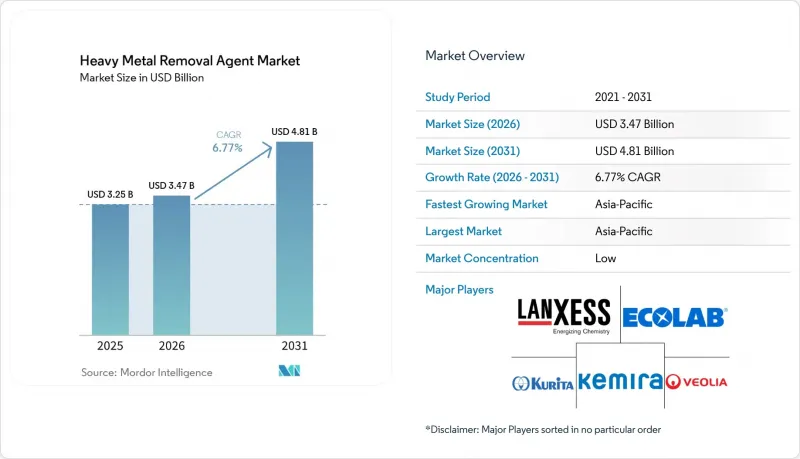
According to Mordor Intelligence, the heavy metal removal agent market size was valued at USD 3.25 billion in 2025 and is estimated to grow from USD 3.47 billion in 2026 to reach USD 4.81 billion by 2031, at a CAGR of 6.77% during the forecast period (2026-2031).
Global Heavy Metal Removal Agent Market Trends and Insights
Tightening Heavy-Metal Discharge and Drinking-Water Standards
The heavy metal removal agent market is responding to a stricter compliance baseline across industrial discharge and drinking water systems, where treatment decisions increasingly depend on both the final contaminant limit and the ability to document consistent results through formal sampling programs. The U.S. Environmental Protection Agency finalized the Lead and Copper Rule Improvements in October 2024 and reduced the lead action level from 0.015 mg/L to 0.010 mg/L. The rule also tightened sampling requirements at schools and childcare facilities. The 2026 recast of the European Union Industrial Emissions Directive introduces Best Available Techniques-associated emission levels for industrial wastewater and increases the need for multi-stage treatment at new installations.
Industrial Expansion in Mining, Electronics and Battery Manufacturing
Battery cathode production is expanding the heavy metal removal agent market because its wastewater contains nickel, cobalt, manganese, lithium, and fluoride. Standard hydroxide precipitation cannot reduce these contaminants to the required discharge levels in a single treatment stage. Facilities therefore use precipitation, selective ion exchange, membrane polishing, and, in some cases, electrochemical recovery. A 2026 review of battery manufacturing and recycling wastewater found that integrated membrane and electrochemical approaches can support high metal recovery and industrial water reuse. A 2025 review found that reverse osmosis achieved removal efficiencies of up to 99.9%, although high-salinity battery effluents increased fouling risk and required effective upstream treatment. LANXESS presented metal ore purification solutions for battery electrode production at Aquatech 2025, showing the link between ion exchange materials and battery supply chains. Selective metal recovery is also becoming relevant because recovered metals can create value alongside compliance benefits.
High Total Cost of Ownership for Advanced Media and Resin Systems
The cost of advanced polishing systems limits adoption in the heavy metal removal agent market, especially among mid-sized industrial operators that must compare compliance investments against simpler precipitation systems and may lack the scale to absorb recurring regeneration and disposal costs. For high-concentration mixed-metal streams above 50 mg/L total metals, hydroxide or sulfide precipitation provides a lower-cost primary treatment route. Treatment to limits below 0.1 mg/L requires ion exchange or selective adsorption media, regeneration chemicals, and spent-media disposal. Complexed metals, including metal-ethylenediaminetetraacetic acid (EDTA) complexes, also make treatment performance less stable because they can pass through primary precipitation and require additional processing.
Other drivers and restraints analyzed in the detailed report include:
- Water Scarcity, Industrial Reuse and Zero-Liquid-Discharge Programs
- Public-Health Response to Lead, Arsenic, Mercury and Chromium Exposure
- Persistence and Remobilization Risk of Conventional Chelants
For complete list of drivers and restraints, kindly check the Table Of Contents.
Segment Analysis
Chelating agents held 34.25% of the heavy metal removal agent market size in 2025. They complex metal ions across a pH range of 2 to 12 and remain important in the polishing stage of multi-step treatment trains. Nouryon's Dissolvine GL Premium contains 55% active L-glutamic acid, N,N-diacetic acid (GLDA). The product was used in industrial cleaning formulations and gained traction in water treatment because it is compatible with downstream membrane filtration. Precipitating agents serve as primary treatment, while adsorbents are relevant where per- and polyfluoroalkyl substances (PFAS) must also be removed. Ion exchange resins retain a role in polishing and selective recovery of lead, cadmium, copper, and nickel at concentrations below 10 mg/L.
Bio-based agents are projected to advance at a 7.23% CAGR through 2031 in the heavy metal removal agent market. Their adoption reflects a continuing shift within the heavy metal removal agent market and obligations under the European Union Registration, Evaluation, Authorisation and Restriction of Chemicals Regulation (REACH), the European Union Ecolabel, and the U.S. Environmental Protection Agency Safer Choice Program. Nouryon launched the Dissolvine MAX range in October 2025 with 100% renewable carbon content and International Sustainability and Carbon Certification PLUS (ISCC PLUS). A 2026 review reported that biosorption accounted for 54.4% of the biological removal approaches reviewed for battery-industry effluents. Metal-organic framework (MOF) sorbents have tunable pore structures and high adsorption capacity, but they remain at the pre-commercial stage within the forecast period.
Complete Report Scope:
- By Product Type
- Chelating Agents
- Precipitating Agents
- Adsorbents
- Ion Exchange Resins
- Bio-Based Agents
- Other Product Types
- By Application
- Industrial Wastewater Treatment
- Municipal Water Treatment
- Soil and Groundwater Remediation
- Industrial Waste Management
- Other Applications
- By End-User Industry
- Industrial
- Municipal
- Residential
- By Geography
- Asia-Pacific
- China
- India
- Japan
- South Korea
- Rest of Asia-Pacific
- North America
- United States
- Canada
- Mexico
- Europe
- Germany
- United Kingdom
- France
- Italy
- Rest of Europe
- South America
- Brazil
- Argentina
- Rest of South America
- Middle East and Africa
- Saudi Arabia
- South Africa
- Rest of Middle East and Africa
- Asia-Pacific
Geography Analysis
Asia-Pacific held 37.53% of the market share in 2025 and is projected to advance at a 7.44% CAGR through 2031. China's 15th Five-Year Plan for 2026 to 2030 carries forward ZLD compliance mandates across chemical and pharmaceutical hubs. It also extends environmental enforcement to battery cathode material producers. India's Central Pollution Control Board requires monitoring of heavy metals in industrial discharges and enforces ZLD requirements for textile, tannery, and pharmaceutical clusters. These measures support multi-stage treatment systems using chelating agents and ion exchange resins, especially at sites where production effluents contain several metals and require reliable polishing before reuse or discharge.
North America remained a major regional participant in 2025, supported by drinking water compliance and industrial pretreatment investment. The 2024 U.S. lead rule reduced the action level to 0.010 mg/L and required service-line inventory submissions. The U.S. Environmental Protection Agency plans a July 2026 notice of proposed rulemaking for metal-finishing effluent guidelines that addresses PFAS discharges in chromium electroplating wastewater. Canada's battery manufacturing plans are also stimulating industrial wastewater investment, where new material capacity can create demand for integrated water infrastructure rather than stand-alone removal equipment.
Europe is shaped by German chemical industry discharge requirements and the Industrial Emissions Directive recast. Kemira Oyj's KemConnect DEX treated the Seine during 2 successive Olympic summer seasons, and its agreement with the Greater Paris Sanitation Authority extends into 2026. South America, and the Middle East and Africa are smaller but important areas for mining, petrochemicals, and water reuse. Brazil's mining activity has drawn attention to mercury and arsenic contamination, while Argentina's lithium operations require selective separation agents. Veolia signed a USD 500 million agreement with Saudi Aramco Total Refining and Petrochemical Company (SATORP) in September 2025 to build and operate an industrial wastewater reuse plant in Jubail Industrial City with a capacity of 8.8 million m3 annually under a 30-year contract beginning in 2028. Water scarcity in the Gulf Cooperation Council (GCC) supports ZLD-based reuse, while South African mine drainage requires neutralization, precipitation, and chelant polishing.
- Accepta Water Treatment
- Aries Chemical, Inc.
- Dow
- DuPont
- Ecolab Inc.
- Kemira Oyj
- Kurita Water Industries Ltd.
- LANXESS
- Mitsubishi Chemical Corporation
- Nouryon
- Paques
- SNF Group
- Syensqo
- Thermax Limited
- Veolia
- Xylem
Additional Benefits:
- The market estimate (ME) sheet in Excel format
- 3 months of analyst support
TABLE OF CONTENTS
1 Introduction
- 1.1 Study Assumptions and Market Definition
- 1.2 Scope of the Study
2 Research Methodology
3 Executive Summary
4 Market Landscape
- 4.1 Market Overview
- 4.2 Market Drivers
- 4.2.1 Tightening Heavy-Metal Discharge and Drinking-Water Standards
- 4.2.2 Industrial Expansion in Mining, Electronics and Battery Manufacturing
- 4.2.3 Water Scarcity, Industrial Reuse and Zero-Liquid-Discharge Programs
- 4.2.4 Public-Health Response to Lead, Arsenic, Mercury and Chromium Exposure
- 4.2.5 Selective Metal Recovery Creating a By-Product Revenue Stream
- 4.3 Market Restraints
- 4.3.1 High Total Cost of Ownership for Advanced Media and Resin Systems
- 4.3.2 Persistence and Remobilization Risk of Conventional Chelants
- 4.3.3 Treatment Performance Volatility from Complexed Metals and Mixed Effluents
- 4.4 Value Chain Analysis
- 4.5 Porter's Five Forces Analysis
- 4.5.1 Bargaining Power of Suppliers
- 4.5.2 Bargaining Power of Buyers
- 4.5.3 Threat of New Entrants
- 4.5.4 Threat of Substitutes
- 4.5.5 Competitive Rivalry
5 Market Size and Growth Forecasts (Value)
- 5.1 By Product Type
- 5.1.1 Chelating Agents
- 5.1.2 Precipitating Agents
- 5.1.3 Adsorbents
- 5.1.4 Ion Exchange Resins
- 5.1.5 Bio-Based Agents
- 5.1.6 Other Product Types
- 5.2 By Application
- 5.2.1 Industrial Wastewater Treatment
- 5.2.2 Municipal Water Treatment
- 5.2.3 Soil and Groundwater Remediation
- 5.2.4 Industrial Waste Management
- 5.2.5 Other Applications
- 5.3 By End-User Industry
- 5.3.1 Industrial
- 5.3.2 Municipal
- 5.3.3 Residential
- 5.4 By Geography
- 5.4.1 Asia-Pacific
- 5.4.1.1 China
- 5.4.1.2 India
- 5.4.1.3 Japan
- 5.4.1.4 South Korea
- 5.4.1.5 Rest of Asia-Pacific
- 5.4.2 North America
- 5.4.2.1 United States
- 5.4.2.2 Canada
- 5.4.2.3 Mexico
- 5.4.3 Europe
- 5.4.3.1 Germany
- 5.4.3.2 United Kingdom
- 5.4.3.3 France
- 5.4.3.4 Italy
- 5.4.3.5 Rest of Europe
- 5.4.4 South America
- 5.4.4.1 Brazil
- 5.4.4.2 Argentina
- 5.4.4.3 Rest of South America
- 5.4.5 Middle East and Africa
- 5.4.5.1 Saudi Arabia
- 5.4.5.2 South Africa
- 5.4.5.3 Rest of Middle East and Africa
- 5.4.1 Asia-Pacific
6 Competitive Landscape
- 6.1 Market Concentration
- 6.2 Strategic Moves
- 6.3 Market Share (%)/Ranking Analysis
- 6.4 Company Profiles (includes Global Overview, Market Overview, Core Segments, Financials as available, Strategic Information, Products and Services, and Recent Developments)
- 6.4.1 Accepta Water Treatment
- 6.4.2 Aries Chemical, Inc.
- 6.4.3 Dow
- 6.4.4 DuPont
- 6.4.5 Ecolab Inc.
- 6.4.6 Kemira Oyj
- 6.4.7 Kurita Water Industries Ltd.
- 6.4.8 LANXESS
- 6.4.9 Mitsubishi Chemical Corporation
- 6.4.10 Nouryon
- 6.4.11 Paques
- 6.4.12 SNF Group
- 6.4.13 Syensqo
- 6.4.14 Thermax Limited
- 6.4.15 Veolia
- 6.4.16 Xylem
7 Market Opportunities and Future Outlook
- 7.1 White-Space and Unmet-Need Assessment

