PUBLISHER: Mordor Intelligence | PRODUCT CODE: 2154735

PUBLISHER: Mordor Intelligence | PRODUCT CODE: 2154735
Oil and Gas Upstream Fasteners - Market Share Analysis, Industry Trends & Statistics, Growth Forecasts (2026 - 2031)
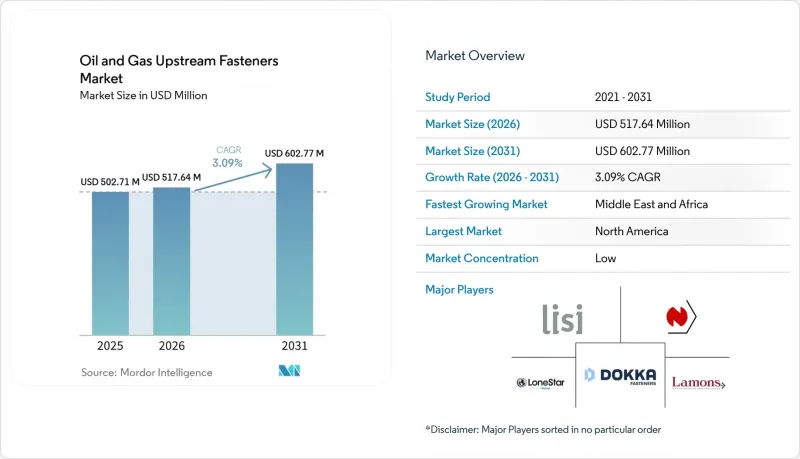
According to Mordor Intelligence, the oil and Gas Upstream Fasteners Market size is projected to expand from USD 502.71 million in 2025 and USD 517.64 million in 2026 to USD 602.77 million by 2031, registering a CAGR of 3.09% between 2026 and 2031.
Global Oil and Gas Upstream Fasteners Market Trends and Insights
Deepwater and Ultra-Deepwater Project Development
Deepwater activity supports demand for components that can withstand pressure, seawater exposure, and sour-service conditions. The oil and gas upstream fasteners market benefits because subsea trees, wellheads, manifolds, and connectors use high-specification bolting across many critical joints. These assemblies commonly require duplex, super duplex, or nickel-based materials instead of standard carbon steel. Petrobras planned to sign 6 proprietary FPSO contracts in 2026 and 2027, supporting continued demand for equipment installed around offshore production systems. Suppliers with documented material traceability and subsea approval can address this demand more effectively than suppliers serving only standard industrial applications. The oil and gas upstream fasteners market also gains value per unit when offshore specifications require more testing and higher-grade alloys.
Brownfield Well Intervention and Integrity Programs
Mature offshore assets require regular inspection, repair, and replacement work to maintain safe operation. This work supports recurring demand in the oil and gas upstream fasteners market because corroded or damaged joint systems may require replacement sets rather than isolated parts. Equinor extended NOK 17 billion in drilling and well services agreements for the Norwegian Continental Shelf in May 2026. Shell expanded its U.S. Gulf brownfield engineering program during 2026, which adds visibility to work on existing offshore assets. Brownfield programs favor suppliers that can provide certified replacements within maintenance schedules. The oil and gas upstream fasteners market also benefits when lifecycle work shifts procurement from occasional purchases to managed service agreements.
Upstream Capex Cyclicality and Oil-Price Exposure
Capital spending decisions remain sensitive to oil prices, project economics, and operator cash priorities. When project sanctions move later, the oil and gas upstream fasteners market faces less visibility into forward orders for specialty grades. Suppliers may be reluctant to hold large inventories of duplex or nickel-based products when demand timing is uncertain. Delays also reduce the benefit of long production lead times for qualified materials. Some suppliers seek adjacent work in hydrogen, carbon capture, or offshore wind to reduce exposure to one investment cycle. That shift is not simple because these applications require their own qualifications, customer relationships, and operating capabilities.
Other drivers and restraints analyzed in the detailed report include:
- API 20E and API 20F Qualification-Driven Procurement
- Middle East and Asian NOC Upstream Investment
- Alloy, Steel, and Tariff Cost Volatility
For complete list of drivers and restraints, kindly check the Table Of Contents.
Segment Analysis
Externally threaded fasteners held 48.4% of the oil and gas upstream fasteners market share in 2025. Studs, bolts, and cap screws remain widely used in wellhead assemblies, drilling equipment, platform topsides, and FPSO systems. Their design fits common flange arrangements and established tensioning practices. The segment benefits from a large installed base that requires both new-build and replacement components. External threads also support high-load connections where access for tensioning equipment is available. This keeps the product category important across established upstream equipment designs.
Internally threaded fasteners are projected to expand at a 3.6% CAGR through 2031. Their use is increasing in subsea assemblies where remote operation and repeatable torque application are important. Female-connection designs can suit equipment installed with remotely operated vehicles in low-visibility conditions. They can also require more complex machining and inspection than standard external-thread products. Non-threaded products, including pins, clips, and retaining rings, retain a smaller role in equipment exposed to vibration and cyclic loads. The oil and gas upstream fasteners market will continue to use each product type because equipment design and operating environment determine the appropriate joint configuration.
Complete Report Scope:
- By Product Type
- Externally Threaded Fasteners
- Internally Threaded Fasteners
- Non-Threaded Fasteners
- By Material
- Carbon and Alloy Steel
- Stainless Steel
- Nickel Alloys
- Duplex and Super Duplex Stainless Steel
- Titanium and Other Specialty Materials
- By Application
- Drilling Equipment
- Subsea Infrastructure
- Wellheads and Christmas Trees
- FPSOs and Floating Production Units
- Offshore Platforms and Rigs
- Flowlines, Risers, and Manifolds
- By Geography
- North America
- United States
- Canada
- Mexico
- Europe
- Germany
- France
- Italy
- Spain
- United Kingdom
- Poland
- Russia
- Rest of Europe
- Asia-Pacific
- China
- India
- Japan
- South Korea
- Australia
- Indonesia
- Vietnam
- Thailand
- Rest of Asia-Pacific
- South America
- Brazil
- Argentina
- Chile
- Rest of South America
- Middle East and Africa
- Saudi Arabia
- United Arab Emirates
- Egypt
- South Africa
- Morocco
- Rest of Middle East and Africa
- North America
Geography Analysis
North America held 29.1% of the oil and gas upstream fasteners market share in 2025. The region combines drilling activity, Gulf of Mexico deepwater work, and maintenance needs in Canadian oil sands operations. Domestic sourcing can support standard carbon steel products, while specialty grades may still rely on broader supply networks. SLB OneSubsea received a subsea boosting contract for bp's Thunder Horse project in June 2026. This work supports the demand for documented subsea components. Europe is supported by North Sea maintenance, intervention, and integrity activity. Equinor's May 2026 drilling and well services extension illustrates the continued need for work on mature offshore infrastructure. European operators also continue to adopt digital approaches to bolted-joint management. MODS updated its Connect Integrity platform in June 2025 with unique joint IDs, digital checks, and validation functions.
Asia-Pacific demand is tied to activity by PETRONAS, CNOOC, and ONGC across offshore and gas assets. The oil and gas upstream fasteners market gains from Indonesian, Malaysian, and South China Sea developments that need subsea production equipment. Eni and PETRONAS established Searah in June 2026 to combine their interests in Indonesia and Malaysia. SLB OneSubsea was awarded a major umbilical contract for an offshore Indonesia project during 2026. South America is led by Brazil, where pre-salt developments support a long pipeline of FPSO and subsea work. SBM Offshore contracted its seventh Multi-Purpose Floater hull in June 2026. These projects require components across production, mooring, and flow-assurance systems.
The Middle East and Africa is projected to grow at a 4.3% CAGR through 2031. The region benefits from large national oil company programs that can provide more consistent demand than short-cycle drilling markets. Aramco's 2026 capital guidance of USD 50 billion to USD 55 billion includes continued upstream investment. Offshore construction and sour-service conditions raise the need for certified, corrosion-resistant bolting. The oil and gas upstream fasteners market is positioned to benefit where new platforms, wellheads, and subsea facilities move into execution. African deepwater projects add a further source of demand for qualified offshore products. Suppliers able to support local logistics and approved-vendor requirements are likely to be better placed in these programs.
- All-Pro Fasteners
- All-Pro Threaded Products
- APIS MC Ltd
- Birmingham Fastener and Supply Inc.
- Brighton-Best International
- Dokka Fasteners AS
- Doxsteel Fasteners
- Hague Fasteners Limited
- HCL Fasteners Ltd
- Lamons Manufacturing & Service Co.
- LISI Group
- LoneStar Group
- MARO Fasteners B.V.
- MW Industries, Inc.
- National Bolt & Nut Corporation
- Thomas Smith Fasteners
- U.S. Bolt Manufacturing, Inc.
Additional Benefits:
- The market estimate (ME) sheet in Excel format
- 3 months of analyst support
TABLE OF CONTENTS
1 INTRODUCTION
- 1.1 Study Assumptions and Market Definition
- 1.2 Scope of the Study
2 RESEARCH METHODOLOGY
3 EXECUTIVE SUMMARY
4 MARKET LANDSCAPE
- 4.1 Market Overview
- 4.2 Market Drivers
- 4.2.1 Deepwater and Ultra-Deepwater Project Development
- 4.2.2 Brownfield Well Intervention and Integrity Programs
- 4.2.3 API 20E and API 20F Qualification-Driven Procurement
- 4.2.4 Middle East and Asian NOC Upstream Investment
- 4.2.5 Digitally Traceable and Smart Fastener Adoption
- 4.2.6 Sour-Service and Corrosion-Resistant Fastener Upgrading
- 4.3 Market Restraints
- 4.3.1 Upstream Capex Cyclicality and Oil-Price Exposure
- 4.3.2 Qualification, Documentation, and Testing Burden
- 4.3.3 Alloy, Steel, and Tariff Cost Volatility
- 4.3.4 Installation Error and Hydrogen-Embrittlement Risk
- 4.4 Supply-Chain Analysis
- 4.5 Porter's Five Forces Analysis
- 4.5.1 Bargaining Power of Suppliers
- 4.5.2 Bargaining Power of Buyers
- 4.5.3 Threat of New Entrants
- 4.5.4 Threat of Substitutes
- 4.5.5 Competitive Rivalry
- 4.6 Technology Outlook
- 4.7 Regulatory Landscape
- 4.8 Investment Analysis
5 MARKET SIZE AND GROWTH FORECASTS
- 5.1 By Product Type
- 5.1.1 Externally Threaded Fasteners
- 5.1.2 Internally Threaded Fasteners
- 5.1.3 Non-Threaded Fasteners
- 5.2 By Material
- 5.2.1 Carbon and Alloy Steel
- 5.2.2 Stainless Steel
- 5.2.3 Nickel Alloys
- 5.2.4 Duplex and Super Duplex Stainless Steel
- 5.2.5 Titanium and Other Specialty Materials
- 5.3 By Application
- 5.3.1 Drilling Equipment
- 5.3.2 Subsea Infrastructure
- 5.3.3 Wellheads and Christmas Trees
- 5.3.4 FPSOs and Floating Production Units
- 5.3.5 Offshore Platforms and Rigs
- 5.3.6 Flowlines, Risers, and Manifolds
- 5.4 By Geography
- 5.4.1 North America
- 5.4.1.1 United States
- 5.4.1.2 Canada
- 5.4.1.3 Mexico
- 5.4.2 Europe
- 5.4.2.1 Germany
- 5.4.2.2 France
- 5.4.2.3 Italy
- 5.4.2.4 Spain
- 5.4.2.5 United Kingdom
- 5.4.2.6 Poland
- 5.4.2.7 Russia
- 5.4.2.8 Rest of Europe
- 5.4.3 Asia-Pacific
- 5.4.3.1 China
- 5.4.3.2 India
- 5.4.3.3 Japan
- 5.4.3.4 South Korea
- 5.4.3.5 Australia
- 5.4.3.6 Indonesia
- 5.4.3.7 Vietnam
- 5.4.3.8 Thailand
- 5.4.3.9 Rest of Asia-Pacific
- 5.4.4 South America
- 5.4.4.1 Brazil
- 5.4.4.2 Argentina
- 5.4.4.3 Chile
- 5.4.4.4 Rest of South America
- 5.4.5 Middle East and Africa
- 5.4.5.1 Saudi Arabia
- 5.4.5.2 United Arab Emirates
- 5.4.5.3 Egypt
- 5.4.5.4 South Africa
- 5.4.5.5 Morocco
- 5.4.5.6 Rest of Middle East and Africa
- 5.4.1 North America
6 COMPETITIVE LANDSCAPE
- 6.1 Market Concentration
- 6.2 Strategic Moves
- 6.3 Market Share Analysis
- 6.4 Company Profiles (includes Global Level Overview, Market Level Overview, Core Segments, Financials as available, Strategic Information, Market Rank/Share, Products and Services, Recent Developments)
- 6.4.1 All-Pro Fasteners
- 6.4.2 All-Pro Threaded Products
- 6.4.3 APIS MC Ltd
- 6.4.4 Birmingham Fastener and Supply Inc.
- 6.4.5 Brighton-Best International
- 6.4.6 Dokka Fasteners AS
- 6.4.7 Doxsteel Fasteners
- 6.4.8 Hague Fasteners Limited
- 6.4.9 HCL Fasteners Ltd
- 6.4.10 Lamons Manufacturing & Service Co.
- 6.4.11 LISI Group
- 6.4.12 LoneStar Group
- 6.4.13 MARO Fasteners B.V.
- 6.4.14 MW Industries, Inc.
- 6.4.15 National Bolt & Nut Corporation
- 6.4.16 Thomas Smith Fasteners
- 6.4.17 U.S. Bolt Manufacturing, Inc.
7 MARKET OPPORTUNITIES AND FUTURE OUTLOOK
- 7.1 White-Space and Unmet-Need Assessment

