PUBLISHER: Mordor Intelligence | PRODUCT CODE: 2154748

PUBLISHER: Mordor Intelligence | PRODUCT CODE: 2154748
South America Frozen Food Packaging - Market Share Analysis, Industry Trends & Statistics, Growth Forecasts (2026 - 2031)
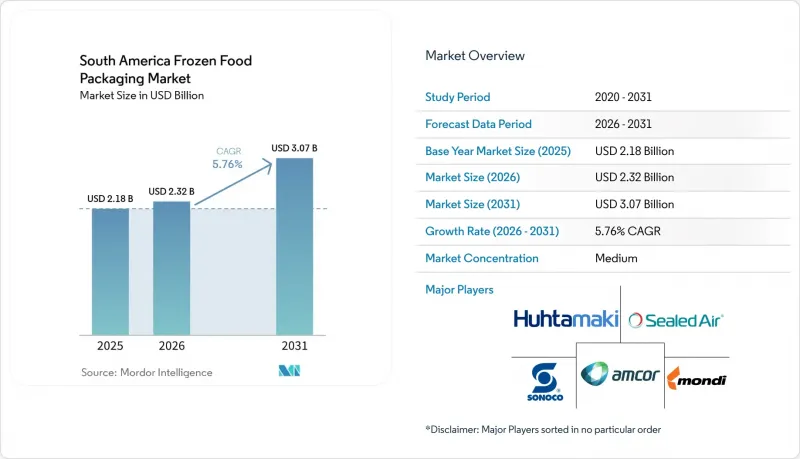
According to Mordor Intelligence, the South America frozen food packaging market was valued at USD 2.18 billion in 2025 and estimated to grow from USD 2.32 billion in 2026 to reach USD 3.07 billion by 2031, at a CAGR of 5.76% during the forecast period (2026-2031).
South America Frozen Food Packaging Market Trends and Insights
Rising Demand for Convenient Frozen Meals and Single-Serve Portions
Frozen foods are becoming more relevant to urban households that need prepared meals and smaller portions. This change supports demand for single-serve and duo-serve packs in Brazil, Colombia, Chile, and Argentina. Smaller packs use more packaging material per kilogram of food than family packs, which increases packaging demand even when food volumes rise more gradually. The South America frozen food packaging market benefits when suppliers provide packs that can move from freezer to microwave without loss of seal performance. Resealable formats and films that reduce freezer burn are also useful for consumers who do not use an entire portion at once. JBS reported that frozen food reached 33.4% household penetration in Brazil in 2025, and its Seara business led lasagna sales by volume at the start of 2026, supporting the shift toward prepared formats.
Expansion of Modern Grocery, Foodservice, and Online Grocery Channels
Modern grocery and foodservice channels require packaging that remains dependable through freezer storage, transport, and shelf display. Private-label frozen products add volume for converters because retailers need consistent packaging across multiple stock-keeping units. These customers also seek shorter qualification cycles and smaller minimum order quantities than large established brands may require. This favors suppliers that can manage a broader range of films, pouches, bags, and secondary packs without compromising food-contact compliance. Online grocery sales increase demand for overwraps and insulated shipping materials, extending packaging requirements beyond the retail shelf. In the South America frozen food packaging market, channel growth therefore expands the role of suppliers that can coordinate primary and secondary packaging needs while meeting delivery requirements.
Volatility in Resin, Paperboard, Aluminum, and Energy Costs
Input cost volatility remains an immediate concern for frozen-food packaging converters. Polyethylene, polypropylene, PET, and EVOH are important materials used in films that provide sealing strength and barrier performance. Their prices can change with global crude oil conditions and supply availability, which limits visibility for packaging suppliers. Energy costs add pressure because extrusion, sealing, and thermoforming operations consume substantial power. Thin mono-material films can be particularly exposed because they depend heavily on resin costs and must meet demanding performance requirements. The South America frozen food packaging market continues to require converters to protect margins without compromising packaging quality or delaying customer deliveries.
Other drivers and restraints analyzed in the detailed report include:
- Growth of Cold-Chain Infrastructure and Frozen-Protein Exports
- Greater Shelf-Life and Food-Quality Expectations
- Uneven Collection and Food-Grade Recycled-Content Availability
For complete list of drivers and restraints, kindly check the Table Of Contents.
Segment Analysis
Plastic held 58.16% of the South America frozen food packaging market share in 2025 because it can be used in pouches, bags, trays, and films designed for subzero conditions. Its flexibility, puncture resistance, and protection against moisture loss make it useful for a broad range of frozen products. Plastic is also compatible with high-volume converting processes used by meat and prepared-food producers across the region. Paper is projected to grow the fastest, at a 7.19% CAGR from 2026 to 2031, reflecting interest in fiber-based alternatives and recyclable formats. Brazil's food-contact rules continue to shape material choices by updating the list of authorized substances for plastic and cellulosic packaging.
Metal retains a role in selected protein products and ready-meal trays, where strength and processing suitability are important. Glass remains limited to premium products because its weight increases transport requirements. Other options include biodegradable biopolymers and barrier-coated cellulose for specialized frozen-food applications. OPIA and FIA Chile documented a project for compostable and biodegradable pouches for high-value frozen seafood, showing interest in alternatives for export-oriented products. The South America frozen food packaging industry retains plastic as its primary material while testing fiber- and bio-based structures that meet freezer, food-contact, and processor operating requirements.
Complete Report Scope:
- By Material
- Glass
- Paper
- Metal
- Plastic
- Other Materials
- By Packaging Product
- Bags
- Boxes
- Tubs and Cups
- Trays
- Wrappers
- Pouches
- Other Packaging Products
- By Food Type
- Readymade Meals
- Fruits and Vegetables
- Meat
- Seafood
- Baked Goods
- Other Food Types
- By Country
- Brazil
- Argentina
- Chile
- Colombia
- Rest of South America
List of Companies Covered in this Report:
- Amcor plc
- Sealed Air Corporation
- Mondi plc
- Sonoco Products Company
- Pactiv Evergreen Inc.
- Genpak LLC
- Graham Packaging Company, L.P.
- Ball Corporation
- Crown Holdings, Inc.
- Tetra Pak International S.A.
- Placon Corporation
- Toyo Seikan Group Holdings, Ltd.
- Smurfit Westrock plc
- ProAmpac Holdings Inc.
- Huhtamaki Oyj
- Coveris Management GmbH
- Grupo Oben Holding
- Petropack S.A.
- Sigmaplast S.A.
- Packall S.R.L.
Additional Benefits:
- The market estimate (ME) sheet in Excel format
- 3 months of analyst support
TABLE OF CONTENTS
1 INTRODUCTION
- 1.1 Study Assumptions and Market Definition
- 1.2 Scope of the Study
2 RESEARCH METHODOLOGY
3 EXECUTIVE SUMMARY
4 MARKET LANDSCAPE
- 4.1 Market Overview
- 4.2 Market Drivers
- 4.2.1 Rising Demand for Convenient Frozen Meals and Single-Serve Portions
- 4.2.2 Expansion of Modern Grocery, Foodservice, and Online Grocery Channels
- 4.2.3 Growth of Cold-Chain Infrastructure and Frozen-Protein Exports
- 4.2.4 Greater Shelf-Life and Food-Quality Expectations
- 4.2.5 Recyclable and Mono-Material Packaging Conversion by Brand Owners
- 4.2.6 Export-Oriented Demand for High-Barrier Packaging in Perishable Foods
- 4.3 Market Restraints
- 4.3.1 Volatility in Resin, Paperboard, Aluminum, and Energy Costs
- 4.3.2 Uneven Collection and Food-Grade Recycled-Content Availability
- 4.3.3 Low-Temperature Performance Trade-Offs in Recyclable Structures
- 4.3.4 Fragmented Cold-Chain Execution and Temperature-Abuse Risk
- 4.4 Industry Value Chain Analysis
- 4.5 Regulatory Landscape
- 4.6 Technological Outlook
- 4.7 Porter's Five Forces Analysis
- 4.7.1 Threat of New Entrants
- 4.7.2 Bargaining Power of Suppliers
- 4.7.3 Bargaining Power of Buyers
- 4.7.4 Threat of Substitutes
- 4.7.5 Competitive Rivalry
- 4.8 Impact of Macroeconomic Factors on the Market
5 MARKET SIZE AND GROWTH FORECASTS (VALUE)
- 5.1 By Material
- 5.1.1 Glass
- 5.1.2 Paper
- 5.1.3 Metal
- 5.1.4 Plastic
- 5.1.5 Other Materials
- 5.2 By Packaging Product
- 5.2.1 Bags
- 5.2.2 Boxes
- 5.2.3 Tubs and Cups
- 5.2.4 Trays
- 5.2.5 Wrappers
- 5.2.6 Pouches
- 5.2.7 Other Packaging Products
- 5.3 By Food Type
- 5.3.1 Readymade Meals
- 5.3.2 Fruits and Vegetables
- 5.3.3 Meat
- 5.3.4 Seafood
- 5.3.5 Baked Goods
- 5.3.6 Other Food Types
- 5.4 By Country
- 5.4.1 Brazil
- 5.4.2 Argentina
- 5.4.3 Chile
- 5.4.4 Colombia
- 5.4.5 Rest of South America
6 COMPETITIVE LANDSCAPE
- 6.1 Market Concentration
- 6.2 Strategic Moves
- 6.3 Market Share Analysis
- 6.4 Company Profiles (includes Global Level Overview, Market Level Overview, Core Segments, Financials as available, Strategic Information, Market Rank/Share, Products and Services, Recent Developments)
- 6.4.1 Amcor plc
- 6.4.2 Sealed Air Corporation
- 6.4.3 Mondi plc
- 6.4.4 Sonoco Products Company
- 6.4.5 Pactiv Evergreen Inc.
- 6.4.6 Genpak LLC
- 6.4.7 Graham Packaging Company, L.P.
- 6.4.8 Ball Corporation
- 6.4.9 Crown Holdings, Inc.
- 6.4.10 Tetra Pak International S.A.
- 6.4.11 Placon Corporation
- 6.4.12 Toyo Seikan Group Holdings, Ltd.
- 6.4.13 Smurfit Westrock plc
- 6.4.14 ProAmpac Holdings Inc.
- 6.4.15 Huhtamaki Oyj
- 6.4.16 Coveris Management GmbH
- 6.4.17 Grupo Oben Holding
- 6.4.18 Petropack S.A.
- 6.4.19 Sigmaplast S.A.
- 6.4.20 Packall S.R.L.
7 MARKET OPPORTUNITIES AND FUTURE TRENDS
- 7.1 White-Space and Unmet-Need Assessment

