PUBLISHER: Mordor Intelligence | PRODUCT CODE: 2154749

PUBLISHER: Mordor Intelligence | PRODUCT CODE: 2154749
South America Protective Packaging - Market Share Analysis, Industry Trends & Statistics, Growth Forecasts (2026 - 2031)
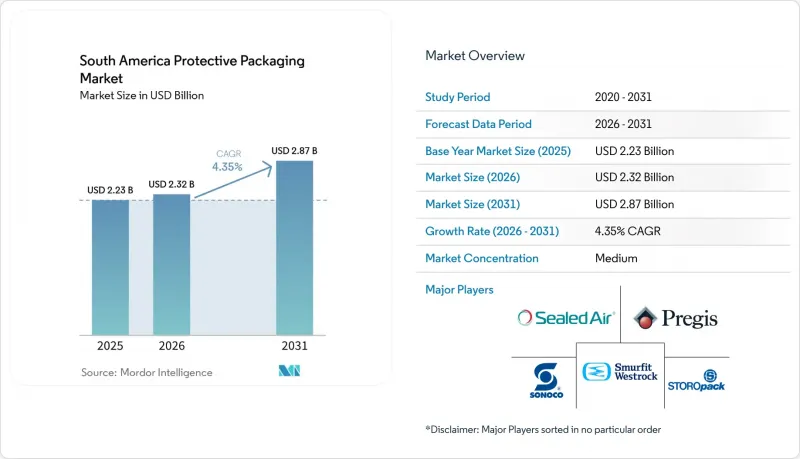
According to Mordor Intelligence, the South America protective packaging market size was valued at USD 2.23 billion in 2025 and estimated to grow from USD 2.32 billion in 2026 to reach USD 2.87 billion by 2031, at a CAGR of 4.35% during the forecast period (2026-2031).
South America Protective Packaging Market Trends and Insights
Growth of E-Commerce and Parcel Fulfillment
Regional online retail sales surpassed USD 190 billion in 2025 and are expected to exceed USD 200 billion in 2026, supporting demand for parcel protection across fulfillment networks. Brazil's e-commerce penetration reached 14.3% of total commerce in 2025, increasing demand for protective mailers, air pillows, and bubble wrap around major fulfillment hubs. Mercado Libre reported that packaging accounted for 18% of its fulfillment costs in 2024, supporting its use of on-demand machinery to reduce material use and packing costs. Its installations reduced per-parcel packaging cost by 18% and void fill by 35%, showing why large platforms favor systems that improve consistency and material efficiency. Dimensional-weight freight charges are also directing buyers toward lighter, flexible formats that maintain protection without increasing shipment size. This pattern supports continuing demand for equipment-linked packaging programs in the South America protective packaging market.
Expansion of Food Safety and Cold-Chain Requirements
Food-contact requirements are increasing the need for documented packaging materials throughout South American cold chains. ANVISA published Resolution No. 979/2025 in June 2025, updating food-contact standards for cellulosic packaging in line with a MERCOSUR measure. The change favors suppliers that can document the composition and compliance status of paper-based protective substrates. Exporters of fresh produce, protein, and processed foods also need protective systems to ensure controlled handling during long journeys. Insulated containers and temperature-indicating formats can address those needs when customers require proof of cold-chain performance. These conditions are expanding the South America protective packaging market beyond standard transport protection into food-safety documentation and temperature assurance.
Volatility in Polymer, Paper, and Foam Input Costs
Input-cost volatility is a major near-term concern for converters that use polyethylene, polypropylene, paper, and specialty foam. Supply disruption in 2026 increased pressure on polymer availability and pricing across regional packaging supply chains. Converters that can switch among paper, fiber, and polymer formats have greater flexibility as material prices change. Single-material operations face a greater risk of margin compression or customer price resistance. The South America protective packaging market may therefore favor suppliers that maintain broader material portfolios, local procurement options, and material specifications that can be adjusted without disrupting customer packing operations.
Other drivers and restraints analyzed in the detailed report include:
- Industrial Output and Intraregional Trade Expansion
- Pharmaceutical and Healthcare Shipment Protection
- Inadequate Collection and Recycling Infrastructure
For complete list of drivers and restraints, kindly check the Table Of Contents.
Segment Analysis
Flexible protective packaging held 64.16% of the South America protective packaging market share in 2025. Its leadership reflected demand from parcel e-commerce and the freight advantage of lightweight air pillows, protective mailers, bubble wrap, and paper fill. These formats suited fast-moving fulfillment centers in Sao Paulo, Bogota, and Santiago because they could be stored compactly and dispensed quickly. Flexible formats also helped sellers control dimensional weight without removing the protection needed for routine parcel handling. Rigid packaging continued to serve industrial goods, automotive parts, and household appliances that needed structural support. Corrugated protectors, molded pulp, and insulated containers remained relevant where product weight, surface sensitivity, or route conditions made flexible protection insufficient.
Foam packaging is projected to expand at a 6.04% CAGR through 2031, the highest rate among product types. Custom-molded inserts and foam-in-place systems support medical devices and high-value electronics, where product damage can create replacement costs, warranty exposure, and customer dissatisfaction. Loose fill and foam sheets also retain a role in industrial shipments that require adaptable protection around irregular shapes. Paper-based fill alternatives are creating substitution pressure on some foam applications as recycled-content rules affect material selection. ANVISA good manufacturing practice requirements and ISO 11607 standards support the use of high-performance formats for sterile medical-device shipments. The South America protective packaging market size for foam formats is therefore supported by applications where precision protection matters more than material cost alone.
Plastics held 41.29% revenue share in 2025, the largest material position in the South America protective packaging market. Polyethylene and expanded polystyrene remained widely used in bubble wrap, air cushions, protective mailers, and other parcel-protection formats. Brazil, Argentina, and Colombia account for much of this demand because of their larger e-commerce and industrial bases. Paper and paperboard serve paper fill and food-grade uses, while foam polymers support industrial and pharmaceutical protection. Molded pulp is used in applications that require structure and a fiber-based material. Material selection is increasingly affected by recovery obligations and customer expectations for traceability.
Bio-based materials are projected to grow at a 5.56% CAGR through 2031, the fastest rate among material segments. Federal Decree No. 12,688/2025 requires 22% recycled content in plastic packaging for large companies from January 2026 and sets a recovery target of 32%. These requirements support recycled fiber, sugarcane-derived materials, and eucalyptus-fiber substrates where performance and compliance can be demonstrated. Klabin's integrated eucalyptus-fiber operations provide a domestic packaging supply with material traceability and the potential for local sourcing. Synthetic additive requirements in Chile also influence how converters assess alternative coatings and binders. The South America protective packaging market size for bio-based materials is therefore linked to both regulatory compliance and the regional availability of fiber inputs.
Complete Report Scope:
- By Product Type
- Rigid
- Corrugated Paperboard Protectors
- Molded Pulp
- Insulated Shipping Containers
- Other Rigid Types
- Flexible
- Protective Mailers
- Bubble Wrap
- Air Pillows / Air Bags
- Paper Fill
- Other Flexible Types
- Foam
- Molded Foam
- Foam-in-Place (FIP)
- Loose Fill
- Foam Rolls / Sheets
- Other Foam Types
- Rigid
- By Material
- Plastics
- Foam Polymers
- Paper and Paperboard
- Molded Pulp
- Bio-Based Materials
- By Functionality
- Cushioning
- Void Fill
- Wrapping
- Blocking and Bracing
- Insulation
- Other Functionalities
- By End-User Industry
- Food and Beverage
- Industrial Goods
- Consumer Electronics
- Healthcare and Pharmaceuticals
- Household Appliances
- E-Commerce Fulfillment
- Other End-User Industries
- By Country
- Brazil
- Argentina
- Chile
- Colombia
- Rest of South America
List of Companies Covered in this Report:
- Sealed Air Corporation
- Pregis LLC
- Storopack Hans Reichenecker GmbH
- Ranpak Holdings Corp.
- Nefab Group AB
- EFP, LLC
- Intertape Polymer Group Inc.
- Sonoco Products Company
- Smurfit Westrock plc
- International Paper Company
- Mondi plc
- DS Smith plc
- Huhtamaki Oyj
- Amcor plc
- Crown Holdings, Inc.
- Avery Dennison Corporation
- Ameson Packaging Co., Ltd.
- Airfil Protective Packaging Ltd
- Polyair Inter Pack Inc.
- Protective Packaging Limited
- Kite Packaging Limited
- Cushion Pack Limited
- DAPACK Ingenieria en Embalajes S.R.L.
- Molpack Corporation
Additional Benefits:
- The market estimate (ME) sheet in Excel format
- 3 months of analyst support
TABLE OF CONTENTS
1 INTRODUCTION
- 1.1 Study Assumptions and Market Definition
- 1.2 Scope of the Study
2 RESEARCH METHODOLOGY
3 EXECUTIVE SUMMARY
4 MARKET LANDSCAPE
- 4.1 Market Overview
- 4.2 Market Drivers
- 4.2.1 Growth of E-Commerce and Parcel Fulfillment
- 4.2.2 Expansion of Food Safety and Cold-Chain Requirements
- 4.2.3 Industrial Output and Intraregional Trade Expansion
- 4.2.4 Pharmaceutical and Healthcare Shipment Protection
- 4.2.5 Recycled-Content Mandates and Sustainable Material Substitution
- 4.2.6 Packaging Automation and Damage-Data-Based Right-Sizing
- 4.3 Market Restraints
- 4.3.1 Volatility in Polymer, Paper, and Foam Input Costs
- 4.3.2 Inadequate Collection and Recycling Infrastructure
- 4.3.3 Foreign-Exchange Exposure and Imported Specialty Materials
- 4.3.4 Fragmented Standards and Informal Protective-Packaging Practices
- 4.4 Industry Value Chain Analysis
- 4.5 Regulatory Landscape
- 4.6 Technological Outlook
- 4.7 Porter's Five Forces Analysis
- 4.7.1 Threat of New Entrants
- 4.7.2 Bargaining Power of Suppliers
- 4.7.3 Bargaining Power of Buyers
- 4.7.4 Threat of Substitutes
- 4.7.5 Competitive Rivalry
- 4.8 Impact of Macroeconomic Factors on the Market
5 MARKET SIZE AND GROWTH FORECASTS (VALUES)
- 5.1 By Product Type
- 5.1.1 Rigid
- 5.1.1.1 Corrugated Paperboard Protectors
- 5.1.1.2 Molded Pulp
- 5.1.1.3 Insulated Shipping Containers
- 5.1.1.4 Other Rigid Types
- 5.1.2 Flexible
- 5.1.2.1 Protective Mailers
- 5.1.2.2 Bubble Wrap
- 5.1.2.3 Air Pillows / Air Bags
- 5.1.2.4 Paper Fill
- 5.1.2.5 Other Flexible Types
- 5.1.3 Foam
- 5.1.3.1 Molded Foam
- 5.1.3.2 Foam-in-Place (FIP)
- 5.1.3.3 Loose Fill
- 5.1.3.4 Foam Rolls / Sheets
- 5.1.3.5 Other Foam Types
- 5.1.1 Rigid
- 5.2 By Material
- 5.2.1 Plastics
- 5.2.2 Foam Polymers
- 5.2.3 Paper and Paperboard
- 5.2.4 Molded Pulp
- 5.2.5 Bio-Based Materials
- 5.3 By Functionality
- 5.3.1 Cushioning
- 5.3.2 Void Fill
- 5.3.3 Wrapping
- 5.3.4 Blocking and Bracing
- 5.3.5 Insulation
- 5.3.6 Other Functionalities
- 5.4 By End-User Industry
- 5.4.1 Food and Beverage
- 5.4.2 Industrial Goods
- 5.4.3 Consumer Electronics
- 5.4.4 Healthcare and Pharmaceuticals
- 5.4.5 Household Appliances
- 5.4.6 E-Commerce Fulfillment
- 5.4.7 Other End-User Industries
- 5.5 By Country
- 5.5.1 Brazil
- 5.5.2 Argentina
- 5.5.3 Chile
- 5.5.4 Colombia
- 5.5.5 Rest of South America
6 COMPETITIVE LANDSCAPE
- 6.1 Market Concentration
- 6.2 Strategic Moves
- 6.3 Market Share Analysis
- 6.4 Company Profiles (includes Global Level Overview, Market Level Overview, Core Segments, Financials as available, Strategic Information, Market Rank/Share, Products and Services, Recent Developments)
- 6.4.1 Sealed Air Corporation
- 6.4.2 Pregis LLC
- 6.4.3 Storopack Hans Reichenecker GmbH
- 6.4.4 Ranpak Holdings Corp.
- 6.4.5 Nefab Group AB
- 6.4.6 EFP, LLC
- 6.4.7 Intertape Polymer Group Inc.
- 6.4.8 Sonoco Products Company
- 6.4.9 Smurfit Westrock plc
- 6.4.10 International Paper Company
- 6.4.11 Mondi plc
- 6.4.12 DS Smith plc
- 6.4.13 Huhtamaki Oyj
- 6.4.14 Amcor plc
- 6.4.15 Crown Holdings, Inc.
- 6.4.16 Avery Dennison Corporation
- 6.4.17 Ameson Packaging Co., Ltd.
- 6.4.18 Airfil Protective Packaging Ltd
- 6.4.19 Polyair Inter Pack Inc.
- 6.4.20 Protective Packaging Limited
- 6.4.21 Kite Packaging Limited
- 6.4.22 Cushion Pack Limited
- 6.4.23 DAPACK Ingenieria en Embalajes S.R.L.
- 6.4.24 Molpack Corporation
7 MARKET OPPORTUNITIES AND FUTURE TRENDS
- 7.1 White-Space and Unmet-Need Assessment

