PUBLISHER: Mordor Intelligence | PRODUCT CODE: 2154757

PUBLISHER: Mordor Intelligence | PRODUCT CODE: 2154757
South America Pharmaceutical Plastic Bottles - Market Share Analysis, Industry Trends & Statistics, Growth Forecasts (2026 - 2031)
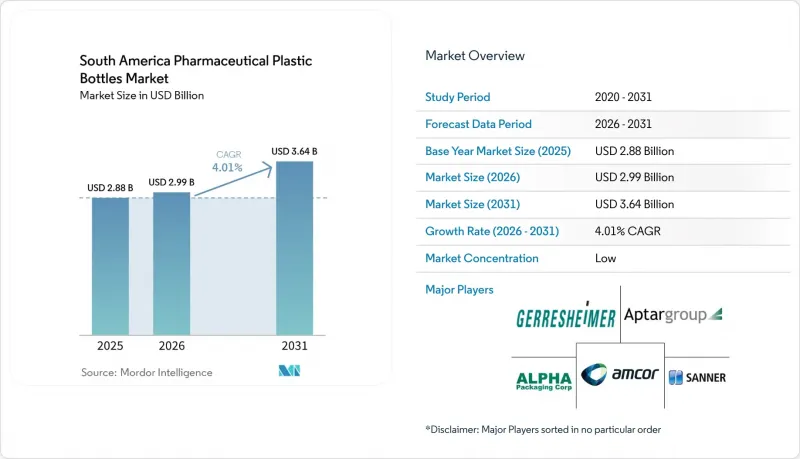
According to Mordor Intelligence, the South America pharmaceutical plastic bottles market size was valued at USD 2.88 billion in 2025 and estimated to grow from USD 2.99 billion in 2026 to reach USD 3.64 billion by 2031, at a CAGR of 4.01% during the forecast period (2026-2031).
South America Pharmaceutical Plastic Bottles Market Trends and Insights
Expansion of Generic Drug Manufacturing
Generic drug manufacturing is a central demand source for the South America Pharmaceutical Plastic Bottles Market, as patent expiries, public procurement, and production-line investment support higher volumes of tablets, capsules, and liquid medicines within the South America Pharmaceutical Plastic Bottles Market. Brazilian domestic drugmakers continued to expand retail sales in 2026, while companies committed to new lines and product launches under revised federal pricing rules. Greater generic output requires more primary packaging at each stage, including bottles, closures, labels, and systems that preserve batch traceability. These products commonly use PET and HDPE formats because they fit automated filling operations, existing closure systems, established stability requirements, and repeatable production scheduling. Generic producers also prefer formats that can be used across multiple product presentations without repeated line adjustments, which supports recurring demand for standard bottles rather than only short runs. This favors converters that can maintain consistent specifications, reliable lead times, and controlled documentation across large generic portfolios.
Growth in Domestic Pharmaceutical Packaging Demand
Domestic pharmaceutical investment is raising local procurement of primary packaging in the South America Pharmaceutical Plastic Bottles Market and expanding the addressable manufacturing base for the South America Pharmaceutical Plastic Bottles Market. Novo Nordisk announced a BRL 6.4 billion (USD 1.09 billion) investment to expand its Montes Claros facility in Brazil in 2025. The project includes aseptic production lines and a quality-control laboratory for GLP-1 injectable medicines. Large plants need predictable, validated packaging supplies during commissioning, process qualification, and ongoing commercial operations, including the ability to accommodate changes to specifications and regulatory documents. Bottle suppliers must complete material qualification and maintain supply continuity while coordinating with pharmaceutical production teams. Several production investments occurring simultaneously can create a denser base of demand for qualified local suppliers, reducing transport time and exposure to shipping disruptions within the South America Pharmaceutical Plastic Bottles Market.
Stringent Pharmaceutical Packaging Compliance
Pharmaceutical packaging compliance can slow material and supplier changes in the South America Pharmaceutical Plastic Bottles Market. ANVISA requires controlled traceability and supports a regulated serialization framework for medicines. A resin change or the addition of recycled content may require compatibility and stability assessments before release, coordinated among the drug manufacturer, converter, material supplier, and quality teams. Smaller converters may find it difficult to fund the testing, documentation, audit systems, and specialist staff needed for regulated supply. Pharmaceutical buyers also face a lengthy requalification process when adding a new primary packaging supplier. These demands favor established converters, but they can limit competition, delay the adoption of materials, and make it difficult to introduce suitable packaging within procurement schedules.
Other drivers and restraints analyzed in the detailed report include:
- Brazil Serialization and Traceability Upgrades
- Demand for Recyclable and Lightweight Bottles
- Volatility in Polymer and Additive Costs
For complete list of drivers and restraints, kindly check the Table Of Contents.
Segment Analysis
PET accounted for 42.14% of the South America Pharmaceutical Plastic Bottles Market size in 2025. Its transparency, barrier performance, and established acceptance under major pharmacopoeial standards support use in products requiring clear packaging and cross-border registrations. Pharmaceutical manufacturers value PET because a familiar format can simplify product dossiers and reduce operational variation across registered product lines, and its compatibility with standard blow-molding processes supports high-volume production for conventional tablet, capsule, and liquid medicine bottles. HDPE is used for desiccant-integrated solid oral containers and moisture-sensitive products, where opacity and moisture resistance are more important than visibility. LDPE remains suited to squeeze bottles for ophthalmic and topical medicines because flexible dispensing is required.
Polypropylene is projected to record a 4.67% CAGR from 2026 to 2031. Its heat resistance, moisture-barrier properties, and fit with mono-material designs support adoption where clarity is less important, while meeting pharmaceutical performance needs in applications that require a robust container and support circularity targets. Repsol's HPP03G is a 100% recyclable polypropylene grade that complies with USP and European Pharmacopeia requirements. Brazil's recycled-content requirements strengthen the case for materials with credible recycling pathways. PET is likely to retain its established role in clarity-dependent applications during the forecast period, particularly where product presentation, visual inspection, and existing filling-line qualification favor a familiar clear bottle, while its installed base means material substitution will depend on the formulation, validation requirements, available recyclate quality, and alternative-bottle performance.
Solid oral containers held 38.71% of the South America Pharmaceutical Plastic Bottles Market share in 2025. Tablets and capsules used to treat chronic conditions create a stable demand for HDPE and PET bottles with child-resistant closures. High-volume cardiovascular, anti-diabetic, and anti-hypertensive medicines commonly use standardized formats that suit automated filling and routine pharmacy dispensing, with established dimensions that help manufacturers plan closures, labels, and secondary packaging around repeatable specifications. Dropper bottles remain important for ophthalmic products and concentrated liquid extracts where precise delivery is needed. Syrup bottles also serve as containers for pediatric medicines and cough-and-cold preparations.
Nasal spray bottles are forecast to expand at a 4.98% CAGR between 2026 and 2031. Intranasal delivery is extending beyond allergy and rhinitis products to migraine rescue, systemic delivery, and emergency epinephrine applications. These formats require precise dosing, metal-free pumps, and controlled dimensions to protect performance through filling, transport, and patient use. Their technical requirements can lift unit values above those of standard oral-bottle formats, while oral-care rinse bottles retain a separate role in over-the-counter portfolios sold through pharmaceutical channels. This mix leaves both standardized and specialized bottle demand relevant to suppliers, requiring manufacturers in the South America Pharmaceutical Plastic Bottles Market to balance high-volume, repeatable solid-oral production with lower-volume formats that demand closer control of pumps, closures, and bottle dimensions, while tailoring the bottle configuration to the dosage form.
Complete Report Scope:
- By Raw Material
- Polyethylene Terephthalate
- High-Density Polyethylene
- Low-Density Polyethylene
- Polypropylene
- Other Raw Materials
- By Bottle Type
- Solid Oral Containers
- Dropper Bottles
- Nasal Spray Bottles
- Liquid Syrup Bottles
- Oral-Care Rinse Bottles
- Other Bottle Types
- By Capacity
- <=30 ml
- 31-100 ml
- 101-250 ml
- 251-500 ml
- Above 500 ml
- By End User
- Branded Pharmaceutical Manufacturers
- Generic Drug Manufacturers
- Contract Development and Manufacturing Organizations
- Over-the-Counter Product Companies
- By Geography
- Brazil
- Argentina
- Colombia
- Chile
- Rest of South America
List of Companies Covered in this Report:
- Gerresheimer AG
- AptarGroup, Inc.
- Drug Plastics & Glass Company, Inc.
- Frapak Packaging B.V.
- Nolato AB
- Sanner GmbH
- Origin Pharma Packaging Ltd
- Inden Pharma S.L.
- LOG Plastic Products Company Ltd.
- Plastiques Puig Packaging, S.L.
- Comar LLC
- Alpha Packaging, Inc.
- Weener Plastics Group B.V.
- Gil Plastic Products Ltd
- Pretium Packaging, LLC
- Plastipak Holdings, Inc.
- Bormioli Pharma S.p.A.
- Raepak Ltd
- Zhejiang B.I. Industrial Co., Ltd
- Ningbo Zhengli Pharmaceutical Packaging Co., Ltd
- Silgan Holdings Inc.
- ALPLA Werke Alwin Lehner GmbH & Co KG
Additional Benefits:
- The market estimate (ME) sheet in Excel format
- 3 months of analyst support
TABLE OF CONTENTS
1 INTRODUCTION
- 1.1 Study Assumptions and Market Definition
- 1.2 Scope of the Study
2 RESEARCH METHODOLOGY
3 EXECUTIVE SUMMARY
4 MARKET LANDSCAPE
- 4.1 Market Overview
- 4.2 Market Drivers
- 4.2.1 Expansion of Generic Drug Manufacturing
- 4.2.2 Growth in Domestic Pharmaceutical Packaging Demand
- 4.2.3 Demand for Recyclable and Lightweight Bottles
- 4.2.4 Brazil Serialization and Traceability Upgrades
- 4.2.5 Regionalized Supply for Critical Medicines
- 4.2.6 Rising Demand for Barrier Bottles in Moisture-Sensitive Formulations
- 4.3 Market Restraints
- 4.3.1 Stringent Pharmaceutical Packaging Compliance
- 4.3.2 Volatility in Polymer and Additive Costs
- 4.3.3 Limited Pharmaceutical-Grade Recyclate Availability
- 4.3.4 Fragmented Reverse Logistics and Waste Collection
- 4.4 Impact of Macroeconomic Factors on the Market
- 4.5 Industry Supply-Chain Analysis
- 4.6 Technology Outlook
- 4.7 Regulatory Landscape
- 4.8 Porter's Five Forces Analysis
- 4.8.1 Threat of New Entrants
- 4.8.2 Bargaining Power of Suppliers
- 4.8.3 Bargaining Power of Buyers
- 4.8.4 Threat of Substitutes
- 4.8.5 Intensity of Competitive Rivalry
5 MARKET SIZE AND GROWTH FORECASTS (VALUE)
- 5.1 By Raw Material
- 5.1.1 Polyethylene Terephthalate
- 5.1.2 High-Density Polyethylene
- 5.1.3 Low-Density Polyethylene
- 5.1.4 Polypropylene
- 5.1.5 Other Raw Materials
- 5.2 By Bottle Type
- 5.2.1 Solid Oral Containers
- 5.2.2 Dropper Bottles
- 5.2.3 Nasal Spray Bottles
- 5.2.4 Liquid Syrup Bottles
- 5.2.5 Oral-Care Rinse Bottles
- 5.2.6 Other Bottle Types
- 5.3 By Capacity
- 5.3.1 <=30 ml
- 5.3.2 31-100 ml
- 5.3.3 101-250 ml
- 5.3.4 251-500 ml
- 5.3.5 Above 500 ml
- 5.4 By End User
- 5.4.1 Branded Pharmaceutical Manufacturers
- 5.4.2 Generic Drug Manufacturers
- 5.4.3 Contract Development and Manufacturing Organizations
- 5.4.4 Over-the-Counter Product Companies
- 5.5 By Geography
- 5.5.1 Brazil
- 5.5.2 Argentina
- 5.5.3 Colombia
- 5.5.4 Chile
- 5.5.5 Rest of South America
6 COMPETITIVE LANDSCAPE
- 6.1 Market Concentration
- 6.2 Strategic Moves
- 6.3 Market Share Analysis
- 6.4 Company Profiles (includes Global Level Overview, Market Level Overview, Core Segments, Financials as available, Strategic Information, Market Rank/Share, Products and Services, Recent Developments)
- 6.4.1 Gerresheimer AG
- 6.4.2 AptarGroup, Inc.
- 6.4.3 Drug Plastics & Glass Company, Inc.
- 6.4.4 Frapak Packaging B.V.
- 6.4.5 Nolato AB
- 6.4.6 Sanner GmbH
- 6.4.7 Origin Pharma Packaging Ltd
- 6.4.8 Inden Pharma S.L.
- 6.4.9 LOG Plastic Products Company Ltd.
- 6.4.10 Plastiques Puig Packaging, S.L.
- 6.4.11 Comar LLC
- 6.4.12 Alpha Packaging, Inc.
- 6.4.13 Weener Plastics Group B.V.
- 6.4.14 Gil Plastic Products Ltd
- 6.4.15 Pretium Packaging, LLC
- 6.4.16 Plastipak Holdings, Inc.
- 6.4.17 Bormioli Pharma S.p.A.
- 6.4.18 Raepak Ltd
- 6.4.19 Zhejiang B.I. Industrial Co., Ltd
- 6.4.20 Ningbo Zhengli Pharmaceutical Packaging Co., Ltd
- 6.4.21 Silgan Holdings Inc.
- 6.4.22 ALPLA Werke Alwin Lehner GmbH & Co KG
7 MARKET OPPORTUNITIES AND FUTURE OUTLOOK
- 7.1 White-Space and Unmet-Need Assessment

