PUBLISHER: Mordor Intelligence | PRODUCT CODE: 2154780

PUBLISHER: Mordor Intelligence | PRODUCT CODE: 2154780
South America Sodium-Glucose-Cotransport-2 (SGLT2) Inhibitor - Market Share Analysis, Industry Trends & Statistics, Growth Forecasts (2026 - 2031)
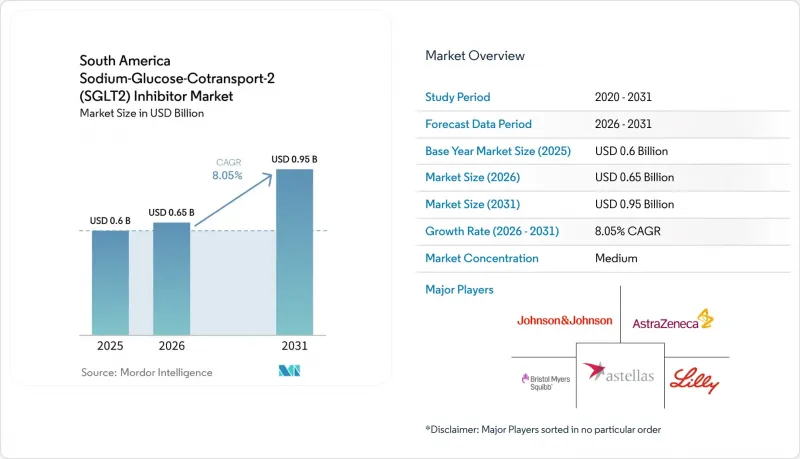
According to Mordor Intelligence, the South America sodium-glucose cotransporter-2 inhibitor market size was valued at USD 0.60 billion in 2025 and is estimated to grow from USD 0.65 billion in 2026 to reach USD 0.95 billion by 2031, at a CAGR of 8.05% during the forecast period (2026-2031).
South America Sodium-Glucose-Cotransport-2 (SGLT2) Inhibitor Market Trends and Insights
Rising Type 2 Diabetes and Cardiorenal Disease Burden
The diabetes burden provided a sustained foundation for the South American SGLT2 inhibitor market. The International Diabetes Federation reported that 35 million adults in South and Central America had diabetes in 2024, resulting in 224,000 diabetes-related deaths and USD 81 billion in related expenditure. The 30.4% undiagnosed rate highlighted a significant untreated population, while the adult diabetes population was projected to reach 52 million by 2050. Brazil had 17 million adults with diabetes, and Argentina had 4.3 million adults with diabetes and a 14% adult prevalence rate, supporting treatment expansion as more patients entered formal care pathways.
Expansion of SGLT2 Use Beyond Glycemic Control
SGLT2 inhibitors increasingly served as cardiorenal therapies beyond their role as glucose-lowering medicines. The 2024 KDIGO guideline recommended these medicines for patients with chronic kidney disease and an estimated glomerular filtration rate (eGFR) of at least 20 mL/min/1.73 m2, including patients without diabetes. The International Society of Nephrology presented this approach in its 2025 SGLT2 inhibitor Cold Map, while Colombia's 2025 expert consensus identified dapagliflozin and empagliflozin as preferred options for chronic kidney disease with albuminuria of at least 200 mg/g. These recommendations expanded prescribing across endocrinology, cardiology, and nephrology, strengthening access through hospital protocols, specialist education, and diagnostic testing.
High Out-of-Pocket Cost and Uneven Reimbursement
High out-of-pocket costs continued to limit utilization outside major public coverage channels. In Argentina, price-reference mechanisms did not consistently keep pace with pharmacy costs during currency instability. Peru's 2025 essential medicines decision applied only to the public-sector framework, leaving private retail patients exposed to full medicine costs. This created varied demand patterns between subsidized public-sector and private-sector patients. Fragmented reimbursement and procurement structures further delayed access in smaller countries.
Other drivers and restraints analyzed in the detailed report include:
- Increasing Public and Private Sector Formulary Adoption
- Evidence-Based Diabetes and Heart Failure Treatment Pathways
- Urban-Rural Inequality in Specialist Diagnosis and Follow-Up
For complete list of drivers and restraints, kindly check the Table Of Contents.
Segment Analysis
Dapagliflozin accounted for 38.56% of revenue in 2025, making it the leading molecule in the South America SGLT2 inhibitor market. Its position reflects early cardiorenal use and AstraZeneca's established access channels in Brazil and Argentina. Brazil's February 2025 Farmacia Popular decision created a subsidized volume base for eligible older adults with type 2 diabetes and cardiovascular disease. Empagliflozin held the second-largest position, supported by Boehringer Ingelheim's established Jardiance franchise. Canagliflozin has a smaller role, as dapagliflozin and empagliflozin are more embedded in public protocols and specialist practice.
Ertugliflozin is forecast to grow at a CAGR of 10.12% from 2026 to 2031. Its later entry provides scope to compete in markets where formularies for older therapies are established. Ipragliflozin and sotagliflozin address smaller cardiorenal patient groups, while sotagliflozin has a differentiated role in heart failure treatment for patients with type 2 diabetes. The market is also seeing more generic dapagliflozin products from EMS, Eurofarma, and Cristalia. ANVISA's bioequivalence requirements support therapeutic quality as generic substitution expands.
Complete Report Scope:
- By Drug
- Dapagliflozin
- Empagliflozin
- Canagliflozin
- Ertugliflozin
- Ipragliflozin
- Sotagliflozin
- Other SGLT2 Inhibitor Drugs
- By Indication
- Type 2 Diabetes Mellitus
- Heart Failure
- Chronic Kidney Disease
- Cardiovascular Risk Reduction
- Other Approved Indications
- By Distribution Channel
- Retail Pharmacies
- Hospital Pharmacies
- Public Health-System Pharmacies
- Online Pharmacies
- By Geography
- Brazil
- Argentina
- Colombia
- Chile
- Peru
- Rest of South America
List of Companies Covered in this Report:
- Astellas Pharma
- AstraZeneca
- Biomm S.A.
- Boehringer Ingelheim
- Bristol-Myers Squibb
- Cristalia Produtos Quimicos Farmaceuticos Ltda.
- Dr. Reddy's Laboratories
- Eli Lilly and Company
- EMS S.A.
- Eurofarma Laboratorios S.A.
- Glenmark Pharmaceuticals
- Hypera S.A.
- Johnson & Johnson
- Laboratorios Roemmers S.A.
- Lexicon Pharmaceuticals, Inc.
- Merck
- Novartis
- Novo Nordisk
- Sanofi
- TheracosBio, LLC
Additional Benefits:
- The market estimate (ME) sheet in Excel format
- 3 months of analyst support
TABLE OF CONTENTS
1 INTRODUCTION
- 1.1 Study Assumptions and Market Definition
- 1.2 Scope of the Study
2 RESEARCH METHODOLOGY
3 EXECUTIVE SUMMARY
4 MARKET LANDSCAPE
- 4.1 Market Overview
- 4.2 Market Drivers
- 4.2.1 Rising Type 2 Diabetes and Cardiorenal Disease Burden
- 4.2.2 Expansion of SGLT2 Use Beyond Glycemic Control
- 4.2.3 Increasing Public- and Private-Sector Formulary Adoption
- 4.2.4 Evidence-Based Diabetes and Heart-Failure Treatment Pathways
- 4.2.5 State-Backed Local Generic and Technology-Transfer Programs
- 4.2.6 Digital Prescription and Pharmacy-Led Chronic-Care Models
- 4.3 Market Restraints
- 4.3.1 High Out-of-Pocket Cost and Uneven Reimbursement
- 4.3.2 Urban-Rural Inequality in Specialist Diagnosis and Follow-Up
- 4.3.3 Country-Level Regulatory and Procurement Fragmentation
- 4.3.4 Inconsistent Supply of Cardiorenal-Disease Diagnostics
- 4.4 Value/Supply-Chain Analysis
- 4.5 Regulatory Landscape
- 4.6 Technological Outlook
- 4.7 Porter's Five Forces Analysis
- 4.7.1 Bargaining Power of Suppliers
- 4.7.2 Bargaining Power of Buyers
- 4.7.3 Threat of New Entrants
- 4.7.4 Threat of Substitutes
- 4.7.5 Competitive Rivalry
5 MARKET SIZE AND GROWTH FORECASTS ( VALUE, USD)
- 5.1 By Drug
- 5.1.1 Dapagliflozin
- 5.1.2 Empagliflozin
- 5.1.3 Canagliflozin
- 5.1.4 Ertugliflozin
- 5.1.5 Ipragliflozin
- 5.1.6 Sotagliflozin
- 5.1.7 Other SGLT2 Inhibitor Drugs
- 5.2 By Indication
- 5.2.1 Type 2 Diabetes Mellitus
- 5.2.2 Heart Failure
- 5.2.3 Chronic Kidney Disease
- 5.2.4 Cardiovascular Risk Reduction
- 5.2.5 Other Approved Indications
- 5.3 By Distribution Channel
- 5.3.1 Retail Pharmacies
- 5.3.2 Hospital Pharmacies
- 5.3.3 Public Health-System Pharmacies
- 5.3.4 Online Pharmacies
- 5.4 By Geography
- 5.4.1 Brazil
- 5.4.2 Argentina
- 5.4.3 Colombia
- 5.4.4 Chile
- 5.4.5 Peru
- 5.4.6 Rest of South America
6 COMPETITIVE LANDSCAPE
- 6.1 Market Concentration
- 6.2 Market Share Analysis
- 6.3 Company Profiles (includes Global Level Overview, Market Level Overview, Core Segments, Financials as available, Strategic Information, Market Rank/Share, Products and Services, Recent Developments)
- 6.3.1 Astellas Pharma Inc.
- 6.3.2 AstraZeneca PLC
- 6.3.3 Biomm S.A.
- 6.3.4 Boehringer Ingelheim International GmbH
- 6.3.5 Bristol-Myers Squibb Company
- 6.3.6 Cristalia Produtos Quimicos Farmaceuticos Ltda.
- 6.3.7 Dr. Reddy's Laboratories Limited
- 6.3.8 Eli Lilly and Company
- 6.3.9 EMS S.A.
- 6.3.10 Eurofarma Laboratorios S.A.
- 6.3.11 Glenmark Pharmaceuticals Limited
- 6.3.12 Hypera S.A.
- 6.3.13 Johnson & Johnson Services, Inc.
- 6.3.14 Laboratorios Roemmers S.A.
- 6.3.15 Lexicon Pharmaceuticals, Inc.
- 6.3.16 Merck & Co., Inc.
- 6.3.17 Novartis AG
- 6.3.18 Novo Nordisk A/S
- 6.3.19 Sanofi S.A.
- 6.3.20 TheracosBio, LLC
7 MARKET OPPORTUNITIES AND FUTURE OUTLOOK
- 7.1 White-Space and Unmet-Need Assessment

