PUBLISHER: Mordor Intelligence | PRODUCT CODE: 2154814

PUBLISHER: Mordor Intelligence | PRODUCT CODE: 2154814
Female Pelvic Implants - Market Share Analysis, Industry Trends & Statistics, Growth Forecasts (2026 - 2031)
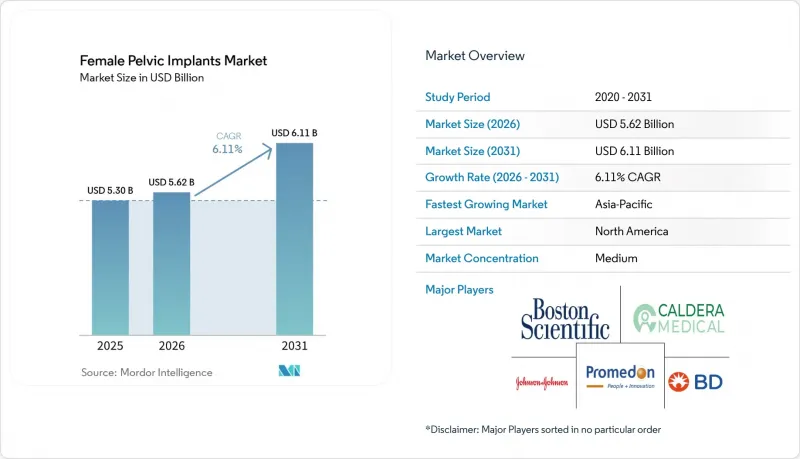
According to Mordor Intelligence, the female pelvic implants market size was valued at USD 5.30 billion in 2025 and is estimated to grow from USD 5.62 billion in 2026 to reach USD 6.11 billion by 2031, at a CAGR of 6.11% during the forecast period (2026-2031).
Global Female Pelvic Implants Market Trends and Insights
Rising Prevalence of Pelvic Organ Prolapse and Stress Urinary Incontinence
Pelvic organ prolapse and stress urinary incontinence create a durable clinical need for the female pelvic implants market. The absolute burden rises as the population grows and ages. A 2025 analysis reported that 11% of U.S. women undergo surgery for pelvic organ prolapse or urinary incontinence by age 79. It also reported that 29.2% of these patients subsequently require revision surgery. The European Association of Urology identified stress urinary incontinence as the most prevalent subtype in its mapping study, affecting 39.1% of respondents. New diagnoses and revision care together support procedure demand.
Increasing Adoption of Minimally Invasive Outpatient Procedures
Outpatient surgery is expanding an important care setting for the female pelvic implants market. The Centers for Medicare & Medicaid Services added 573 codes to the ASC Covered Procedures List in its 2026 final payment rule. This provides a stronger reimbursement basis for eligible outpatient procedures. Sling systems that support shorter procedures and same-day discharge are well positioned in this setting. Hospitals will remain important for complex repair and patients needing close monitoring. Suppliers need training, inventory, and reimbursement support that suit ambulatory surgical centers.
Mesh-Related Complications and Revision Risk
Mesh erosion, chronic pelvic pain, dyspareunia, and infection continue to affect decision making in the female pelvic implants market. A 2025 review reported a 33% relapse rate for native-tissue repair. This leaves clinicians balancing recurrence risk against mesh-related complications. The FDA requires section 522 postmarket surveillance for mini-slings with novel technological characteristics. These requirements favor companies able to maintain long-term clinical follow-up. They also increase the importance of documented safety and biocompatibility.
Other drivers and restraints analyzed in the detailed report include:
- Aging and Post-Menopausal Female Population
- Lightweight and Adjustable Implant Innovation
- Regulatory Restrictions on Transvaginal POP Mesh
For complete list of drivers and restraints, kindly check the Table Of Contents.
Segment Analysis
Vaginal mesh implants held 45.65% of the female pelvic implants market share in 2025. Their position reflects their established use in stress urinary incontinence procedures. Retropubic and transobturator designs remain clinically recognized options for selected patients. Vaginal sling implants are forecast to grow at an 8.54% CAGR through 2031. Single-incision systems fit the movement toward outpatient care.
Vaginal grafts serve pelvic organ prolapse reconstruction and complex repair. The female pelvic implants market size for grafts was not separately provided. Biologic and synthetic grafts meet different clinical needs. The BioSynIRS trial provides 12-month comparative evidence for multicompartment reconstruction. Mesh-free anchoring products such as Promedon's Ancoris address apical repair without transvaginal mesh.
Polypropylene mesh held 51.76% share in 2025. It benefits from established supply, clinical familiarity, and a lower cost profile. It remains common in high-volume sling programs. Research on coated polypropylene meshes suggests that material modification can improve implant-tissue interaction. Existing suppliers also benefit from completed regulatory and clinical documentation.
PVDF mesh is forecast to grow at a 7.87% CAGR through 2031. It is associated with greater resistance to degradation after implantation. Its cost premium can limit adoption beyond specialist centers. Biological grafts have a role in revision and complex multicompartment cases. Absorbable and composite materials require longer-term durability evidence before wider uptake.
Complete Report Scope:
- By Product Type
- Vaginal Mesh Implants
- Vaginal Sling Implants
- Vaginal Graft Implants
- Other Product Types
- By Material
- Polypropylene Mesh
- PVDF Mesh
- Biological Grafts
- Absorbable and Composite Materials
- By Indication
- Pelvic Organ Prolapse (POP)
- Stress Urinary Incontinence (SUI)
- Mixed Urinary Incontinence
- By End-User
- Hospitals
- Ambulatory Surgical Centers (ASCs)
- Specialty Clinics
- Geography
- North America
- United States
- Canada
- Mexico
- Europe
- Germany
- United Kingdom
- France
- Italy
- Spain
- Rest of Europe
- Asia-Pacific
- China
- Japan
- India
- Australia
- South Korea
- Rest of Asia-Pacific
- Middle East and Africa
- GCC
- South Africa
- Rest of Middle East and Africa
- South America
- Brazil
- Argentina
- Rest of South America
- North America
Geography Analysis
North America held 42.43% of the female pelvic implants market share in 2025. Favorable reimbursement, specialist capacity, and robotic surgical infrastructure support the region. The United States is the largest country market. Boston Scientific and AUGS provide 2026 coding and reimbursement resources for pelvic floor care. The 2025 Gynecare TVT portfolio transfer to Caldera Medical also changed competition in the U.S. sling category.
Europe is the second-largest regional contributor. Germany, the United Kingdom, France, Italy, and Spain account for much of its revenue. Germany recorded the highest uterine prolapse disability-adjusted life year rate in the supplied 2025 evidence at 21.13 per 100,000. Regulation 2017/745 and the European vigilance guidance increase requirements for clinical evidence and follow-up.
Asia-Pacific is forecast to grow at a 7.43% CAGR through 2031. Japan and South Korea benefit from aging populations and established clinical standards. China and India offer procedure growth as urban healthcare capacity expands. Social stigma, underdiagnosis, and limited rural specialist access remain barriers. South America has an emerging base supported by referral networks and Promedon's Argentine operations.
- ABISS
- American Medical Systems
- B. Braun
- Betatech Medical
- Beckton Dickinson
- Boston Scientific
- Caldera Medical
- Cook Group
- Cousin Biotech
- DynaMesh / FEG Textiltechnik
- Dipromed
- Johnson & Johnson
- Neomedic International
- pfm medical
- Promedon Group
- P.M.I. GmbH
- THT bio-science
- UroCure
Additional Benefits:
- The market estimate (ME) sheet in Excel format
- 3 months of analyst support
TABLE OF CONTENTS
1 Introduction
- 1.1 Study Assumptions & Market Definition
- 1.2 Scope Of The Study
2 Research Methodology
3 Executive Summary
4 Market Landscape
- 4.1 Market Overview
- 4.2 Market Drivers
- 4.2.1 Rising Prevalence of Pelvic Organ Prolapse and Stress Urinary Incontinence
- 4.2.2 Increasing Adoption of Minimally Invasive Outpatient Procedures
- 4.2.3 Aging and Post-Menopausal Female Population
- 4.2.4 Lightweight and Adjustable Implant Innovation
- 4.2.5 Expanding Urogynecology Access and Reimbursement
- 4.2.6 Postoperative Digital Monitoring and Personalized Patient Selection
- 4.3 Market Restraints
- 4.3.1 Mesh-Related Complications and Revision Risk
- 4.3.2 Regulatory Restrictions on Transvaginal POP Mesh
- 4.3.3 High Procedure Cost and Uneven Reimbursement
- 4.3.4 Limited Specialist Training and Delayed Diagnosis
- 4.4 Supply-Chain Analysis
- 4.5 Regulatory Landscape
- 4.6 Technological Outlook
- 4.7 Porter's Five Forces
- 4.7.1 Threat Of New Entrants
- 4.7.2 Bargaining Power Of Buyers
- 4.7.3 Bargaining Power Of Suppliers
- 4.7.4 Threat Of Substitutes
- 4.7.5 Competitive Rivalry
5 Market Size & Growth Forecasts (Value, USD)
- 5.1 By Product Type
- 5.1.1 Vaginal Mesh Implants
- 5.1.2 Vaginal Sling Implants
- 5.1.3 Vaginal Graft Implants
- 5.1.4 Other Product Types
- 5.2 By Material
- 5.2.1 Polypropylene Mesh
- 5.2.2 PVDF Mesh
- 5.2.3 Biological Grafts
- 5.2.4 Absorbable and Composite Materials
- 5.3 By Indication
- 5.3.1 Pelvic Organ Prolapse (POP)
- 5.3.2 Stress Urinary Incontinence (SUI)
- 5.3.3 Mixed Urinary Incontinence
- 5.4 By End-User
- 5.4.1 Hospitals
- 5.4.2 Ambulatory Surgical Centers (ASCs)
- 5.4.3 Specialty Clinics
- 5.5 Geography
- 5.5.1 North America
- 5.5.1.1 United States
- 5.5.1.2 Canada
- 5.5.1.3 Mexico
- 5.5.2 Europe
- 5.5.2.1 Germany
- 5.5.2.2 United Kingdom
- 5.5.2.3 France
- 5.5.2.4 Italy
- 5.5.2.5 Spain
- 5.5.2.6 Rest of Europe
- 5.5.3 Asia-Pacific
- 5.5.3.1 China
- 5.5.3.2 Japan
- 5.5.3.3 India
- 5.5.3.4 Australia
- 5.5.3.5 South Korea
- 5.5.3.6 Rest of Asia-Pacific
- 5.5.4 Middle East and Africa
- 5.5.4.1 GCC
- 5.5.4.2 South Africa
- 5.5.4.3 Rest of Middle East and Africa
- 5.5.5 South America
- 5.5.5.1 Brazil
- 5.5.5.2 Argentina
- 5.5.5.3 Rest of South America
- 5.5.1 North America
6 Competitive Landscape
- 6.1 Market Concentration
- 6.2 Market Share Analysis
- 6.3 Company Profiles {(Includes Global Level Overview, Market Level Overview, Core Segments, Financials As Available, Strategic Information, Market Rank/Share For Key Companies, Products & Services, And Recent Developments)}
- 6.3.1 ABISS
- 6.3.2 American Medical Systems
- 6.3.3 B. Braun Melsungen AG
- 6.3.4 Betatech Medical
- 6.3.5 Becton, Dickinson and Company
- 6.3.6 Boston Scientific Corporation
- 6.3.7 Caldera Medical
- 6.3.8 Cook Medical
- 6.3.9 Cousin Biotech
- 6.3.10 DynaMesh / FEG Textiltechnik
- 6.3.11 Dipromed Srl
- 6.3.12 Johnson & Johnson Services, Inc.
- 6.3.13 Neomedic International
- 6.3.14 pfm medical ag
- 6.3.15 Promedon Group
- 6.3.16 P.M.I. GmbH
- 6.3.17 THT bio-science
- 6.3.18 UroCure
7 Market Opportunities & Future Outlook
- 7.1 White-Space & Unmet-Need Assessment

