PUBLISHER: Mordor Intelligence | PRODUCT CODE: 2154818

PUBLISHER: Mordor Intelligence | PRODUCT CODE: 2154818
South America Canned Food Packaging - Market Share Analysis, Industry Trends & Statistics, Growth Forecasts (2026 - 2031)
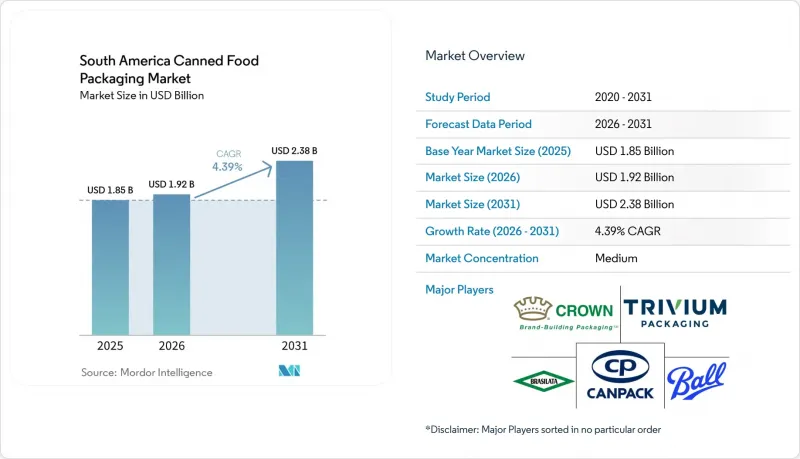
According to Mordor Intelligence, the South America canned food packaging market size was valued at USD 1.85 billion in 2025 and estimated to grow from USD 1.92 billion in 2026 to reach USD 2.38 billion by 2031, at a CAGR of 4.39% during the forecast period (2026-2031).
South America Canned Food Packaging Market Trends and Insights
Demand for Convenience and Ready-to-Eat Foods
Urban households and dual-income families continued to favor shelf-stable foods that require limited preparation during 2025, particularly where commuting patterns and time constraints reduce the appeal of cooking from basic ingredients every day. This supports ready meals because cans offer accessible protein-and-carbohydrate combinations at a lower cost than chilled convenience products, while also allowing households to store food for later consumption. The South America Canned Food Packaging Market also benefits from foodservice demand for sauce bases, proteins, and prepared starches used by quick-service restaurants and institutional caterers, which need consistent quality across multiple locations. These customers can hold inventory longer and manage kitchen operations with less dependence on cold storage, helping them plan procurement around availability rather than daily delivery schedules. Foodservice orders can also be steadier than household pantry purchases during periods of regional economic pressure, because institutions and restaurant operators still require basic ingredients to maintain menus. The growing role of this channel gives canmakers a more predictable demand base for ready-meal formats and supports production planning across food categories.
Shelf-Life Extension and Food-Waste Reduction
Food loss remains significant in distribution networks with limited refrigeration capacity, particularly outside major cities and along long routes connecting agricultural areas, processors, wholesalers, and retail outlets. Cans create an oxygen-, moisture-, and microbial-barrier that allows processors to move products at ambient temperatures without relying on refrigerated vehicles or retail cabinets. This function helps food companies serve Brazil's interior and Colombia's secondary cities without adding temperature-controlled logistics, which can be difficult for regional processors to fund. The South America Canned Food Packaging Market, therefore, supports regional processors that need to sell harvest output beyond local fresh-food channels and manage supply across seasons. A shelf life of 2 to 5 years can reduce the capital needed for refrigerated distribution and help smaller processors meet supermarket requirements for regular, reliable supply. For brands entering nonmetropolitan areas, this distribution role remains difficult for flexible alternatives to match at a similar cost and with comparable protection.
Volatile Steel and Aluminum Costs
Steel and aluminum represent a large share of the cost of a finished food can, making commodity movements an immediate operating risk for both large canmakers and smaller regional producers. Local canmakers have limited ability to offset these movements because relevant benchmarks are set in international aluminum, scrap, and tinplate markets rather than by local food-can demand alone. Raw material purchases are commonly priced in USD, while cash sales are typically negotiated in Brazilian real, Argentine peso, or Colombian peso, creating a direct currency mismatch in procurement and revenue. Currency depreciation can therefore widen the gap between input costs and local selling prices, particularly when food brands resist price changes after their budgets have been agreed. The South America Canned Food Packaging Market is especially exposed when annual customer contracts limit rapid price adjustments, and canmakers must continue supplying essential food-packaging volumes. Smaller producers may defer equipment upgrades when they cannot recover sudden cost increases from food brands, slowing investment in lightweighting, coating changes, and other line improvements.
Other drivers and restraints analyzed in the detailed report include:
- Expansion of Modern Retail and E-Commerce
- Recyclability and Plastic-Reduction Preference
- Competition from Flexible and Plastic Packaging
For complete list of drivers and restraints, kindly check the Table Of Contents.
Segment Analysis
Fruits and vegetables accounted for 32.34% of the South America Canned Food Packaging Market share in 2025, making them the largest product category and a core volume base for food can production. The category aligns with regional agricultural output and with established household demand for tomatoes, corn, peas, hearts of palm, and tropical fruits that can be purchased outside harvest periods. Canning gives processors a way to extend seasonal harvests into year-round supply at stable price points, while reducing their dependence on immediate fresh-market sales. This is useful where fresh-produce supply chains remain uneven across cities and inland locations, and where seasonal abundance can otherwise create short-term price pressure. Meat products and seafood also drive substantial demand, with canned tuna providing an accessible protein option in coastal cities and inland markets where shoppers value shelf stability.
Ready meals are forecast to grow at a 5.12% CAGR through 2031, the fastest rate among product categories in the South America Canned Food Packaging Market. The segment is supported by working households in Sao Paulo, Bogota, and Buenos Aires who have less time to cook from scratch and may prefer products that are easy to store. Quick-service restaurants and institutional caterers also use canned components to simplify preparation, manage portion control, and reduce the variability that can arise from handling fresh ingredients. During economic weakness, some consumers may substitute canned meals for restaurant spending or higher-cost fresh proteins, which provides some resilience for value-focused product lines. Beans, soups, pet food, and other canned products provide steady volume across economic cycles, while demand for them helps canmakers maintain line utilization when premium categories soften.
Complete Report Scope:
- By Product Type
- Ready Meals
- Meat Products
- Seafood
- Fruits and Vegetables
- Other Product Types
- By Material
- Steel and Tinplate
- Aluminum
- Other Materials
- By Can Type
- Three-Piece Cans
- Two-Piece Cans
- By Geography
- Brazil
- Argentina
- Colombia
- Rest of South America
List of Companies Covered in this Report:
- Crown Holdings, Inc.
- Trivium Packaging B.V.
- CANPACK S.A.
- Sonoco Products Company
- Silgan Holdings Inc.
- Ball Corporation
- Brasilata S.A. Embalagens Metalicas
- Envases Universales de Mexico, S.A.P.I. de C.V.
- Grupo Zapata, S.A. de C.V.
- Massilly Holding S.A.S.
- Tecnocap S.p.A.
- Toyo Seikan Group Holdings, Ltd.
- Toyo Seikan Kaisha, Ltd.
- CPMC Holdings Limited
- Kian Joo Can Factory Berhad
- Nampak Limited
- Colep Packaging S.A.
- JFE Container Co., Ltd.
- Daiwa Can Company
- Hokkan Holdings Limited
- Mauser Packaging Solutions
- Ideal Can Canada Inc.
Additional Benefits:
- The market estimate (ME) sheet in Excel format
- 3 months of analyst support
TABLE OF CONTENTS
1 INTRODUCTION
- 1.1 Study Assumptions and Market Definition
- 1.2 Scope of the Study
2 RESEARCH METHODOLOGY
3 EXECUTIVE SUMMARY
4 MARKET LANDSCAPE
- 4.1 Market Overview
- 4.2 Market Drivers
- 4.2.1 Demand for Convenience and Ready-to-Eat Foods
- 4.2.2 Shelf-Life Extension and Food-Waste Reduction
- 4.2.3 Expansion of Modern Retail and E-Commerce
- 4.2.4 Recyclability and Plastic-Reduction Preference
- 4.2.5 Mercosur Local-Sourcing and Import-Substitution of Cans
- 4.2.6 Small-Batch Retort Meals for Foodservice and Emergency Channels
- 4.3 Market Restraints
- 4.3.1 Volatile Steel and Aluminum Costs
- 4.3.2 Competition from Flexible and Plastic Packaging
- 4.3.3 Consumer Perceptions of Processed Foods
- 4.3.4 BPA-Free Coating Conversion and Qualification Costs
- 4.4 Impact of Macroeconomic Factors on the Market
- 4.5 Industry Value Chain Analysis
- 4.6 Regulatory Landscape
- 4.7 Technological Outlook
- 4.8 Porter's Five Forces Analysis
- 4.8.1 Bargaining Power of Suppliers
- 4.8.2 Bargaining Power of Buyers
- 4.8.3 Threat of New Entrants
- 4.8.4 Threat of Substitutes
- 4.8.5 Intensity of Competitive Rivalry
5 MARKET SIZE AND GROWTH FORECASTS (VALUE)
- 5.1 By Product Type
- 5.1.1 Ready Meals
- 5.1.2 Meat Products
- 5.1.3 Seafood
- 5.1.4 Fruits and Vegetables
- 5.1.5 Other Product Types
- 5.2 By Material
- 5.2.1 Steel and Tinplate
- 5.2.2 Aluminum
- 5.2.3 Other Materials
- 5.3 By Can Type
- 5.3.1 Three-Piece Cans
- 5.3.2 Two-Piece Cans
- 5.4 By Geography
- 5.4.1 Brazil
- 5.4.2 Argentina
- 5.4.3 Colombia
- 5.4.4 Rest of South America
6 COMPETITIVE LANDSCAPE
- 6.1 Market Concentration
- 6.2 Strategic Moves
- 6.3 Market Share Analysis
- 6.4 Company Profiles (includes Global Level Overview, Market Level Overview, Core Segments, Financials as available, Strategic Information, Market Rank/Share, Products and Services, Recent Developments)
- 6.4.1 Crown Holdings, Inc.
- 6.4.2 Trivium Packaging B.V.
- 6.4.3 CANPACK S.A.
- 6.4.4 Sonoco Products Company
- 6.4.5 Silgan Holdings Inc.
- 6.4.6 Ball Corporation
- 6.4.7 Brasilata S.A. Embalagens Metalicas
- 6.4.8 Envases Universales de Mexico, S.A.P.I. de C.V.
- 6.4.9 Grupo Zapata, S.A. de C.V.
- 6.4.10 Massilly Holding S.A.S.
- 6.4.11 Tecnocap S.p.A.
- 6.4.12 Toyo Seikan Group Holdings, Ltd.
- 6.4.13 Toyo Seikan Kaisha, Ltd.
- 6.4.14 CPMC Holdings Limited
- 6.4.15 Kian Joo Can Factory Berhad
- 6.4.16 Nampak Limited
- 6.4.17 Colep Packaging S.A.
- 6.4.18 JFE Container Co., Ltd.
- 6.4.19 Daiwa Can Company
- 6.4.20 Hokkan Holdings Limited
- 6.4.21 Mauser Packaging Solutions
- 6.4.22 Ideal Can Canada Inc.
7 MARKET OPPORTUNITIES AND FUTURE OUTLOOK
- 7.1 White-Space and Unmet-Need Assessment

