PUBLISHER: Mordor Intelligence | PRODUCT CODE: 2154819

PUBLISHER: Mordor Intelligence | PRODUCT CODE: 2154819
South America Baby Food Packaging - Market Share Analysis, Industry Trends & Statistics, Growth Forecasts (2026 - 2031)
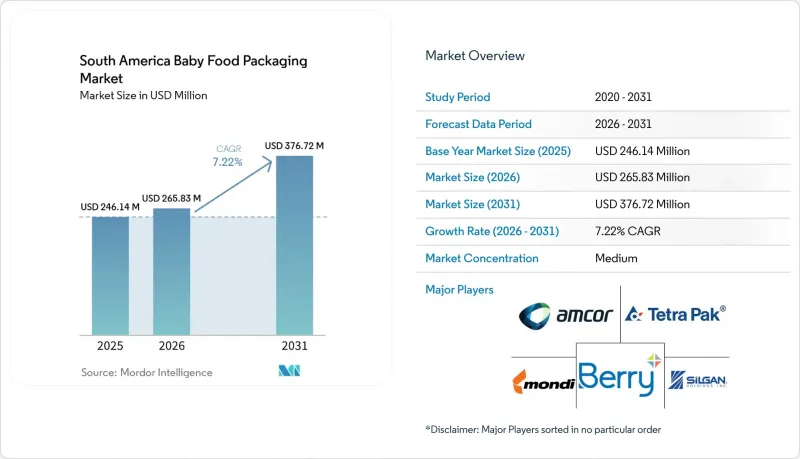
According to Mordor Intelligence, the South America baby food packaging market size was valued at USD 246.14 million in 2025 and is estimated to grow from USD 263.92 million in 2026 to reach USD 376.72 million by 2031, at a CAGR of 7.22% during the forecast period (2026-2031).
South America Baby Food Packaging Market Trends and Insights
Spouted Pouch Convenience Reshaping Infant Nutrition Distribution
Spouted pouches are gaining acceptance because they reduce package weight compared with equivalent glass or metal formats. Lower package weight can reduce freight requirements across long inland routes and support broader product availability. These formats also provide resealability and single-serve convenience for caregivers who buy ready-to-feed products. Aseptic spouted pouches combine portion control with product protection for liquid and pureed infant nutrition products. The South America Baby Food Packaging Market can use these formats to support ambient distribution where refrigerated handling is limited. Format decisions are therefore closely linked to channel reach, product protection, and distribution costs.
Urban Dual-Income Households Supporting Premium Packaging Demand
Urban dual-income households place more value on ready-to-feed and single-serve infant nutrition products when time available for food preparation is limited. The International Labor Organization documented continuing changes in employment conditions affecting women through 2025. Ready-to-feed liquid products require packaging with reliable barriers, visible tamper evidence, and convenient serving portions. These requirements can increase packaging value per unit compared with powder products sold in larger containers. Demand in the South America Baby Food Packaging Market is most relevant in large urban areas, including Sao Paulo, Belo Horizonte, Recife, Buenos Aires, Cordoba, and Rosario. Suppliers that offer aseptic cartons, bottles, and pouches can address this demand without changing the product's handling requirements for consumers.
Raw-Material Price and Currency Volatility Limiting Margin Recovery
Polypropylene and polyethylene prices are commonly linked to USD-denominated commodity markets. Currency weakness can therefore raise the local cost of imported resins before packaged food prices adjust. Flexible pouch producers may be more exposed because multilayer structures require several resin grades and barrier layers. This exposure can reduce converters' ability to recover higher costs in customer contracts. Braskem identifies renewable polyethylene as part of its portfolio, giving suppliers access to a material linked to Brazil's sugarcane feedstock base. Available domestic bio-based material capacity does not eliminate broader exposure to import parity and resin price movements. The South America Baby Food Packaging Market remains sensitive to these cost movements because infant nutrition packages require consistent material performance and cannot readily compromise on barrier quality.
Other drivers and restraints analyzed in the detailed report include:
- Shelf-Stable and Aseptic Formats Addressing Cold-Chain Constraints
- Safe, Traceable, and Sustainable Packaging Raising Supplier Requirements
- Food-Contact Compliance and Chemical-Testing Costs Raising Qualification Thresholds
For complete list of drivers and restraints, kindly check the Table Of Contents.
Segment Analysis
Plastic held 42.71% of the South America Baby Food Packaging Market share in 2025, reflecting its established use in bottles, pouches, closures, and jars. Its range of processing options allows converters to use the material across both rigid and flexible package formats. Brazil's polymer conversion base supports the local supply of many plastic packaging applications. Plastic also remains important where lightweight and barrier performance are needed for ambient distribution. Bioplastics are forecast to grow at an 8.14% CAGR through 2031, making them the fastest-growing material category. This expansion is linked to brand-owner sustainability programs and growing commercial interest in sugarcane-derived bio-polyethylene.
Danone Brazil's 2025 packaging project with Braskem demonstrates a commercial application of lower-material and bio-based design in the South America Baby Food Packaging Market. Paperboard is gaining use in secondary packaging for dried baby food and powder formula. ProAmpac expanded its RP-2000 High Barrier Series in 2026 to include a recyclable, fiber-based platform for sensitive dry food applications. Metal remains relevant for premium powder formula tins sold through organized retail. Glass remains a smaller material option because its weight and fragility complicate long-distance distribution. The baby food packaging industry must balance sustainability expectations against the barrier, hygiene, and transport needs of infant nutrition products.
Complete Report Scope:
- By Material
- Plastic
- Paperboard
- Metal
- Glass
- Bioplastics
- By Package Type
- Bottles
- Cartons
- Jars
- Pouches
- Bag-in-Box
- By Product
- Liquid Milk Formula
- Dried Baby Food
- Powder Milk Formula
- Prepared Baby Food
- Baby Snacks
- By Geography
- Brazil
- Argentina
- Rest of South America
List of Companies Covered in this Report:
- Amcor plc
- Tetra Laval Group
- Mondi plc
- Berry Global Group, Inc.
- Silgan Holdings Inc.
- Sonoco Products Company
- Ardagh Group S.A.
- Winpak Ltd.
- DS Smith plc
- SIG Group AG
- Cheer Pack North America LLC
- Gualapack S.p.A.
- Scholle IPN
- UFlex Limited
- ProAmpac LLC
- Huhtamaki Oyj
- AptarGroup, Inc.
- Plastipak Holdings, Inc.
- Crown Holdings, Inc.
- Sealed Air Corporation
Additional Benefits:
- The market estimate (ME) sheet in Excel format
- 3 months of analyst support
TABLE OF CONTENTS
1 INTRODUCTION
- 1.1 Study Assumptions and Market Definition
- 1.2 Scope of the Study
2 RESEARCH METHODOLOGY
3 EXECUTIVE SUMMARY
4 MARKET LANDSCAPE
- 4.1 Market Overview
- 4.2 Market Drivers
- 4.2.1 Convenience-Led Adoption of Spouted Pouches
- 4.2.2 Expansion of Urban Dual-Income Households
- 4.2.3 Growth of Shelf-Stable and Aseptic Formats
- 4.2.4 Increasing Demand for Safe, Traceable, and Sustainable Packaging
- 4.2.5 Rural Cold-Chain Avoidance Through Ambient Distribution
- 4.2.6 Localized Pack-Size Adaptation for Uneven Household Purchasing Power
- 4.3 Market Restraints
- 4.3.1 Raw-Material Price and Currency Volatility
- 4.3.2 Food-Contact Compliance and Chemical-Testing Costs
- 4.3.3 Limited Collection Infrastructure for Multilayer Pouches
- 4.3.4 Spoilage and Inventory Risk Outside Major Urban Centers
- 4.4 Impact of Macroeconomic Factors on the Market
- 4.5 Industry Value Chain Analysis
- 4.6 Regulatory Landscape
- 4.7 Technological Outlook
- 4.8 Porter's Five Forces Analysis
- 4.8.1 Bargaining Power of Suppliers
- 4.8.2 Bargaining Power of Buyers
- 4.8.3 Threat of New Entrants
- 4.8.4 Threat of Substitutes
- 4.8.5 Competitive Rivalry
5 MARKET SIZE AND GROWTH FORECASTS (VALUE)
- 5.1 By Material
- 5.1.1 Plastic
- 5.1.2 Paperboard
- 5.1.3 Metal
- 5.1.4 Glass
- 5.1.5 Bioplastics
- 5.2 By Package Type
- 5.2.1 Bottles
- 5.2.2 Cartons
- 5.2.3 Jars
- 5.2.4 Pouches
- 5.2.5 Bag-in-Box
- 5.3 By Product
- 5.3.1 Liquid Milk Formula
- 5.3.2 Dried Baby Food
- 5.3.3 Powder Milk Formula
- 5.3.4 Prepared Baby Food
- 5.3.5 Baby Snacks
- 5.4 By Geography
- 5.4.1 Brazil
- 5.4.2 Argentina
- 5.4.3 Rest of South America
6 COMPETITIVE LANDSCAPE
- 6.1 Market Concentration
- 6.2 Strategic Moves
- 6.3 Market Share Analysis
- 6.4 Company Profiles (includes Global Level Overview, Market Level Overview, Core Segments, Financials as available, Strategic Information, Market Rank/Share, Products and Services, Recent Developments)
- 6.4.1 Amcor plc
- 6.4.2 Tetra Laval Group
- 6.4.3 Mondi plc
- 6.4.4 Berry Global Group, Inc.
- 6.4.5 Silgan Holdings Inc.
- 6.4.6 Sonoco Products Company
- 6.4.7 Ardagh Group S.A.
- 6.4.8 Winpak Ltd.
- 6.4.9 DS Smith plc
- 6.4.10 SIG Group AG
- 6.4.11 Cheer Pack North America LLC
- 6.4.12 Gualapack S.p.A.
- 6.4.13 Scholle IPN
- 6.4.14 UFlex Limited
- 6.4.15 ProAmpac LLC
- 6.4.16 Huhtamaki Oyj
- 6.4.17 AptarGroup, Inc.
- 6.4.18 Plastipak Holdings, Inc.
- 6.4.19 Crown Holdings, Inc.
- 6.4.20 Sealed Air Corporation
7 MARKET OPPORTUNITIES AND FUTURE OUTLOOK
- 7.1 White-Space and Unmet-Need Assessment

