PUBLISHER: Mordor Intelligence | PRODUCT CODE: 2154850

PUBLISHER: Mordor Intelligence | PRODUCT CODE: 2154850
Swollen Knee Treatment - Market Share Analysis, Industry Trends & Statistics, Growth Forecasts (2026 - 2031)
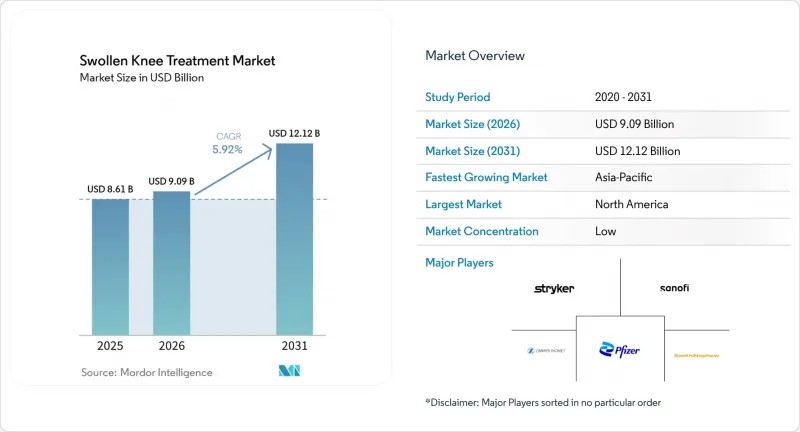
According to Mordor Intelligence, the swollen knee treatment market size is projected to be USD 8.61 billion in 2025, USD 9.09 billion in 2026, and reach USD 12.12 billion by 2031, growing at a CAGR of 5.92% from 2026 to 2031.
Global Swollen Knee Treatment Market Trends and Insights
Aging-Related Growth in Knee Osteoarthritis
Knee osteoarthritis affected 33.6% of U.S. adults aged 65 years and older in 2025, and the rate reached 42.1% among women in this age group. Symptomatic rates rose from 7% at age 45 to 12% at age 60, which extends demand beyond the oldest patient groups. High-SDI countries carried an age-standardized prevalence of 4,656.7 per 100,000 people, but middle-SDI countries have greater room for diagnosis and care. Incidence peaked at ages 50 to 64, bringing more working-age patients into the swollen knee treatment market. This patient group favors treatment in the swollen knee treatment market that can preserve mobility and reduce time away from work. It also supports demand for therapies and recovery protocols that can delay late-stage care.
Rising Obesity-Associated Knee Disease
Obesity and hyperlipidemia were associated with more severe synovitis and poorer functional outcomes after total knee arthroplasty in patients with knee osteoarthritis. Higher obesity classes were also associated with greater health care use and knee osteoarthritis medication consumption. Eli Lilly reported that retatrutide reduced WOMAC pain scores by up to 75.8% and produced average weight loss of 28.7% at 68 weeks in people with obesity and knee osteoarthritis. The results place weight management alongside orthopedic treatment for an overlapping patient population. Better weight control can improve joint mechanics before surgical care is needed. This link broadens the treatment pathway addressed by the swollen knee treatment market.
Safety Risks and Restricted Use of Long-Term Analgesics
Chronic NSAID use carries cardiovascular, gastrointestinal, and renal risks, leading clinical guidance to favor the lowest effective dose for the shortest period. The Hong Kong College of Orthopedic Surgeons recommends topical NSAIDs as first-line management for knee osteoarthritis and oral products as second-line treatment. Germany's DGOU guideline in May 2025 also emphasized limited NSAID dosing and removed glucosamine from its recommendations. Meta-analyses reported limited benefit for non-tramadol opioids and discontinuation rates of 22%, compared with 15% for controls. These restrictions place pressure on branded oral analgesics and opioid-containing products. The result limits pharmaceutical growth in the swollen knee treatment market.
Other drivers and restraints analyzed in the detailed report include:
- Expansion of Minimally Invasive and Outpatient Care
- Longer-Acting and Single-Injection Therapies
- Reimbursement Uncertainty for Viscosupplementation and Biologics
For complete list of drivers and restraints, kindly check the Table Of Contents.
Segment Analysis
Pharmaceuticals held 44.28% of the swollen knee treatment market share in 2025, supported by NSAIDs, corticosteroids, and hyaluronic acid viscosupplements. These products remained common first- and second-line options for knee swelling. Within pharmaceuticals, single-injection regimens are shifting value toward cross-linked and ultra-high-molecular-weight hyaluronic acid products. Evidence that these products may delay surgery supports their use before surgical intervention. The disease-modifying osteoarthritis drug category had seen repeated clinical failures. Biosplice submitted its lorecivivint NDA to the FDA in January 2026. The submission could mark the first major advance in this category in nearly 28 years. It could also change how pharmaceutical treatment is positioned in the swollen knee treatment industry.
Accessories are projected to grow at a 7.80% CAGR through 2031, making them the fastest-growing treatment category. Smart and sensor-enabled supports lead to this expansion. Wearable-based telerehabilitation also produced greater neuromuscular adaptation than conventional physiotherapy. Unloader and functional braces retain substantial use in osteoarthritis. Post-operative and rehabilitative braces are also expanding as total knee arthroplasty moves to ambulatory settings. Surgical treatment retains volume through replacement and arthroscopy. Robotic approaches can increase capital-equipment spending and support implant standardization. This mix gives accessories a larger role in the swollen knee treatment market.
Osteoarthritis accounted for 44.03% of indication revenues in 2025. The condition had a global patient population of 374.7 million, sustaining its position throughout the forecast period. The United States direct annual costs per patient ranged from USD 3,719 to USD 4,518. The indication uses pharmaceuticals, therapy, accessories, and surgical treatment. Broader coverage of joint-preserving procedures in Japan and Germany can extend intervention before total replacement. Rheumatoid arthritis was the second-largest indication. It is supported by corticosteroid and biologic prescribing. It also benefits from established reimbursement pathways in the United States and Europe. These patterns keep osteoarthritis at the center of the swollen knee treatment market.
Sports and traumatic injuries are forecast to grow at a 7.82% CAGR through 2031. Organized sports participation and greater awareness of acute knee effusion management support this rate. Aspiration, arthrocentesis, physical therapy, and meniscal or ligament reconstruction benefit from this demand. Smart support can also monitor recovery for active patients. The FDA approved MACI Arthro in August 2024 for arthroscopic delivery in adults with cartilage defects up to 4 cm2. The expanded label addressed 20,000 additional patients annually and increased Vericel's target surgeon base from 5,000 to 7,000. Gout, crystal arthropathies, bursitis, tendinopathy, infection, and septic arthritis remained smaller but distinct sources of demand. They mainly require aspiration, corticosteroid injections, or antimicrobial pharmaceutical care. This diversity broadens activity in the swollen knee treatment industry.
Complete Report Scope:
- By Treatment
- Pharmaceuticals
- Non-Steroidal Anti-Inflammatory Drugs
- Non-NSAID Analgesics
- Corticosteroids
- Hyaluronic Acid and Viscosupplementation
- Disease-Modifying Osteoarthritis Drugs
- Opioid Analgesics
- Other Pharmaceuticals
- Therapy
- Physical Therapy and Rehabilitation
- Intra-Articular Injection Therapy
- Bone Marrow Aspirate Concentrate Therapy
- Adipose-Derived and Cell-Based Therapies
- Aspiration and Arthrocentesis
- Nerve Blocks and Patient-Controlled Analgesia Pumps
- Accessories
- Assistive Devices and Bracing
- Compression Sleeves and Wraps
- Unloader and Functional Braces
- Post-Operative and Rehabilitative Braces
- Smart and Sensor-Enabled Supports
- Other Accessories
- Surgical Treatment
- Arthroscopy
- Meniscal and Ligament Reconstruction
- Cartilage Repair and Resurfacing
- Osteotomy
- Partial Knee Replacement
- Total Knee Replacement
- Other Surgical Treatments
- Pharmaceuticals
- By Indication
- Osteoarthritis
- Rheumatoid Arthritis
- Sports and Traumatic Injuries
- Gout and Crystal Arthropathies
- Bursitis and Tendinopathy
- Infection and Septic Arthritis
- Other Indications
- By Route of Administration
- Oral
- Intravenous and Intramuscular
- Procedural and Surgical
- Other Route of Administrations
- By End User
- Hospitals
- Orthopedic Clinics
- Rheumatology Clinics
- Ambulatory Surgical Centers
- Other End Users
- By Geography
- North America
- United States
- Canada
- Mexico
- Europe
- Germany
- United Kingdom
- France
- Italy
- Spain
- Rest of Europe
- Asia-Pacific
- China
- Japan
- India
- Australia
- South Korea
- Rest of Asia-Pacific
- Middle East and Africa
- GCC
- South Africa
- Rest of Middle East and Africa
- South America
- Brazil
- Argentina
- Rest of South America
- North America
Geography Analysis
North America held 41.85% of the swollen knee treatment market share in 2025. High procedural intensity, established reimbursement for surgery and injections, and an aging population support the region. The United States's knee osteoarthritis prevalence reached 33.6% among adults aged 65 years and older. The shift toward ambulatory surgical centers lowers hospital elective volume while raising contributions from ambulatory centers and clinics.
Europe was the second-largest regional market in 2025. Germany, the United Kingdom, and France carried the highest absolute osteoarthritis patient volumes in the region. DGOU issued an evidence-based gonarthrosis guideline in May 2025 that removed glucosamine and electrotherapy from recommendations. The policy directs care toward exercise-based treatment, followed by pharmacological or surgical options where needed.
Asia-Pacific is projected to grow at a 7.88% CAGR through 2031, the fastest rate among regions. Japan and South Korea have high age-standardized knee osteoarthritis prevalence, supported by policy and product changes. Japan added femoral distal osteotomy and arthroscopic meniscal stabilization to national insurance coverage in 2024. South Korea saw GC Wellbeing's 2024 approval for Healroad Once Inj., adding competition in single-injection hyaluronic acid treatment. China drives absolute volume growth in the swollen knee treatment market through health care infrastructure development. India and Australia, along with the smaller Middle East and Africa and South American markets, extend the swollen knee treatment market opportunity through investment, manufacturing incentives, reimbursement, and population aging.
- Anika Therapeutics
- Arthrex
- Bauerfeind
- Bayer
- Bioventus Inc.
- Breg
- Eli Lilly and Company
- Enovis Corporation
- Exactech
- Ferring Pharmaceuticals
- Fidia Farmaceutici
- Genascence Corporation
- Johnson & Johnson MedTech
- Kolon TissueGene, Inc.
- LG Chem
- Medtronic
- Merck
- Novartis
- OrthogenRx, Inc.
- Ossur hf.
- Pacira BioSciences
- Pfizer
- Sanofi
- Seikagaku
- Smiths Group
- Stryker
- Teva Pharmaceutical Industries
- Vericel
- Zimmer Biomet
Additional Benefits:
- The market estimate (ME) sheet in Excel format
- 3 months of analyst support
TABLE OF CONTENTS
1 Introduction
- 1.1 Study Assumptions & Market Definition
- 1.2 Scope of the Study
2 Research Methodology
3 Executive Summary
4 Market Landscape
- 4.1 Market Overview
- 4.2 Market Drivers
- 4.2.1 Aging-Related Growth in Knee Osteoarthritis
- 4.2.2 Rising Obesity-Associated Knee Disease
- 4.2.3 Expansion of Minimally Invasive and Outpatient Care
- 4.2.4 Longer-Acting and Single-Injection Therapies
- 4.2.5 Sensor-Enabled Bracing and Digitized Rehabilitation
- 4.2.6 Earlier Intervention Driven by Obesity and Musculoskeletal Care Integration
- 4.3 Market Restraints
- 4.3.1 Safety Risks and Restricted Use of Long-Term Analgesics
- 4.3.2 Reimbursement Uncertainty for Viscosupplementation and Biologics
- 4.3.3 Difficulty Demonstrating Disease Modification in Heterogeneous Knee Disease
- 4.3.4 Fragmented Clinical Protocols for PRP, Stem-Cell and Regenerative Therapies
- 4.4 Supply-Chain Analysis
- 4.5 Regulatory Landscape
- 4.6 Technological Outlook
- 4.7 Porter's Five Forces Analysis
- 4.7.1 Threat of New Entrants
- 4.7.2 Bargaining Power of Suppliers
- 4.7.3 Bargaining Power of Buyers
- 4.7.4 Threat of Substitutes
- 4.7.5 Competitive Rivalry
5 Market Size & Growth Forecasts (Value in USD)
- 5.1 By Treatment
- 5.1.1 Pharmaceuticals
- 5.1.1.1 Non-Steroidal Anti-Inflammatory Drugs
- 5.1.1.2 Non-NSAID Analgesics
- 5.1.1.3 Corticosteroids
- 5.1.1.4 Hyaluronic Acid and Viscosupplementation
- 5.1.1.5 Disease-Modifying Osteoarthritis Drugs
- 5.1.1.6 Opioid Analgesics
- 5.1.1.7 Other Pharmaceuticals
- 5.1.2 Therapy
- 5.1.2.1 Physical Therapy and Rehabilitation
- 5.1.2.2 Intra-Articular Injection Therapy
- 5.1.2.3 Bone Marrow Aspirate Concentrate Therapy
- 5.1.2.4 Adipose-Derived and Cell-Based Therapies
- 5.1.2.5 Aspiration and Arthrocentesis
- 5.1.2.6 Nerve Blocks and Patient-Controlled Analgesia Pumps
- 5.1.3 Accessories
- 5.1.3.1 Assistive Devices and Bracing
- 5.1.3.2 Compression Sleeves and Wraps
- 5.1.3.3 Unloader and Functional Braces
- 5.1.3.4 Post-Operative and Rehabilitative Braces
- 5.1.3.5 Smart and Sensor-Enabled Supports
- 5.1.3.6 Other Accessories
- 5.1.4 Surgical Treatment
- 5.1.4.1 Arthroscopy
- 5.1.4.2 Meniscal and Ligament Reconstruction
- 5.1.4.3 Cartilage Repair and Resurfacing
- 5.1.4.4 Osteotomy
- 5.1.4.5 Partial Knee Replacement
- 5.1.4.6 Total Knee Replacement
- 5.1.4.7 Other Surgical Treatments
- 5.1.1 Pharmaceuticals
- 5.2 By Indication
- 5.2.1 Osteoarthritis
- 5.2.2 Rheumatoid Arthritis
- 5.2.3 Sports and Traumatic Injuries
- 5.2.4 Gout and Crystal Arthropathies
- 5.2.5 Bursitis and Tendinopathy
- 5.2.6 Infection and Septic Arthritis
- 5.2.7 Other Indications
- 5.3 By Route of Administration
- 5.3.1 Oral
- 5.3.2 Intravenous and Intramuscular
- 5.3.3 Procedural and Surgical
- 5.3.4 Other Route of Administrations
- 5.4 By End User
- 5.4.1 Hospitals
- 5.4.2 Orthopedic Clinics
- 5.4.3 Rheumatology Clinics
- 5.4.4 Ambulatory Surgical Centers
- 5.4.5 Other End Users
- 5.5 By Geography
- 5.5.1 North America
- 5.5.1.1 United States
- 5.5.1.2 Canada
- 5.5.1.3 Mexico
- 5.5.2 Europe
- 5.5.2.1 Germany
- 5.5.2.2 United Kingdom
- 5.5.2.3 France
- 5.5.2.4 Italy
- 5.5.2.5 Spain
- 5.5.2.6 Rest of Europe
- 5.5.3 Asia-Pacific
- 5.5.3.1 China
- 5.5.3.2 Japan
- 5.5.3.3 India
- 5.5.3.4 Australia
- 5.5.3.5 South Korea
- 5.5.3.6 Rest of Asia-Pacific
- 5.5.4 Middle East and Africa
- 5.5.4.1 GCC
- 5.5.4.2 South Africa
- 5.5.4.3 Rest of Middle East and Africa
- 5.5.5 South America
- 5.5.5.1 Brazil
- 5.5.5.2 Argentina
- 5.5.5.3 Rest of South America
- 5.5.1 North America
6 Competitive Landscape
- 6.1 Market Concentration
- 6.2 Market Share Analysis
- 6.3 Company Profiles {(includes Global level Overview, Market level overview, Core Segments, Financials as available, Strategic Information, Market Rank/Share for key companies, Products & Services, and Recent Developments)}
- 6.3.1 Anika Therapeutics, Inc.
- 6.3.2 Arthrex, Inc.
- 6.3.3 Bauerfeind AG
- 6.3.4 Bayer AG
- 6.3.5 Bioventus Inc.
- 6.3.6 Breg, Inc.
- 6.3.7 Eli Lilly and Company
- 6.3.8 Enovis Corporation
- 6.3.9 Exactech, Inc.
- 6.3.10 Ferring Pharmaceuticals
- 6.3.11 Fidia Farmaceutici S.p.A.
- 6.3.12 Genascence Corporation
- 6.3.13 Johnson & Johnson MedTech
- 6.3.14 Kolon TissueGene, Inc.
- 6.3.15 LG Chem Ltd.
- 6.3.16 Medtronic plc
- 6.3.17 Merck & Co., Inc.
- 6.3.18 Novartis AG
- 6.3.19 OrthogenRx, Inc.
- 6.3.20 Ossur hf.
- 6.3.21 Pacira BioSciences, Inc.
- 6.3.22 Pfizer Inc.
- 6.3.23 Sanofi S.A.
- 6.3.24 SEIKAGAKU CORPORATION
- 6.3.25 Smith & Nephew plc
- 6.3.26 Stryker Corporation
- 6.3.27 Teva Pharmaceutical Industries Ltd.
- 6.3.28 Vericel Corporation
- 6.3.29 Zimmer Biomet Holdings, Inc.
7 Market Opportunities & Future Outlook
- 7.1 White-space & unmet-need assessment

