PUBLISHER: Mordor Intelligence | PRODUCT CODE: 2154860

PUBLISHER: Mordor Intelligence | PRODUCT CODE: 2154860
Offshore Maintenance, Repair, and Overhaul (MRO) - Market Share Analysis, Industry Trends & Statistics, Growth Forecasts (2026 - 2031)
According to Mordor Intelligence, the offshore maintenance, repair, and Overhaul Market size is projected to expand from USD 118.93 billion in 2025 and USD 125.41 billion in 2026 to USD 167.69 billion by 2031, at a CAGR of 5.98% between 2026 and 2031.
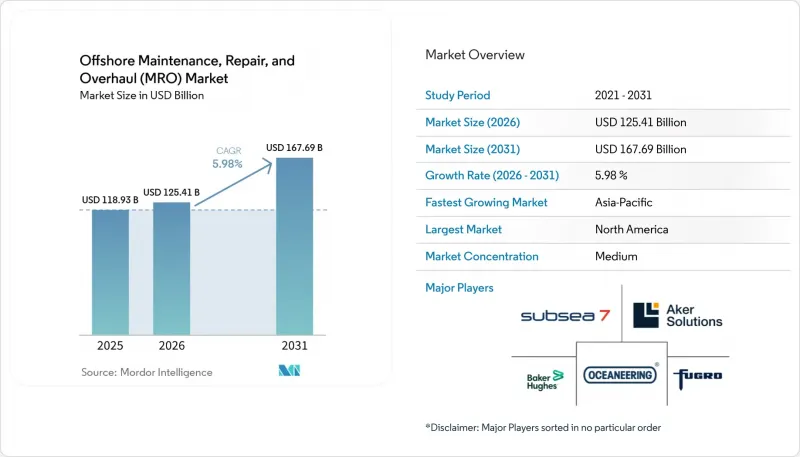
Global Offshore Maintenance, Repair, and Overhaul (MRO) Market Trends and Insights
Aging Offshore Assets and Compliance Requirements
Many offshore structures now operate beyond their original design lives, so maintenance programs must address condition rather than age alone. Lloyd's Register reported in 2026 that some offshore structures designed for 25 years had been safely extended to 40 years or longer through risk-based inspection and targeted upgrades. This work includes structural inspection, coating renewal, corrosion control, equipment overhaul, and subsea surveys. Operators also face scheduled certification and environmental obligations that cannot be postponed without affecting an asset's operating status. These requirements create a recurring base of demand for the offshore MRO market, even when drilling activity changes. Service providers benefit when they can combine inspection findings, repair planning, and vessel access in a single contract.
Offshore Wind Expansion and Local Service Capacity
Offshore wind adds a growing maintenance requirement that differs from traditional oil and gas work. The Global Wind Energy Council stated that the growing wind buildout requires early workforce planning across construction and operations. Larger turbines require specialized access systems, service operation vessels, and technicians with turbine-specific training. Global Tech I appointed Wind Multiplikator under a 10-year service agreement for 80 AREVA M5000 turbines, showing that independent providers can compete after warranty periods. This creates room for providers that can service several turbine brands and manage vessels efficiently. Local-content requirements and outsourced operations and maintenance also favor regional companies that can supply crews and logistics near new projects. These conditions widen the range of work available in the offshore MRO market without changing the need for high technical standards.
Vessel Access, Weather, and Spare-Part Constraints
Offshore work must fit within weather windows, which makes vessel availability a direct operating constraint. A delayed campaign can affect later bookings in the same region and raise mobilization costs for several operators. Mandatory drydocking and special-survey cycles add work that operators cannot simply defer. This places greater value on early booking of construction, inspection, and service vessels. Safety-critical parts also require qualification, and replacement components can have long lead times in remote offshore locations. These factors can delay activity in the offshore MRO market, even where operators have approved maintenance budgets.
Other drivers and restraints analyzed in the detailed report include:
- Robotics, Digital Tools, and Condition-Based Work
- Floating Assets and Complex Maintenance Scopes
- Workforce and Connected-System Risks
For complete list of drivers and restraints, kindly check the Table Of Contents.
Segment Analysis
Oil and gas held 55.1% of the offshore MRO market share in 2025, supported by the large installed base of rigs, platforms, pipelines, and floating production systems. Aging infrastructure requires corrosion control, equipment upkeep, inspection, and life-extension activity. Production losses from unplanned downtime create a strong reason to maintain critical equipment. The segment also covers offshore support vessels and maritime logistics assets that need hull, propulsion, and positioning-system work. Many operators are outsourcing regular maintenance to specialist providers. This supports the offshore MRO market where providers can deliver crews, vessels, and project coordination together.
The others segment is forecast to expand at a 9.7% CAGR through 2031, led mainly by offshore wind and emerging renewable assets. Vestas received a 2026 order for RWE's 1,380 MW Vanguard West project in the United Kingdom, including a five-year service agreement followed by long-term operational support. Wind contracts often use availability measures rather than time-and-materials terms. Providers must therefore manage weather, logistics, equipment, and parts performance within the agreed service model. Mixed turbine fleets also create demand for service companies with multi-brand capability. The offshore MRO market has an opportunity to transfer proven offshore planning practices into renewable operations.
Complete Report Scope:
- By End-User
- Offshore Support Vessels (OSVs)
- Maritime Logistics
- Oil and Gas
- Others (Renewable Energy - Wind & Solar, etc.)
- By Structure
- Oil Rigs
- Pipeline
- Platform
- Vessels
- Ships & Containers
- Others
- By Services
- Maintenance
- Repair
- Other Services (Includes Inspection, Spare Parts, etc.)
- By Geography
- North America
- United States
- Canada
- Mexico
- Europe
- Germany
- France
- Italy
- Spain
- United Kingdom
- Poland
- Russia
- Rest of Europe
- Asia-Pacific
- China
- India
- Japan
- South Korea
- Australia
- Indonesia
- Vietnam
- Thailand
- Rest of Asia-Pacific
- South America
- Brazil
- Argentina
- Chile
- Rest of South America
- Middle East and Africa
- Saudi Arabia
- United Arab Emirates
- Egypt
- South Africa
- Morocco
- Rest of Middle East and Africa
- North America
Geography Analysis
North America held 25.5% of the offshore MRO market share in 2025, supported by the mature U.S. Gulf of Mexico asset base. The region contains shallow-water platforms and deepwater floating systems that require different integrity and maintenance programs. Shell described a standardized life-extension approach for deepwater floating production systems in the Gulf of America. This approach supports earlier assessment and more consistent maintenance planning across an operating portfolio. Canada's Bay du Nord development is moving toward a final investment decision in 2027 after Subsea7 and SLB OneSubsea received front-end engineering work in 2026. Mexico also provides opportunities as offshore operators require integrity-related services. Regulatory requirements across the region create a recurring demand floor for the offshore MRO market.
Europe remains an important maintenance center because many North Sea wind farms are entering later service periods. This installed base needs turbine inspection, cable work, vessel support, component exchange, and life-extension assessments. Germany's BSH stated in 2026 that the country was on course to exceed 40 GW of offshore wind capacity in 2034. The region also has an established supply chain of vessels, trained technicians, and service providers. Operators are increasingly considering independent service providers once turbine warranties expire. This supports competition in the offshore MRO market while retaining a high need for certification and safety compliance.
Asia-Pacific is forecast to grow at a 6.8% CAGR through 2031, making it the fastest-growing regional part of the offshore MRO market. Indonesia, Malaysia, Vietnam, Japan, South Korea, and Taiwan combine deepwater activity with offshore wind expansion. Saipem's contract for the Kutei North Hub in Indonesia adds a future FPSO service requirement once the asset enters production. South America is supported by Brazil's pre-salt FPSO fleet and long-duration service contracts. Baker Hughes' Petrobras agreement illustrates the recurring machinery service needs of this fleet. The Middle East and Africa also need inspection and repair services as assets age and deepwater projects progress. Service providers with regional supply chains can reduce logistics exposure across these geographies.
- Baker Hughes Company
- Fugro N.V.
- Subsea7 S.A.
- Oceaneering International, Inc.
- Aker Solutions ASA
- TechnipFMC plc
- Saipem S.p.A.
- Halliburton Company
- SLB
- Weatherford International plc
- EnerMech Ltd
- OCS Services Pte. Ltd.
- Allrig Group
- International Maritime Industries
- Crystal Offshore Pte. Ltd.
- JOME Engineering L.L.C.
- Middle East Maritime Repair
- Siemens Gamesa Renewable Energy, S.A.
- Vestas Wind Systems A/S
- GE Vernova Inc.
Additional Benefits:
- The market estimate (ME) sheet in Excel format
- 3 months of analyst support
TABLE OF CONTENTS
1 INTRODUCTION
- 1.1 Study Assumptions and Market Definition
- 1.2 Scope of the Study
2 RESEARCH METHODOLOGY
3 EXECUTIVE SUMMARY
4 MARKET LANDSCAPE
- 4.1 Market Overview
- 4.2 Market Drivers
- 4.2.1 Aging Offshore Assets Requiring Life Extension
- 4.2.2 Offshore Wind Fleet Expansion and Larger Turbines
- 4.2.3 Mandatory Integrity and Environmental Compliance Cycles
- 4.2.4 Remote Robotics and Data-Driven Maintenance Adoption
- 4.2.5 Offshore Energy Localization and Outsourced O&M
- 4.2.6 Floating Production and Floating Wind Asset Complexity
- 4.3 Market Restraints
- 4.3.1 Weather-Window and Vessel Availability Constraints
- 4.3.2 Shortage of Certified Offshore Technicians and Repair Specialists
- 4.3.3 Cyber-Physical Risk in Connected Maintenance Systems
- 4.3.4 Long Lead Times for Safety-Critical Spares and Qualification
- 4.4 Supply-Chain Analysis
- 4.5 Porter's Five Forces Analysis
- 4.5.1 Bargaining Power of Suppliers
- 4.5.2 Bargaining Power of Buyers
- 4.5.3 Threat of New Entrants
- 4.5.4 Threat of Substitutes
- 4.5.5 Competitive Rivalry
- 4.6 Technology Outlook
- 4.7 Regulatory Landscape
- 4.8 Investment Analysis
5 MARKET SIZE AND GROWTH FORECASTS
- 5.1 By End-User
- 5.1.1 Offshore Support Vessels (OSVs)
- 5.1.2 Maritime Logistics
- 5.1.3 Oil and Gas
- 5.1.4 Others (Renewable Energy - Wind & Solar, etc.)
- 5.2 By Structure
- 5.2.1 Oil Rigs
- 5.2.2 Pipeline
- 5.2.3 Platform
- 5.2.4 Vessels
- 5.2.5 Ships & Containers
- 5.2.6 Others
- 5.3 By Services
- 5.3.1 Maintenance
- 5.3.2 Repair
- 5.3.3 Other Services (Includes Inspection, Spare Parts, etc.)
- 5.4 By Geography
- 5.4.1 North America
- 5.4.1.1 United States
- 5.4.1.2 Canada
- 5.4.1.3 Mexico
- 5.4.2 Europe
- 5.4.2.1 Germany
- 5.4.2.2 France
- 5.4.2.3 Italy
- 5.4.2.4 Spain
- 5.4.2.5 United Kingdom
- 5.4.2.6 Poland
- 5.4.2.7 Russia
- 5.4.2.8 Rest of Europe
- 5.4.3 Asia-Pacific
- 5.4.3.1 China
- 5.4.3.2 India
- 5.4.3.3 Japan
- 5.4.3.4 South Korea
- 5.4.3.5 Australia
- 5.4.3.6 Indonesia
- 5.4.3.7 Vietnam
- 5.4.3.8 Thailand
- 5.4.3.9 Rest of Asia-Pacific
- 5.4.4 South America
- 5.4.4.1 Brazil
- 5.4.4.2 Argentina
- 5.4.4.3 Chile
- 5.4.4.4 Rest of South America
- 5.4.5 Middle East and Africa
- 5.4.5.1 Saudi Arabia
- 5.4.5.2 United Arab Emirates
- 5.4.5.3 Egypt
- 5.4.5.4 South Africa
- 5.4.5.5 Morocco
- 5.4.5.6 Rest of Middle East and Africa
- 5.4.1 North America
6 COMPETITIVE LANDSCAPE
- 6.1 Market Concentration
- 6.2 Strategic Moves
- 6.3 Market Share Analysis
- 6.4 Company Profiles (includes Global Level Overview, Market Level Overview, Core Segments, Financials as available, Strategic Information, Market Rank/Share, Products and Services, Recent Developments)
- 6.4.1 Baker Hughes Company
- 6.4.2 Fugro N.V.
- 6.4.3 Subsea7 S.A.
- 6.4.4 Oceaneering International, Inc.
- 6.4.5 Aker Solutions ASA
- 6.4.6 TechnipFMC plc
- 6.4.7 Saipem S.p.A.
- 6.4.8 Halliburton Company
- 6.4.9 SLB
- 6.4.10 Weatherford International plc
- 6.4.11 EnerMech Ltd
- 6.4.12 OCS Services Pte. Ltd.
- 6.4.13 Allrig Group
- 6.4.14 International Maritime Industries
- 6.4.15 Crystal Offshore Pte. Ltd.
- 6.4.16 JOME Engineering L.L.C.
- 6.4.17 Middle East Maritime Repair
- 6.4.18 Siemens Gamesa Renewable Energy, S.A.
- 6.4.19 Vestas Wind Systems A/S
- 6.4.20 GE Vernova Inc.
7 MARKET OPPORTUNITIES AND FUTURE OUTLOOK
- 7.1 White-Space and Unmet-Need Assessment

